7DS Grand Cross Event Guide: Types, Currency & Exchange Shops
By John Ganang 22 August 2026, 12:00 WIB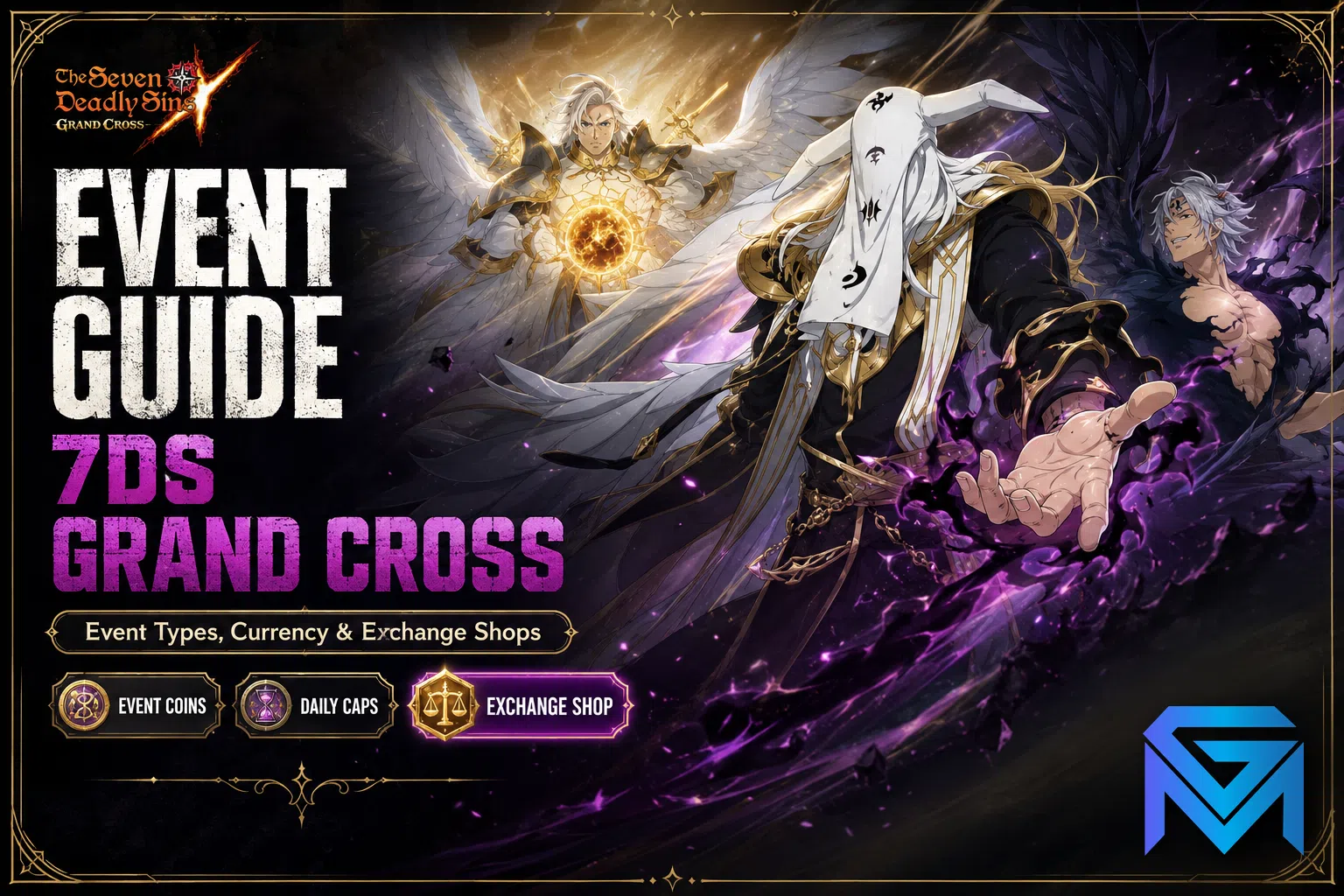
Events in The Seven Deadly Sins: Grand Cross come in four repeating shapes: farmable stage events that pay out event coins, mission and check-in events that pay on completion, draw festivals built around mileage milestones, and minigame events such as bingo, fishing or treasure hunts. Almost all of them funnel into an Event Exchange Shop. There is a fuller breakdown in 7DS Grand Cross Game Modes Explained.
Once you can identify which shape an event is, you know immediately whether it rewards stamina, attention or patience, and that single judgement is what separates players who clear an exchange shop from players who run out of time on the last weekend. This guide covers the event types the game rotates through, how event currency and exchange shops actually work, where events are hidden in the interface, how much stamina an event realistically deserves, and how to plan a two-week event backwards from its shop.
What kinds of events does 7DS Grand Cross run?
Grand Cross rotates through four broad event categories: farming events with dedicated stages and an event currency, mission and attendance events that reward completion rather than grinding, draw and festival events tied to summon mileage, and minigame events layered on top of a seasonal theme. Most major updates combine several at once.
Farming events are the ones that consume resources. They add temporary stages, usually with a Normal and a Hard difficulty, and each clear drops an event currency alongside the usual materials. The Hard stages almost always pay noticeably better per run, so once your teams can clear them reliably, there is rarely a reason to farm the Normal versions.
Mission and attendance events cost almost nothing and are pure profit. Event missions ask for simple, countable actions such as logging in during the event window, clearing a set number of stages, or defeating a specific boss a handful of times, and they pay in tickets, Diamonds or draw materials. A recent Holy War Festival, for example, handed out ten pickup tickets for completing six missions that included event attendance and boss clears.
Draw and festival events are structured around summoning rather than stages, and they set milestone rewards at fixed mileage totals. Minigame events wrap the whole thing in a theme, and Grand Cross has used fishing, bingo boards and searchable treasure maps in recent years. These are usually the source of the daily-capped currency described in the next section.
How does event currency and the Event Exchange Shop work?
Nearly every event issues its own temporary currency, spent in an Event Exchange Shop that closes when the event ends. Coins arrive from event stages, missions and minigames, and many events cap how many you can earn per day, which quietly sets the true length of the event.
That daily cap is the number most players overlook. The 6th Anniversary Garden Party, for instance, limited fishing to 100 event coins per day, with heavier fish paying more. When a cap like that exists, the shop is not a race that rewards a single marathon session; it is a fixed schedule, and missing three days is genuinely unrecoverable no matter how much stamina you have banked.
Exchange shops also apply per-item purchase limits, and those limits are usually daily rather than total. Where an SSR Pendant is restricted to one per day, clearing that item means logging in on ten separate days, which again turns the shop into a calendar problem instead of a farming problem. Check the limits on the first day, not the last.
As a general priority order, community consensus across recent events has been consistent: buy the character-power items first (pendants and awakening or enhancement materials), then Diamonds, then everything else. The reasoning is straightforward. Diamonds are obtainable from dozens of other sources year-round, whereas event-exclusive upgrade materials disappear with the shop. If you are still mapping out where your Diamonds come from outside events, the 7DS Grand Cross beginner's guide to heroes, Diamonds and teams lays out the core economy.
Where do you actually find events in the game?
Events surface in two places. The event banner in the top-left of the main screen holds the current headline event, its stages and its Exchange Shop, while Hidden Places, reached from the right side of Knighthood in the West District, holds smaller or seasonal content that never appears on the main banner at all.
The Hidden Places entry is the one that costs players rewards, because nothing in the interface pushes you toward it. Free daily draws, small themed activities and secondary event nodes have all lived there across different updates, and they expire on the same schedule as everything else.
Knighthood is worth opening daily for a second reason. Knighthood check-in awards a free Diamond each day provided at least twenty members check in, and daily Knighthood tasks reset on their own timer, so unclaimed progress is lost at the reset rather than carried over. During an event window those small daily sources compound with event missions. For the detail behind that, see Demonic Beast Guide Bosses, Rewards and Teams.
Your personal check-in rewards land automatically on your first login after the daily reset, which sits at 11:00 PM PST. Knowing your own local equivalent of that reset matters more during events than at any other time, because a login three minutes on the wrong side of it costs a full day of a capped currency.
How much stamina should you commit to an event?
Commit only what the event's own cap can absorb. If the currency is daily-capped, extra stamina buys you nothing, and the surplus is better spent on your normal progression routes. If the event is uncapped and stage-based, work out the total coins the shop requires and divide by the days remaining before you start dumping resources.
Stamina in Grand Cross refills quickly but holds a low maximum, so the practical constraint is how often you log in rather than how much you have stored. Capping out for hours wastes regeneration, and during an event that lost regeneration converts directly into missed shop items. Two or three short sessions a day beat one long one.
Half-stamina periods are the single biggest lever available, and they run roughly once every two weeks. Battle experience earned equals stamina spent, so halving the cost effectively doubles both the drops and the account progress a given event stage produces. Where an event overlaps one of these windows, the correct play is to hold non-urgent farming until it starts.
Stamina potions are available in the Coin Shop for R coins and Friendship Coins, which are otherwise low-value currencies for an established account. Buying potions there during an event is one of the few reliable ways to add farming capacity without spending Diamonds. Watch for event battles that use limited attempts rather than stamina, since those cannot be extended at any price. The 7DS Grand Cross farming guide to efficient progression goes deeper into where stamina pays best outside event windows.
How do festival and draw events differ from farming events?
Festival events reward summoning rather than stamina. They attach guaranteed rewards to fixed mileage totals on a special draw, so the meaningful decision is whether you can reach the next milestone, not how many stages you can clear. Planning them is a saving problem months ahead of the event itself.
The structure has been consistent across recent festivals. The New Year Fes 2026: Infinite Sunshine draw placed guaranteed rewards at 150, 300, 450, 600, 750 and 900 mileage in its first cycle, with SSR heroes at 150, 450 and 750, an SSR or UR at 300 and 600, and the featured new UR hero at 900. Read that ladder before your first pull, because stopping between milestones is where value is lost.
Festivals also carry free content that costs nothing to claim. Free multi-draws have appeared on the data download screen, and long-running campaigns layer on top: the 777 Relay Campaign ran across seven months toward the game's seventh anniversary, paying out Diamonds, draw mileage bonuses and coupon rewards month by month.
Because these events are calendar-driven rather than stamina-driven, they interact with a very different kind of preparation. Diamonds saved over an ordinary two-month stretch decide whether you reach 900 mileage or stall at 600, and no amount of event grinding during the festival itself will close that gap.
How should an event fit into your daily routine?
Handle the fixed-cost items first, then spend what stamina remains on the event. Check-in, Knighthood check-in and daily Knighthood tasks all take seconds and reset regardless of what else you do, so clearing them before touching event stages guarantees you never lose them to a shortened session.
After the dailies, run whatever caps out first. Daily-capped event currency should be earned early in your session, because it is the only reward in the game that cannot be recovered later. Uncapped event stages come next, and ordinary progression farming last, since it is the only category that is genuinely still there tomorrow.
Event missions deserve an explicit read-through on day one. They frequently reward far more than an equivalent hour of grinding, and several are satisfied incidentally by farming you were already doing, so knowing them in advance means you never repeat content to complete one.
Keep an eye on which of your teams can actually clear the Hard stages. If a Hard tier is out of reach, the realistic options are gearing an existing team rather than starting a new one, or accepting the slower Normal-stage rate for that event. The 7DS Grand Cross rank up guide covers how account rank gates the content those teams get access to. If climbing that rank yourself is not something you have time for during an event push, our rank boosting explainer covers the alternative of paying a verified player to raise it for you.
How do you plan an event so you finish the exchange shop?
Work backwards from the shop on day one. Total the coin cost of everything you actually want, subtract what missions and minigames will pay you for free, divide the remainder by the days remaining, and you have a daily target that tells you within minutes whether the shop is achievable at all.
Do that arithmetic before you spend anything. Players who farm first and total up later routinely discover in the final week that the shop was never reachable, having already burned stamina that would have been worth more elsewhere. A shop you cannot clear is not a failure; it is information that lets you cherry-pick the two or three best items and ignore the rest.
Front-load the farming when the event is uncapped. Drop rates and stage costs do not improve over an event's run, and finishing early insulates you against the maintenance extensions, real-life interruptions and overlapping updates that regularly eat the last few days of an event window.
Finally, keep your Gold reserve in mind. Event rewards frequently arrive as heroes and upgrade materials that then need Gold to actually apply, and an account that clears a shop but cannot afford to enhance anything has converted an event into storage rather than progress. The 7DS Grand Cross Gold farming guide covers the sources worth keeping topped up before a big event lands.
Common questions about 7DS Grand Cross events
Does unspent event currency carry over to the next event? No. Event currencies are temporary and expire with the event, and leftover coins are usually converted into a small consolation reward or lost entirely. Spend down to zero before an event closes.
Are Hard event stages always worth farming over Normal? Yes, once you can clear them consistently. Hard stages pay more currency and better materials per run, and the stamina cost does not rise proportionally. Only stay on Normal if your teams cannot clear Hard reliably without retries.
What should I buy first in an Event Exchange Shop? Character-power items with hard purchase limits, such as pendants and event-exclusive enhancement materials, then Diamonds, then the rest. Anything obtainable outside the event should be last, because the shop is your only window for the exclusives.
Can I catch up if I miss the first week of an event? Only when the currency is uncapped. If the event limits daily earnings, missed days are permanently gone, so recalculate your target against the days actually remaining rather than the original event length.
Do events require the newest heroes to complete? Rarely. Most event stages are tuned so an established, well-geared roster can clear the Hard tier, and gear quality typically matters more than having the current banner unit.
Where to Find 7DS Grand Cross Boosting and Hourly Services
On GameMarket.gg you can see how 7DS Grand Cross boosting orders are handled.
If you would rather not lose a capped event to a week you cannot log in daily, browse the Seven Deadly Sins: Grand Cross hourly services from verified sellers and check each listing's stated hours and task scope before ordering.
GameMarket.gg is a trusted digital marketplace for everything gaming-related. We serve the gaming community by providing secure access that enhances every gaming journey.