7DS Grand Cross Beginner's Guide: Heroes, Diamonds & Teams
By John Ganang 13 August 2026, 07:37 WIB
The Seven Deadly Sins: Grand Cross rewards the roster you own, not the hours you log, which is why an account's real value is the collection of heroes sitting on it. This guide is the map to the whole game: how heroes, rarities, and Combat Class work, what Diamonds and the gacha actually buy, how servers and teams fit together, and how to buy or sell an account without getting burned. Grand Cross is Netmarble's turn-based RPG built on Nakaba Suzuki's manga, and because every festival hero and collaboration unit lives permanently on a single account, the market that trades those accounts is one of the busiest in mobile gaming. Everything below ties back to that one idea, and to the part of GameMarket.gg where you can act on it.
Why is there a 7DS Grand Cross account market?
The market exists because everything valuable in Grand Cross is permanent and account-bound. Heroes you pull, awaken, and rank up never expire, and limited festival and collaboration units cannot be re-summoned once their banner ends, so buying the account is the only way to inherit someone else's roster.
That permanence turns luck into an asset. A player who summoned a strong festival unit years ago still owns it today, and someone who missed that banner has no in-game route back to it. The account becomes the item, and its price tracks which heroes it holds far more than how long it has been played. This is the same scarcity logic behind every listing you will see, and understanding it is the foundation for everything else in this guide, from reading a hero's rarity to judging whether a price is fair.
How do heroes, rarities, and Combat Class work?
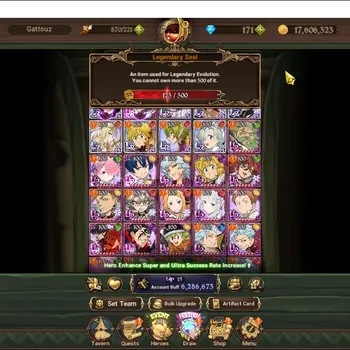
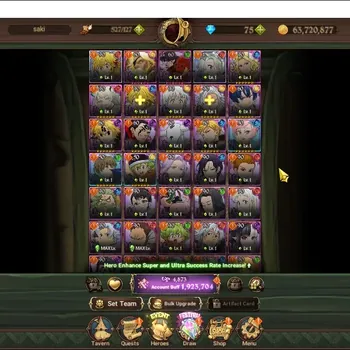
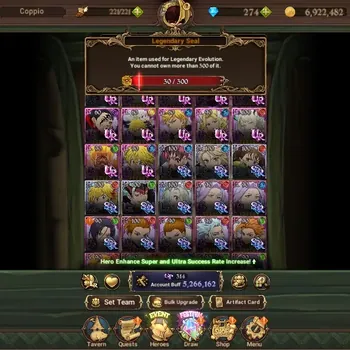
Heroes are graded by rarity and made stronger through evolution and awakening, while Combat Class (CC) is the single number that sums up an account's total power. The rarity ladder runs R, SR, SSR, then UR, with a new top-tier LR grade added in 2026 for select heroes. Our 7DS Grand Cross account progression guide to heroes and gear explains how CC actually climbs.
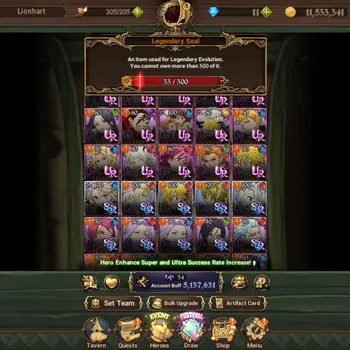
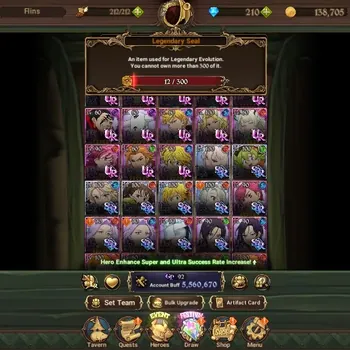
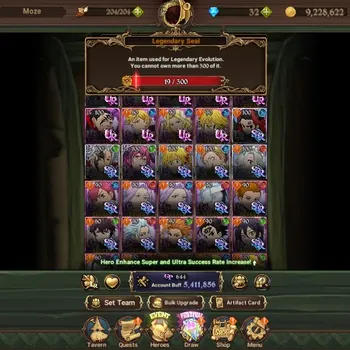
You do not summon the highest grades directly. The gacha hands out up to SSR, and you push a hero further by evolving it: R becomes SR, SR becomes SSR, and an SSR can be evolved into a UR, which unlocks a higher level cap through limit-breaking. In April 2026 Netmarble introduced LR (Legendary) evolution for certain heroes, adding a grade above UR, and this is exactly the "LR" you see counted in account listings like "5 LR + 8 UR." Because the top grades take heavy investment to reach, an account already stacked with UR and LR heroes is worth far more than one with the same heroes still sitting at SSR.
Awakening is the second power axis, and it is where those "2/6" and "6/6" tags come from. A hero can be awakened up to six times, each awakening adding a star under the portrait and a permanent boost to stats and Combat Class, paid for with awakening materials and gold. A "6/6" unit is fully awakened and therefore both stronger and rarer than the same hero at 2/6, so two accounts listing the same headline hero can be priced very differently once you read the awakening level. Combat Class ties it all together: it climbs with every evolution, awakening, gear upgrade, and level, which is why sellers lead with a figure like "6.2M CC" as fast shorthand for how developed the account is.
What are Festival and Collaboration heroes, and do they come back?
Festival and Collaboration heroes are the limited units that drive most of an account's value, because they only appear on special banners and cannot be summoned the rest of the year. Festival heroes are premium versions of core cast members; Collaboration heroes are crossover characters from other franchises.
Festival banners headline anniversaries and major updates with reworked, high-ceiling versions of familiar characters, and units such as Nemesis Meliodas or Lostvayne Meliodas are the sort of festival-tier heroes that anchor a strong roster (they appear as "NMeli" and "LMeli" in listings). Collaborations are the other prestige class: Grand Cross has crossed over with franchises including Attack on Titan, Re:Zero, The King of Fighters, Stranger Things, Fire Force, and the virtual K-pop group MAVE, each bringing crossover heroes and cosmetics available only during the event.
Here is the accurate version of the "limited" claim, because it matters when you pay for a collab account. These units are available for a fixed period, and once the banner closes they leave the summon pool. Some may return through a rerun or an anniversary revival, but the timing is never guaranteed, so nobody should promise a specific hero "will come back." That uncertainty is precisely why an account already holding retired festival or collaboration heroes is priced on scarcity, and why buyers chasing a specific unit often decide the account is the safer route than waiting on a rerun that may never be announced.
How do Diamonds and top up work?
Diamonds are Grand Cross's premium currency, and their main job is fuelling the gacha. You spend Diamonds on summon draws, costume sets that carry their own stats and enhancing curve, and event shops, and because banners are the only source of new heroes, Diamonds are effectively the price of expanding your roster.
You earn Diamonds through story progress, events, achievements, and generous anniversary logins, and you can also buy them directly, with our guide to earning and spending Diamonds in Grand Cross listing every free source and what each draw actually costs. During big festivals Netmarble hands out large Diamond bundles and free draws to all players, which is when many accounts jump in value as their owners cash in dozens of summons at once. Two practical notes for spenders: Diamonds you buy and Diamonds you earn function identically for summoning, and buying through a verified channel matters because top-up disputes are painful to resolve after the fact. If you would rather fund an account through a protected checkout than an unfamiliar reseller, that is exactly what the marketplace side of this guide is for, and it routes to the same secure system as accounts and services.
Which server should you choose?
Grand Cross runs three separate build regions, Global, Japan, and Korea, and your account is tied to one of them, so the server is a permanent property you should confirm before buying. Japan and Korea often sit slightly ahead on content, while Global consolidates the worldwide player base.
Within Global, accounts are further grouped by region label such as Global and Asia, which is what the "Server: Global" or "Server: Asia" line on a listing refers to. This affects who you play alongside and, for cooperative and ranked content, your latency. The good news for roster value is that Netmarble has made festivals available across all regions, so a hero pulled on one server is not locked out of another region's meta; still, an account cannot simply hop between the three build regions, so treat the listed server as fixed and match it to where you actually intend to play.
How do teams and game modes work?
Combat is turn-based and built around skill cards, and success comes from team composition rather than a single carry. You field teams of heroes whose skills combine, and different modes reward different builds, which is why a versatile roster is worth more than one or two strong units.
On the PvP side, Ranking Battle pits your team against other players and is where climb-focused players spend most effort, since a higher rank both signals account strength and unlocks rewards. PvE is broader: Death Match, Demonic Beast Battle, boss raids, and story content each ask for tuned line-ups, and race-based synergies (Human, Demon, Goddess, Giant, Fairy, and the Seven Deadly Sins themselves) reward stacking heroes of a shared type. Because a deep bench lets you answer every mode, an account with wide rarity coverage across several races is more flexible, and therefore more valuable, than one with a single stacked team. This is also why "endgame" accounts command a premium: they can already clear the content that a starter roster cannot.
What separates a starter, midgame, and endgame account?
Accounts are grouped into tiers that describe how far the roster has been built, and matching the tier to your goal saves you from overpaying. The ladder runs Starter, Midgame, Endgame, and Whale, with the price of each band set by roster depth and the number of top-grade heroes it holds.
A Starter account is a clean, low-investment foothold on the right server, best when you want to build the roster yourself and simply skip the earliest grind. Midgame accounts carry a workable bench with several strong SSR and UR heroes, enough to clear most PvE content and hold a mid PvP rank. Endgame accounts are the volume seller for a reason: they field deep rosters with multiple UR and LR heroes, high awakening levels, and the Combat Class to attempt the hardest content immediately. Whale accounts sit at the ceiling, packed with heavily awakened festival and collaboration units that took years and heavy spending to assemble. Because each step up is really a step up in scarce heroes rather than playtime, deciding your target tier before you browse is the fastest way to a fair purchase.
Whichever tier you land on, the account still has to be played efficiently afterwards: our 7DS Grand Cross farming guide covers the stamina, gold and daily-reset routine that turns any account into steady progress.
From there, the 7DS Grand Cross gold farming guide breaks down the most reliable gold sources, and the 7DS Grand Cross rank up guide covers how to climb Ranking Battle without wasting stamina.
What should you look for when buying a 7DS account?
Read the listing like an inventory sheet, because a Grand Cross title is dense with exactly the details that set value. The numbers and tags describe the roster, and four of them do most of the work: Combat Class, the LR and UR counts, the named heroes, and the login method.
Start with Combat Class for a snapshot of overall development, then the LR and UR counts ("5 LR + 8 UR") for how many top-grade heroes the account holds. Next read the named heroes and their awakening levels, since a festival or collaboration unit at 6/6 is a different asset than the same hero at 1/6, and any listed collab units tell you which retired banners the account captured. Confirm the server matches where you play, and read the login method carefully: many accounts are sold "CodeOnly" or via a "login transfer code," meaning access is handed over through a transfer code rather than the original email, so you must understand how you will secure it after purchase. Finally, "Check SS" means the seller provides screenshots, so study them to verify the claimed roster is actually shown before you commit.
How do you buy or sell safely, and secure the account afterward?
Buy and sell through a system that holds the money until the account is verified, and lock the account down the moment it is yours. On GameMarket.gg every order is covered by Buyer Protection: payment is released to the seller only after you confirm the account was delivered as described.
Before paying, match the four checks above against the listing and keep all communication inside the platform, because deals moved to outside apps fall outside Buyer Protection. Right after a purchase, secure access immediately: change the password, update or bind the account to your own credentials where the login method allows, and enable two-step verification wherever it is offered, which closes the door on the previous owner. Selling works in reverse: list the real Combat Class, servers, and heroes, show clear screenshots of your best units, price against comparable listings rather than guessing, and let payment release once the buyer confirms the handover. The same scarcity that sets a high buy price works in your favour as a seller, so an account holding retired festival or collaboration heroes should never be listed as though it were a generic starter.
Where to Find 7DS Grand Cross Accounts, Top Up and Hourly Services
Whether you want an endgame roster deep in UR and LR heroes, a specific server, or a clean starter account to build on, it all runs through one protected system. Browse verified Seven Deadly Sins: Grand Cross account listings to find the exact server, tier, and heroes you want, and when you would rather skip the daily hero-shard grind altogether, top up your Diamonds directly through the 7DS Grand Cross top-up store. You can always start from the full Seven Deadly Sins: Grand Cross marketplace to compare everything in one place, each order backed by Buyer Protection from checkout to confirmation.
Ready to power up faster? Grab a 7DS Grand Cross Diamonds top-up and keep your progress moving today.
GameMarket.gg is a trusted digital marketplace for everything gaming-related. We serve the gaming community by providing secure access that enhances every gaming journey.