7DS Grand Cross Game Stages Explained: Early, Mid and Late Game
By John Ganang 13 September 2026, 12:00 WIB
The Seven Deadly Sins: Grand Cross has three practical game stages: early game runs from tutorial to roughly the point where a full team is UR-graded and Story Mode stops being a wall; mid game is the gear-and-awakening grind where Demonic Beasts and Knighthood income decide your pace; late game is optimisation, where account power comes from set quality, substats and roster depth rather than new characters.
Netmarble's RPG never announces a stage change with a banner. Instead, the game quietly shifts what limits you. In the first weeks the limit is which heroes you own. A little later the limit becomes how much gear you can farm and enhance. Eventually neither of those is scarce, and the limit becomes how good your substats and your team compositions are. Recognising which of those three walls you are standing in front of is the single most useful diagnostic in the game, because the correct action in one stage is a waste of resources in another. This guide describes each stage by its symptoms, names the systems that gate it, and lays out what to prioritise so you leave the stage instead of grinding sideways inside it.
What actually defines an early, mid or late game account?
Stages are defined by what limits progress, not by account level or days played. Early game is limited by hero availability, mid game by gear and awakening materials, late game by substat quality and roster depth. Two accounts of the same level can sit in different stages.
Combat Class, the single number 7DS shows on your team, is a convenient but misleading yardstick. It aggregates hero level, awakening, gear main stats and enhancement, and it rises quickly when you enhance gear you will later throw away. A player can push Combat Class hard and still fail content that a lower-CC account clears comfortably, because the lower account has the right heroes with the right gear sets on them. This is why the useful question is never "what is my CC?" but "what is currently stopping me?".
The three answers map cleanly to the three stages:
- Hero-limited (early game). You lose fights because you do not own a hero that can do the job — no reliable debuffer, no dedicated healer, no attacker of the right attribute.
- Gear-limited (mid game). You own the right heroes but they are wearing mismatched sets, low enhancement levels, or gear that has never been rerolled.
- Optimisation-limited (late game). You own the heroes and the sets, and progress now depends on substat rolls, awakening completion, food buffs and knowing which team answers which boss.
Because the stages overlap, most accounts are partly in two of them at once. That is normal. The rule of thumb is to spend on whichever wall is currently blocking the content you want to clear, and to ignore the other two until they become the wall.
What should you prioritise in the early game?
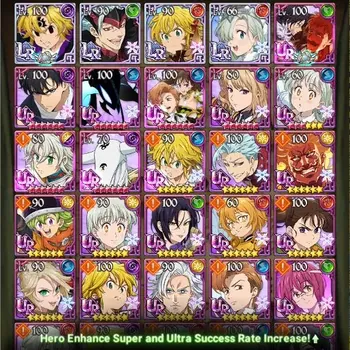
In early game, prioritise finishing Story Mode chapters, completing the beginner and attendance reward tracks, and building one functional team of three plus a sub-slot. Do not spread diamonds across many banners. A single working team clears more content than five half-built ones.
The early game exists because 7DS is a team game with attribute rock-paper-scissors — Strength beats Speed, Speed beats HP, HP beats Strength — and because ultimate moves and card ranks matter more than raw stats at low levels. Until you own heroes that cover the basic roles, no amount of gear fixes a fight.
Build one team, not five
A functional early team needs three things: a source of sustained damage, a source of debuffs or buff-stripping, and a way to survive an enemy ultimate. Grand Cross is generous here — the free and low-rarity units handed out through Story Mode and beginner events genuinely carry accounts through the first several chapters. Levelling three heroes to the current cap and awakening them beats levelling twelve heroes halfway, because Story Mode difficulty scales in steps and you only need to beat the step in front of you.
Spend diamonds narrowly
Early accounts feel diamond-rich because of one-off rewards, and that is exactly when diamonds are easiest to waste. Pulling on every banner produces a wide, shallow roster. The better pattern is to hold for a banner that fills a role your team is missing, and to remember that duplicate pulls in 7DS are not dead — they feed awakening. If you want the full accounting of income sources and sensible spend order, the 7DS Grand Cross diamonds guide covering how to earn and spend them goes through it system by system.
Do the boring dailies
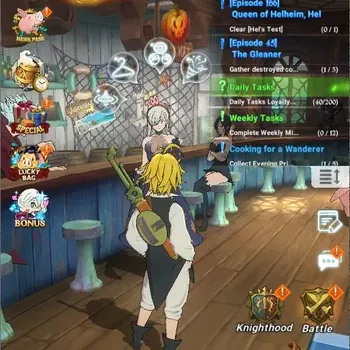
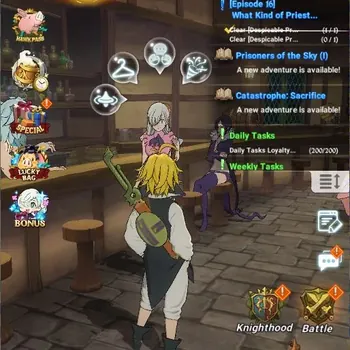
Daily missions, the Tavern, and free stamina claims are worth more in the early game than at any other point, because early costs are low and every stamina point converts almost directly into progress. Skipping a day of dailies at day 10 costs proportionally far more than skipping one at day 200. New players who want the full beginner sequence in order will find it laid out in the 7DS Grand Cross beginner's guide to heroes, diamonds and teams.
You have left the early game when Story Mode stops being the thing you fail, and you start failing because your gear is bad rather than because you lack a hero.
What changes when you hit the mid game?
Mid game begins when hero shortage stops being the bottleneck and gear does. Priorities shift to farming coordinated gear sets, clearing Demonic Beasts for enhancement materials, joining an active Knighthood, and pushing UR grade on your core heroes rather than adding new ones.
This is the longest stage in 7DS, and the one where most accounts stall. The reason is structural: early game rewards breadth, mid game punishes it. Every hero you decide to gear costs a full set of six equipment pieces, the enhancement stones to bring them up, and the roll attempts to make the substats usable. Deciding to gear one hero too many is how a mid-game account ends up with eight mediocre units and nothing that clears content.
Gear sets stop being optional
Equipment in Grand Cross comes in sets, and set bonuses — attack, defence, health, critical chance, critical damage, resistance and the rest — are large enough to change which fights you win. A hero wearing four matching pieces of the right set frequently outperforms the same hero wearing higher-enhancement mismatched gear. This is the mid game's core lesson: coordination beats raw numbers. Choose the set that matches the hero's job, not the set with the biggest headline stat.
Demonic Beasts become the daily anchor
Demonic Beast fights are the main renewable source of the materials that raise gear and heroes, and they are attribute-locked, which quietly forces roster breadth back onto you — but now in a targeted way. Instead of "own many heroes", the requirement becomes "own one competent team per attribute". Running Beasts consistently, even at a difficulty slightly below your ceiling, produces more usable material over a week than occasionally attempting the highest tier and failing.
Knighthood income compounds
Joining an active Knighthood adds a second income stream — boss participation rewards, coins for the Knighthood shop, and passive perks — that costs nothing but showing up. An inactive Knighthood is one of the most common silent drags on a mid-game account, because the loss is invisible: you never see the rewards you did not earn.
UR grade and awakening
Pushing core heroes to UR grade through evolution materials and awakening duplicates raises stat ceilings in a way gear cannot. Awakening also converts those "wasted" duplicate pulls from the early game into real power. The stage-by-stage detail of how hero grade, awakening and gear interact is covered in the 7DS Grand Cross account progression explanation for heroes and gear.
You have left the mid game when your core heroes are UR-graded, wearing coordinated sets, and your losses come from substat quality or team choice rather than from missing equipment.
What does late game progress actually look like?
Late game progress is incremental and optimisation-driven. New heroes rarely change your account; better substats, completed awakenings, food buffs and correct team composition per boss do. Sessions become shorter and more targeted, aimed at specific rolls rather than broad farming.
Late-game 7DS is a different activity from early-game 7DS. The daily loop shrinks — stamina still gets spent, but the goal is narrow. You are rerolling substats on a specific piece, chasing the last awakening copies for a specific hero, or testing a composition against a boss mechanic you keep losing to. Progress that used to arrive in visible jumps now arrives as a few percent at a time.
Substats are the real currency
Two identical-looking gear pieces can differ enormously once substats are counted. Critical chance, critical damage, attack percentage and the defensive equivalents decide whether a team meets a damage threshold or misses it by a hair. Late-game accounts are largely a story of substat luck plus the patience to keep rerolling. This is also why late-game power is hard to see from outside: the difference between a good and a great account is buried in numbers the Combat Class figure barely reflects.
Depth over novelty
A late-game account needs multiple complete teams, not one very strong one, because endgame content is attribute-gated and mechanic-gated. Demonic Beasts, PvP-style modes and event bosses all ask for different answers. The account that can field three finished teams clears more than the account with one spectacular team and two skeletons.
Small multipliers, applied consistently
Cooking buffs, the right accessory, correct card management during a fight, and ultimate timing are individually minor and collectively decisive at the ceiling. Late game is where reading the fight matters as much as building for it — 7DS combat is card-based, and merging cards to raise their rank is a skill expression that no amount of gear substitutes for.
Late game does not end. It becomes maintenance: keep up with new gear tiers as Netmarble releases them, keep awakening the heroes you actually use, and accept that the curve is flat by design.
Which mistakes stall accounts between stages?
The common stalls are: gearing too many heroes at once, chasing Combat Class instead of clearing content, hoarding resources indefinitely, skipping Knighthood activity, and re-farming content that no longer rewards materials you need. Each of these keeps an account busy without moving it forward.
- Gear spread. Six pieces per hero is expensive. Finish one hero before starting the next.
- CC chasing. Enhancing gear you will replace inflates the number and burns the stones. Enhance gear you intend to keep.
- Infinite hoarding. Saving diamonds is right until it is procrastination. Resources held forever contribute nothing.
- Dead Knighthood. An inactive guild is a permanent, invisible income cut.
- Wrong farm. Farming content that drops materials you already have plenty of is the most common way to feel productive while standing still.
The fix in every case is the same diagnostic from the top of this article: identify the current wall, and spend on that wall only.
How long does each stage take?
There is no fixed timeline, and any figure you see should be treated as a rough range rather than a rule. Early game is typically measured in weeks of consistent play, mid game in months, and late game is open-ended. Play frequency and event timing move these boundaries substantially.
Two factors compress the schedule more than anything else. The first is event timing: 7DS runs frequent collaboration and anniversary events whose reward tracks hand out materials and pulls at a rate normal play cannot match, so an account that starts just before a large event advances faster than one that starts just after. The second is consistency — daily stamina and Demonic Beast runs compound, and missed days do not come back. Netmarble publishes event periods in the in-game notice board and official patch notes, which is the only reliable place to check what is currently running.
Because of that variance, comparing your progress against another player's day count is not informative. Comparing against your own bottleneck is.
How do you check which stage you are in right now?
Run a three-question check: can you field one complete team per attribute? Are your main heroes UR-graded with coordinated gear sets? Are you losing fights to substats and mechanics rather than to missing units or equipment? The first "no" marks your current stage.
Answering no to the first question places you in the early game, and the correct response is to finish Story Mode, complete beginner tracks and build one working team before anything else. Answering yes to the first but no to the second places you in the mid game, and the correct response is to narrow your focus to a small number of heroes and farm gear and Demonic Beast materials for them specifically. Answering yes to the first two places you in the late game, where the work is substat rerolling, awakening completion and composition testing.
Re-run the check every few weeks. Accounts move between stages unevenly — a strong pull can jump you forward, and a new content tier can push the wall back in front of you. The check takes a minute and it prevents the most expensive mistake in the game, which is spending mid-game resources on an early-game problem or vice versa.
If you are weighing up where an account sits before committing time to it, you can browse verified 7DS Grand Cross accounts to compare rosters, hero grades and gear depth against the stage descriptions above, and the full 7DS Grand Cross guide hub collects the rest of the game's systems in one place.
GameMarket.gg is a trusted digital marketplace for everything gaming-related. We serve the gaming community by providing secure access that enhances every gaming journey.