7DS Grand Cross Account Progression Explained: Heroes & Gear
By John Ganang 21 August 2026, 06:00 WIB
Progression in The Seven Deadly Sins: Grand Cross is measured by Combat Class (CC), a single number that combines a hero's level, evolution grade, awakening stars, ultimate level, equipped gear, and costumes. Raising CC is not one activity but six overlapping ones, and knowing which of them actually moves the number is what separates a stalled account from a growing one.
What is Combat Class and why does everything revolve around it?
Combat Class is 7DS Grand Cross's aggregate power score. It is calculated from a hero's base stats and every permanent upgrade layered on top: hero level, evolution grade, awakening stars, ultimate move level, the six equipment pieces, and any costume bonuses. A higher CC means higher attack, defence, and HP in every game mode.
Progression speed is only half the picture when you are shopping for an account — see our guide on spotting trust signals and red flags in 7DS Grand Cross account listings before you commit to a seller.
CC matters because most of the game's content is gated by it, formally or informally. Story difficulty tiers, Demon raids, Knighthood boss content, and the PvP ladder all assume a rough CC band, and a hero who is 30% under that band will lose fights that are otherwise winnable on skill. Netmarble surfaces CC on every hero card and as an account-wide total precisely because it is the shorthand players use to judge readiness. That shorthand becomes literal in the Fight Festival's Elite bracket, where gear-inclusive CC decides who attacks first; our Geared PvP guide breaks down what that means for defense-team gear priorities.
The practical consequence is that CC is a budgeting problem. Every upgrade path costs a different resource — gold, awakening stones, materials, gear tickets, stamina — and they are not interchangeable, so it is worth knowing where 7DS Grand Cross gold actually comes from and how stamina, daily tasks and resets are scheduled before you commit any of it. Spending everything on one hero produces a spiky account that clears nothing; spreading evenly produces an account that clears nothing either. The rest of this guide covers where each point of CC actually comes from.
How do hero grades and evolution work?
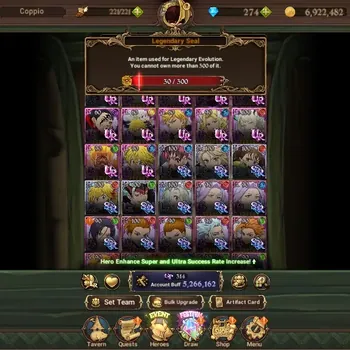
Heroes are graded R, SR, SSR, and UR. What changes at the very top of that ladder is covered in our explainer on the UR grade, evolution, pendants and books. Evolution raises a hero from one grade to the next, which permanently increases base stats, raises the level cap, and adds a large chunk of CC. Evolution consumes duplicate heroes or evolution materials, so it is usually the first real bottleneck a new account meets.
Because evolution requires copies, the summoning system and the evolution system are effectively the same economy. Pulling a duplicate of a hero you already own is not wasted — it is the currency that pushes that hero to the next grade. This is why experienced players talk about a hero being "6/6" or "3/6": they are describing how far along the awakening and duplicate track the hero is, not just whether they own it.
A hero at UR grade with a low ultimate level and poor gear will still underperform an SSR that has been properly invested in. Grade sets the ceiling; the other systems decide how close you get to it. For a new account, evolving a small core of universally useful heroes beats evolving whichever hero the last banner happened to give you.
What does awakening do for a hero?
Awakening permanently raises a hero's stats and CC, and can be applied up to six times, with each level adding a star beneath the hero's portrait. It consumes awakening materials and gold rather than duplicates of the hero itself, which makes it one of the more predictable investments on the board.
Awakening is usually the best gold-to-CC conversion available to a mid-game account, because the materials come from repeatable content rather than from banner luck. The fusion system lets lower-tier awakening materials be combined upward, so surplus materials from early content are not dead weight — they feed later awakenings at a conversion cost.
The sequencing that works for most accounts is: evolve the hero to the grade you intend to keep, then awaken, then invest in ultimate level and gear. Awakening before evolution is not wasted, but evolution often changes which heroes you actually want in the line-up, and awakening materials are the resource you will most regret spending on a bench hero.
How much does ultimate move level matter?
Every evolution stage of a hero's ultimate move adds roughly 400 CC, so a fully invested line-up can gain on the order of nine to ten thousand CC from ultimate levels alone. It is one of the cleanest CC sources in the game because the cost is materials rather than duplicates.
Beyond the raw number, ultimate level raises the damage and effect strength of the hero's ultimate itself, which is what actually decides raid and PvP outcomes. A hero whose entire value is a debuff or a burst ultimate gets disproportionate returns here, while a hero valued for passive stats gets less.
Because the CC gain is flat per stage across heroes, ultimate levelling is also the most reliable way to close a CC gate when your account is a few thousand short of an entry requirement. If a piece of content is refusing to let you in, this is usually the cheapest lever left.
How does equipment work in 7DS Grand Cross?
Each hero equips six pieces of gear, and each piece carries a main stat plus a set bonus. Gear rolls with a randomised main stat, so two identical-looking drops can be worth very different amounts. Sets are chosen by role: attackers generally want Attack and Defence sets, tanks want HP and Defence.
The stat you want on each slot is dictated by what the hero does, not by what is rare. An attacker wants attack, crit chance, and crit damage concentrated where those roll; a tank wants HP and defence. Because the main stat is fixed at drop and cannot be rerolled freely, gear farming is a filtering exercise: you are looking for pieces that rolled the right stat, then investing in those.
Gear rarity also decides investment cost. C-tier gear is dramatically cheaper to enhance and awaken than SSR-tier gear — the awakening stone requirement scales with rarity, with low-tier gear needing 1-star stones where SSR needs 5-star. For a new account, a fully awakened C-tier set on the right stats often outperforms a half-finished SSR set that drains every stone you own.
What is gear awakening, and why does it dominate late CC?
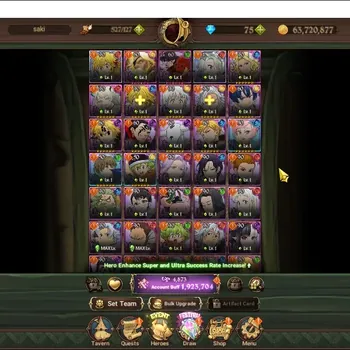
Once a piece of gear reaches +5 enhancement, it can be awakened: the enhancement level resets to +0 while the main stat is retained, and the piece gains a bonus percentage stat. Repeating this cycle is where most of a developed account's CC comes from, and it is why endgame accounts have such large CC gaps.
The reason gear awakening dominates is compounding. Each awakening adds a percentage bonus rather than a flat value, so it multiplies against a hero whose base stats have already been raised by evolution and awakening. The same awakened gear on a low-investment hero returns far less, which is why gear is usually the last major system a well-run account invests in rather than the first.
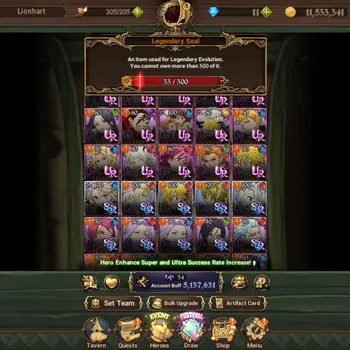
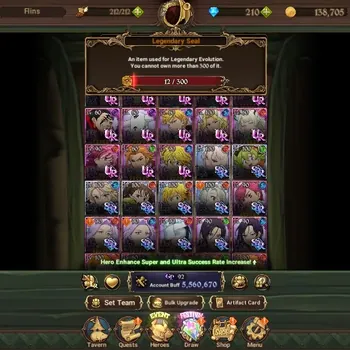
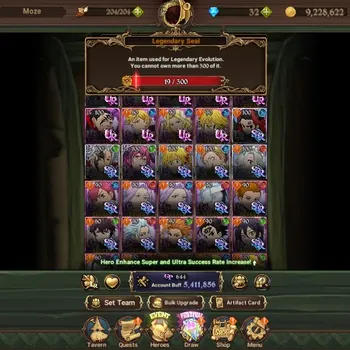
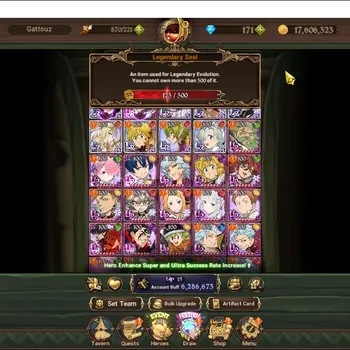
UR gear sits at the top of the ladder and is gated behind a fully enhanced and awakened piece plus high-tier materials — one 6-star awakening stone and ten engraving stones per piece. That cost is why UR gear is concentrated on a handful of heroes even on very developed accounts, and why "how many UR pieces" is a meaningful description of an account's stage.
Do costumes and other extras affect progression?
Yes. Costumes carry stat bonuses in addition to their appearance, so equipping and enhancing them adds real CC. They are a genuine progression system rather than pure cosmetics, which is an important distinction for anyone comparing 7DS Grand Cross to games where skins are decorative only.
Alongside costumes, account-wide systems contribute passively: collection bonuses from owning and evolving heroes, food buffs cooked from ingredients, and Knighthood perks all feed into effective power even when they do not all show on a hero's CC number. These are slow, cumulative gains that reward simply playing rather than spending.
The reason this matters for progression planning is that a portion of an account's strength is not visible on any single hero. Two accounts with identical CC on paper can perform differently based on collection completion, costume investment, and food access — which is also why time played tends to show up as smoothness rather than as a headline number.
What do the account stages actually mean?
Players and marketplaces both describe 7DS Grand Cross accounts in stages — starter, mid-game, endgame, and whale — and those labels map to concrete progression milestones rather than to how much was spent. Knowing where the boundaries sit tells you what content an account can realistically clear.
- Starter. Story progression underway, a handful of SSR heroes, little or no gear awakening, and CC low enough that difficulty tiers gate content. The bottleneck is materials, not roster.
- Mid-game. A functional core line-up evolved and awakened, ultimate levels partly invested, gear sets correct but only lightly awakened. Most repeatable content is accessible; the top raid tiers are not.
- Endgame. Multiple fully built line-ups, deep gear awakening, several UR pieces, and access to the highest difficulty content. CC growth slows here because remaining gains cost high-tier stones.
- Whale. Broad roster depth across many heroes rather than a few, extensive UR gear, and near-complete collection bonuses — the stage where flexibility, not raw CC, is the asset.
The useful takeaway is that stages are defined by systems completed, not by hero count. An account with fifty SSR heroes and no gear awakening is a starter account with a large roster; an account with eight properly finished heroes is comfortably mid-game.
Where does day-to-day progress actually come from?
Almost all progression materials come from repeatable stamina content: story stages for hero experience and evolution material, dedicated dungeons for gold and awakening material, and raid or boss content for the higher-tier stones. Stamina, not skill, is the binding constraint on how fast an account grows.
That makes daily consistency worth more than long sessions. Stamina regenerates on a timer and caps, so an account that spends stamina twice a day converts substantially more of it into progress over a month than one that plays in weekend bursts. The same applies to dailies and weekly missions, which pay in exactly the materials the upgrade systems consume.
Event periods change the maths considerably. Anniversary and seasonal events distribute awakening materials, gear, and summon currency in volumes that ordinary weeks do not, so timing heavy investment around them is a real strategy rather than a superstition. Netmarble publishes event schedules through the in-game notice board, which is the schedule worth planning around.
How should you plan an upgrade order?
Build depth on a small core before breadth across a roster. A workable order is: pick four to six heroes that cover damage, sustain, and debuff; evolve them; awaken them; raise ultimate levels; then fix gear sets and begin gear awakening. Only after that core clears content should you widen the roster.
Three mistakes cost new accounts the most time:
- Spreading awakening materials across a dozen heroes. Six half-built heroes clear less than three finished ones.
- Enhancing high-rarity gear too early. The stone cost is punishing before your stone income has scaled.
- Ignoring ultimate levels. They are flat, predictable CC and are frequently the cheapest way past a content gate.
If you are still mapping out the game's systems from the beginning — summoning, diamonds, and how teams are constructed — our 7DS Grand Cross beginner's guide to heroes, diamonds and teams covers the layer beneath this one.
Where to Find 7DS Grand Cross Top Up and Accounts
On GameMarket.gg you can compare 7DS Grand Cross top-up options before you spend.
If you would rather start from an account that has already cleared the early material bottleneck, you can compare verified 7DS Grand Cross accounts by stage, server, and roster depth, with every order covered by Buyer Protection from checkout to confirmation. Before you finalize a purchase, it is worth confirming the login itself is fully transferable; GameMarket.gg's guide to 7DS Grand Cross login methods and account binding covers exactly what to check before the handover.
Players comparing early-game Diamonds and CC investment against a defined PvP or PvE direction can also see how those choices play out long-term in our PvP vs PvE accounts breakdown.
GameMarket.gg is a trusted digital marketplace for everything gaming-related. We serve the gaming community by providing secure access that enhances every gaming journey.