Honkai: Star Rail Trailblaze Power Guide: Regen, Caps and Best Uses
By John Ganang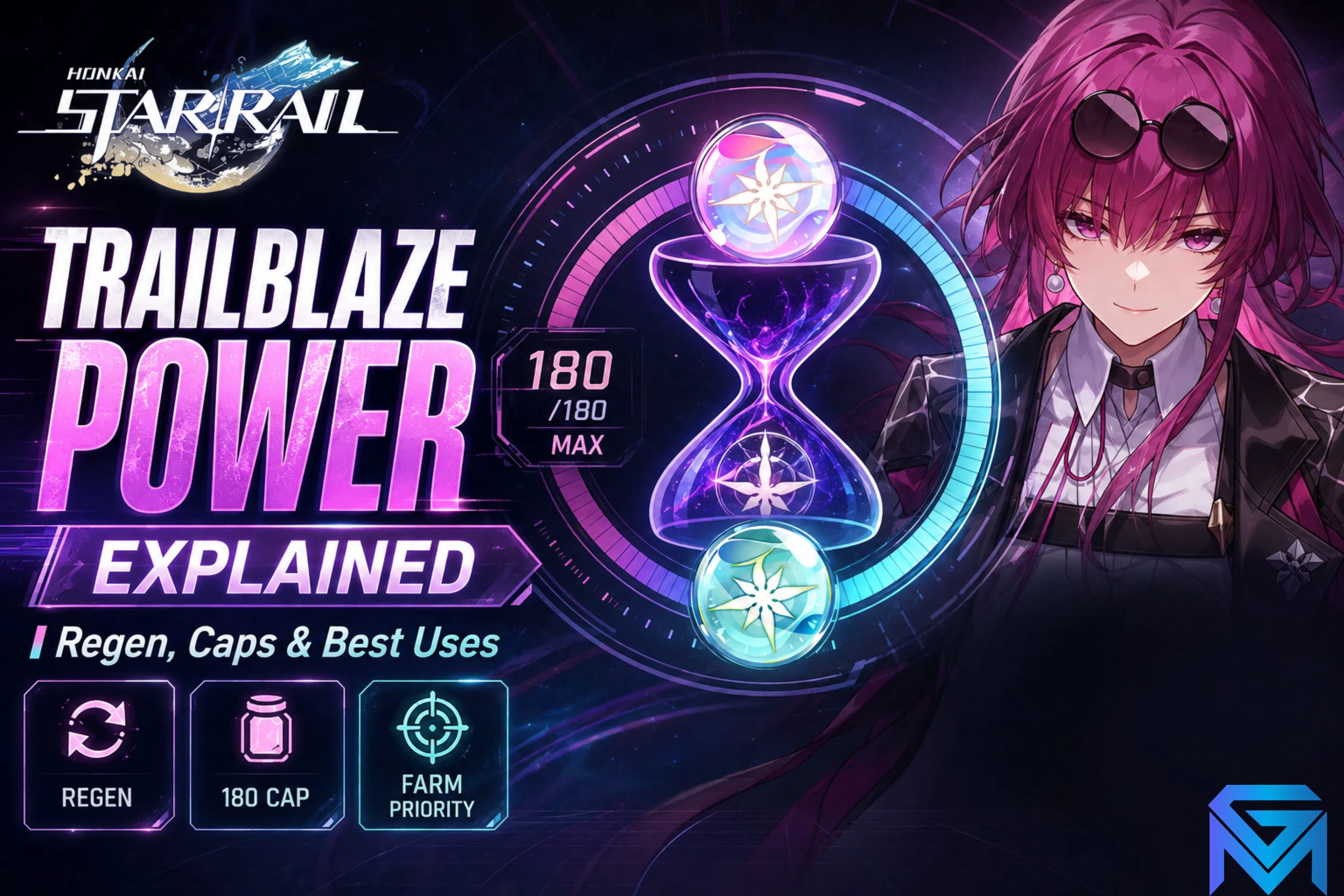
Trailblaze Power is Honkai: Star Rail's stamina resource, and it decides how much material you can farm each day. It regenerates one point every six minutes — 240 per day — sits behind a standing cap, and overflow is caught by Reserved Trailblaze Power instead of being lost. For how that regen interacts with Echo of War, Simulated Universe and Nameless Honor's Monday reset, see GameMarket's weekly reset breakdown. Exploring a planet fully is also one of the fastest ways to bank Trailblaze EXP toward a higher Trailblaze Level, which raises your Power cap over time — our world exploration guide covers what chests and puzzles hand out along the way.
That single mechanic quietly sets the ceiling on your account's growth rate. Characters level with EXP materials, Traces need Calyx drops and Stagnant Shadow ascension gems, and Relics come almost entirely from Caverns of Corrosion — all of it metered by the same pool. Understanding where Trailblaze Power comes from, what each node charges, and which nodes deserve priority is the difference between a roster that climbs steadily and one that stalls at the Equilibrium wall. This guide breaks down regeneration, caps, storage, refills, node costs, and a practical spending order, using HoYoverse's own in-game descriptions and official version notes as the reference point.
What is Trailblaze Power in Honkai: Star Rail?
Trailblaze Power is the game's stamina currency. It is consumed when you claim rewards from Calyxes, Stagnant Shadows, Caverns of Corrosion, and Echoes of War. It regenerates passively in real time whether or not you are logged in, and it is account-wide rather than per-character.
The resource sits in the top-right corner of the overworld HUD next to Stellar Jade and Credits. Clicking it opens the replenishment panel, which shows the current value, the cap, the countdown to the next point, and the options available to top it up. Nothing else in the game — Simulated Universe runs, Memory of Chaos, Assignments, story missions, daily training quests, or overworld chest hunting — draws from this pool. That distinction matters: a large part of Honkai: Star Rail's content is deliberately stamina-free, so a day with zero Trailblaze Power still has plenty to do.
Trailblaze Power should not be confused with Trailblaze Level, which is your account's experience level, or with Equilibrium Level, which is the difficulty tier that controls drop quality. Trailblaze Power is purely the throughput meter. Trailblaze Level gates which zones and systems you can access; Equilibrium Level decides how good the drops are when you spend the Power. All three interact, but only one of them is a consumable. Our Equilibrium Level guide covers how to raise it and exactly what changes at each tier.
How fast does Trailblaze Power regenerate?
One point of Trailblaze Power regenerates every six minutes of real time. That works out to ten points per hour and 240 points across a full 24-hour day. Regeneration continues offline and does not pause when the standing cap is reached — overflow is redirected into Reserved Trailblaze Power instead.
The six-minute tick is fixed. There is no account upgrade, no Light Cone, no Eidolon, and no event buff that speeds it up, which makes Trailblaze Power one of the few genuinely uncompressible resources in the game. Everything else — Credits, EXP materials, Relic quality — can be accelerated by playing better or spending elsewhere. Regeneration cannot.
The practical consequence is that a 24-hour absence costs you nothing as long as your storage can absorb 240 points, and a 48-hour absence costs you nothing as long as it can absorb 480. That is why the storage numbers below matter more than the regeneration rate itself. For most players the correct mental model is not "I have 180 Power right now" but "I have a daily budget of 240, plus a buffer I should not let overflow."
What is the Trailblaze Power cap, and what is Reserved Trailblaze Power?
The standing cap is 300 Trailblaze Power, raised from the original 240 in an earlier version update. Once you hit 300, further regeneration flows into Reserved Trailblaze Power, a separate overflow bank that holds up to 2,400 points and can be converted back into usable Power at any time.
Reserved Trailblaze Power was one of the most significant quality-of-life changes HoYoverse has shipped for the farming loop, and it fundamentally changed how much attention the resource demands. Before it existed, letting the meter sit full for a day was a permanent loss. Now the same overflow is banked, and the only real deadline is the 2,400-point ceiling on the reserve itself.
Stacked together, 300 standing plus 2,400 reserved equals 2,700 points of headroom. At 240 per day, that is roughly eleven days of accumulation before anything is genuinely wasted. Players who log in even once a week never lose a point. The conversion runs both ways in practice: you pull from the reserve in chunks when you want to burn a large amount in one session, which is exactly what you want before a new Relic set becomes farmable or when a character you have been saving for finally arrives.
One caveat worth internalising: the reserve is a buffer, not a strategy. Power sitting in reserve is Power not yet turned into Relic substats or Trace levels, and Relic farming has such a wide outcome distribution that starting earlier is almost always better than starting later. Treat the reserve as insurance against a busy week, not as a savings account.
How much Trailblaze Power does each activity cost?
Costs are tiered by node type. Calyxes charge 10 Power per run, Stagnant Shadows charge 30, Caverns of Corrosion charge 40, and Echoes of War charge 30 with a weekly clear limit. Every node also offers a multi-claim option that spends the corresponding multiple in one action.
Here is what your Power actually buys, node by node:
- Calyx (Golden) — 10 Power. Drops character and Light Cone EXP materials, and Credits. The bread-and-butter node for levelling anything.
- Calyx (Crimson) — 10 Power. Drops Trace materials tied to a specific Path, such as those needed to upgrade skills and talents. Path-specific, so check which Calyx serves the characters you are building.
- Stagnant Shadow — 30 Power. Drops ascension gems for a specific Type (Physical, Fire, Ice, Lightning, Wind, Quantum, Imaginary) plus Trace ascension materials. Required for every character ascension breakpoint.
- Cavern of Corrosion — 40 Power. Drops Relics from two designated sets per cavern. The single largest long-term sink in the game.
- Echo of War — 30 Power. Weekly boss content with a hard clear limit (three per week) that drops Trace-levelling materials and Light Cone ascension items. The limit resets with the weekly reset, and unused clears do not carry over.
The multi-claim function does not offer a discount — it is a time saver, not an efficiency gain. Ten Calyx runs cost 100 Power whether you press the button once or ten times. What it does change is your ability to dump a large reserve balance quickly without sitting through repeated load screens.
Note that Simulated Universe and Divergent Universe do not charge Trailblaze Power for the runs themselves. Their Planar Ornament rewards are gated by Immersifiers, a separate consumable, which means Planar sets sit outside the Power economy entirely. This is a frequent point of confusion for players who assume all Relic-adjacent farming shares one meter.
How do you restore Trailblaze Power beyond natural regeneration?
Two mechanisms exist. Fuel is a consumable item that restores 60 Trailblaze Power each and can be used freely up to a daily limit. Stellar Jade refills restore a fixed amount at an escalating Jade cost within the same day, resetting to the base price after the daily reset.
Fuel is the efficient option and should always be used before Jade. It arrives from the Nameless Honor battle pass track, Simulated Universe store exchanges, event shops, and assorted mission rewards, and it accumulates faster than most players spend it. Because Fuel does not expire, a large stockpile is a genuine asset — it is effectively banked farming time that ignores the Reserved Power ceiling.
Stellar Jade refills are the expensive option. The first refill of a day costs a small amount of Jade and each subsequent refill within that day costs progressively more, which is a deliberate design brake. As a rule, Jade spent on Power is Jade not spent on Warps, and the exchange rate is poor unless you are chasing a hard deadline — the last day of a Relic-farming push before a character releases, or the final hours of a limited event that requires farmed materials. Outside those cases, treat Jade refills as something you do not do.
Neither method touches the Reserved Power bank. Fuel and Jade both add to your standing Power, so if you are near the 300 cap you will waste part of the restore. Spend down first, then restore.
What should you spend Trailblaze Power on first?
Early accounts should prioritise Calyxes for character and Trace levels, because raw character level and Trace ranks give the largest early power gains. Once your core team is ascended and Traces are progressing, shift the bulk of your daily Power into Caverns of Corrosion for Relics, which becomes the permanent long-run sink.
A workable priority order for most accounts looks like this:
- Stagnant Shadows when an ascension is blocked. A character stuck at an ascension breakpoint is losing more stats than any Relic upgrade would give. Clear the block, then move on. These are burst spends, not daily habits.
- Golden and Crimson Calyxes while your main team is under-levelled. Character EXP and Trace materials are the cheapest power-per-Trailblaze-Power in the game at 10 per run.
- Echoes of War every week without fail. Three clears at 30 Power is 90 Power for materials you cannot get anywhere else, and unused clears are lost at reset. This is the only node with a genuine use-it-or-lose-it property.
- Caverns of Corrosion with everything left over. Relic farming has no completion point. Once your team is levelled and ascended, this is where the remaining budget lives, more or less permanently.
Two habits separate efficient accounts from wasteful ones. The first is farming the right Cavern — each one drops two specific sets, and running the wrong cavern for a hundred Power is a hundred Power gone. The second is raising Equilibrium Level promptly, because higher Equilibrium tiers improve drop quality and quantity for the same Power cost. Farming at a low Equilibrium is the most common invisible waste in the game.
If you are still mapping out how the account's various levels interlock, our HSR progression guide covering levels, Warp and characters lays out the sequence, and the Honkai: Star Rail beginner's guide to Warp, characters and Stellar Jade is the right starting point if you are new to the game entirely.
How does Trailblaze Power fit into a daily routine?
A standard session spends the day's 240 points in one sitting, completes the daily training quests for the activity rewards, and dispatches Assignments. Because Assignments and daily quests cost no Power, the routine takes only a few minutes even on days when the full budget goes into a single node.
The daily training panel awards activity points for actions you were doing anyway — clearing a Calyx, using a consumable, defeating enemies with a Weakness Break — and hitting the daily activity threshold pays out Stellar Jade. Structuring your Power spend so it incidentally completes those objectives is free value. If the day's objective asks for Weakness Break clears, our breakdown of HSR characters, best teams and Path-based team building covers which units convert that objective fastest.
On days you cannot log in, nothing is lost — the reserve absorbs the overflow. On days you have extra time, pull from the reserve and run a long Cavern session. The system is designed so that consistency matters more than daily precision, which is unusual for a stamina economy and worth taking advantage of.
What are the most common Trailblaze Power mistakes?
The recurring errors are letting the Reserved bank hit its 2,400 ceiling, spending Stellar Jade on refills without a deadline, farming Caverns for Relic sets no current character uses, and running nodes at a lower Equilibrium Level than the account could sustain.
Overflowing the reserve is the most costly and the easiest to avoid: an eleven-day gap is generous, but a long break without a single login will start burning points. Jade refills are the most expensive mistake per action — the escalating cost curve exists precisely to discourage the habit, and most players who form it do so during their first month, before they understand how abundant Fuel becomes later.
Farming the wrong Relic set is subtler. It usually happens when a player farms a set they read about in a tier list rather than one their actual roster wants, or keeps farming a set long after the character it was for has been shelved. Before committing a week of Power to a cavern, check that the two sets it drops are wanted by units you are actually fielding — and if you are still deciding what your team should look like, our guide to HSR Light Cones, Paths, Superimposition and rarity and the breakdown of how HSR Eidolons work and which ones matter both help clarify which characters are worth the investment before you spend the Power.
Finally, remember that Trailblaze Power is throughput, not progress. An account with a huge reserve and an unlevelled team is behind an account that has been spending steadily at a proper Equilibrium tier. The resource rewards the player who converts it into stats every few days, not the player who hoards it.
Where to Find Honkai: Star Rail Accounts, Top Up and Market Listings
Beyond ready-made accounts, players who prefer to keep their own roster can compare Honkai: Star Rail top-up options to refill Stellar Jade and the Express Supply Pass faster, or browse the full Honkai: Star Rail marketplace for every account, top-up and service listing GameMarket.gg carries for the game.
If you would rather start from an account that already has the Equilibrium tiers, ascended units and Relic groundwork in place, browse the Honkai: Star Rail accounts available on GameMarket.gg and pick one that matches the roster you actually want to play.
GameMarket.gg is a trusted digital marketplace for everything gaming-related. We serve the gaming community by providing secure access that enhances every gaming journey. Notably, Apocalyptic Shadow does not consume Trailblaze Power at all, so once a rotation is unlocked, see how Apocalyptic Shadow scoring and rewards actually work instead of budgeting stamina for it.