Honkai: Star Rail World Exploration Guide: Puzzles & Chests
By Sir Ayup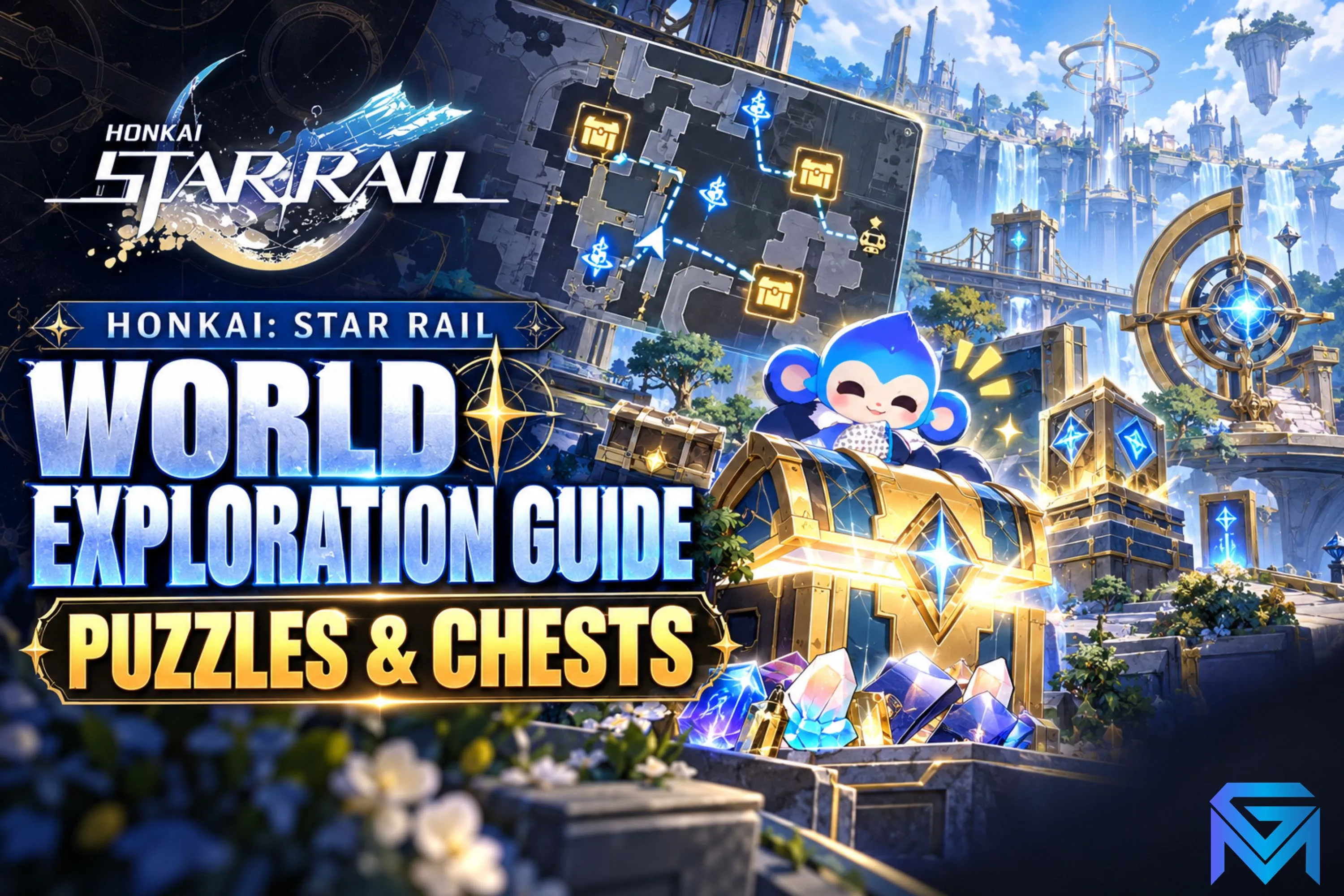
World exploration in Honkai: Star Rail means physically walking each planet's map to open chests, solve environmental puzzles, and trigger hidden interactions, and it pays out Credits, character EXP materials, Stellar Jade, and Trailblaze EXP that the main story alone never fully covers. None of it is timed or missable in the way combat modes are, which is exactly why it's the content players let pile up until it becomes a multi-hour backlog.
🗺️ What Do Exploration Chests Actually Give You?
Exploration chests hand out Credits, character EXP materials, and small amounts of Stellar Jade, with rarer chests occasionally including Trace or ascension materials tied to that specific planet. The exact mix depends on the chest tier, but every chest contributes toward that map's completion tally.
Chests are split roughly into common floor chests, which are one-time pickups sitting in plain sight, and puzzle-locked chests, which only open once you've solved whatever mechanism guards them. Some planets also hide "Data Bank" style markers and lore-item pickups that don't reward materials directly but count toward the exploration percentage shown on the map screen. That percentage matters beyond bragging rights: several planets tie bonus Stellar Jade or a cosmetic reward to crossing set completion thresholds, so a map sitting at 80% is usually still owed a real reward, not just a rounding error.
🏅 What Other Rewards Come From Full Exploration Besides Chests?
Beyond the chests themselves, fully clearing a planet's exploration usually unlocks a batch of Trailblaze Level EXP, contributes toward that region's Data Bank or archive completion, and on several planets grants a one-time cosmetic or title tied to reaching 100%. None of these are things a chest icon on the map represents directly, which is why they're easy to miss.
The Data Bank entries in particular are worth tracking down even though they hand out no materials on their own: collecting a set of them on a given planet often triggers a separate reward pickup, and they're one of the few exploration objectives that also double as lore content, since each entry is a short piece of world-building text. Achievement hunters chasing full completion treat these the same as chests, just with a longer walk and no visual marker guiding them there.
🧩 How Do Exploration Puzzles and Mechanisms Work?
Each major area uses its own puzzle language rather than one universal system: pressure-plate switches that need multiple party members or objects standing on them at once, light-beam mirrors that must be rotated to redirect a beam into a receiver, and memory or pattern puzzles where you repeat a sequence shown earlier in the area.
The Herta Space Station leans on elevator and switch-timing puzzles, Jarilo-VI's Backwater Pass and Administrative District use pressure-plate and rotating-platform mechanisms, the Xianzhou Luofu favors light-beam and formation puzzles tied to its aesthetic, and Penacony's dream layers introduce rule-based puzzles where the solution changes depending on which dream state you're currently in. None of these require a guide to brute-force, but a mechanism that looks solved from one camera angle often isn't, so rotating the camera before assuming a puzzle is broken saves more time than any specific trick.
Later regions keep adding new variants on top of the old ones rather than replacing them, so a planet released well into the game's story can layer two or three puzzle types on top of each other inside a single sub-area. Amphoreus, for example, mixes formation-style puzzles with terrain that changes shape depending on story flags you've already triggered, which means revisiting an area after a story beat can reveal a previously blocked path even though nothing on the map explicitly tells you to go back. Treat any area that felt "finished" right after a major story chapter as worth a second pass, since terrain and puzzle states on several planets are tied to story progress rather than locked in permanently the first time you walk through.
⚡ What Is Trailblaze EXP, and How Is It Different From Trailblaze Power?
Trailblaze EXP is a separate progress bar from Trailblaze Power: EXP accumulates from exploring, completing story chapters, and finishing daily and weekly objectives, and filling it raises your Trailblaze Level, while Power is the stamina resource you spend to challenge Calyxes and stages. Exploration feeds the EXP bar, not the Power pool.
Trailblaze Level matters because it gates content and raises your Power cap and Equilibrium Level over time, meaning a higher Trailblaze Level indirectly means more Power available per day. Since exploring new planets is one of the fastest ways to bank large chunks of Trailblaze EXP in a single sitting, a new player who skips exploration on arrival is also slow-rolling their own stamina cap growth without realizing the two systems are connected. For how the Power side of that resource actually regenerates and caps out, our Trailblaze Power guide covers regen rate and cap increases in full.
🔧 How Do Exploration Rewards Connect to Farming Materials?
Exploration chests supply a meaningful slice of early character EXP materials and Credits, but the bulk of Trace-upgrade and ascension materials still come from running Calyxes and Stagnant Shadows on Trailblaze Power, not from one-time chest pickups. Exploration front-loads a head start; repeatable farming carries the rest of the climb.
That split is why exploration feels generous on a planet you've just unlocked and then goes quiet: once the one-time chests are cleared, the map has nothing left to give, and material farming shifts entirely onto Calyxes and boss stages. If you're trying to figure out which specific materials a character actually needs before you go farming for them, our character ascension guide breaks down Trace and ascension material types, and our relics guide covers where to farm relic sets once you've moved past the exploration-chest phase entirely.
🌌 Does Simulated Universe Count as World Exploration?
No. Simulated Universe and Divergent Universe are separate roguelike modes with their own Trailblaze Power cost and their own reward currencies (mainly Curios and Planar Ornament materials), and they don't contribute to a planet's exploration percentage. They're a different content bucket entirely, run on-demand rather than tied to a fixed map.
The confusion is understandable because both modes send you walking through rooms opening things, but Simulated Universe resets its layout every run while world exploration is a fixed, permanent map you clear once. If you haven't touched Simulated Universe yet, our Simulated Universe explainer covers how Blessings, Curios, and Paths work inside a run.
⏱️ How Long Does Fully Exploring a New Planet Actually Take?
A newly released planet's main exploration, separate from clearing its story chapters, typically runs from roughly one to several hours depending on how many puzzle-locked chests and side areas it has, and that estimate assumes you already know where to look rather than wandering blind. Larger planets released later in the game's life tend to run longer than the earliest ones.
That time cost is exactly why exploration is one of the first things that falls behind on a busy account: it doesn't expire, so it's easy to tell yourself you'll circle back, and then three planets' worth of unopened chests are sitting there at once. Because none of it requires combat skill or account-specific decisions, it's also one of the more straightforward chunks of upkeep to hand off for a session rather than block out personal time for.
The time also scales unevenly. A planet's first sub-area is usually the fastest to clear because it's small and mostly linear, while later districts on the same planet tend to add verticality, backtracking, and puzzle chains that stretch the same nominal "one area" into 30-plus minutes on their own. Accounts that started recently and are working through several already-released planets back-to-back feel this the most, since the backlog isn't one planet's worth of exploration but every planet released before they started, compounding into a multi-session project rather than a single evening's task.
🔁 Is It Worth Re-Exploring Old Planets After Finishing Their Story?
Yes, if you skipped chests the first time through, since one-time exploration rewards don't expire or get removed later. A chest you never opened on Jarilo-VI is still sitting there whether you cleared that story arc last week or a year ago.
The one thing that does change is priority: once a planet's story is old news, going back for a handful of missed chests is a low-value chore compared to keeping up with new planets and current-patch content, so it's usually worth batching leftover old-planet cleanup into a single pass rather than treating it as urgent. Achievement hunters aside, most players are better off finishing current exploration fully as it releases so there's nothing left to mop up later.
🔎 Where to Find Honkai: Star Rail Boosting and Hourly Services
If chest-hunting and puzzle-solving across several planets isn't how you want to spend an evening, GameMarket.gg's current Honkai: Star Rail hourly services listings let a seller knock out exploration and material farming on your account for a set block of time. For rank pushes or Simulated Universe clears instead, the Honkai: Star Rail boosting listings cover those separately.
Whether it's one backlogged planet or a full account's worth of unopened chests, a booked hourly session can clear it out faster than fitting it in between your own play sessions. For the fundamentals of Warp, characters, and Stellar Jade before you go further, start with our Honkai: Star Rail beginner's guide.
GameMarket.gg is a trusted digital marketplace for everything gaming-related. We serve the gaming community by providing secure access that enhances every gaming journey.