HSR Characters & Best Teams: Paths, Types & Team Building
By John Ganang 18 August 2026, 06:00 WIB
In Honkai: Star Rail, every character is defined by two fixed traits, its Path and its Type, and a team is simply four of them arranged so their roles cover one another. Learn those two systems and team-building stops being guesswork. A focused roster almost always beats a big one.
That is the whole idea this guide builds on. Honkai: Star Rail, developed and published by HoYoverse, gives each unit a permanent Path that decides its job in a fight and a permanent Type that decides which enemies it damages efficiently, and everything from Eidolons to Light Cones to the four team roles hangs off those two labels. Below we walk through how characters are classified, what Eidolons and Light Cones actually add, the four roles a balanced team needs, the main team archetypes, and how a well-built roster is what really gives an account its value. For the wider picture of how an account advances overall, our HSR progression guide to levels, Warp and characters sets the context this article slots into.
🧭 How are Honkai: Star Rail characters classified?
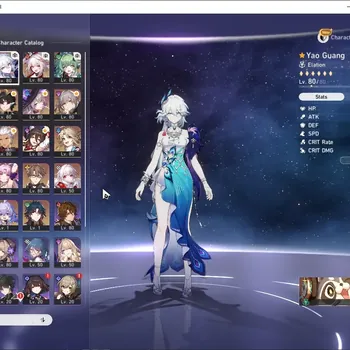
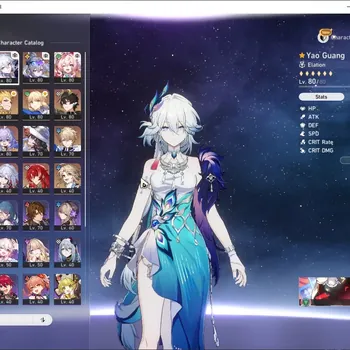
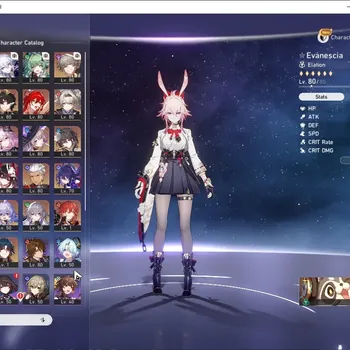
Every playable unit has one of eight Paths, which sets its combat role, and one of seven Types, which sets its damage element. In short, the Path decides what a character does in a fight, while the Type decides which enemies it can break efficiently.
The eight Paths are Destruction, The Hunt, Erudition, Harmony, Nihility, Preservation, Abundance, and Remembrance. Destruction units are durable single-target and blast carries; The Hunt specializes in high single-target burst; Erudition handles multi-target area damage; Harmony buffs allies; Nihility debuffs enemies and drives damage-over-time; Preservation shields; and Abundance heals. Remembrance is the newest Path, added in Version 3.0 with Aglaea, and its characters fight alongside summoned Memosprites that act as separate units on the field. Because the Path is fixed, it tells you at a glance whether a character is meant to deal damage, enable it, or keep the team alive. The seven Types are Physical, Fire, Ice, Lightning, Wind, Quantum, and Imaginary, and they matter for one core mechanic: Weakness Break. Every enemy has a Toughness bar with specific Type weaknesses, and hitting a weakness drains that bar until the enemy is Broken and takes bonus damage plus a delay, a window our explainer on Weakness Break, Toughness and Break Effect damage takes apart in detail. That is why a carry's Type is not cosmetic; matching your damage Type to an enemy's weakness is how you break it quickly, so a strong unit into the wrong enemy still underperforms.
⭐ What do Eidolons E0 to E6 actually change?
Eidolons are duplicate-fueled upgrades numbered E0 through E6. E0 is the base character with no copies, and each additional copy unlocks the next Eidolon, adding stat boosts or new kit mechanics. On most limited units, E1, E2, and E6 are the meaningful power spikes.
An E0 character is fully functional; Eidolons are vertical investment stacked on top. Some early Eidolons are close to transformative, turning a good unit into a top-tier one by removing a cooldown, adding an extra action, or lifting a damage cap. Others are modest percentage bumps. The catch is cost, because each Eidolon requires another full copy of the character, and for a limited 5-star that means pulling the same banner again. If you are still learning how the pull economy works, the HSR beginner's guide to Warp, characters and Stellar Jade explains where those copies come from. For that reason most players run their limited carries at E0 and put resources into breadth of roles rather than depth on one unit. This is also where account value concentrates: an E1 or E2 on a strong limited character represents a large amount of pulls, so it raises a listing's worth far more than an extra low-rarity character would. Keep in mind that limited and collaboration characters, such as the Fate series units, are offered for a set period and may return through a rerun later, though a rerun is never guaranteed, so an Eidolon on one of those is not something you can simply pick up on demand.
🗡️ How do Light Cones fit a character's kit?
A Light Cone is a character's weapon, providing base stats plus a passive effect. Signature Light Cones are tuned to a specific unit's kit, and Superimposition levels S1 through S5 strengthen that passive by feeding in duplicate cones, much like Eidolons do for characters. Our HSR Light Cones guide to Paths, Superimposition and rarity covers how to choose a cone for each unit.
The important rule is that a Light Cone's passive only activates on a wielder who shares the cone's Path, so a Harmony cone does nothing on a Destruction carry beyond its raw stats. Because of that, cone choice follows the character's Path first and its exact kit second. Signature 5-star cones usually give the biggest boost, since they are designed around one unit's mechanics, but a well-chosen 4-star cone is often close enough that the signature is a luxury rather than a requirement. Superimposition works the same way Eidolons do, with S1 as the base and each duplicate raising the effect up to S5, and the same cost logic applies, so most players are happy at S1 on a signature. For account value, a limited carry that already holds its signature Light Cone is worth clearly more than the same character without it, because a buyer inherits a finished damage core rather than a half-built one.
🧩 What are the four roles in a balanced HSR team?
A standard team runs four roles: a main DPS that deals the bulk of the damage, a sub-DPS or specialist for extra output, an Amplifier that buffs allies or debuffs enemies, and a Sustain that heals or shields. Most reliable comps cover all four.
The main DPS is the unit your whole team feeds, usually a Destruction, The Hunt, or Erudition carry. The Amplifier slot is where Harmony buffers and Nihility debuffers live, and it exists because raising your carry's damage by a percentage is often worth more than adding a second attacker. The Sustain slot, filled by an Abundance healer or a Preservation shielder, is what lets you survive longer fights without losing turns to healing. The fourth slot flexes into a sub-DPS, a second Amplifier, or a specialist that fits the content. Two stats quietly tie these roles together: Speed, which decides how often each unit acts, and Energy, which fuels Ultimates. Because the hardest content is scored on a turn limit, a team that acts faster and cycles Ultimates sooner clears more, which is why players tune Speed breakpoints instead of only chasing raw attack. A team missing one of the four roles tends to feel it, either dying to a boss it cannot out-heal or running out of time it could have saved with a buff.
🔗 How do Follow-Up, Break, and DoT teams differ?
These are three different damage engines. Follow-up teams stack extra attacks that fire outside the normal turn order, Break teams weaponize Toughness Break and Super Break, and damage-over-time teams pile stacking ailments onto enemies. Each is built around a different subset of characters and stats.
Follow-up attack teams revolve around units whose kits trigger additional hits when allies act or when enemies are struck, so they favor characters and Light Cones that add or amplify those bonus attacks. Break teams invest in the Break Effect stat and lean on matching enemy weaknesses, because Super Break converts that Toughness damage into a large chunk of extra output once an enemy is Broken. Damage-over-time teams, usually anchored by Nihility units, stack effects like Bleed, Burn, Shock, and Wind Shear that tick every turn regardless of your own actions, which makes them strong against enemies you cannot burst quickly. Which engine you build is guided by the endgame modes, because each rewards a different shape of team. Pure Fiction favors wide area damage and units that flood the field, Apocalyptic Shadow rewards fast single-target and Break damage against a boss, and Memory of Chaos sits in between and asks for two well-rounded sides. So the archetype you commit to should follow the content you most want to clear, not the other way around.
🎯 Hypercarry or Dual DPS: which team should you build?
Build a hypercarry team when you own one standout DPS, since three supports then pour everything into that single carry for consistent results. Build dual DPS when you have two strong carries that share a Type or a clear synergy. For most accounts, hypercarry is the safer default.
A hypercarry team is one carry plus an Amplifier, a Sustain, and a flex support, and its strength is reliability: you invest relics, a Light Cone, and traces into one unit and let the other three raise its ceiling. That focus is why it is easier to build and why it clears content dependably even on a shallow roster. A dual DPS team splits the damage between two carries, which raises the overall ceiling but demands that both units are properly built, both have their gear, and their turns and Energy do not fight each other. Choose hypercarry if your roster is still thin or you have exactly one clear best carry, and choose dual DPS only when you genuinely have two synergistic carries worth the double investment. The mistake that sinks most accounts is neither option; it is spreading finite relics and materials, whose sets and main stats our Honkai: Star Rail relics guide covers in detail, across a dozen half-finished units so that none can carry, because in timed content one fully built team beats five partial ones every time.
💠 How does your roster shape an HSR account's value?
An account's worth tracks the quality and completeness of its teams, not its raw character count. A handful of fully built, meta-relevant carries with matching supports and Light Cones is worth more than a large but shallow collection of underinvested units.
When experienced buyers read a listing, they are really checking whether the account contains ready-to-use teams. They look at which limited 5-stars are present, the Eidolon level on the key carries, whether those carries hold their signature Light Cones, and whether the supports needed to make a complete team are also there. A high Trailblaze Level with many characters but no coherent four-person team is far less useful than a lower-level account with one finished hypercarry team, because the second one can clear content on day one. Server matters too, since progress never leaves the region it was made on, and on this marketplace the large majority of accounts sit on the Asia server; our explainer on HSR servers and cross-progression covers why that choice is permanent. Reading a roster through this lens, teams first and headcount second, is what separates a genuine bargain from a long list of names you would still have to invest in yourself.
❓ Frequently asked questions
How many characters do you need to clear HSR endgame? Roughly two complete four-person teams, because the hardest modes split you across two sides at once. That is about eight well-built units with the right roles, not a giant roster of half-built characters.
Do Eidolons or Light Cones matter more? For most units a signature Light Cone gives a bigger and cheaper power jump than early Eidolons, because a cone needs only one copy while each Eidolon requires another full character. Cones first, Eidolons later.
Can a character be used off its Type? Yes, but less efficiently, because Weakness Break only triggers when your damage Type matches the enemy's weakness. An off-type carry still deals damage; it simply skips the Break bonus and the delay that comes with it.
What makes a team "balanced"? Coverage. One reliable damage source, enough buffs or debuffs to raise it, and a Sustain to survive, all built with enough Speed to act often inside a timed fight. Missing any one of those is what most failed clears have in common.
Where to Find Honkai Star Rail Top Up and Accounts
On GameMarket.gg you can compare Honkai: Star Rail top-up options before you spend.
If you would rather begin with a roster that already has complete, well-built teams instead of assembling one pull by pull, browse the current Honkai: Star Rail accounts for sale, check the listed limited characters, Eidolon levels, signature Light Cones, and server, and pick one whose teams already match the content you most want to clear.
GameMarket.gg is a trusted digital marketplace for everything gaming-related. We serve the gaming community by providing secure access that enhances every gaming journey.