HSR Light Cones Explained: Paths, Superimposition & Rarity
By John Ganang 20 August 2026, 14:00 WIB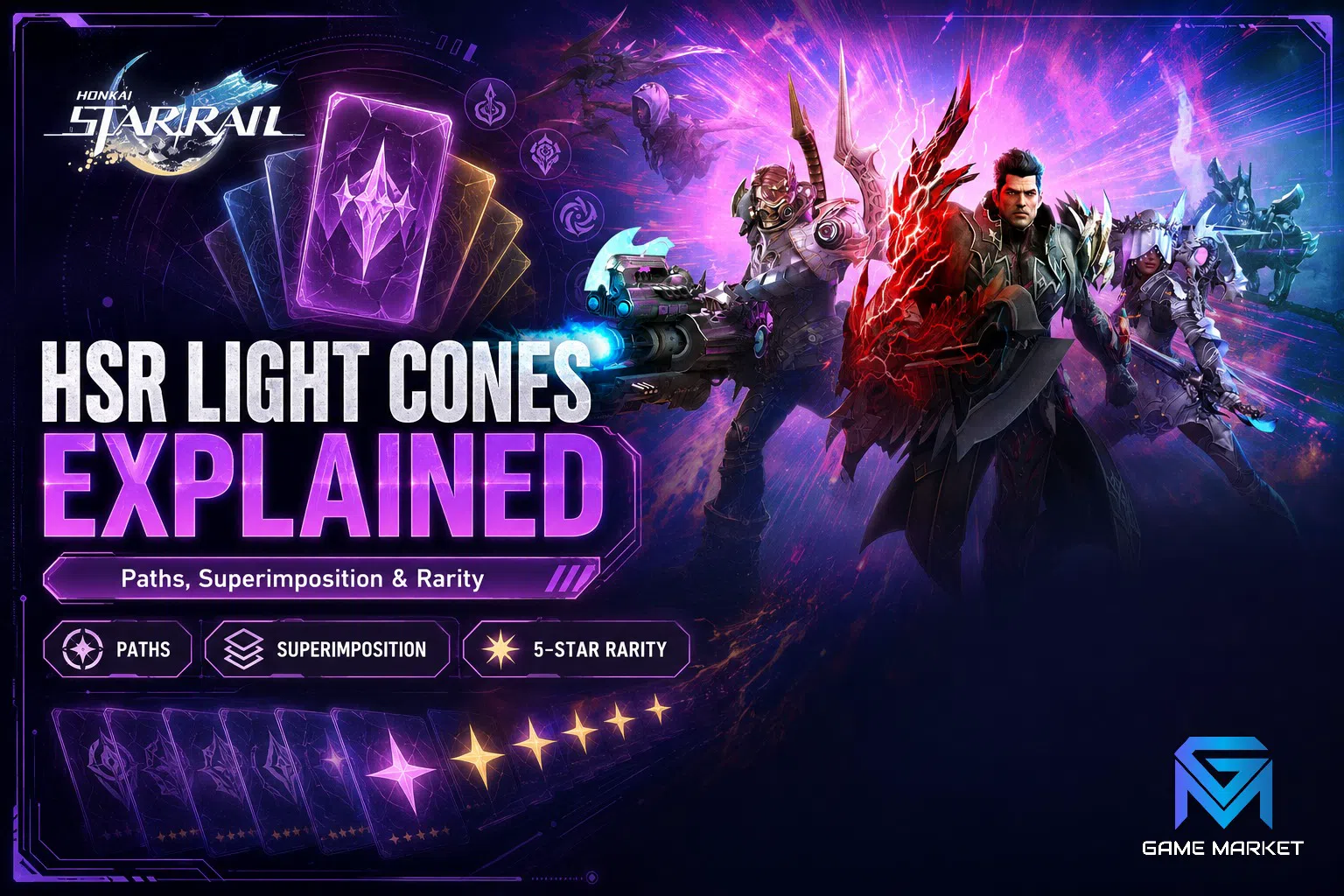
Light Cones are Honkai: Star Rail's weapon slot. Each one raises a character's base HP, ATK and DEF, and carries a passive ability that only activates when the Light Cone's Path matches the character's Path. Rarity runs from three to five stars, and feeding duplicates into one strengthens that passive through Superimposition. If that part matters to you, Honkai Star Rail Express Supply Pass Explained goes deeper.
That single paragraph covers the mechanics, but it hides the part that actually decides how a roster performs. A four-star Light Cone on the correct Path routinely outperforms a five-star on the wrong one, because half of what you are equipping is an ability the game simply refuses to switch on. This guide works through Paths, rarity, Superimposition and where Light Cones come from, in the order that matters when you are deciding what to level.
What is a Light Cone in Honkai: Star Rail?
A Light Cone is the equippable item every character carries into combat, functioning the way a weapon does in other games. It contributes base HP, ATK and DEF to the character holding it, and it carries one named passive, called the Light Cone Ability, printed on the item itself.
Two things about that definition matter more than they first appear. The first is that the stat contribution is a base-stat contribution, meaning it feeds into the same pool as the character's own base values before percentage bonuses from Relics are applied. A higher-rarity Light Cone therefore magnifies every percentage buff stacked on top of it, which is why a strong Light Cone quietly improves a build twice over.
The second is that a Light Cone can be levelled and ascended independently of the character holding it, using the same Credits-and-material loop as character levelling. Levelling a Light Cone raises its base stats; ascension raises its level ceiling. Both are cheap compared with Relic farming and are the fastest route to a noticeable damage increase for a newer account. If you are still getting oriented, the Honkai: Star Rail beginner's guide covering Warp, characters and Stellar Jade covers the systems that feed this one.
How does Path matching work, and why does it matter so much?
Every Light Cone belongs to one of the game's Paths, and so does every character. When they match, the Light Cone Ability activates. When they do not, the character still receives the base stats but gets nothing at all from the passive, which is usually the larger share of what the item is worth.
The Paths in play are Destruction, Hunt, Erudition, Harmony, Nihility, Preservation, Abundance and Remembrance, and each groups characters by combat role rather than by element. Destruction and Hunt handle sustained and single-target damage, Erudition covers multi-target damage, Harmony buffs allies, Nihility applies debuffs, Preservation shields, Abundance heals, and Remembrance operates through summoned memosprites. A Light Cone's passive is written for the role its Path implies, so a Harmony Light Cone will speak in terms of buffing allies and a Nihility one in terms of applying and exploiting weakness.
The practical consequence is the most common mistake newer Trailblazers make: pulling a five-star Light Cone, seeing the high base stats, and equipping it on whoever needs the most help. That character keeps the stats and loses the ability entirely. A four-star on the right Path, fully Superimposed, will very often beat it. Check the Path icon before the star rating, every time. The Honkai: Star Rail characters and team-building guide lays out how those same Paths determine which units belong together.
What does Light Cone rarity actually change?
Rarity spans three, four and five stars, and it changes two things: the base stat total and the strength of the passive. A five-star Light Cone carries the highest base stats in the game and usually the most conditional, most powerful ability. Three-stars sit at the bottom of both.
Three-star Light Cones are the ones the game hands out constantly, from early Warps and from Simulated Universe rewards. Their abilities are simple and unconditional, which makes them genuinely useful filler for a character you have not invested in yet. Because copies are abundant, they are the one rarity you can fully Superimpose almost for free.
Four-star Light Cones are the workhorses of most accounts. Several of them provide effects competitive with five-star options, and because copies appear on standard and event Warp banners as well as from event shops and Forgotten Hall rewards, reaching a high Superimposition on one is realistic. For most players, a fully Superimposed four-star on the correct Path is the practical ceiling for the majority of the roster. For the detail behind that, see Nameless Honor Explained Battle Pass Tracks and Rewards.
Five-star Light Cones divide into signature cones, released alongside a specific character on their banner, and standard-banner cones available permanently. Signature cones are tuned to their character and often reference the exact mechanic that character is built around, which is why they can look underwhelming on anyone else even on the correct Path. They are also the most expensive thing in the game to duplicate.
How does Superimposition work?
Superimposition consumes a duplicate copy of a Light Cone to strengthen its ability. Each copy raises the Superimposition level by one, up to a maximum of five, which means a fully Superimposed Light Cone has consumed five copies in total. Base stats are unaffected; only the ability scales.
The scaling is meaningful rather than marginal. A Light Cone granting a 20% attack bonus at Superimposition 1 might grant closer to 36% at Superimposition 5, roughly a two-thirds increase in the effect for four extra copies. The numbers differ per Light Cone, but the shape of the curve holds: each copy adds a similar increment, so there is no breakpoint you have to reach and no wasted investment if you stop partway.
How far to push depends entirely on rarity. Three-stars should be taken to Superimposition 5 without hesitation, because copies pile up whether you want them or not. Four-stars are worth pushing when a copy arrives naturally from a banner or a shop, but chasing them with pulls rarely pays. Five-stars are where restraint matters most: a second copy of a signature cone costs the same pulls as an entirely new five-star character, and for almost every account the new character adds more to the roster than a larger percentage on one existing unit.
One irreversible detail deserves attention. Superimposition consumes the duplicate permanently, and it cannot be undone. Before feeding a copy in, confirm you do not want to run both simultaneously on two characters of the same Path, which is a genuinely common situation with Harmony and Nihility cones on teams that field two supports.
Where do Light Cones come from?
Four sources supply almost every Light Cone on an account: Warp banners, the Embers Exchange and other permanent shops, event and battle-pass rewards, and Forgotten Hall and Simulated Universe progression. Only signature five-stars are restricted to a limited banner window. For the detail behind that, see Honkai.
The banner split is the part worth understanding, because it determines what is permanently obtainable and what is not. Character event Warps carry that patch's signature five-star Light Cone on their own Light Cone banner, available while the banner runs. The standard Warp pool holds a fixed set of five-star Light Cones that never leaves, meaning copies accumulate slowly but indefinitely on any long-running account. Event shops and the battle-pass reward track supply strong four-stars for currency rather than luck, which is the most reliable route to a Superimposition 5 four-star.
Because signature cones are tied to a banner window while standard cones are not, two accounts at similar Trailblaze Levels can hold very different Light Cone inventories depending on when they started and which banners they played through. That is also why Light Cone lists sit alongside character rosters in the Honkai: Star Rail accounts listed by verified sellers — the cones an account holds describe what its characters can actually do, not just which units are present.
What do Light Cone abilities do on each Path?
Light Cone abilities follow the logic of their Path, which makes them broadly predictable before you read the text. Damage Paths grant conditional offensive multipliers, support Paths grant team-wide buffs or energy, and sustain Paths convert survivability into uptime. Knowing the pattern tells you what to look for.
On Destruction and Hunt, abilities almost always attach a damage multiplier to a condition the character naturally meets: falling below a health threshold, attacking a single enemy, or landing a follow-up attack. Hunt cones lean toward single-target and critical-hit conditions, matching the Path's role against elite enemies and bosses.
Erudition cones scale with the number of enemies hit or with using the Ultimate, since the Path exists to clear waves. Nihility cones trigger on debuffed targets, so their real strength depends on whether the rest of the team can apply the debuff reliably — a Nihility cone on a team with no debuffer is a stat stick.
Harmony cones grant Energy Regeneration Rate, speed or team-wide damage buffs, which is why they are among the most valuable four-stars in the game: the buff applies to the whole team regardless of who deals the damage. Preservation cones convert shielding or DEF into either mitigation or, on the better ones, damage, letting a defensive unit contribute offensively. Abundance cones add outgoing healing or convert healing into a secondary benefit such as attack for the healed ally. Remembrance cones scale around memosprite uptime and the damage that summons deal.
Because the passive is where most of a Light Cone's worth lives, reading the ability text against your team's actual composition matters more than comparing star ratings. A Nihility cone with a superb multiplier is genuinely weaker than a plain Harmony cone on a team that never applies debuffs.
What should you actually invest in first?
Level the Light Cone on your main damage dealer to the current ascension ceiling first, then your sustain unit, then supports. Path correctness comes before rarity at every step, and Superimposition comes last because it is the only part that requires duplicates you may never see.
That order follows from where the returns sit. Your primary damage dealer converts base ATK into damage more efficiently than anyone else on the team, so the base stats do the most work there. A sustain unit — a Preservation shielder or an Abundance healer — benefits from base HP and DEF in a way that directly changes whether a fight is survivable, which matters more than incremental damage in Memory of Chaos content. Supports come last only because their contribution is usually the passive rather than the stats, and the passive is already active as long as the Path matches.
Two habits save a lot of wasted material. Do not level a Light Cone you intend to replace within a patch, since ascension materials are shared with characters and are the tighter constraint on most accounts. And do not leave a character holding a mismatched cone simply because it is the highest rarity in your inventory — swapping to a correctly-Pathed three-star is free and usually an upgrade. For where all of this sits in the wider progression picture, the Honkai: Star Rail progression guide covering levels, Warp and characters connects Light Cone investment to Trailblaze and Equilibrium Level gating, and the guide to HSR servers and cross-progression explains why an inventory built on one region stays there.
Common questions about Light Cones
Can any character equip any Light Cone? Yes. Any character can equip any Light Cone and will receive its base HP, ATK and DEF. The Light Cone Ability is the only part gated behind matching Paths.
Is a five-star Light Cone always better than a four-star? No. On the correct Path a five-star is stronger, but a four-star on the matching Path will usually outperform a five-star on the wrong one, because the mismatched five-star contributes no ability at all.
How many copies does full Superimposition take? Five in total: the original plus four duplicates, taking the Light Cone to Superimposition 5.
Does Superimposition increase base stats? No. It scales only the Light Cone Ability. Base HP, ATK and DEF come from rarity, level and ascension.
Should I Superimpose a five-star signature Light Cone? For most accounts, no. A second copy costs roughly what an entirely new five-star character costs in pulls, and a new character usually adds more to a roster than a larger percentage on one unit.
Where to Find Honkai Star Rail Top Up and Accounts
On GameMarket.gg you can compare Honkai: Star Rail top-up options before you spend.
If you would rather step into a roster that already has the Paths and cones you want to play, browse the Honkai: Star Rail accounts available on GameMarket.gg and read the Light Cone list alongside the character list — the two together describe what the account can actually clear.
GameMarket.gg is a trusted digital marketplace for everything gaming-related. We serve the gaming community by providing secure access that enhances every gaming journey.