7DS Grand Cross Servers Explained: Global, Japan, Asia & Korea
By John Ganang 17 September 2026, 08:00 WIB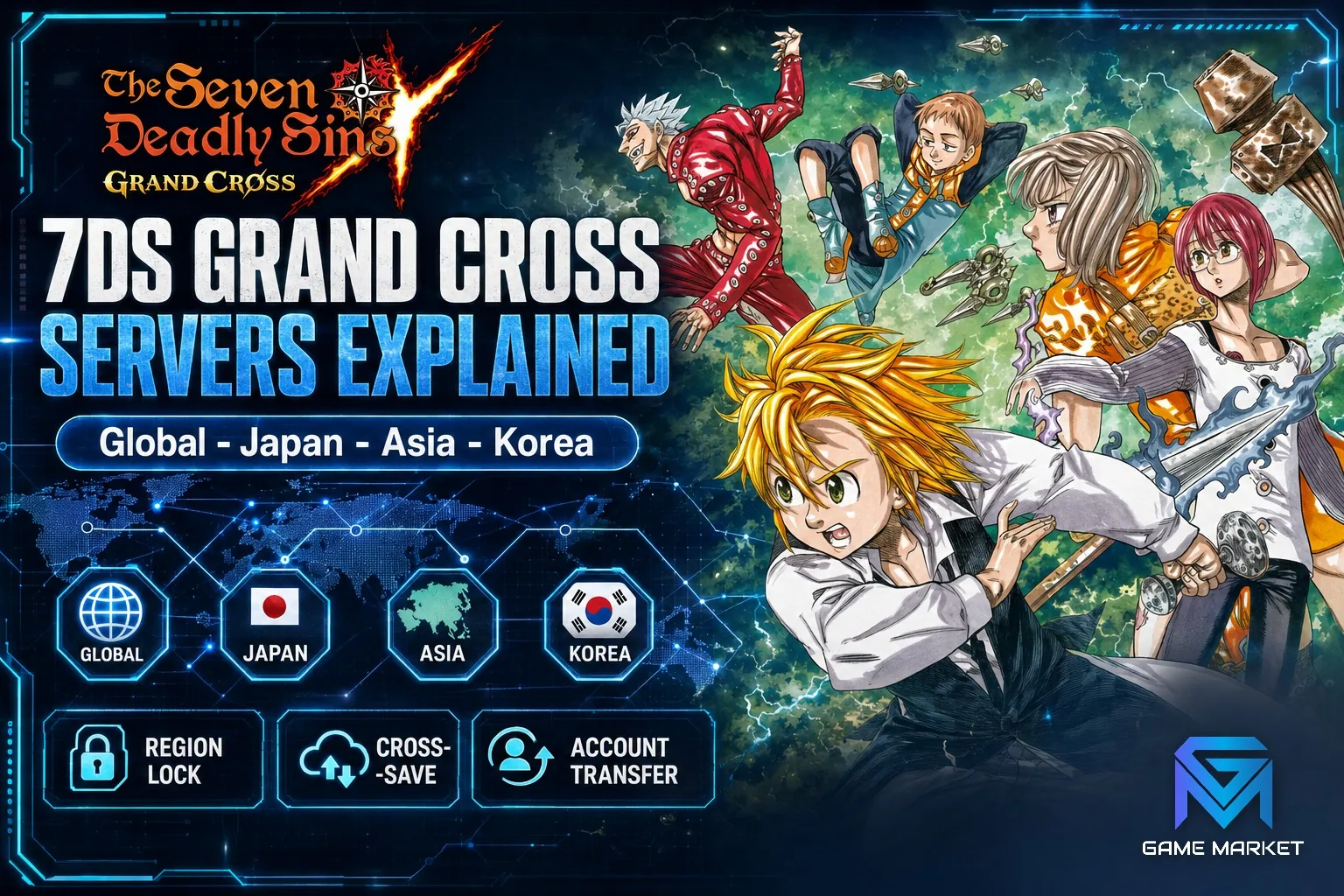
Choosing a server in The Seven Deadly Sins: Grand Cross means choosing a regional version of the game, and that choice is permanent for the account you build on it. Global, Japan and Korea are separate builds with separate accounts, separate banner schedules and separate economies. Progress never moves between them, so pick before you invest.
Most players who ask about "Asia servers" are really asking a different question: which client should I download, and what will I be locked out of later? That is the question this guide answers. Netmarble operates The Seven Deadly Sins: Grand Cross as a set of regional services rather than as one worldwide server list with a region dropdown, so the decision happens at install time, not at the character-creation screen. Below, each version is broken down by who runs it, what content cadence to expect, how the community around it behaves, and what practical friction you will hit if you pick the one that does not match where you actually live.
What are 7DS Grand Cross servers, and how do regional versions differ?
They are separate regional services, not channels inside one game. Global, Japan and Korea each run their own client, account database, banner order, event calendar and store pricing. An account created on one version does not exist on the others, and the versions are updated on different schedules.
The distinction matters because the vocabulary players use is inconsistent. In many gacha titles, a "server" is a shard you select after logging in — you can often move between shards, and the whole player base shares one patch. Grand Cross does not work that way. Netmarble publishes regionally, so the practical unit is the version: the Korean service, the Japanese service, and the Global service that serves most other territories in English and several other languages.
Three things are genuinely different between versions, and everything else follows from them. First, content timing: a hero, festival banner or collaboration that has already run on one version may be months away on another. Second, the economy: free diamond payouts, compensation gifts, login events and store bundles are configured per region, so the same account effort produces different draw counts. Third, the population: guild activity, PvP matchmaking depth and how quickly your language's community posts guides all depend on which service you joined.
What is not different is the core game. Combat is the same card-linking system, the same Ultimate Move gauge, the same gear substat grind and the same Awakening and Holy Relic progression on every version. You are not choosing a different game; you are choosing a release lane and a social environment.
What does the Global version actually cover, and who is it for?
The Global version is Netmarble's international service, launched in March 2020, and it is the default answer for most players outside Korea and Japan. It runs in English and several other supported languages, serves players across the Americas, Europe, Southeast Asia and Oceania, and has the largest English-speaking community.
Global is where the practical advantages stack up for a new player. Customer support, patch notes and in-game text are available in English, which matters more than it sounds when the game asks you to parse a skill description with three conditional clauses. The guide ecosystem — tier lists, gear substat priorities, PvP team compositions — is overwhelmingly written for Global's roster and banner order, so the advice you find matches the units you can actually draw this month.
Global is also the version that most players in Asia end up on. There is no separate "Asia client" for the majority of Asian territories; players in Southeast Asia, India and much of the region download Global and play alongside Western players. When you see "Asia server" in a marketplace listing or a forum thread, it usually means one of two things: an account created on Global by a player based in Asia, or an account on a regional storefront variant. Because that label is used loosely, treat it as a description of the owner's location, not as a guarantee of a distinct service — confirm the actual version before assuming anything about the account.
The trade-off with Global is content pacing. Because Korea receives most content first, Global players read about heroes and mechanics well before they arrive locally. Some players find that useful for planning their diamond saving; others find it frustrating. It is a matter of temperament, not of power — Global receives the same content, in its own order, with balance adjustments already applied.
What makes the Japan version different?
The Japanese service is a separate app with a separate account pool, run for the Japanese market. Its banner order, collaboration lineup and event calendar are tuned to that audience, and its interface and voice work are Japanese. It appeals mainly to players who read Japanese or specifically want that version's collaborations.
The Seven Deadly Sins is a Japanese property, so the Japanese service has a natural cultural home. Collaborations and campaigns there are often built around media timing that does not line up with Global's schedule. If a particular crossover is your reason for playing, the Japanese version may be where it appeared, and it may not be reproduced elsewhere in the same form.
The costs are real, though. Store access typically requires a Japanese account on your device's app store, payment methods can be region-restricted, and support correspondence will be in Japanese. Community resources in English exist but are thinner and slower. For a player who cannot read the skill text, the daily experience becomes guesswork on exactly the systems — gear substats, link conditions, buff durations — where guessing is expensive.
Is the Korea version worth playing for non-Korean players?
Korea is the home service and generally receives new heroes and systems first, which is why data-miners and theorycrafters follow it. For a non-Korean player it is usually the hardest option: the interface is Korean, account registration and payment can be restricted, and support is unlikely to serve you in English.
Playing on Korea is best understood as an information strategy rather than a home for your main account. Many dedicated Global players follow Korean patch notes and content creators to see which heroes are coming and how they perform, then plan their own diamond spending accordingly. That benefit is available for free — you can read ahead without moving your account.
If you are considering Korea as your primary version, be honest about the friction. Every quality-of-life problem you accept compounds over the months of progression that Grand Cross expects. A hero you cannot evaluate, an event you cannot read and a support ticket you cannot file are not one-time costs; they recur every patch.
Can you transfer an account or progress between servers?
No. Grand Cross treats the regional versions as separate services, and there is no supported way to migrate a roster, diamonds, gear or costumes from one to another. Linking your account to a platform such as Facebook or Google preserves it across your own devices, not across versions.
This is the single most important fact in the whole decision, so it is worth stating plainly: the version you choose is where your account lives for good. Account linking exists to protect you from losing progress when you change or reset a phone — it saves your access, not your region. A player who builds a strong roster on the Japanese version and later wants to play in English does not move that roster; they start again.
The practical consequence is that reinstalling is not a fix. If you discover after a month that you picked the wrong version, your options are to keep playing where you are or to accept the loss and restart. Because the early game front-loads a large amount of free currency and beginner missions, restarting is survivable — but it is a real cost, and it is entirely avoidable by spending five minutes on the decision now.
If you are unsure how much of your progress is actually portable across devices, our 7DS Grand Cross account progression breakdown covers what the game stores against your account and what it stores against your login method.
How should your server choice change the way you reroll and start?
Reroll on the version you intend to keep, never on a different one. Rerolling means repeating the tutorial and opening the beginner draws until you get a hero you want, and because accounts do not migrate, a good reroll on the wrong version is wasted effort.
Once you have settled the version question, the sequence is straightforward. Check which banners are live on your version before you start rerolling — the banner order differs, so a target that a guide recommends may not be available to you yet. Then decide whether you are rerolling for a specific hero or for general roster quality, because those are different stopping conditions and mixing them wastes hours.
Understanding the draw system before you spend anything is what makes the difference between an efficient start and a frustrating one. Rates, pity behaviour and the difference between hero draws and other draw types are covered in our 7DS Grand Cross draw and banner guide, and the currency side — where diamonds come from and what deserves them first — is in the 7DS Grand Cross diamonds guide.
One more starting decision interacts with your version: how far you intend to push a single hero. Because UR-grade progression consumes evolution materials that are gated by events and shops which are configured per region, your version influences how quickly a given hero reaches its ceiling. The mechanics themselves are identical everywhere, and they are explained in our 7DS Grand Cross UR grade guide.
How do latency, reset times and event timing change by server?
Connection quality and daily scheduling are the two practical, everyday effects of your choice. Servers hosted closer to you generally feel more responsive, and each version's daily reset, guild boss windows and PvP season boundaries are set in its own regional timezone — which decides whether your dailies land at a convenient hour.
Latency in Grand Cross is not as punishing as it is in a shooter, because most combat is turn-based card play. Where it does show up is in loading times, in real-time PvP modes and in guild content that everyone rushes at the same moment after a reset. If you sit on the far side of the world from your version's servers, expect slower loading rather than unplayable combat.
Reset timing deserves more attention than players usually give it. Grand Cross is a daily-task game: stamina refreshes, free shop entries and mission rollovers all key off a single daily reset. If that reset falls in the middle of your night, you will routinely lose a day of stamina, and over months that is a meaningful amount of progression. Work out what the reset time will be in your own timezone before you commit, and treat an awkward reset as a genuine argument against a version.
Event timing works the same way. Guild bosses, ranked seasons and limited event shops open and close on the version's clock. A player whose active hours fall outside their guild's peak will find it harder to join organised content, which is one of the quieter reasons that people drift away from a version that otherwise looked fine on paper.
What should you check before you commit to a server?
Run through five checks: which language you can comfortably read in-game; whether your app store and payment methods work for that version; what the daily reset time is where you live; where your friends or guild already play; and which banners are currently running on that version.
Take those in order, because they are ranked by how hard they are to undo. Language and store access are structural — if you cannot read the game or cannot access its store, no amount of enthusiasm fixes it. Reset time is a lifestyle fit that only becomes obvious after a few weeks. Friends and guild are the strongest retention factor in any live game, and if the people you want to play with are already on Global, that single fact outweighs most theoretical advantages of another version.
Banner timing comes last on purpose. It is the factor players weigh most heavily and the one that matters least in the long run, because every version eventually receives the roster. Choosing a version because one hero is available this week, and then living with a language you cannot read for a year, is a bad trade.
If you want the full picture of how a Grand Cross account develops after this decision — heroes, gear, teams and the pacing of the early game — start with our 7DS Grand Cross beginner's guide.
Frequently asked questions
Is there a dedicated Asia server for 7DS Grand Cross?
For most Asian territories, no separate Asia client is offered — players there use the Global version. "Asia" in listings and forum posts usually describes where the account holder is located or which regional storefront was used, not a distinct service. Always confirm the actual version.
Can I play the Japanese version from outside Japan?
Availability depends on your device's app store region and on the publisher's distribution settings, which can change. Even where installation is possible, in-app purchases and support are aimed at the Japanese market, so verify store and payment access before investing time.
Does the Global version get the same heroes as Korea?
Global receives the same content library over time, but in its own order and on its own schedule, often with balance adjustments already applied. Reading Korean patch notes is a reasonable way to anticipate what is coming, not a reason to switch versions.
If I picked the wrong version, what are my options?
There is no supported transfer, so you either continue where you are or start fresh on the version you want. The early game grants a substantial amount of free currency and beginner rewards, which softens a restart, but nothing carries over from the abandoned account.
If you would rather skip the regional guesswork and step straight into a roster that already matches the version you want to play, browse the verified listings on the GameMarket.gg 7DS Grand Cross accounts marketplace and check each listing's stated version before you commit.
GameMarket.gg is a trusted digital marketplace for everything gaming-related. We serve the gaming community by providing secure access that enhances every gaming journey.