7DS Grand Cross Collaboration Heroes Explained: How They Work
By John Ganang 22 September 2026, 06:00 WIB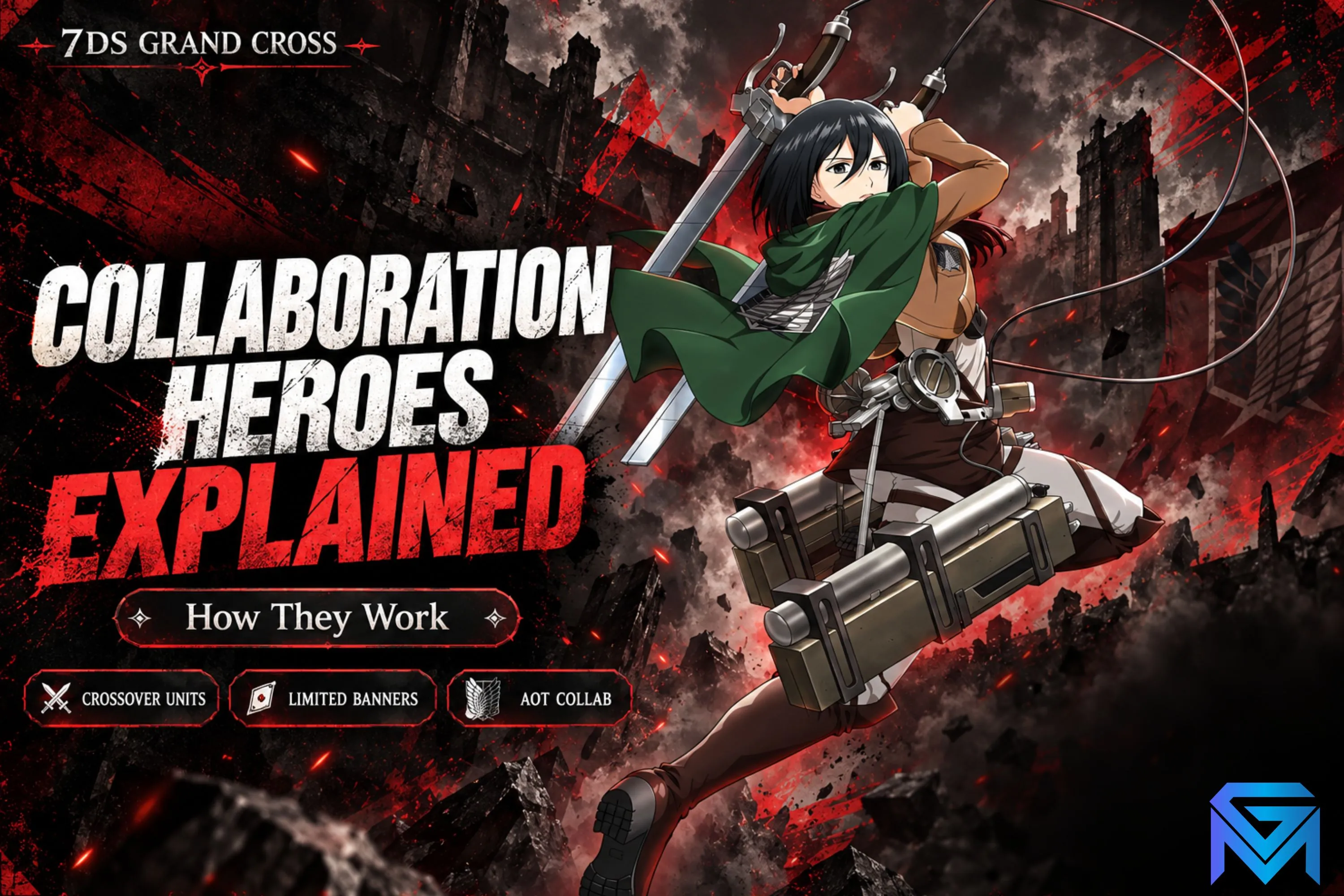
Collaboration heroes in 7DS Grand Cross are UR- and SSR-rank characters borrowed from outside anime series like That Time I Got Reincarnated as a Slime and The Rising of the Shield Hero, added through limited-time crossover banners rather than the game's own Seven Deadly Sins story. They draw from a separate pity pool, only appear during their event window, and count toward Combat Class exactly like native heroes once pulled.
What Are Collaboration Heroes in 7DS Grand Cross?
Collaboration heroes are playable characters licensed from a partner anime and inserted into 7DS Grand Cross for a limited event, distinct from Festival heroes, who come from the game's own cast on a story-anniversary banner. Netmarble has run this format repeatedly since 2020, treating each collab as a self-contained mini-banner with its own currency, shop and boss fight rather than a permanent roster addition. If you're still getting oriented on heroes, Diamonds and teams in general, the 7DS Grand Cross beginner's guide covers the wider roster system that collab heroes slot into.
The two confirmed, named examples are That Time I Got Reincarnated as a Slime (TenSura) and The Rising of the Shield Hero. Both bring their headline cast in as SSR or UR heroes with kits built around their source-material identity: TenSura's Rimuru Tempest as a shapeshifting DPS/support hybrid, Shield Hero's Naofumi Iwatani as a defense-oriented tank-support built around Raphtalia. Because these heroes never appear on the standard Festival or story pity track, a player who skips the event window has no fallback route to the exact same banner odds later.
How Do Collaboration Banners Differ From Standard Festival Banners?
A collaboration banner runs on its own Diamond-funded pity counter and hero-coin shop, separate from the concurrent Festival or story banner, so pulls on one track never contribute progress toward the other. That separation is why players who want a specific collab hero need to commit Diamonds to that banner specifically rather than assuming general pulls carry over.
Structurally the systems are identical: the same duplicate-to-awaken conversion, the same hero-coin exchange for a guaranteed copy after enough draws, and the same UR-then-SSR pull-rate tiers used elsewhere in the game. What changes is scope and duration. A collab banner is live only for the length of its event, typically a few weeks, and its hero-coin shop closes with it, so unused coins from a collab track do not roll over into general currency once the event ends.
The hero-coin shop attached to each collab banner is the part players actually rely on more than raw luck. Every draw on the collab banner, whether it produces a duplicate or a hero you already own, deposits coins into a dedicated shop where enough accumulated coins buy the featured hero outright. Because that shop is bounded to the event window, the practical planning question isn't "will I get lucky," it's "can I reach the shop threshold in the number of days the event runs," which is a budgeting problem, not a probability one.
Which Collaboration Events Has 7DS Grand Cross Actually Run?
7DS Grand Cross's first collaboration was TenSura in 2020, and Netmarble has revived it more than once since, most recently as "TenSura Collab: The Demon Lord Returns" in October 2024. That October 2024 run brought back six previously-released TenSura heroes, including Rimuru Tempest in his [Slime], [Ruler of Monsters] and [Octagram] Demon Lord forms, Milim Nava as [Tyrant of Destruction], Benimaru as [Kijin] and Shuna as [Oni], alongside two brand-new heroes for that specific rerun: Milim Nava as [Proven Power] and Shion as [Demon Lord's Secretary].
The Rising of the Shield Hero collaboration is the other named event, first launched in 2022 and brought back since. It added six heroes from that series: Naofumi Iwatani as [Shield Hero], Raphtalia as [Naofumi's Sword], Filo as [Queen's Successor], Fitoria as [Filolial Queen], Glass as [Vassal Wielder] and Kizuna Kazayama as [Hunting Hero]. Both franchises are licensed crossovers, not in-house Seven Deadly Sins content, which is exactly why the game brands them separately from Festival banners in its own event calendar.
Each collab event has typically paired its hero banner with a dedicated PvE encounter built around a named boss from the source material, such as Demon Lord Clayman anchoring the original TenSura collaboration as a limited-time fight rather than a recurring dungeon. Clearing that fight has usually been the gate for a chunk of the event's own reward track, separate from whatever you pull on the banner itself, so treating a collab purely as "a banner" undersells the event; it's a self-contained content drop with its own story beats, boss and shop layered on top of the pull.
How Strong Are Collaboration Heroes in Actual Combat?
Collaboration heroes are released at UR or top-tier SSR rank, so they carry the same combat-class weight as any other hero of that rarity, and several of them have stayed relevant well past their original release. Rimuru's various collab forms in particular have been reused across multiple TenSura reruns because Netmarble keeps tuning them alongside newer content instead of letting them go stale.
What separates a strong collab hero from a merely rare one is kit role, not origin. Naofumi's shield-based aggro and defense buffs make him a genuine tank-support pick for accounts that lack one, so, because that role gap is common on early-to-mid accounts, pulling him solves a team-comp problem rather than just adding another card. A collab UR that duplicates a role you already cover well is a much weaker pickup than the same rarity filling a hole in your comp.
How Do Collaboration Hero Kits Compare to Each Other?
Naofumi and Rimuru anchor the two collaborations in opposite team roles, which is why comparing them by rarity alone misses the point. Naofumi is built as a defense-and-aggro tank-support: his kit pulls enemy focus and buffs the party's survivability, which is exactly the role a glass-cannon-heavy roster is usually missing. Rimuru, by contrast, is a flexible DPS/support hybrid whose different collab forms (Slime, Ruler of Monsters, Octagram Demon Lord) lean further toward damage the higher-tier the specific version, so picking "which Rimuru" matters as much as picking Rimuru at all.
The supporting cast reinforces those same lanes rather than duplicating the leads. Raphtalia and Filo sit closer to sub-damage roles that benefit from Naofumi's aggro pull, so, because a tank only helps if something behind it is dealing damage, running Naofumi without at least one of his supporting Shield Hero cast wastes part of the synergy the collab was built around. Benimaru and Shuna on the TenSura side skew toward buffing and utility rather than raw burst, which is why a roster that already has strong native damage dealers often gets more mileage from a TenSura support than from another TenSura attacker.
How Should You Prepare an Account Before a Collaboration Event Starts?
The single highest-leverage prep step is stockpiling Diamonds ahead of the announcement, since collab banners are time-boxed and Diamonds earned mid-event rarely arrive fast enough to meaningfully change your pull count before the hero-coin shop closes. Holding back a Diamond reserve during the weeks before a rumored or datamined collab is far more effective than trying to catch up once the event is already live.
Beyond currency, keep Battle Manuals, EXP items and evolution materials like Pendants and Books on hand rather than spending them the moment they drop, because a freshly-pulled collab UR is only as strong as the investment you can immediately put behind it. An account that pulls Rimuru but leaves him at a low level and unevolved for weeks gets a fraction of the Combat Class and combat value that the same pull would deliver on an account that had materials ready to go the same day. Open hero slots and a roster spot for a new team comp around the collab hero round out the practical checklist; none of this affects pull luck, but it determines how much of that luck actually translates into account power.
Do Collaboration Heroes Come Back Once Their Event Ends?
Some do: TenSura has reran in 2020, 2022 and 2024, showing Netmarble is willing to bring a popular collab back years later. That said, a rerun is never guaranteed, no fixed schedule is ever announced in advance, and a hero missed on one run may sit unavailable for a long stretch before, or if, it returns.
Treat every collab banner as a use-it-or-risk-losing-it window rather than something you can defer indefinitely. Because Shield Hero and TenSura are both licensed content, their return depends on Netmarble renewing collaboration rights with the source studio, which is a business decision outside the game's own control and not something a patch note will predict.
How Do Collaboration Heroes Affect an Account's Overall Progression?
A collab UR adds Combat Class the same way any UR does, through rarity, level, awakening stage and equipped gear, so it raises account power the same way any hero investment does. What it signals beyond raw CC is history: an account holding heroes from the 2020 TenSura run and the 2022 Shield Hero run has necessarily been active, and spending, across multiple years of events rather than pulling everything in one recent burst.
Evolving a collab UR into its stronger forms uses the same Pendant and Book materials as any other UR, detailed in the UR grade and evolution guide, so owning the hero is only half the investment. A collab UR sitting at base rank without evolution or awakening materials spent on it contributes far less than the same hero fully built, which matters if you're judging how much progress a roster actually represents rather than just counting rare-hero names.
Should You Pull on a Collaboration Banner?
Pull if the collab hero fills a role your roster is genuinely missing, such as a dedicated tank-support like Naofumi or a flexible DPS/support hybrid like Rimuru, because a role gap is a real capability problem that a same-rarity duplicate elsewhere in your roster does not solve. Skip if the kit overlaps a hero you already run at higher investment; a second copy of a role you've solved mostly just spends Diamonds for a CC number, not a team upgrade.
Wait if you're early in the event window and unsure of your target, since these banners typically run for several weeks and the hero-coin shop lets you convert overflow draws toward a guaranteed copy, so there's rarely a reason to force pulls in the first day. The most common mistake is chasing a collab hero purely because it's rare and time-limited, then benching it once the event hype fades; decide by role fit first, and let rarity and time pressure be secondary factors, not the deciding ones.
Frequently Asked Questions
Can I still get a collaboration hero after its event ends?
Only if Netmarble reruns that specific collaboration later, which has happened with TenSura three times since 2020 but is never scheduled in advance. Outside a rerun, there's no standing method to pull a retired collab hero on demand.
Do collaboration heroes need different gear than native heroes?
No. They use the same gear slots, rune system and Pendant/Book evolution track as any other hero of their rarity, so nothing about their gear planning is special beyond the kit they're built around.
Does a collaboration hero count toward Combat Class differently than a native UR?
No. CC is calculated from rarity, level, awakening and gear, not from which banner a hero originated on, so a collab UR and a Festival UR of the same build stage contribute the same.
Is Diamonds the only currency for pulling collaboration banners?
Diamonds fund the draw itself, the same premium currency used elsewhere in the game, though events sometimes hand out a limited number of free collab-specific tickets through login rewards during the event window.
Where 7DS Grand Cross Accounts, Diamonds and the Game Hub Fit In
If you're evaluating a roster that already carries collaboration heroes rather than pulling for one yourself, GameMarket.gg lists 7DS Grand Cross accounts with their hero rosters and Combat Class disclosed, a Diamond top-up section for players building toward the next collab banner on their own account, and the full 7DS Grand Cross market hub for everything else tied to the game.
If you'd rather skip the pity math on the next collab rerun and buy into a roster that already has the hero built and evolved, browse current 7DS Grand Cross accounts on GameMarket.gg to compare Combat Class and hero lists before committing Diamonds of your own.
GameMarket.gg is a trusted digital marketplace for everything gaming-related. We serve the gaming community by providing secure access that enhances every gaming journey.