7DS Grand Cross UR Grade Explained: Evolution, Pendants & Books
By John Ganang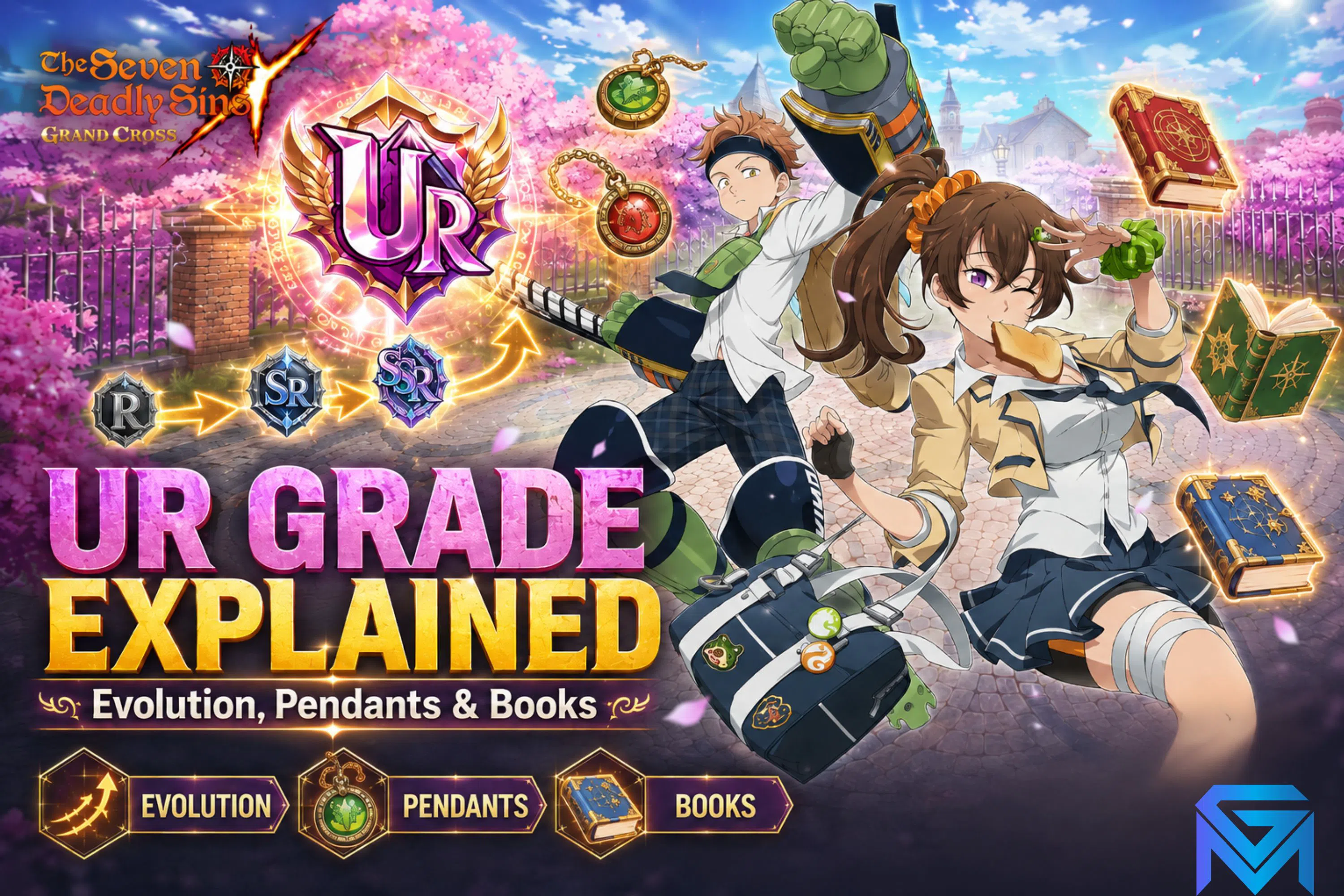
UR is the highest hero grade in The Seven Deadly Sins: Grand Cross, and it is reached only by evolving an SSR hero — never by drawing one. A UR evolution raises the level cap from 50 to 60, unlocks the hero's Unique passive, and consumes Grimoires, Evolution Pendants and Gold. If that part matters to you, 7DS Grand Cross Account Power Explained goes deeper.
That single sentence hides a lot of planning. Grade is only one of four progression axes in Grand Cross — grade, level, awakening and gear all move independently — and UR is the one that costs the most and refunds the least if you aim it at the wrong hero. This guide walks through what the UR grade actually changes, what each evolution costs, where the materials come from, which heroes justify the spend, and what happens after a hero is already sitting at UR.
What is UR grade in 7DS Grand Cross?
UR is the top rung of the four-grade ladder — R, SR, SSR, UR. Each grade sets a hard level cap: R stops at Lv30, SR at Lv40, SSR at Lv50, and UR opens Lv60 and beyond through Limit Breaking. Banners and shops only ever hand out SSR at most.
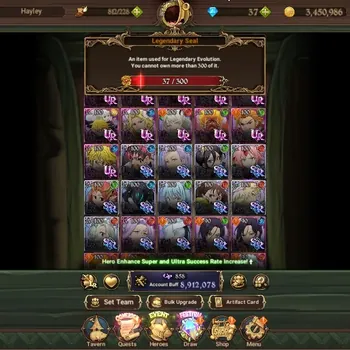
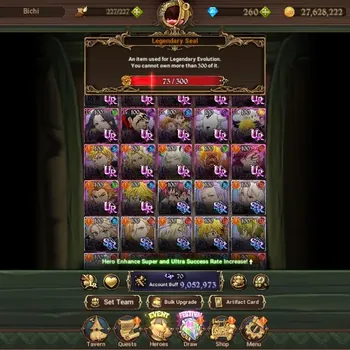
The important consequence of that last line is that UR is a player-made grade. There is no UR banner, no UR exchange ticket and no UR guaranteed pull. Every UR hero on every account in the game was manually evolved by somebody who farmed the materials for it. This is why grade tells you something that a summon history does not: a roster full of UR units is evidence of farming time, not draw luck.
Grade also feeds Combat Class. Evolving a hero raises base stats permanently, and because Combat Class is computed from stats, a UR evolution moves an account's headline number in a way that no amount of level-60 grinding on an SSR shell can. It is worth being precise here, though: evolution resets the hero's level back to 1. The stat gain is permanent, but you re-level from scratch immediately after, which is why players batch evolutions with a stock of experience material rather than doing them one at a time.
One frequent mix-up worth clearing early: grade is not awakening. Awakening (the star count, driven by duplicate heroes and coins) and grade (R through UR, driven by evolution materials) are separate systems that both make a hero stronger. A 6★ SSR and a 0★ UR are different animals, and an account listing that mentions one but not the other is only telling you half the story. Our 7DS Grand Cross account progression guide lays out how those axes stack together across a full roster.
How do you evolve a hero to UR grade?
Open the Heroes tab, select the hero, and press Evolve. The screen lists exactly which Grimoires and Evolution Pendants that specific hero needs, in what quantity, plus the Gold cost. The hero must already be at the maximum level for its current grade before the Evolve button becomes available.
The flow in practice looks like this:
- Take the hero to its current cap. An SSR must reach Lv50 before it can evolve to UR. Feed experience material or clear stages until the cap is hit.
- Read the requirement list. Requirements are per-hero, not universal — they depend on the hero's attribute (Strength, Speed or HP) and on the grade the hero was originally released at.
- Tap a missing material and use the Location button. The game routes you straight to the stage, dungeon or shop that drops it. This is the single most underused button in the interface and it removes almost all guesswork about where to farm.
- Confirm the evolution. Grade changes, base stats jump, the Unique passive unlocks if it was previously locked, and level resets to 1.
- Re-level immediately. A Lv1 UR is statistically worse than the Lv50 SSR it replaced until you push it back up, so never evolve a hero the night before a ranked window closes.
Because the level reset is unavoidable, the cheapest sequencing is to evolve while you still have experience material banked rather than after you have spent it. Players who plan a UR run tend to hold a reserve specifically for the re-level.
What materials does a UR evolution cost?
Three things: Grimoires (commonly called Books), Evolution Pendants, and Gold. Grimoires come in Strength, Speed and HP varieties matching the hero's attribute. Pendants are tiered — a hero whose base grade was SR consumes SR Pendants, while a hero released as SSR consumes the far scarcer SSR Pendants.
That Pendant distinction is the whole economy of UR progression, and it is the part most new players get wrong. A hero that started life as an SR and was walked up through SR → SSR → UR needs more total Pendants, but they are the cheap kind. A hero that was released as an SSR needs fewer Pendants, but every one of them is an SSR Pendant, and SSR Pendants are a genuine bottleneck rather than a formality. When you look at a mature roster, the SSR Pendant spend is usually the constraint that decided which heroes got evolved and which are still parked at SSR.
Gold is the third leg and is rarely the limiting one at mid game, but it is not trivial either — a UR evolution is one of the larger single Gold outlays in the game, and it competes directly with gear enhancement and awakening for the same pile. If Gold is what is holding you back rather than materials, the fix is a farming-route problem rather than a grade problem.
Two accuracy notes worth carrying with you. First, exact material counts are tuned by Netmarble over time and differ per hero, so treat any fixed number you read on a fan site as a snapshot rather than a rule — the in-game Evolve screen is always the current source. Second, evolution material requirements are attribute-specific, so stockpiling only Strength Grimoires will leave you unable to touch your Speed and HP units. For the detail behind that, see Gacha Explained Draw Types, Rates & Duplicates.
Where do you farm Grimoires and Evolution Pendants?
Grimoires drop from the dedicated SP dungeon rotation — Fort Solgres is the standard destination, with the three attribute types available on a schedule. Evolution Pendants come from a wider mix: story and side content for the lower tiers, and raid rewards, event exchanges and coin shops for the SSR tier.
Some practical structure around that:
- Grimoires (Books): the SP dungeon is the reliable, repeatable source. Because it rotates by attribute, the efficient pattern is to check which attribute is up today and farm that one to a comfortable buffer, rather than farming reactively when an evolution is already blocked.
- SR Evolution Pendants: broadly available. Story clears, daily content and routine event shops keep most accounts supplied without special effort.
- SSR Evolution Pendants: the real constraint. These concentrate in raid boss rewards, limited event exchanges and coin shops. They come in slowly and are not meaningfully farmable on demand, which is why the community advice has always been to decide your UR targets before you spend them.
- Gold: the tavern economy, daily farming stages and event payouts. Gold is the one input you can reliably brute-force with stamina.
The general rhythm is that Grimoires respond to effort and Pendants respond to patience. If you are impatient about a UR target, the lever you actually have is finishing the raid and event content that pays SSR Pendants, not grinding an extra hour of dungeon.
What actually changes when a hero hits UR?
Three things change at once: the level cap opens from 50 to 60, every base stat receives a permanent multiplier, and the hero's Unique passive becomes active. The Unique is usually the largest practical gain, because Uniques often buff an entire race or attribute group rather than just the hero carrying them.
Unique passives are where UR stops being a stat exercise and becomes a team-building decision. A Unique that reads "increases the basic stats of Fairy allies by 8%" is not a personal buff — it is an aura that changes the value of every Fairy on the roster. That means the correct UR target is sometimes not your strongest hero but the one whose Unique lifts the team you actually field. Players who evolve purely by tier list and ignore Uniques routinely end up with a strong solo unit sitting in a squad that gained nothing from the evolution.
The stat multiplier itself is straightforward but compounding: higher base stats mean gear percentage rolls apply to a bigger number, and mean the level 51–60 stretch is worth more than the level 41–50 stretch was. This is also why UR + good gear pulls away from UR + default gear much faster than the equivalent gap at SSR.
What UR does not do is change a hero's skills, cards or ultimate. A hero with a weak kit at SSR has the same weak kit at UR, just with better numbers behind it. Grade amplifies a hero; it does not fix one.
Which heroes deserve a UR evolution first?
Prioritise heroes that clear three tests at once: a Unique passive that buffs a race or attribute you already field, a kit that stays relevant in raids and PvP rather than only in story, and a base grade that does not drain your SSR Pendant reserve for a marginal gain.
Some durable selection logic, independent of any particular season's meta:
- Support and utility units age better than pure damage. Cleanses, heals, buffs and crowd control stay useful across content updates; a damage number that was best-in-slot last year is routinely outscaled. Heroes like Blue King have historically been community UR staples for exactly this reason — a cleanse, a heal, control and an aura Unique in one body.
- Race-aura Uniques multiply. If eight of your usable heroes share a race, the Unique that buffs that race is worth more than a Unique that only buffs its owner.
- Free and story-obtainable heroes are efficient targets. A hero you were given for free but whose base grade is SSR still costs SSR Pendants — but heroes you can reliably awaken because duplicates are obtainable pair well with a UR evolution, since grade and awakening compound.
- Do not UR a bench unit for Combat Class. Grade raises Combat Class whether or not the hero is ever deployed, which tempts people into evolving for a number. The materials are permanent and non-refundable; the number is cosmetic if the hero never fights.
The honest framing is that there is no universal UR list that survives contact with a live game. Rosters differ, content differs, and Netmarble adjusts hero performance through balance passes. The stable advice is the filter above, applied to whatever you actually own. If you are still assembling a starting roster, the 7DS Grand Cross beginner's guide to heroes, diamonds and teams covers which units are worth building toward before you commit Pendants to any of them.
What comes after UR — how does Limit Breaking work?
Limit Breaking is the post-UR track that pushes a hero past the Lv60 ceiling. It consumes raid-sourced materials — Red Demon's Horns, SSR Evolution Pendants and Grimoires — and is applied in steps, each of which lifts the cap a little further and adds stats along the way.
This matters for planning because Limit Breaking draws on the same SSR Pendant pool as UR evolutions. A player who evolves six heroes to UR and then discovers they cannot Limit Break any of them has spread a scarce resource too thin. The usual endgame pattern is narrow and deep: a small core of heroes taken to UR and then Limit Broken, rather than a wide bench of freshly-evolved Lv60 units.
Limit Breaking also re-anchors the value of raid content. Red Demon's Horns and their equivalents come from raid bosses, which means an account's ability to progress past UR is gated by its ability to clear raids — which in turn is gated by having UR heroes. That loop is intentional, and it is why raid clear capability is one of the more informative things to know about a Grand Cross account.
Is UR gear the same thing as a UR hero?
No — they are unrelated systems that share a name. UR heroes come from evolution with Grimoires and Pendants. UR gear is created through Merlin's Engrave Equipment menu in the tavern, using a 6★ awakening stone plus engraving stones, and it upgrades a piece of equipment rather than a character.
The confusion is common enough to cost people materials. If someone tells you an account "has UR", ask which one they mean: a roster of UR-evolved heroes, or a set of UR-engraved gear pieces. Both are real investments, but they represent completely different farming histories — hero UR reflects dungeon and raid time, gear UR reflects awakening-stone and engraving-stone accumulation.
In build terms the two do stack, and the strongest configurations pair a UR hero with UR gear so that the gear's percentage rolls apply to the evolved base stats. That is the endgame target, not the starting point — a UR hero in solid SSR gear performs well; SSR heroes in UR gear are usually a sign of misallocated resources.
In what order should grade, awakening, level and gear be raised?
For most accounts: level to the current cap first, then gear the hero to a workable baseline, then awaken as duplicates allow, and evolve to UR when the hero has proven it belongs in your main squads. Grade is the most expensive and least reversible step, so it goes last among equals.
The reasoning is about information rather than optimisation. Levelling and gearing are cheap and reversible enough that you learn whether a hero suits your playstyle before committing anything scarce. Awakening is gated by duplicates, so it happens on the game's schedule rather than yours. UR evolution is the one decision that permanently consumes a bottleneck resource on a specific hero, which means it should be the last decision you make, not the first.
There is one common exception. If a hero's Unique passive is the thing your team needs — an aura that lifts a whole race you already field — then the Unique only exists at UR, and delaying the evolution delays the team benefit rather than just the personal one. In that narrow case, evolving earlier is correct.
Common questions about UR grade
Can you pull a UR hero from a banner? No. SSR is the highest grade obtainable from draws, exchanges and shops. Every UR hero in the game was evolved by a player.
Does evolving to UR reset my hero's level? Yes. Evolution returns the hero to Lv1 with a raised cap and permanently higher base stats. Keep experience material in reserve so the hero is not weak for long.
Do awakening stars carry over through an evolution? Awakening and grade are tracked separately, so awakening progress is not lost when a hero changes grade. They are two independent investments in the same unit.
Are SSR Pendants ever farmable on demand? Not reliably. They concentrate in raid rewards, event exchanges and coin shops, which means they accumulate on the game's schedule. Plan your UR targets around the reserve you have, not the one you hope to build.
Is it worth URing a hero I only use in story content? Generally no. Story content is clearable without UR investment, and the materials do not come back. Save evolutions for heroes that appear in raid, PvP or event squads.
Where to Find 7DS Grand Cross Top Up and Accounts
On GameMarket.gg you can compare 7DS Grand Cross top-up options before you spend.
If you would rather start from a roster that already has its UR core evolved and its raid clears in place, you can browse available 7DS Grand Cross accounts on GameMarket.gg and compare what has actually been built on each one — grade, awakening and gear together, not just a headline Combat Class.
How that UR grade and CC investment gets split between a small Arena-focused core versus a wide PvE roster is explained in our PvP vs PvE accounts breakdown.
GameMarket.gg is a trusted digital marketplace for everything gaming-related. We serve the gaming community by providing secure access that enhances every gaming journey.