7DS Grand Cross Awakening Guide: Holy Relics, CC and Power Growth
By John Ganang 17 September 2026, 06:00 WIB
Awakening in 7DS Grand Cross is the stat-and-passive upgrade track that turns a finished hero into an endgame one, and Holy Relics are the separate relic slots that carry most of your late-game Combat Class. Both matter, but they pay out at different times, and the order you invest in decides how fast your account actually gets stronger.
That distinction trips up a lot of returning players. You can pull a strong SSR, evolve it, gear it, and still bounce off Demonic Beast tiers because the hero is technically "complete" while its Awakening board and relic slots are empty. This guide walks the whole power stack in the order the game actually rewards, so newcomers know what each system does and veterans can sanity-check where their resources are leaking.
⭐ What does Awakening actually do in 7DS Grand Cross?
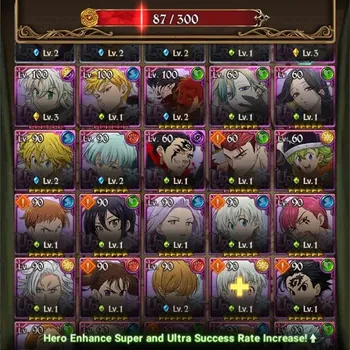
Awakening is a per-hero upgrade track that consumes hero-specific Awakening materials and gold to add permanent stat bonuses, and at set stages it upgrades a hero's passive or Ultimate behaviour. It is separate from level, grade and gear — an unawakened max-level hero is only partly built.
The important thing to understand is that Awakening is hero-locked. The materials you spend come from that hero's own duplicate pool and from the awakening resources tied to their grade, which is why duplicates in this game are rarely wasted. When a banner hero shows up again on a rerun or in an exchange shop, the copies feed straight back into the same track.
Awakening pays out in two shapes, and telling them apart is what stops you from over-investing:
- 🟢 Flat stat stages — small, reliable bumps to Attack, Defense and HP. These raise your Combat Class immediately but change very little about how a fight plays out.
- ⭐ Threshold stages — the stages that touch a passive, a buff duration, or the Ultimate's scaling. These are the ones that change whether a hero clears a stage or not.
In plain terms: the number on the screen goes up every stage, but the hero only becomes a different hero at the threshold stages. If you are budgeting materials across a roster, push your two or three core damage dealers to their threshold stages before you top anyone off for the flat stats.
Netmarble's in-game hero details panel shows exactly which stage unlocks which effect before you spend, and it is worth reading it once per hero rather than mass-awakening on autopilot. The panel is the authoritative source; community spreadsheets drift after balance passes.
🔮 How do Holy Relics raise your Combat Class?
Holy Relics are a dedicated equipment layer earned from Demonic Beast content. Each relic slot carries its own stats and set bonus, they are enhanced with relic-specific materials rather than normal gear resources, and because they stack on top of gear, they carry a large share of late-game Combat Class.
Relics behave differently from gear in three ways that matter for planning:
- 🔁 They come from a repeatable, stamina-gated source. Demonic Beast battles reset on a schedule, so relic progress is a steady drip rather than a gacha spike. You cannot rush it with diamonds the way you can rush a banner.
- 🎯 They are attack-type aligned. Relics are built around the damage profile of the hero wearing them, so a relic set farmed for one carry is not freely portable to a hero with a different profile.
- 📈 They compound with Awakening. Relic stats multiply against the same Attack and Defense pools your Awakening stages inflate, which is why accounts that ignore relics feel weak despite a high roster count.
For a full breakdown of which beast drops what and how the rotation is scheduled, our 7DS Grand Cross event and exchange shop guide covers the currency side, since several relic and awakening materials appear in event shops as well as in the beast drops themselves.
The practical rule for relics: farm the beast that feeds your main carry until that hero's set is complete and enhanced, then rotate. Splitting relic materials across four half-finished heroes is the single most common way accounts stall in the mid-game.
📊 What is Combat Class and why does it mislead players?
Combat Class, or CC, is an aggregate score the game calculates from level, grade, gear, gear enhancement, Awakening, Ultimate level and relics. It is a useful shorthand for account power, but it weights raw stats heavily and ignores team synergy, turn order and card manipulation entirely.
This is why two accounts at the same CC can perform completely differently. CC does not know that your team has no debuff cleanse, that your buffer dies on turn two, or that your card draw is inconsistent. It counts stats.
Where CC is genuinely useful:
- ✅ Gating checks. Some content and matchmaking pools reference CC directly, so hitting a threshold can unlock or smooth access.
- ✅ Progress tracking. Comparing your own CC across weeks is a fair measure of whether your investment is landing.
- ✅ Account valuation. When accounts change hands, CC is the fastest first-pass signal, which is why it dominates listings — our companion piece on 7DS account progression goes deeper on the roster side of that picture.
Where CC misleads:
- ❌ It rewards spreading investment thin across many heroes, which is exactly the wrong strategy for clearing hard content.
- ❌ It does not distinguish a well-rolled gear substat from a badly-rolled one of the same rarity tier.
- ❌ It says nothing about whether you own the specific utility units a given fight demands.
Treat CC as a thermometer, not a strategy. If your CC is climbing but your clears are not, the problem is composition or gear quality, not volume.
⚔️ Should you chase gear substats or raw CC first?
Chase substats first on your core three heroes, then let CC follow. Gear in 7DS Grand Cross rolls variable secondary stats, and a well-rolled set at a lower nominal tier routinely outperforms a poorly-rolled set that shows a higher Combat Class on the summary screen.
The reason is how the damage formula stacks. Crit chance, crit damage and attack percentage interact multiplicatively with your Awakening and relic bonuses, while flat filler stats do not. A set with three useful rolls and one dead roll beats a set with four mediocre rolls even when the second set reads as "stronger".
A workable gear priority for most damage dealers:
- Attack percentage on the primary slots — this is the base everything else multiplies against.
- Crit chance up to a reliable rate, since crit damage is worthless if you are not critting.
- Crit damage once your crit rate is stable.
- Defensive filler only on the heroes expected to survive multi-turn fights.
Supports and tanks invert that list, and the specific sets that suit each role are covered in our 7DS gear sets and role fits guide. The general principle holds regardless of patch: roll quality beats roll count.
🧭 What order should you upgrade a new hero in?
Level and grade first so the hero is usable, then gear it with whatever complete set you have spare, then push Awakening to its first threshold stage, then relics, then refine gear rolls. Doing relics before Awakening thresholds wastes the multiplier, because relics scale against stats Awakening has not yet raised.
Step by step, for a hero you have decided is worth investing in:
- 🔼 Max level and grade. Non-negotiable baseline. An under-grade hero cannot hold the gear it needs.
- 🧰 Equip a complete set. Any complete set beats mismatched high-tier pieces, because set bonuses are where the early multipliers live.
- ⭐ Awakening to the first threshold. Check the hero panel for which stage touches the passive, and stop there on your first pass.
- 🔮 Relic set for that hero's profile. Complete the set before enhancing any single piece deeply.
- 💪 Ultimate level. Cheap relative to its impact on burst damage; easy to forget.
- 🎲 Gear re-rolls. The infinite-money-sink stage. Only start it once everything above is done.
The sequencing matters more than the totals. Players who follow this order with modest resources routinely out-clear players who dumped everything into gear re-rolls on turn one, because each step in the list raises the ceiling of the step after it.
🍳 Which daily systems actually feed Awakening and relics?
Your stamina spend is the real bottleneck. Awakening materials, relic drops and the gold to apply them all trace back to daily stamina-gated content, so the accounts that grow fastest are the ones that never let stamina overflow — not the ones that log in the longest.
The recurring feeders worth protecting every day:
- ⏳ Stamina-gated farming stages for material drops. Missing a natural refill is a permanent loss, not a delay. Our 7DS stamina and daily reset guide maps the refill windows.
- 💰 Gold income. Every system above consumes gold, and gold is the constraint that bites hardest during a re-roll phase — see the 7DS gold farming guide for the reliable sources.
- 👹 Demonic Beast attempts. The only relic source. Unused attempts are unrecoverable.
- 🎪 Event shop clears. Rotating events frequently stock the exact awakening material a hero is short of, at a far better rate than grinding for it.
None of that is glamorous, and that is the point. Power growth in 7DS Grand Cross is overwhelmingly a function of consistent daily throughput rather than lucky pulls, which is also why the general 7DS farming guide is the highest-leverage read for anyone who feels stuck.
🚧 What are the common progression walls and how do you break them?
Most walls are resource-allocation problems wearing a difficulty costume. The three that stop accounts hardest are the roster-spread wall, the relic-drip wall and the gold wall, and each has a specific fix that does not require pulling anything new.
The roster-spread wall. You own twenty heroes and none of them are finished. Symptom: high CC, low clear rate. Fix: pick three — one damage dealer, one support, one durable body — and complete the full upgrade order on those three before touching anyone else. Roster breadth is an endgame luxury, not a mid-game strategy.
The relic-drip wall. Relics only come from beast attempts, so no amount of diamonds fixes a missed week. Symptom: your gear is fine and your damage still falls short of thresholds. Fix: treat beast attempts as the first thing you spend each day, before story or events, and concentrate the drops on one hero at a time.
The gold wall. Gear re-rolling burns gold faster than any other system in the game. Symptom: you have materials you cannot apply. Fix: stop re-rolling entirely for a week, bank gold, then re-roll in a concentrated block on one gear set.
There is a fourth, softer wall worth naming: the rank wall, where your account level caps how much stamina and how many attempts you get in the first place. That one is slower to solve but compounds with everything else — the 7DS rank up guide covers the efficient path there.
❓ Frequently asked questions
Does Awakening reset if I re-grade a hero?
No. Awakening progress persists through grade upgrades. Confirm on the hero panel before spending if you are working with an unfamiliar unit, but the systems are tracked independently by design.
Are duplicate SSRs wasted once a hero is fully awakened?
Not entirely — surplus copies convert into the shared resources used elsewhere in the awakening and grade systems. The conversion rate is worse than direct use, so a fully-awakened hero is still the point at which duplicates lose most of their value.
Should a returning player rebuild an old hero or start fresh with a new one?
Rebuild, in almost every case. Level, grade and Awakening progress on an old hero represent resources you have already spent; abandoning it means paying that cost twice. The exception is a hero whose role has been fully displaced by a newer unit you already own.
Is a higher Combat Class always better when comparing two accounts?
No. CC counts stats, not composition. An account with a lower CC but three fully-finished, well-geared heroes is more capable in hard content than a higher-CC account with twenty half-built ones.
If you would rather keep your daily beast attempts, stamina cycles and event shop clears running while you are busy — the exact throughput this whole guide depends on — you can browse the available 7DS Grand Cross hourly services on GameMarket.gg and pick a block that fits your schedule.
GameMarket.gg is a trusted digital marketplace for everything gaming-related. We serve the gaming community by providing secure access that enhances every gaming journey.