7DS Grand Cross Combat Guide: Card Ranks, Combos and Ultimate Moves
By John Ganang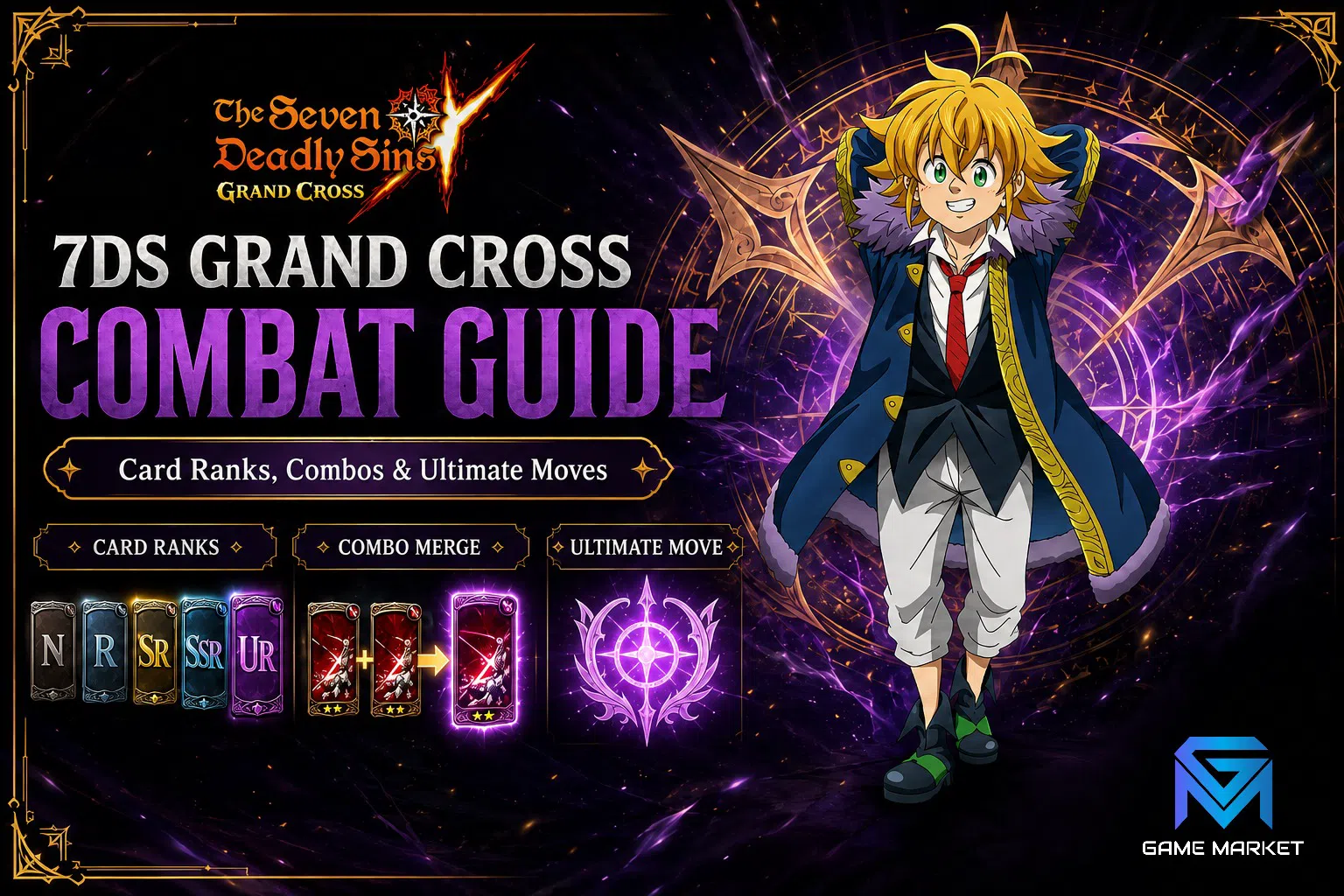
Combat in The Seven Deadly Sins: Grand Cross runs on a card queue: each turn you draw skill cards, merge two identical cards to upgrade them by one rank, and spend Ultimate Gauge to fire an Ultimate Move. Damage comes from rank upgrades and combo order far more than from raw hero stats, which is why two players with the same team can post wildly different clears.
Almost every difficulty wall in Grand Cross — Demon fights, Knighthood bosses, PvP against a stronger roster — is a card-management problem wearing a stat-check costume. The game hands you a limited draw, a merge mechanic that multiplies value, an Ultimate Gauge that rewards patience, and a turn structure that punishes spending everything the moment it appears. This guide covers each of those systems in the order they matter during a turn, with the specific rules and breakpoints that decide whether a fight is winnable at your current power.
How does the card system actually work each turn?
At the start of every turn the game deals a hand of skill cards drawn from your three active heroes, plus the Ultimate Move card for any hero whose gauge is full. You play a fixed number of cards per turn, and unplayed cards are discarded — the hand does not carry over.
Each hero contributes cards from their own skill set, so a three-hero team produces a mixed hand. Which specific cards appear is randomised, but the pool is not: a hero with two damage skills and one buff will, over many turns, feed you roughly that mix. Team composition is therefore also draw-pool composition. Stacking three heroes whose useful card is the same buff means most hands will be full of cards you do not want to play.
The turn structure creates the core tension. You must decide, with incomplete information about next turn's draw, whether to spend a card now for immediate value or merge it for a stronger version. That decision is what separates a clean clear from a slow grind, and it is worth understanding before spending resources on 7DS Grand Cross account progression through heroes and gear, because a well-played weaker roster routinely beats a badly played stronger one.
What do card ranks do and how does merging work?
Every skill card has a rank. Merging two identical cards of the same rank produces one card of the next rank up, with a substantially larger effect — more damage, a longer buff duration, or a stronger debuff. Merging costs you one card slot but converts two mediocre plays into one strong one.
The scaling is not linear. A rank-up is typically worth far more than playing both original cards separately, which is why the merge is the single highest-value habit in the game. Two low-rank damage cards played individually chip; the same two merged into a higher rank can break a boss's guard or push a kill a full turn earlier.
Merging has one hard rule players lose fights to: the cards must be the same skill from the same hero at the same rank. Two different damage skills, or the same skill at two different ranks, will not merge. This makes the highest ranks progressively harder to reach, since each one requires two of the tier below, and the draw has to cooperate.
Practical consequences follow. First, holding a low-rank card for one turn hoping to pair it is often correct against long fights and wrong against short ones — merge value needs turns to pay off. Second, buff and debuff cards frequently merge into their most efficient form early, because their upgraded duration covers the whole fight rather than one turn. Third, a card that is already at the top rank you can realistically reach should just be played; hoarding it wastes the slot.
How does the Ultimate Gauge and Ultimate Move work?
The Ultimate Gauge fills as you play cards and take actions across the turn. When it is full, the hero's Ultimate Move enters your hand as a card. Playing it consumes the gauge and delivers the hero's signature effect — typically the largest single burst of damage or the strongest team-wide buff they have.
Ultimate Moves also have ranks, and they can be merged in the same way as ordinary cards when the hand allows it. An upgraded Ultimate is often the difference between clearing a health threshold and stalling one turn short.
Timing matters more than frequency. Firing an Ultimate into a boss that is about to gain a defensive buff, or before your own damage-amplification debuffs are on the target, wastes the largest tool in your kit. The reliable sequencing is: apply debuffs and buffs first, then release the Ultimate into the window where they are active. Against enemies with damage-reduction phases, holding the gauge through the phase is usually correct even though it feels wasteful.
Gauge generation is a team property as much as a hero one. Some heroes and some card types build gauge faster, and a team built around a single Ultimate-dependent carry needs supports that accelerate the gauge rather than compete for card slots.
Why does the order you play cards in change the result?
Cards resolve in the order you queue them, so the sequence decides which effects are active when damage lands. Debuffs that increase damage taken, buffs that raise attack, and stance or pierce effects only apply to cards played after them — a perfectly ranked damage card fired before its setup does a fraction of its potential.
The default correct order in most fights is: defensive or cleanse cards if the incoming turn threatens you, then attack buffs on your carry, then damage-amplifying debuffs on the target, then damage, then the Ultimate. Reversing any two of those steps silently loses damage without any error message telling you so.
Grand Cross layers a second effect on top: playing cards consecutively builds toward combo bonuses, and certain team synergies reward specific card-type sequences. This is why the same three heroes with the same cards can produce very different totals in the hands of two players — and why fights that seem impossible often unlock after a sequencing change rather than a power increase. Efficient turn play is also the fastest route through the daily grind covered in our 7DS Grand Cross farming guide.
How should card pools shape your team building?
Build teams around card economy, not just stat totals. A strong team supplies a clear carry whose damage cards are worth merging, at least one hero whose buffs or debuffs multiply that carry, and enough gauge generation that the Ultimate arrives on schedule rather than by accident.
The common beginner error is three carries. Three damage heroes flood the hand with competing high-cost cards, none of which get merged reliably, and the team ends up playing three mediocre single-rank attacks per turn instead of one upgraded one. Two support-flavoured heroes and one focused carry usually out-damages three carries outright.
Attribute matchups sit on top of card play. Grand Cross uses a rock-paper-scissors attribute wheel, and being on the favourable side of it is a large multiplier that no amount of card skill fully replaces. Checking the enemy attribute before entering a fight and swapping to the countering hero is the cheapest power increase available at any point in the game.
Gear and set bonuses then decide how much of that structure survives contact — a carry without the right set can lose its damage window entirely. Our breakdown of 7DS Grand Cross rank-up and climbing efficiently covers where those upgrades pay off first.
Does card strategy change between PvE and PvP?
Yes, substantially. PvE fights are long and scripted, which rewards patient merging and held Ultimates. PvP is short and reactive, which rewards immediate pressure, cleanses, and denying the opponent the turns they need to reach their own merges and Ultimates.
In PvE against Demons and Knighthood bosses, the fight has known phases: damage windows, defensive phases, and enrage timers. Because you can plan against a script, the optimal line is usually to spend the first turns building rank and applying persistent debuffs, then dump everything into the known damage window.
PvP inverts that. An opponent who is allowed three quiet turns will assemble exactly the same upgraded burst you would, so speed, stuns, freezes and cleanses become far more valuable than they look on paper. Control effects that would be a luxury in PvE are frequently the win condition in PvP, because every turn you take away is a merge the opponent never completes.
Stamina and daily-run efficiency shape how much of either mode you can actually practise. If you are budgeting time and resources across both, the 7DS Grand Cross stamina, daily tasks and resets guide maps where the day's runs are best spent.
What are the most common card-play mistakes?
The recurring errors are all economy errors: playing every card the moment it appears, merging in fights too short for the merge to pay off, firing Ultimates before setup, and building teams whose card pools compete instead of combining. Each one quietly costs a large fraction of the team's real output.
A second cluster involves ignoring information the game is giving you. Enemy attribute, incoming attack telegraphs, and the enemy's own gauge are all visible, and all three should change what you queue. Playing the same opening every fight regardless of the enemy is the most common reason a roster that "should" clear a stage does not.
The third is over-investing in breadth. Spreading upgrade materials across many heroes leaves you with a wide roster of half-built units and no team that can carry the account's hardest content. A single fully-built core team clears far more than five partial ones, and it makes every event and shop rotation easier to convert into progress — a pattern our 7DS Grand Cross event, currency and exchange shop guide goes into in detail.
Finally, do not treat randomness as an excuse. The draw is random, but the pool, the merge rules, the order of resolution and the enemy script are all deterministic. Nearly every fight that feels like bad luck was decided by one of those four before the cards were dealt. Players new to the system will find the fundamentals laid out step by step in the 7DS Grand Cross beginner's guide to heroes, diamonds and teams.
Where to Find 7DS Grand Cross Accounts and Top Up
On GameMarket.gg you can browse 7DS Grand Cross accounts on GameMarket, the 7DS Grand Cross market hub.
Good card play stretches every resource you put into the game further, and Diamonds are what keep the draws and stamina flowing while you build that core team. You can find 7DS Grand Cross Diamond top-up options on GameMarket.gg whenever you want to keep a run going.
GameMarket.gg is a trusted digital marketplace for everything gaming-related. We serve the gaming community by providing secure access that enhances every gaming journey.