7DS Grand Cross Gacha Explained: Draw Types, Rates & Duplicates
By John Ganang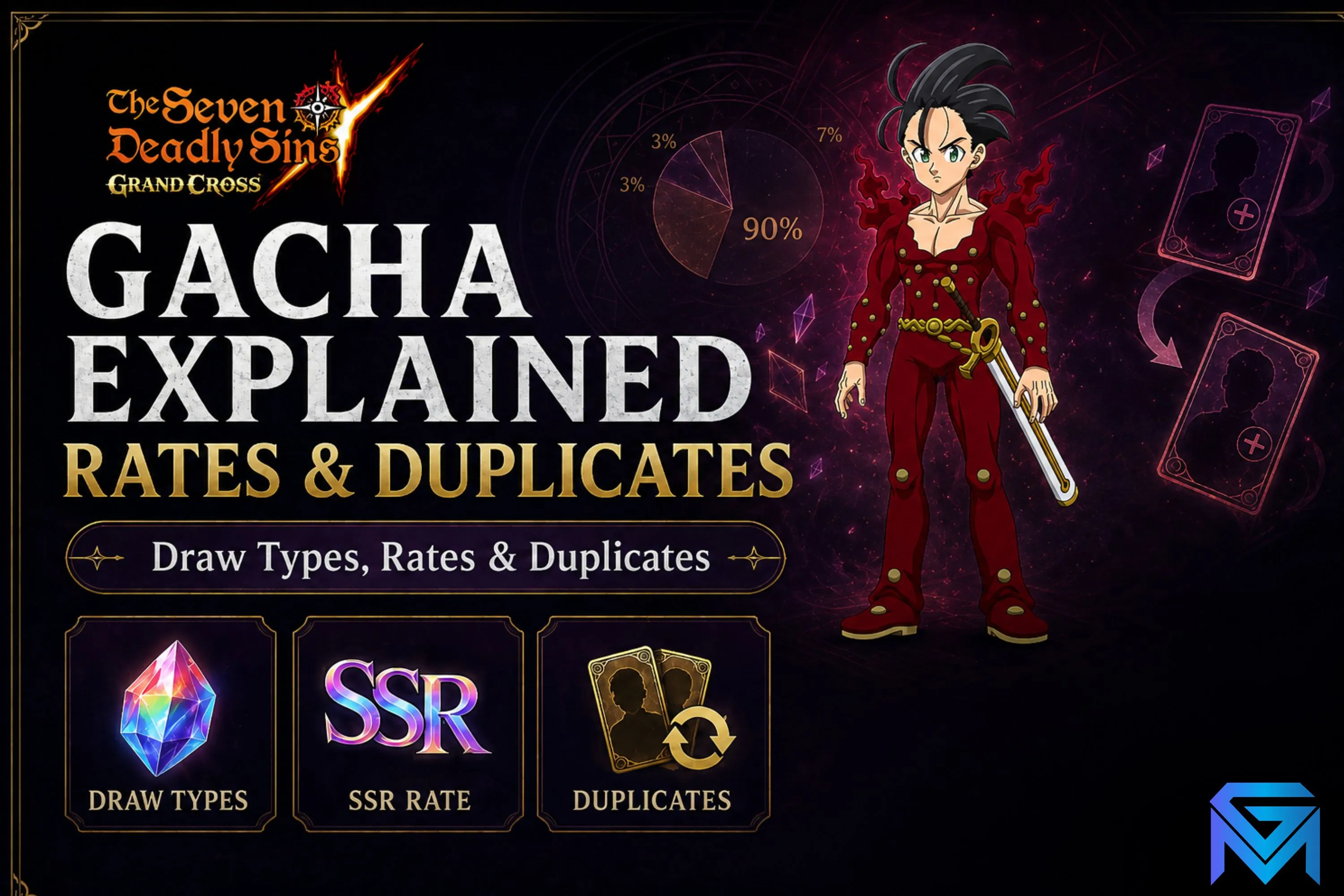
The gacha system in The Seven Deadly Sins: Grand Cross is a randomised hero draw funded mainly by Diamonds, where every pull rolls independently against fixed grade odds, a rate-up pool decides which units are boosted, and duplicates are never wasted because they convert into awakening progress and Hero Coins.
That single sentence hides a lot of moving parts. Netmarble's draw system layers several different banner structures on top of one core roll, and each layer changes what your Diamonds are actually buying: a chance at a specific unit, a guaranteed floor after enough attempts, or currency you can spend deterministically later. Understanding which layer you are pulling into is the difference between a roster that grows every festival and one that stalls at the same three SSRs for months. This guide breaks the system down mechanically — how a roll is resolved, what the grade tiers mean, how the pity structures behave, why duplicates matter more than most new players assume, and how to plan a Diamond budget around all of it.
How does a single draw actually get resolved?
Each draw is an independent random roll against the banner's published grade distribution. The game first decides the rarity you receive, then picks a unit from the pool available at that rarity, applying any rate-up weighting. Previous pulls do not change these odds except through explicit pity mechanics.
This independence is the part players most often misread. A run of ten R-grade heroes does not make the eleventh draw "due" for an SSR. The roll has no memory of what came before it; the only memory in the system lives in the counters the game shows you explicitly — the pity bar, the guaranteed-draw counter on certain banners, and the accumulating Hero Coin total. Everything else resets to the same probability on every single pull.
The pool matters as much as the rate. Two banners can advertise the same headline SSR percentage while behaving completely differently, because one restricts the SSR pool to a handful of festival units and the other spreads the same percentage across the entire standard roster. When the pool is wide, the chance of landing the specific hero you want is the SSR rate divided across dozens of candidates. When the pool is narrow or rate-up weighted, that same SSR rate concentrates on far fewer outcomes. Always read the featured list, not just the headline number.
Multi-draws are, mechanically, just a batch of single draws performed at once, with the important exception that many multi-draw packages attach a guarantee — a minimum grade somewhere in the batch, or a bonus item awarded per batch. The guarantee is what makes multi-draws the default recommendation on most banners, not any hidden improvement to the underlying per-roll odds.
What do the hero grades mean and how do they change value?
Grand Cross ranks heroes from R through SR, SSR and the later UR tier. Grade sets a hero's base stat ceiling and how far they can be developed, but it does not by itself decide usefulness — several SR-grade units remain fixtures in high-end teams because of their specific skill kits.
R and SR heroes arrive constantly from draws and events. Their practical role for most accounts is fodder and utility: they feed awakening, they fill early-game content, and a small number of them hold permanent roster spots thanks to unique debuffs or link abilities. Treating every R pull as a failure is the fastest way to misjudge the system, because the awakening economy depends on a steady flow of low-grade duplicates.
SSR is where the draw system's tension lives. SSR heroes carry the strongest kits, headline every festival banner, and are the units the rate-up mechanics are built around. Within SSR there is enormous spread — a limited festival SSR and a standard-pool SSR share a rarity label and very little else in terms of team impact. UR represents a further development ceiling reached through evolution rather than raw draws, which is why UR progression is usually discussed as an account-development topic rather than a gacha one. Our 7DS Grand Cross account progression breakdown covers how heroes and gear develop after they leave the draw screen.
The practical consequence for draw planning: grade tells you the ceiling, the kit tells you the value, and the banner tells you the availability. A player chasing raw SSR count will pull on whatever banner is cheapest. A player building a functioning team pulls only where the featured list contains units their roster is missing.
Which banner types exist and how do they differ?
Grand Cross runs several banner structures side by side: a permanent standard draw, rotating rate-up banners for individual heroes, festival banners that restrict the SSR pool to a curated set, and collaboration banners tied to limited crossover events. Each uses a different combination of pool size, pity behaviour and currency.
The standard draw is the widest pool and the least efficient way to chase a specific hero, but it is the backbone of the awakening economy because it feeds duplicates of common units. Rate-up banners narrow the odds toward one or two featured heroes while keeping the rest of the pool intact, which improves your chance of the target without guaranteeing it.
Festival banners are the structural outlier. By trimming the SSR pool down to a limited selection, they raise the effective chance of any individual featured unit far above what the same SSR percentage would deliver on a standard banner. This is why experienced players hoard Diamonds between festivals rather than spending them continuously — the same Diamond buys a materially better outcome inside a restricted pool.
Collaboration banners follow the festival logic but add availability pressure: crossover heroes are tied to a licensing window. It is accurate to say they are period-limited and that some have returned in later reruns; it is not accurate to promise that any specific collaboration unit will come back, and Netmarble does not commit to reruns in advance. Plan around the possibility of a return rather than the certainty of one.
A fifth category worth naming is the ticket-based or event-restricted draw, funded by event currency instead of Diamonds. These sit outside the normal budget entirely and should be treated as free rolls with their own pool — never as a substitute for saving toward a festival. For the detail behind that, see Gear Sets Explained Bonuses and Role Fits.
How do pity bars and guarantees change the maths?
Pity mechanics convert an unbounded random process into a bounded one. Instead of an open-ended losing streak, a pity bar fills with every draw and delivers a guaranteed outcome once it reaches its threshold, which caps the worst case a player can experience on that banner.
Two distinct guarantee shapes appear in Grand Cross, and confusing them is a common budgeting error. The first is a grade guarantee: after a set number of draws, the game promises a hero at or above a stated rarity. This protects you from getting nothing valuable, but it does not promise the specific unit you are chasing, because the guaranteed roll still selects from the banner's pool. The second is a selector or exchange guarantee, where accumulated draws or a dedicated currency let you claim a chosen hero outright. That second shape is the only one that removes randomness from the outcome.
Because pity is banner-scoped, progress usually does not carry between banners. A half-filled bar on an expiring banner is a sunk cost, which is why the decision to start pulling should be made with enough Diamonds banked to reach the threshold, not with whatever happens to be in the wallet. Working out the full cost — draws to threshold multiplied by Diamond cost per draw — before the first pull is the single most useful habit in the entire system.
Guarantees also interact with multi-draws. When a banner attaches a per-batch bonus or minimum, splitting your budget into single pulls sacrifices those bonuses for no gain in odds. Unless a banner explicitly rewards single draws, batching is strictly better.
Why are duplicate heroes valuable instead of wasted?
Duplicates are the system's built-in consolation economy. Pulling a hero you already own feeds that hero's awakening progression, raising their stat ceiling, and surplus duplicates convert into Hero Coins — a currency spent in a dedicated shop on units and materials you can choose deliberately.
This turns the gacha from a pure lottery into a slow deterministic accumulator running underneath the random one. Every draw that "fails" to produce a new SSR still moves two counters forward: awakening material for units you own, and Hero Coin balance you can eventually spend on a specific target. Over a long enough horizon, a patient player converts bad luck into a chosen hero.
Awakening is where most duplicate value lands. Raising a hero's awakening level increases their base stats meaningfully, and for units you actually field, an awakened copy of a mid-tier hero frequently outperforms an un-awakened stronger one. New players routinely underrate this and chase breadth — many heroes at low investment — when depth on a functional team clears content faster.
The Hero Coin shop rewards the opposite discipline: patience. Because the shop stock rotates and coins accumulate slowly, the correct play is usually to hold coins for a unit that meaningfully changes your roster rather than spending them on the first SSR that appears. Treat the coin balance as a savings account with a deliberate withdrawal, not as loose change. Our guide breaks down Diamond Spending Priority What to Buy First.
How should Diamonds be budgeted across the draw calendar?
Effective budgeting means treating Diamonds as a reserve spent in planned blocks rather than a trickle. Calculate the full pity cost of a target banner, bank that amount before pulling, and skip banners whose featured list does not fill a genuine gap in your roster.
Diamonds arrive from a wide range of sources — story progression, daily and weekly tasks, event completions, achievement milestones and periodic distributions — which means income is fairly predictable over a month even though it feels slow day to day. That predictability is what makes planning possible: if you know roughly what a month produces, you know how many festival banners a year you can genuinely commit to.
The most common budgeting mistake is banner-by-banner reactivity. Spending a few thousand Diamonds on every rate-up as it appears distributes your income across many low-value outcomes and leaves nothing banked when a festival or collaboration you actually care about arrives. The alternative discipline is simple: define one or two priority windows in advance, ignore everything else, and let the reserve build.
A second, subtler mistake is ignoring the free draw channels. Event tickets, login rewards and campaign draws all produce rolls at zero Diamond cost, and they contribute duplicates and Hero Coins on the same terms as paid rolls. Clearing those consistently raises your effective draw count without touching the reserve. If you are still establishing the basic routine, the 7DS Grand Cross beginner's guide to heroes, Diamonds and teams lays out where those recurring rewards come from.
How should you read published rates without misinterpreting them?
Published rates describe the probability of a single roll, not the outcome of a session. A stated SSR rate applies identically to your first draw and your hundredth, and the chance of the specific featured hero is always lower than the headline SSR figure once the pool is accounted for.
The useful mental conversion is from per-roll probability to cumulative probability. Repeated small chances accumulate, but far more slowly than intuition suggests, and they never reach certainty without a guarantee. This is precisely why the pity threshold — not the advertised rate — should anchor your budget. The rate tells you what a lucky outcome looks like; the pity threshold tells you what the worst case costs.
Rate details are published in-game on each banner's information screen, and Netmarble's official announcements carry the featured lists and any banner-specific guarantee terms. Because these values and structures change between banners and can be adjusted across regional versions, the in-game notice attached to the banner you are actually pulling on is the authoritative source — not a number remembered from a previous festival.
Finally, be sceptical of outcome-based reasoning shared in communities. Screenshots of early SSRs and long dry streaks are both entirely normal products of independent rolls, and neither reveals anything about a banner's true rates. The published table and the pity counter are the only two numbers that carry information.
What are the most common gacha mistakes in Grand Cross?
The recurring errors are structural rather than tactical: pulling without enough Diamonds to reach pity, spreading a budget thinly across every rate-up, dismissing duplicates as waste, and chasing rarity instead of the specific kits a team composition is missing.
Starting a banner underfunded is the most expensive of these, because it converts a bounded cost into an unbounded one. If you cannot reach the guarantee, you are buying raw probability with no floor — the exact scenario the pity system exists to prevent.
Roster-blind pulling is the second. Grand Cross teams are built on link skills, attribute matchups and debuff coverage, so a fourth SSR damage dealer often contributes less than the awakening levels the same Diamonds could have supported. Auditing what your team cannot currently do — sustain, break, specific debuffs — before opening the draw screen produces better decisions than any rate table.
Third is ignoring the deterministic layer entirely. Players who never check their Hero Coin balance or awakening progress are effectively playing only the random half of a system that was designed with a guaranteed half attached.
Frequently asked questions
Do the odds improve the longer I go without an SSR? No. Each roll is independent and rolls against the same published rate. The only mechanic that improves with draw count is the explicit pity or guarantee counter shown on the banner.
Are multi-draws better odds than singles? The per-roll odds are the same. Multi-draws are usually better because many banners attach a guaranteed minimum grade or a bonus item to each batch, which single pulls forfeit.
Does pity carry over to the next banner? Generally no — pity is tracked per banner and does not transfer, which is why you should only start pulling with enough Diamonds banked to reach the threshold on that banner.
Should I pull on the standard banner or wait for a festival? For chasing a specific strong unit, waiting is usually better, because festival banners restrict the SSR pool and concentrate the same rate onto fewer possible outcomes.
What happens to a duplicate hero I do not need? Duplicates feed awakening progression for that hero, and surplus copies convert into Hero Coins that can be spent deliberately in the Hero Coin shop.
Where to Find 7DS Grand Cross Accounts and Top Up
On GameMarket.gg you can browse 7DS Grand Cross accounts on GameMarket, the 7DS Grand Cross market hub.
If your roster planning has reached the point where Diamond income is the bottleneck, you can review the current 7DS Grand Cross top up listings on GameMarket.gg, or browse the wider 7DS Grand Cross guide hub for the rest of the series.
GameMarket.gg is a trusted digital marketplace for everything gaming-related. We serve the gaming community by providing secure access that enhances every gaming journey.