7DS Grand Cross Costumes Guide: Stats, Sources & Enhancing
By John Ganang 27 August 2026, 12:00 WIB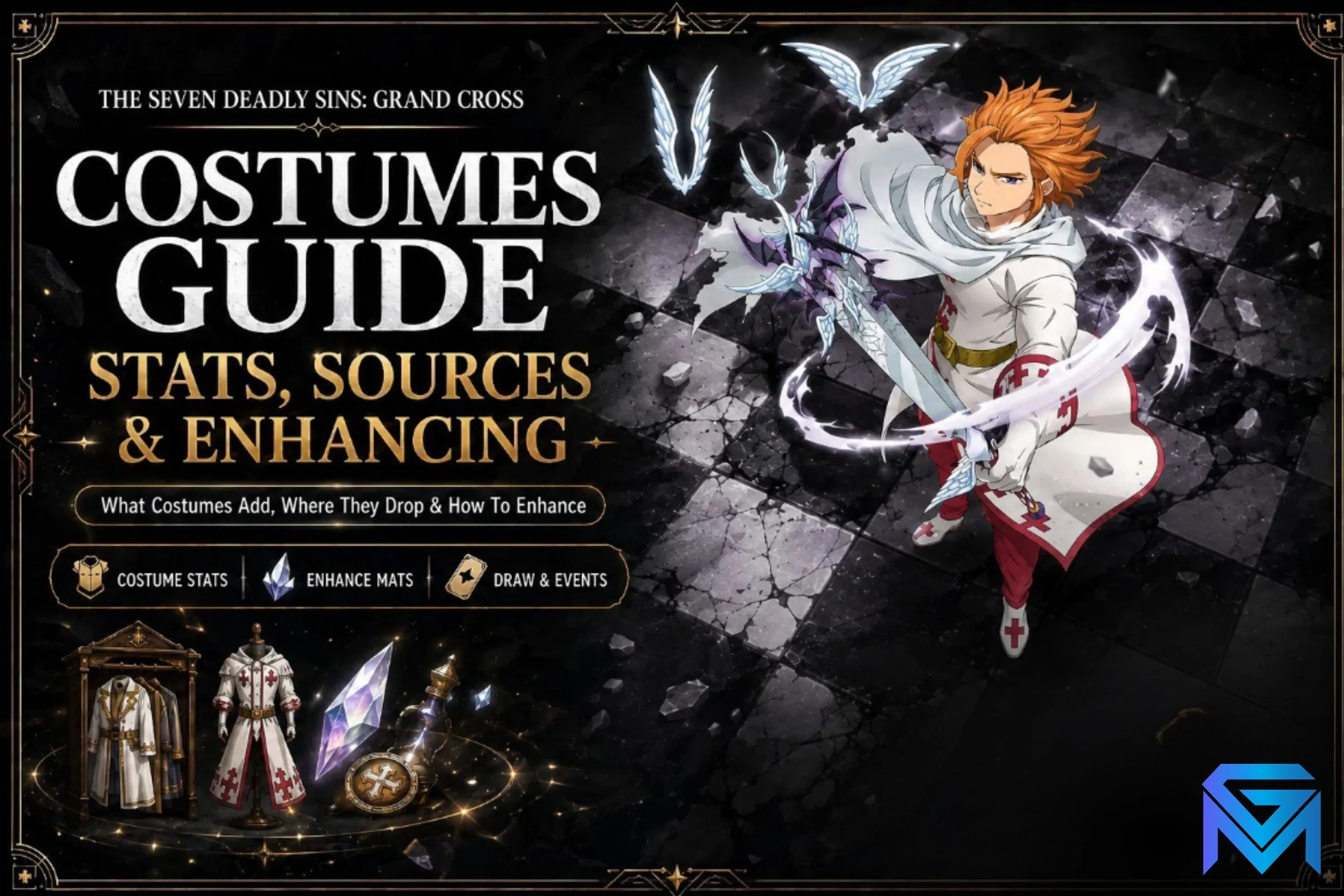
Costumes in 7DS Grand Cross are not cosmetics. They are a permanent stat system: every costume you unlock feeds a shared pool, and the five you register in each of the three categories add their bonuses together on top of your hero's gear. That makes your closet one of the few power sources in the game that never resets and never gets replaced. If that part matters to you, 7DS Grand Cross Cooking Guide goes deeper.
Most players discover this backwards. They chase gear rolls for weeks, watch their Combat Class stall, then find out that the outfits sitting unregistered in their closet were worth thousands of CC the whole time. Gear is a ceiling you fight for; costumes are a floor you build. Understanding which costumes count, how the closet is shared between hero variants, and which of the three categories to enhance first is the difference between a roster that plateaus at midgame and one that keeps climbing. Because a closet like this is a large part of what separates a PvP-ready roster from a PvE-ready one, our breakdown of PvP versus PvE account builds shows where costumes fit in.
What are Costumes in 7DS Grand Cross?
Costumes are equippable stat items split into three categories: Outfit, Weapon, and Cosmetic. Each hero can register up to five costumes per category, and all five contribute their bonuses at once. Unlike gear, costume bonuses are additive and permanent, so a registered costume never stops paying out.
The categories are defined by what they occupy on the model rather than by what they do. Outfits are body pieces: dresses, robes, armour sets. Weapons are what the hero holds, which for a caster like Merlin means her orb rather than a blade. Cosmetics cover the head and face, so hats, hairstyles, and glasses. Mechanically the three behave identically, but they enhance at different rates and different costs, which is why the split matters more than it first appears.
The critical detail is registration. Owning a costume does nothing on its own; you have to register it into one of the five slots for that category before the stats apply. Because the bonuses stack rather than compete, there is no build decision here in the usual sense. You are not picking the best costume, you are filling all fifteen slots with the highest grade you can, and grade runs SR, SSR, then UR at the top.
How does the shared closet between hero variants work?
Every variant of the same character shares one closet. Red Gowther, Green Gowther, Blue Gowther, and Green Halloween Gowther all draw from the same pool, so a costume unlocked on any one of them is registrable on all of them. This single rule is what makes costume farming viable for free-to-play accounts.
It matters because of how the game hands out costumes on Limit Break. Each time you Limit Break a hero to a new grade, that hero gives you a costume of the matching grade. Taken alone that is slow. Taken across a shared closet it compounds, because Limit Breaking four different Gowther variants to UR produces four UR costumes that any Gowther can register. A character with many released variants therefore reaches a full closet far faster than a character with one.
That changes how you read your own roster. A duplicate variant you would otherwise write off as filler is a costume source for the unit you actually play, so the dupes sitting in your box are not dead weight. It also means investment in a character with deep variant coverage compounds in a way that investment in a one-off unit does not, which is worth knowing before you commit Limit Break materials. If you are still getting your bearings on how heroes, grades, and Limit Break interact, the 7DS Grand Cross beginner's guide to heroes, Diamonds and teams covers the progression layer this system sits on top of.
Where do Costumes actually come from?
There are four reliable sources: the Sacred Treasure Shop, Limit Breaking heroes, the Vaizel Fight Festival Shop, and maxing a hero's Affinity. Two of those cost currency and two cost only time, which means a patient account can fill most of a closet without spending anything.
The Sacred Treasure Shop is the paid route and the broadest one. It runs four sections, covering Events, Weapon, Outfit, and Cosmetics, and it stocks SR, SSR, and UR costumes. Which sections rotate, and what each event currency actually buys, is broken down in our 7DS Grand Cross event guide to event types, currencies and exchange shops. Everything in it requires either money or Diamonds, so it is the fastest path and the most expensive one. The event section is the part worth watching, because limited costumes rotate out and, unlike gear, a costume you miss is not farmable later. For the detail behind that, see Gear Sets Explained Bonuses and Role Fits.
Limit Breaking is the backbone of a free account's closet, for the reason covered above: it converts variants you already own into permanent stats on the variant you play. The Vaizel Fight Festival Shop is the PvP route, and it is gated by tier rather than by luck. Fight Festival Coins buy Weapon costumes, with Gold tier unlocking SR, Platinum unlocking SSR, and Master unlocking UR. That is a genuinely strong free source of UR weapons, but it demands a PvP team that can hold Master, so it rewards accounts that have already invested in a competitive roster rather than accounts just starting out.
Affinity is the slowest and the most universal. Take any hero to Affinity level 5, the maximum, and that hero hands over a costume, usually a Weapon or a Cosmetic. These are always SSR rather than UR, so they are not an endgame answer, but they are free, they apply to every hero in the game, and they fill slots that would otherwise sit empty while you save toward better pieces. An SSR in a registered slot beats a UR you do not own yet.
How does Costume Enhancement work, and what does it cost?
Enhancement raises a costume's main stat and can raise its grade, with UR as the cap. It unlocks after Chapter 8, once Hell difficulty Death Matches become available, and it consumes both Gold and category-specific materials. Only the main stat is enhanced, so substats stay fixed at whatever the costume rolled.
Each category consumes its own material. Outfits need Splendid Fabric, Weapons need Brilliant Component, and Cosmetics need Alluring Perfume. All three drop from Death Matches, with Hell difficulty as the primary source and costume materials also appearing in the Gold reward chest on Extreme difficulty. Clearing Death Matches also awards them through the periodic daily tasks, which are the highest-value pickup in the system because the reward is large relative to the stamina spent.
The costs diverge sharply by category, and this is where most of the real decision-making lives:
- Cosmetics: 3.33% growth per upgrade, 50,000 Gold per upgrade, 30 materials to max
- Outfits: 2% growth per upgrade, 10,000 Gold per upgrade, 50 materials to max
- Weapons: 1.67% growth per upgrade, 20,000 Gold per upgrade, 60 materials to max
Read those numbers together and the priority order falls out on its own: Cosmetics, then Weapons, then Outfits. Cosmetics give the most growth per upgrade and need the fewest materials to finish, so they convert a scarce resource into Combat Class faster than anything else, even though they are the most Gold-hungry per step. Outfits are cheap in Gold but need 50 materials for the weakest growth rate, which makes them the last thing you should be pouring Fabric into while your Perfume sits unspent.
One further rule shapes where the materials go. You can now enhance a low-grade costume up to UR, taking an SSR the whole way, but it costs considerably more to max out than a natural UR does. Natural URs need fewer materials for the same finish. So if materials are your bottleneck, enhance natural URs first and treat SSR-to-UR conversion as a project for pieces you are certain you will keep long term, since only registered costumes pay stats and an enhanced piece sitting outside the five slots is wasted investment. Our guide breaks down Combat Guide Card Ranks, Combos and Ultimate Moves.
What are Costume Set Bonuses, and are they worth chasing?
Some costumes belong to a set, and completing the set grants an effect beyond the additive stats. These are typically holiday or collaboration releases, and the bonus can change a hero's Ultimate Move effects or award extra materials from specific content, which puts them in a different category from ordinary closet filler.
Gowther's Cat Witch set is the clearest worked example. It consists of the Cat Witch Outfit, The Witch's Cat, and Dreameater Cat, and completing it changes the Ultimate Move effects at SSR starting grade while also granting one additional Anvil when clearing Fort Solgres stages. That Anvil bonus is capped at ten activations per day, and if two heroes carry duplicate set effects only the one furthest to the left activates, so stacking the same set across a team does not multiply the reward.
The acquisition path for that set also shows why timing matters more than planning here. The outfit came from evolving Green Halloween Gowther to UR, while the weapon and cosmetic were bought from a collaboration exchange shop. Once that collaboration ended, the straightforward route closed. Limited costumes behave like limited banners: some return through reruns and some do not, and Netmarble does not commit to a schedule, so treat a set you want as available now rather than available later.
Whether to chase one depends on what the effect actually does. A set that changes an Ultimate Move on a hero you play daily is a real upgrade; a set that grants a material bonus on content you have already outgrown is not. Because the underlying stat bonuses stack into the shared closet regardless, you are never wasting the pieces, but you should not spend event currency on a set purely for the set bonus without checking that the effect applies to something you still run.
How should you prioritise costumes across your roster?
Spread wide before you go deep. Filling empty registered slots with SSR costumes across your main team returns more Combat Class than perfecting one hero's closet, because an empty slot contributes zero while even an unenhanced SSR contributes something. Only once the slots are full does enhancement become the better use of resources.
That ordering follows from how the system pays out. Fifteen slots per hero, three categories of five, means the gap between a half-filled closet and a full one is large and purely a matter of ownership rather than investment. Affinity costumes and Limit Break costumes cost no materials at all, so the first phase of costume progression is really a farming and roster-management problem, not a spending one. This is also why costume power tends to arrive in steps rather than smoothly, since it tracks how many variants and Affinity maxes you have accumulated.
Once slots are full, concentrate enhancement rather than spreading it. Materials are the binding constraint, and the priority order established above applies within a single hero before it applies across several: take one frequently-used hero's Cosmetics up, then that hero's Weapons, then move on. Because the closet is shared across variants, that investment follows the character rather than the specific unit, so it survives a meta shift that pushes you from one variant to another. Spreading a limited Perfume stock thinly across six heroes leaves all six under-enhanced and none of them meaningfully stronger.
The one exception is a hero you are still deciding about. Enhancement materials do not refund, and grade conversion from SSR to UR is expensive, so hold that investment until the hero has earned a permanent place. Costumes are the part of your account that compounds quietly over months, which is exactly why they reward patience over reaction; that is also why endgame 7DS Grand Cross accounts tend to show deep closets rather than just headline units, since a full closet is the one thing that cannot be rushed in a week.
What do players most often get wrong about Costumes?
The three recurring mistakes are leaving costumes unregistered, enhancing Outfits first because they are cheap in Gold, and skipping the Death Match daily tasks. Each one quietly costs Combat Class over months rather than visibly failing, which is why they persist so long on otherwise well-built accounts.
Unregistered costumes are the most common and the most costly, because the fix is free. Players unlock a costume through Limit Break or Affinity, see it added to the closet, and never open the registration screen. The stats simply do not apply until you place the piece into one of the five slots, so an account can be carrying a dozen dormant costumes while wondering why its Combat Class trails accounts with similar gear. Audit the closet on your main team first; it is the fastest CC you will ever gain.
The Outfit trap is subtler and comes from reading only half the cost table. Outfits enhance for 10,000 Gold a step against 50,000 for Cosmetics, so they look like the efficient choice, but they deliver 2% growth against 3.33% and demand 50 materials against 30. Since materials gate progress far harder than Gold does on most accounts, optimising for the Gold column means burning your scarcest resource on your weakest return. The right instinct is to spend Gold freely and materials carefully, not the reverse.
Skipping Death Match dailies compounds both problems, because those tasks are where the materials come from and they are deliberately generous relative to the stamina they cost. An account that runs Death Matches only when it needs something specific will always feel material-starved, which then pushes it toward the cheap-Gold Outfit route and back into the same trap. Running the daily tasks consistently is what turns the closet from a stalled system into a steadily growing one, and because the closet never resets, that consistency pays out for as long as the account lives.
Where to Find 7DS Grand Cross Accounts and Top Up
On GameMarket.gg you can midgame 7DS Grand Cross accounts, and compare 7DS Grand Cross top-up options before you spend, and endgame 7DS Grand Cross accounts.
If you would rather start from an account that already has the closet depth, variant coverage, and Affinity work behind it, browse the available 7DS Grand Cross accounts on GameMarket.gg, or begin with the starter 7DS Grand Cross accounts if you want a clean base to build your own closet on.
GameMarket.gg is a trusted digital marketplace for everything gaming-related. We serve the gaming community by providing secure access that enhances every gaming journey.