7DS Grand Cross Gear Sets Explained: Bonuses and Role Fits
By John Ganang 15 September 2026, 12:00 WIB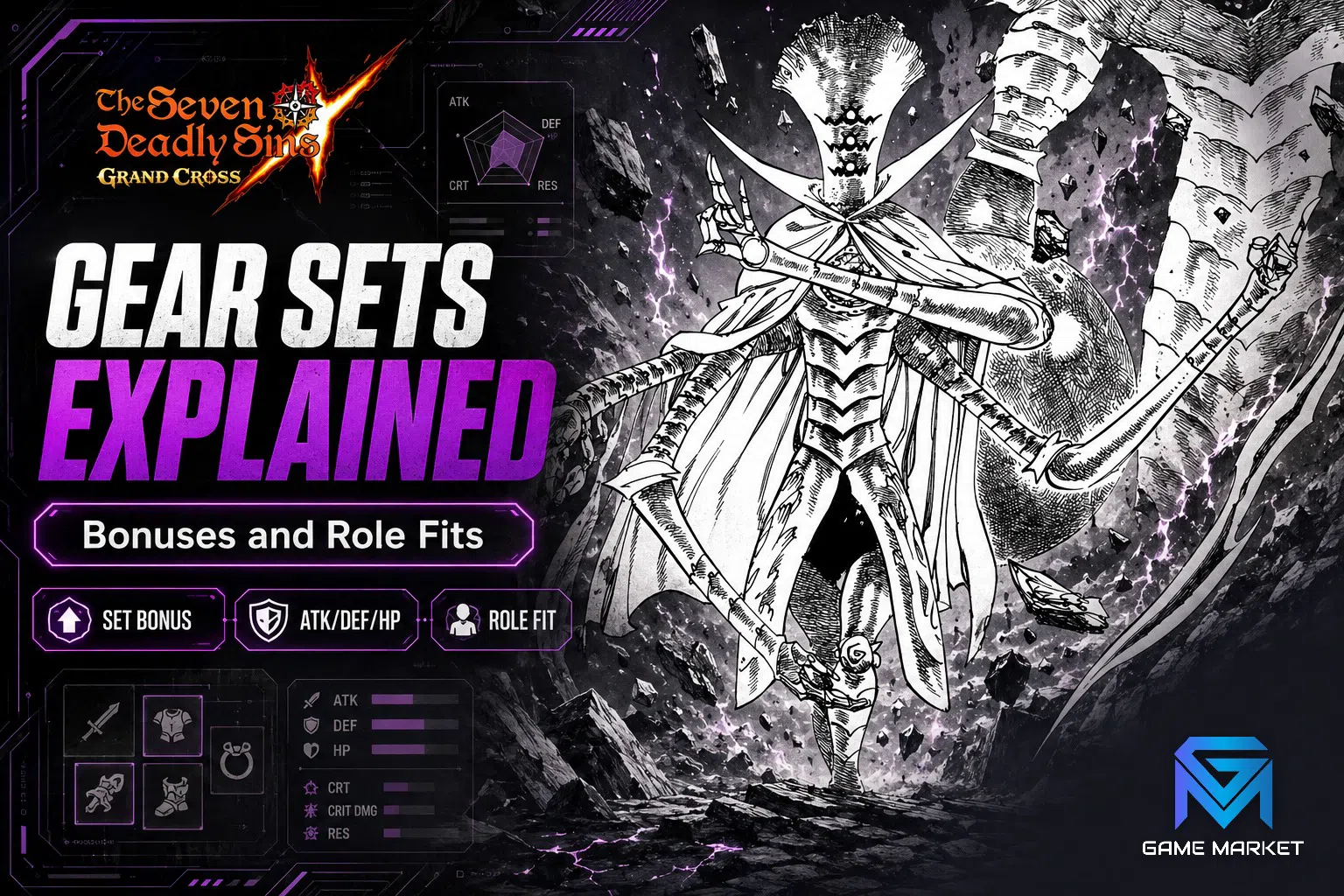
Gear sets in The Seven Deadly Sins: Grand Cross are decided by three matching pieces, and every hero wears six slots, so each hero runs two set bonuses at once. That two-by-three structure is the whole game: you are not hunting one perfect item, you are assembling two complete triples that suit what the hero is asked to do.
What does a gear set actually do?
A set bonus activates when a hero has three pieces of the same set equipped, and it applies a percentage boost to one stat or behaviour. Because six slots divide cleanly into two triples, a fully geared hero always carries exactly two active set bonuses, never one and never three.
That fixed arithmetic is what makes gear planning in this game different from games where set pieces stack in twos and fours. There is no partial credit: two pieces of a set do nothing at all, and four pieces of a set do exactly what three do, with the fourth piece contributing only its own main stat. So the question is never "how close am I to a set" but "which two sets is this hero running".
The consequence for farming is that gear arrives in useful units of three. A single excellent drop is only excellent once you own two more of the same set at a comparable rarity, which is why players who chase individual high-roll pieces stall while players who bank toward complete triples keep moving. If you are still working out how gear sits alongside the other power levers on an account, the 7DS Grand Cross account progression guide covering heroes and gear maps the full Combat Class picture; this article stays on the sets themselves.
Which set bonuses matter most, and what do they change?
The commonly used sets cover Attack, Defence, HP, Crit Chance, Crit Damage, Pierce Rate, Resistance, Lifesteal, Regeneration and Stun Resistance. Offensive sets raise a damage input directly, defensive sets raise survivability, and the utility sets change how reliably a hero lands or resists an effect rather than how hard they hit.
Crit Chance and Crit Damage deserve to be understood as a pair rather than as two separate options, because they multiply each other. Crit Damage on a hero whose crit rate is low is largely dead weight, so the usual progression is to secure a workable crit rate first and only then convert into Crit Damage. That ordering explains why so many established PvP builds run a crit-oriented triple alongside an Attack triple instead of doubling down on raw attack.
Pierce Rate and Resistance are the same relationship viewed from opposite sides of a fight. Pierce increases the chance an attack ignores the target's defensive reduction, while Resistance reduces the chance of being pierced, which is why both appear so often in competitive PvP builds and so rarely in early PvE ones. Against story content with predictable enemies you can usually skip them; against other players, whose builds are unpredictable, they change outcomes.
Lifesteal, Regeneration and Stun Resistance are situational by design. Lifesteal turns damage output into sustain, which is valuable on long boss fights where no healer is present, and close to worthless on burst-clear farming teams that end fights in two turns. Netmarble has expanded the set roster over the years through updates, so treat any list of sets as a snapshot and confirm the current options in the gear menu before committing materials.
How do main stats and set bonuses interact on the same piece?
Every piece carries a main stat that is rolled at drop and a set identity that is fixed at drop. They are independent: an Attack-set piece can roll an HP main stat, and a Defence-set piece can roll crit damage. Both halves need to be right before a piece is worth investing in.
This is where most wasted material goes, because the two attributes are easy to conflate. A hero running an Attack triple whose three pieces all rolled defensive main stats gains the set percentage but almost none of the raw offence the build was supposed to produce. The set bonus is a multiplier on a number the main stats are supposed to supply, so a set without the matching main stats multiplies something small.
In practice you filter twice. First by set, because that determines which triple the piece can ever join, and second by main stat, because that determines whether the piece pulls its weight inside that triple. A drop that fails either filter is salvage material, not a candidate, and treating it as salvage immediately is what keeps an inventory readable.
Which sets fit each hero role?
Attackers generally run an offensive triple plus a crit triple; tanks run HP and Defence; supports and debuffers usually want survivability plus whatever stat makes their effect land. Role, not rarity, decides the pairing, because a set that does nothing for a hero's job is CC on paper only.
For a damage hero the standard shape is Attack plus Crit Chance while crit rate is still low, then Attack plus Crit Damage once crit rate is comfortable from other sources. Because the two crit stats multiply, the switch point is not a matter of taste; it is the moment where adding crit damage returns more than adding crit chance, and that moment arrives earlier on heroes whose kits grant crit rate themselves.
Tanks and front-line heroes invert the logic. Their job is to survive long enough for the team's damage to land, so HP and Defence triples do more than any offensive set would, and Resistance becomes attractive the moment the hero is expected to hold up in PvP. A tank that dies early costs the team far more than the damage a mis-set attacker fails to deal.
Support and debuff heroes are the ones most often geared wrong. Their value is in an effect landing rather than in a number growing, so they want enough bulk to survive the first exchange plus the stat that supports their specific mechanic. Gearing a debuffer as a miniature attacker is a common way to end up with a hero who neither survives nor contributes.
How does gear rarity change what a set costs to run?
Rarity does not change which set bonus a piece grants, but it changes the size of the main stat and, more importantly, the cost of enhancing and awakening the piece. Higher-rarity gear scales further and costs disproportionately more to raise, which makes rarity a budgeting decision rather than a straight upgrade.
The practical effect is that a complete, properly enhanced set at a lower rarity routinely outperforms a scattered collection of high-rarity pieces that nobody could afford to raise. Because enhancement materials are the true bottleneck rather than drops, the account that finishes cheap triples on its core team clears content sooner than the account hoarding unenhanced premium pieces for a build it has not yet funded.
That also shapes when to jump rarity tiers. Moving a hero to a higher-rarity set is worth doing when you can fund all three pieces to a similar enhancement level, and not before, since a triple where one piece lags acts like a triple built at the lower piece's level. Half-finished upgrades are the most expensive mistake in the gear economy because the materials are spent but the payoff has not arrived.
Where does usable gear actually come from?
Gear enters an account from repeatable stage content, boss and raid rewards, event exchanges, and the shops that sell pieces or gear tickets for earned currency. None of these are gated behind pulling, which is why gear is one of the few power systems a patient free-to-play account can fully close.
Because the supply is broad but the useful fraction is narrow, the limiting resource is rarely drops and almost always the stamina and materials to convert drops into finished pieces. This is the same budgeting problem that governs the rest of the account, and it is why gear farming rewards a target list. Deciding in advance which two triples each of your five or six core heroes needs turns an endless grind into a finite shopping list.
Salvaging is the other half of the supply chain and is consistently underused. Pieces that fail the set filter or the main-stat filter are worth more broken down into materials that fund the pieces you are actually building than kept in an inventory you will never open. Netmarble's own gear menus surface the salvage return before you confirm, so the decision is always visible.
How do you decide when to replace a set you already built?
Replace a set when the hero's job changes or when you can fund all three replacement pieces to the enhancement level the current triple already sits at. A partial swap breaks the existing bonus immediately while the new one is not yet paying, so the account gets weaker before it gets stronger.
The cleanest trigger is a role change. A hero moved from general PvE clearing into a PvP line-up genuinely needs different sets, because Pierce and Resistance start mattering where they previously did not, and that justifies rebuilding. A hero who is simply a little stronger elsewhere rarely justifies it, because the materials would have bought more Combat Class somewhere else on the account.
The second trigger is a crit threshold. Once a damage hero's crit rate is reliably high from kit, food and other sources, the Crit Chance triple has stopped scaling and swapping it for Crit Damage converts a stat that has plateaued into one that has not. That specific swap is worth planning for in advance so the replacement pieces are already banked when the threshold arrives.
How do set priorities change between PvE and PvP?
PvE fights are against known enemies with fixed patterns, so sets that raise raw throughput win. PvP is against builds you cannot see in advance, so sets that protect against variance, chiefly Pierce Rate and Resistance, start earning their slots even though they add no damage on paper.
In repeatable PvE content the enemy's defensive numbers are effectively a constant, which means you can gear purely for the fastest clear and never think about the opponent's build again. Boss and raid content shifts that slightly, because fights last long enough for sustain to matter, and that is where Lifesteal or Regeneration on a hero expected to survive many turns can outperform another point of attack.
PvP inverts the calculation because the person on the other side is optimising against you. A build that ignores Resistance is fine until it meets a heavily pierce-focused opponent, at which point the defensive investment that looked wasted becomes the reason the fight is winnable at all. This is why competitive players commonly maintain separate gear loadouts rather than one universal set, and why the same hero can look correctly geared in one mode and clearly wrong in the other.
Which gear-set mistakes cost accounts the most progress?
The four expensive mistakes are gearing by rarity instead of by role, enhancing pieces before a triple is complete, ignoring main stats while chasing set names, and spreading gear across a wide bench instead of finishing a small core. Each one spends real materials for very little Combat Class.
Spreading is the quietest of the four because it feels productive. Every hero on the roster ends up wearing something, the account-wide numbers creep up, and yet nothing clears, because content checks the strength of the team you actually field rather than the average across everyone you own. Finishing two complete triples on five heroes beats putting four decent pieces on twenty.
The counterweight to all four is a written plan. Choosing the two sets and the main-stat priorities for each core hero before farming turns every drop into an immediate keep-or-salvage decision, and it stops the slow drift where materials go wherever the last good drop happened to land. Gear is the most controllable system in the game precisely because none of it depends on luck at the banner.
If your account has hit a Combat Class wall that gear alone cannot close, you can browse available 7DS Grand Cross accounts on GameMarket.gg, or explore the wider The Seven Deadly Sins: Grand Cross marketplace hub to see what is currently listed. New players who want the ground-floor version of every system first should start with the 7DS Grand Cross beginner's guide to heroes, diamonds and teams.
GameMarket.gg is a trusted digital marketplace for everything gaming-related. We serve the gaming community by providing secure access that enhances every gaming journey.