HSR Warp Pity Explained: Soft Pity, 50/50 and Guaranteed Pulls
By John Ganang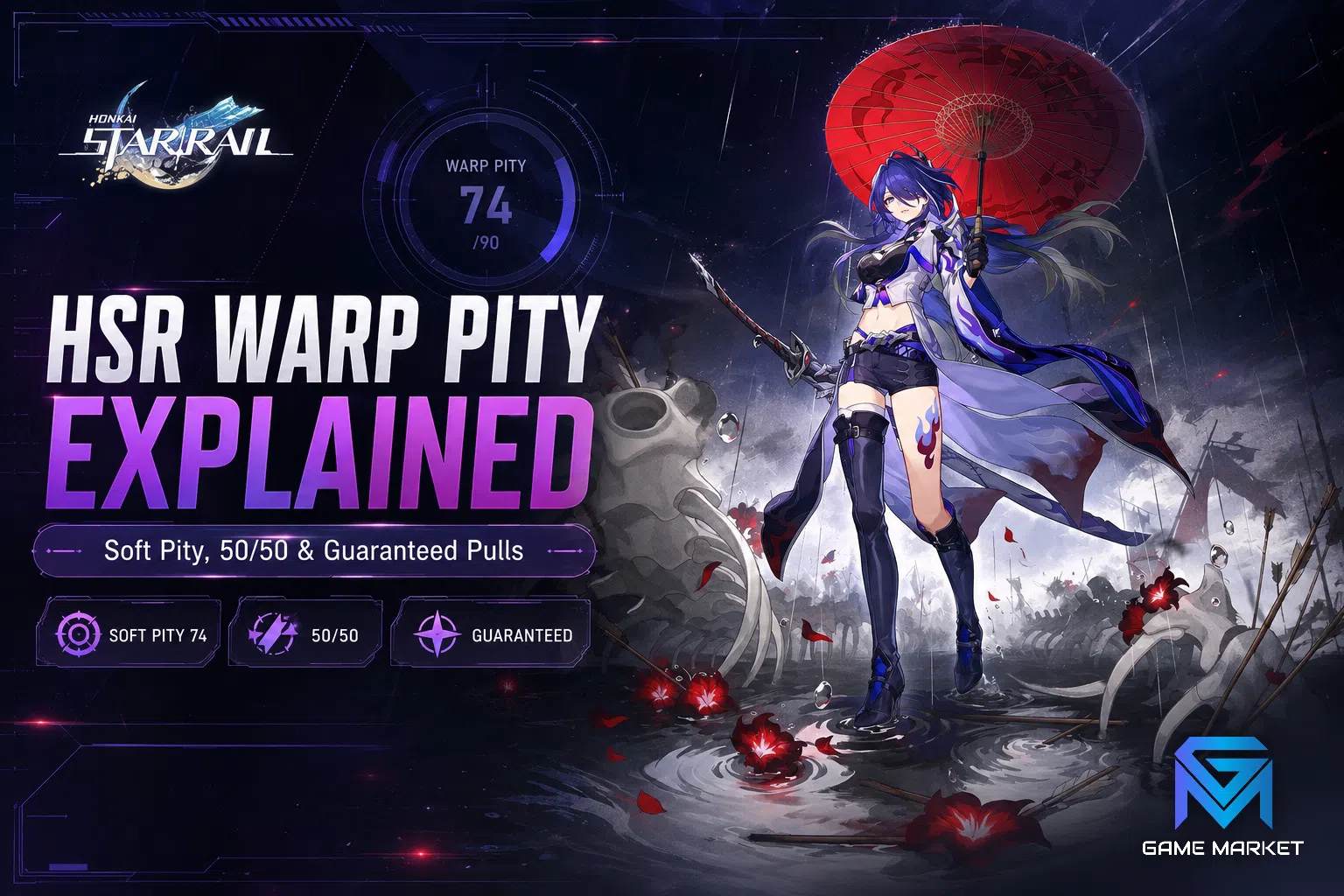
Warp pity in Honkai: Star Rail is a hidden counter that guarantees a 5-star once you reach a fixed number of pulls on a banner. On the Character Event Warp a 5-star is guaranteed within 90 warps, the odds spike sharply from roughly the 74th warp, and if that 5-star is not the featured character, the very next 5-star on that banner type is.
That single sentence hides most of what actually decides whether a Stellar Jade balance turns into the character you wanted. Pity is not one counter but several, running in parallel and on different rules: a 5-star counter, a 4-star counter, a featured-character flag, and a completely separate set of counters for Light Cone banners and the standard pool. Understanding which counter carries over, which one resets, and where the real probability curve bends is the difference between planning a patch and hoping for one. This guide breaks down every layer of the system as HoYoverse documents it in the in-game warp details, then shows how to turn those numbers into a pull plan.
What is pity in Honkai: Star Rail warps?
Pity is a guarantee counter attached to each warp banner type. Every warp increments it; pulling a 5-star resets it to zero. Once the counter reaches the banner's hard limit — 90 on character banners, 80 on Light Cone banners — the next warp is a guaranteed 5-star.
HoYoverse does not display this counter directly on the banner screen, but it is fully documented in the "Details" panel each banner carries, and your warp history records every pull for the last six months. Counting back from your most recent 5-star in the history log tells you exactly where you stand.
The base advertised rate for a 5-star on the Character Event Warp is 0.6%. That number alone is misleading, because the game also publishes a consolidated rate of roughly 1.6% — the average rate once the guarantee mechanism is factored across a full cycle. The gap between 0.6% and 1.6% is entirely produced by pity. In practice almost nobody wins a character at the advertised rate; the overwhelming majority of 5-stars arrive in a narrow band near the end of the counter.
Pity is also per banner type, not per character. A counter built up on one featured character's banner carries directly to the next character banner when the patch rotates. Nothing is lost when a banner ends — only the featured character changes. This is the single most important structural fact in the system, and it is what makes long-term saving viable.
How does soft pity change your 5-star odds?
Soft pity is the point where the 5-star rate stops being flat and begins climbing steeply. On the Character Event Warp this begins at approximately warp 74 of the counter, and each subsequent warp carries a dramatically higher chance than the 0.6% base until the hard guarantee at 90.
This ramp is not officially published as a per-pull table, but it is the only way the advertised 0.6% base rate and the ~1.6% consolidated rate can both be true, and community datamining across millions of logged pulls has consistently placed the inflection in the low-to-mid 70s. The practical consequence is what matters: the region between warp 74 and warp 90 is where the large majority of 5-stars actually land.
Two planning conclusions follow. First, the expected cost of a 5-star is meaningfully lower than the hard pity of 90 — most accounts average somewhere in the mid-70s per 5-star across a long sample. Second, a counter sitting at 60 is far more valuable than twice a counter sitting at 30, because the value is concentrated at the top of the curve. Half a pity is worth much less than half of a 5-star.
This is also why partial saving is a trap. Stopping a session at warp 70 because the jade ran out leaves you in the most expensive possible position: you have paid for almost all of the counter and captured none of the ramp. If a banner is a genuine target, the amount to budget is the amount that reaches 90 from your current counter, not a round number of pulls.
What is the 50/50 and how does the guarantee work?
The 50/50 is the second layer. When a 5-star drops on the Character Event Warp, there is a 50% chance it is the featured character and a 50% chance it is a random 5-star from the standard pool. Losing that roll sets a guarantee flag: your next 5-star on any character event banner is 100% the featured character.
The guarantee flag, like the pity counter, persists across banner rotations. If you lose a 50/50 in one patch and stop pulling, you enter the next character banner already guaranteed. Many experienced players deliberately treat a lost 50/50 as an entry ticket to the next character rather than a reason to keep spending on the current one.
The standard-pool characters that can steal a 50/50 are the permanent 5-stars — the roster available on the Stellar Warp. They are not wasted pulls in any real sense: standard 5-stars are durable, often fill roles that rotate back into relevance, and their duplicates convert into Undying Starlight. But they are not the character you queued the jade for, and the planning question is always the same: what does this pull cost me if it loses? For the detail behind that, see Simulated Universe Explained Blessings, Curios & Paths.
Combining both layers gives the honest worst case for a specific featured character. If you start from a fresh counter with no guarantee, the absolute ceiling is 180 warps: 90 to force a 5-star that loses the 50/50, then 90 more to force the guaranteed featured one. That 180 figure — not 90 — is the number a cautious plan should be built around when the character is non-negotiable.
How does 4-star pity work alongside the 5-star counter?
The 4-star counter runs independently and is much tighter: a 4-star or better is guaranteed within every 10 warps, at a base rate of 5.1% and a consolidated rate near 13%. It has its own 50/50 too — a 4-star has a 50% chance of being one of the three rate-up 4-star characters on the banner.
Because 10-warp batches align with the 4-star guarantee, pulling in tens is the conventional habit, though the counters do not actually care how pulls are grouped — a single warp and a ten-warp both advance every counter by the same amount per pull. The batching is a convenience, not an advantage.
Losing the 4-star 50/50 sets a guarantee for the featured 4-stars on the next 4-star drop, exactly mirroring the 5-star system. This matters more than it looks: HSR's rate-up 4-stars are frequently strong supports and sustains, and Eidolon copies of them arrive fast enough that the 4-star stream is a real source of account power, not just filler. If you are curious how those duplicate copies translate into actual kit upgrades, our guide to HSR Eidolons and which ones matter covers the per-character breakpoints.
One subtlety: a 5-star drop also satisfies the 4-star counter, because the guarantee is "4-star or above". A 5-star landing on warp 7 resets the 10-pull counter along with the 90-pull one.
Does pity carry over between banners and patches?
Yes, within a banner type. Character Event Warp pity and its 50/50 flag carry from one featured character to the next indefinitely, including across version updates. Light Cone Event Warp keeps a completely separate counter, and the Stellar Warp keeps a third. None of the three ever feed each other.
This separation is the rule most often misread. Pulling 50 times on a Light Cone banner does nothing at all for a character banner counter, and vice versa. Players who split jade across both banners in the same patch are building two counters in parallel and are much less likely to complete either.
When two character banners run simultaneously — the standard configuration in recent versions, with two featured 5-stars on separate banner slots — they still share one counter and one guarantee flag. Warps spent on the first banner advance the pity used by the second. This makes double-banner patches unusually efficient for players who want either character and are indifferent about which arrives first, and unusually dangerous for players who want one specific character, since a 50/50 loss can be triggered on the banner they were not targeting.
Counters do not decay over time. An account that stops pulling for three patches returns with exactly the counter it left. That permanence is what makes deliberate skipping a legitimate strategy rather than a sacrifice, and it is a core part of how account progression compounds — a theme covered more broadly in our HSR progression guide covering levels, warp and characters.
How do Light Cone banners differ from character banners?
The Light Cone Event Warp uses friendlier numbers on every axis: a 0.8% base 5-star rate, a hard guarantee at 80 warps instead of 90, and a 75% chance that the 5-star is the featured Light Cone rather than 50%. Its 4-star base rate is 6.6%, also higher than the character banner's 5.1%.
The trade-off is that the guarantee behaves differently. Losing the 75/25 on a Light Cone banner sets a guarantee for the featured Light Cone on the next 5-star from that banner type — but Light Cone banners rotate with their characters, so a guarantee carried into the next patch applies to a different weapon than the one you were chasing. Unlike a character guarantee, which almost always eventually pays out on someone you want, a Light Cone guarantee can strand you.
Whether a signature Light Cone is worth an 80-pull counter depends heavily on the character and on what free or 4-star alternatives exist. Many 5-star characters lose only a modest slice of their output when running a well-chosen 4-star or battle-pass Light Cone instead of their signature. Our breakdown of HSR Light Cones, paths and superimposition walks through where the real gaps are and where a cheaper option is close enough.
What about the Stellar Warp and the Departure Warp?
The Stellar Warp is the permanent standard banner: 90-warp hard pity, no featured character, no 50/50, and a pool of permanently available 5-stars. Because there is no rate-up to lose, every 5-star from it is "on rate" by definition, and its counter is entirely separate from the event banners.
The Departure Warp is the beginner banner, limited to 50 warps total at a discounted cost, with a 5-star guaranteed within those 50 pulls from the standard pool. It exists once per account and is strictly better value per pull than the Stellar Warp, which is why it is the first thing any new account should exhaust.
Standard-pool 5-stars also arrive from sources outside warping — the selector rewards tied to early progression milestones and long-term Stellar Warp accumulation among them. Treating the standard pool as a slow background income stream rather than an active target is the usual approach: it fills roles over time without competing for the jade that event banners need. Which standard characters are worth prioritizing when a selector does appear depends on your existing roster, and our HSR characters and best teams guide maps the Path and Type gaps most accounts need to close.
How should you plan Stellar Jade around pity?
Plan in counters, not in currency. Convert your Stellar Jade and Star Rail Special Passes into a warp count, compare it against the distance to your hard pity, and decide before the banner opens whether you can reach 90 — and, if the character is essential, whether you can reach 180 from a no-guarantee start.
A few rules follow directly from the mechanics rather than from preference. Check your guarantee state first, because entering a banner already guaranteed halves the worst case and changes what is affordable. Never split a patch's jade across a character banner and a Light Cone banner unless both counters are already deep. And treat a lost 50/50 as progress banked for the next patch rather than a sunk cost demanding more pulls now.
Income planning is the other half. A patch cycle delivers a fairly predictable amount of Stellar Jade from daily training, Simulated Universe clears, endgame mode rewards, events and mail — enough for a meaningful but not unlimited number of warps. Knowing that figure for your own account, measured over one full patch, converts vague saving into an actual schedule: how many patches you must skip to arrive at the next target with 180 warps in reserve.
New players should sequence this carefully rather than pulling reactively. Clearing the Departure Warp, building a functional four-character core, and letting the counter accumulate produces a far stronger account at the three-month mark than spreading jade thinly across every banner. The HSR beginner's guide to warp, characters and Stellar Jade lays out that opening sequence in order.
Frequently asked questions about HSR pity
Does pity reset when a banner ends? No. The counter and the guarantee flag both carry to the next banner of the same type. Only the featured character changes.
Does pulling one at a time versus ten at a time change my odds? No. Every warp advances the counters identically. Ten-pulls are a convenience that aligns neatly with the 10-warp 4-star guarantee, nothing more.
If I lose the 50/50, is my next 5-star definitely the featured character? Yes, on the character event banner type. The guarantee is absolute and persists until it is used, including across patches.
Can I see my current pity count in game? Not as a number on the banner, but your warp history records every pull. Counting warps since your last 5-star gives you the exact counter.
Is 90 the average cost of a 5-star? No, 90 is the ceiling. Because soft pity begins around 74, the long-run average lands meaningfully below the hard guarantee — but the average is not something a single pull session can rely on.
Where to Find Honkai: Star Rail Accounts and Top Up
On GameMarket.gg you can browse Honkai: Star Rail top-up options, the Honkai: Star Rail market hub.
Understanding pity is what turns warping from a slot machine into a schedule you can actually plan around. If you would rather start from a roster that already has the characters and Eidolons you want rather than counting your way there, browse the Honkai: Star Rail accounts available on GameMarket.gg, and keep an eye on the HSR guides and news hub for the rest of the series.
GameMarket.gg is a trusted digital marketplace for everything gaming-related. We serve the gaming community by providing secure access that enhances every gaming journey.