eFootball Team Strength Explained: How Squad Rating Is Calculated
By John Ganang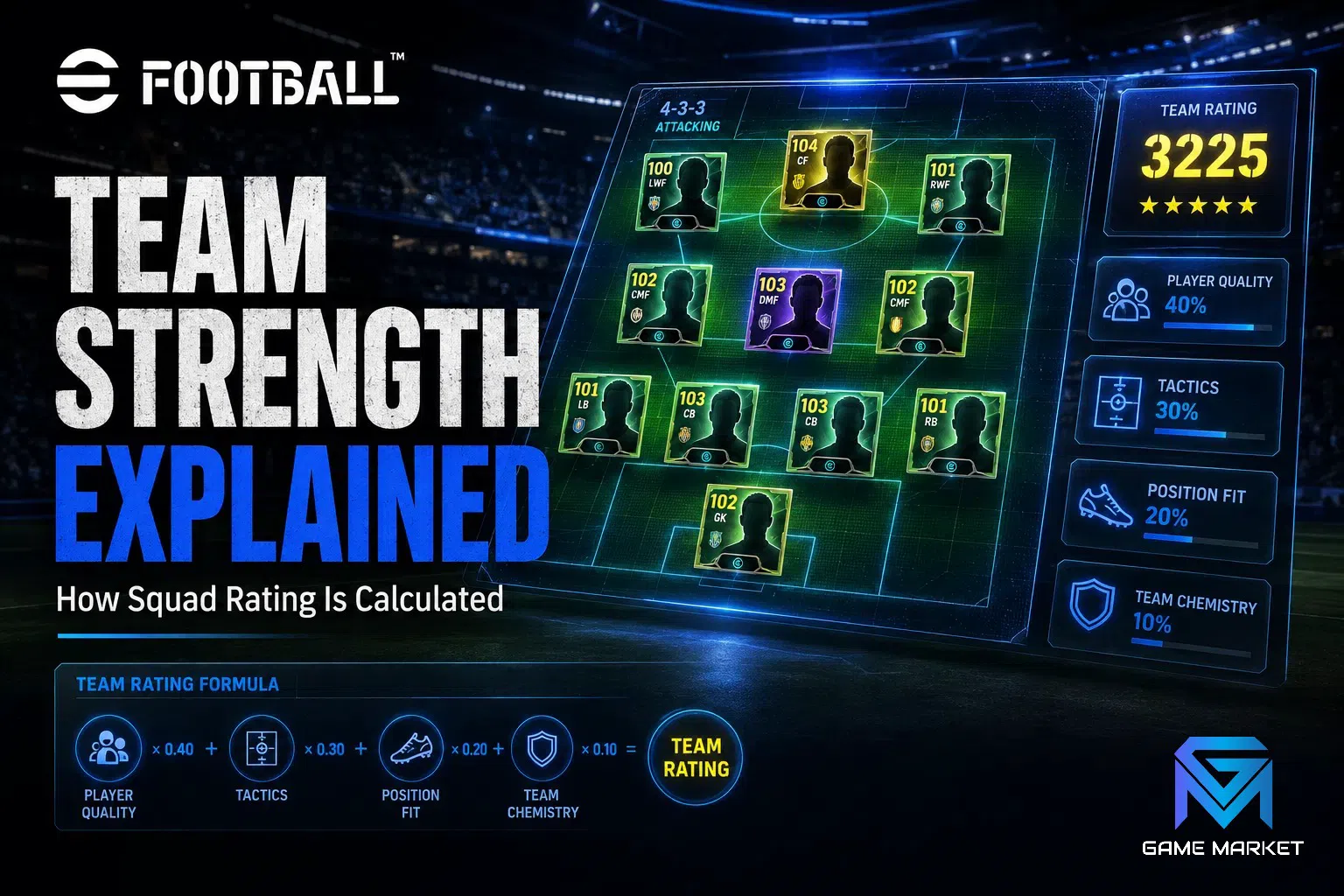
Team Strength in eFootball is a single number that summarises your starting eleven, your bench, your manager's tactics and your squad's current condition. It is a weighted average, not a sum, so one 100-rated signing barely moves it. Raising it means lifting your weakest regular starters.
That distinction is the whole article. Most players treat Team Strength as a scoreboard and chase it by packing one elite card, then wonder why the number climbs two points and their results do not change at all. The rating is designed to describe the squad you actually field across ninety minutes, including the players who come on at the hour mark, and it rewards depth far more visibly than it rewards a single headline name.
What is Team Strength in eFootball?
Team Strength is the composite squad rating shown on your Team Management screen. It blends the overall ratings of your eleven starters and your registered substitutes with bonuses from your selected Team Playstyle, manager tactics, player position fitness and team spirit. It is a snapshot of the squad, not of your best card.
Konami surfaces the figure in two places: on the squad selection screen, where it sits beside your formation, and in matchmaking previews, where you see your opponent's figure next to yours before kick-off. Because it appears in both places, players read it as a power level. It is closer to a health check. A squad with a very high Team Strength and a badly balanced formation will still concede, and a squad with a modest figure and disciplined tactics will still win.
The number is recalculated live. Change a substitute, swap a manager, move a midfielder out of his natural position, and the figure updates immediately. This responsiveness is useful: you can treat the Team Management screen as a sandbox, make one change at a time, and watch exactly which change is carrying weight. That single habit teaches more about the formula than any guide can.
How is Team Strength actually calculated?
The core input is a weighted average of your starting eleven's overall ratings, with your registered bench contributing at a reduced weight. On top of that base, eFootball layers modifiers for team spirit, manager tactical fit, position suitability for each player and the active Team Playstyle bonus. The result is rounded to a whole number.
Konami has never published exact coefficients, and the sensible position is to describe the behaviour rather than invent decimals. What is consistently observable in-game is the direction and rough magnitude of each input:
- Starting eleven ratings carry the largest share. Replacing a 78-rated regular starter with an 88-rated card produces a clearly visible jump.
- Bench ratings matter, but at a fraction of the weight. Filling five weak substitute slots with mid-tier cards often produces a bigger total gain than one elite starter, because you are lifting five low numbers instead of one already-high number.
- Position suitability applies a penalty when a player is out of his natural role. A centre-back deployed as a defensive midfielder contributes a reduced effective rating until you run Position Training on him.
- Team spirit rises when your squad's individual playing styles match the manager's instructions and your chosen formation. Mismatched styles suppress the figure even when raw ratings are high.
- Manager tactical fit shifts the number when the manager's preferred formation matches the one you are fielding.
Because it is an average with modifiers rather than a total, the formula has a ceiling effect. As your squad's floor rises, each new signing has less room to improve the mean. Players moving from a starter squad into a competitive one usually see fast early gains, then a long plateau. That plateau is mathematics, not a bug.
Why does Team Strength barely move when you add one high-rated card?
Because a weighted average dilutes any single input. A 95-rated card entering a squad of eleven starters and five substitutes replaces one entry in a sixteen-slot calculation. If the card it displaces was already 84, the mean shifts by a fraction of a point once the bench weighting is applied.
This is the single most common source of confusion. A player opens a pack, lands a genuinely excellent attacker, drops him straight into the eleven, and watches Team Strength rise by one. The instinct is that something is broken. Nothing is: the squad's average was already respectable, and one slot out of sixteen cannot move an average far.
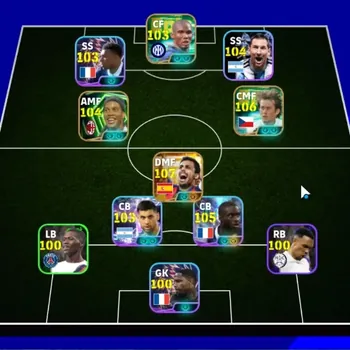
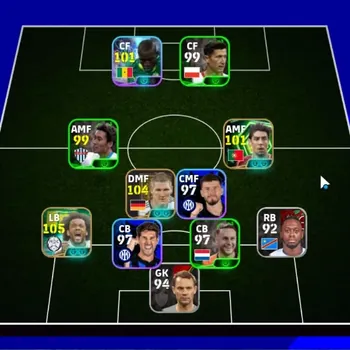
The practical consequence is a different shopping list. If you want the displayed figure to move, audit the bottom of your squad rather than the top. Find the three lowest-rated players who actually see minutes, including substitutes, and lift those. Two mid-tier signings that replace two weak regulars almost always beat one elite signing that replaces an already-good regular. If you are weighing which cards to chase, our breakdown of eFootball player card types and what each rarity actually offers explains where the reliable mid-tier value sits.
Does Team Strength decide who wins a match?
No. Team Strength is a descriptive rating, not a hidden multiplier applied during play. Matches are resolved by player inputs, individual card stats, stamina, tactics and momentum. A lower-rated squad with better spacing and a manager whose tactics fit the formation regularly beats a higher-rated one.
It is worth being precise about what the number does and does not touch. It does not add damage, speed or accuracy. It does not weight refereeing or luck. What it correlates with is the quality of the eleven you field, which of course influences results indirectly. Correlation is doing all the work in that sentence.
Where the figure genuinely matters is matchmaking context and self-diagnosis. Seeing an opponent at a substantially higher rating tells you their squad depth is better, which usually means their substitutes will be stronger than yours in the last twenty minutes. That is actionable information: it argues for managing stamina earlier and closing the game out rather than trading chances late.
How do Playing Styles and team tactics change your Team Strength?
Playing Styles adjust the figure through team spirit. When a player's individual style matches the role your tactics ask him to perform, spirit rises and Team Strength follows. When it clashes, the squad rating drops even though no card's overall rating changed. Style coherence is effectively free rating.
Concretely, a striker with the Poacher style slotted into a system built around a Deep Lying Forward will show a lower contribution than his overall rating implies, and your team spirit bar will not fill. Swap in a card whose style matches the instruction and both the bar and the composite number improve without spending anything.
The same applies at the tactical layer. Each manager has a preferred formation and set of instructions. Fielding a manager's own shape produces a higher tactical fit than forcing him into a formation he does not favour. Since managers can be acquired cheaply relative to headline players, aligning manager and formation is one of the cheapest available upgrades to the displayed rating.
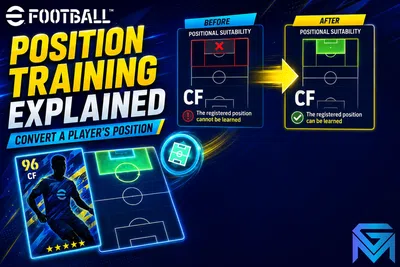
Position suitability sits alongside this. eFootball marks how well each player fits the position you have assigned. Out-of-position players suffer a rating penalty that feeds directly into the composite. Running Position Training on a card you intend to use in an unnatural role removes that penalty permanently, and it costs progression points rather than currency.
How do condition arrows and stamina affect it on match day?
Condition arrows adjust a player's effective performance for a single match, and squads shown before kick-off reflect the current condition of your selected eleven. A team full of downward arrows will underperform its nominal rating; a team of upward arrows will overperform. Condition rerolls each day.
Condition is the reason two sessions with an identical squad can feel completely different. The arrow system applies a modest boost or penalty across a player's stats, and it lands hardest on cards whose value depends on one attribute — a pacy winger with a downward arrow loses the specific thing you picked him for.
Stamina works on a longer clock inside the match itself. Players tire, their effective stats fall, and the quality of your bench decides how much of that decline you can reverse. This is the practical argument for treating substitutes as part of the squad rather than as spare parts, and it is the reason eFootball weights the bench into the calculation at all. A squad whose bench is thirty points below its eleven is not a strong squad; it is a strong forty-five minutes.
Before a competitive session, check the arrows, adjust the eleven around them, and accept that the displayed figure will fluctuate day to day. That fluctuation is the system working as intended.
What is the fastest way to raise Team Strength without spending?
Level your existing regulars through Training Programs, run Position Training on out-of-position players, align your manager with the formation you actually field, and fill weak substitute slots with mid-tier cards earned from GP. Lifting the squad's floor beats chasing its ceiling.
A workable order of operations, cheapest first:
- Fix position suitability. Every out-of-position starter is a penalty you are paying every match. Position Training clears it and costs progression points, not currency.
- Align manager and formation. Pick the manager whose preferred shape matches yours, or change your shape to match a manager you already own. Zero cost, immediate tactical-fit gain.
- Audit the bench. List your five substitutes. Any slot more than fifteen points below your weakest starter is dragging the average and will also cost you the closing stages of matches.
- Level the regulars you already trust. Progression points spent on a card you field every match compound; points spent on a card you never select do nothing for the figure or for results.
- Use free-to-play currency deliberately. GP accumulates steadily and is well suited to depth signings. Our guide to farming GP without spending in eFootball covers the reliable sources, and the wider breakdown of the best ways to earn coins and GP is worth reading before you commit a large balance.
Understanding which currency to use for which job saves a lot of wasted progress. The differences are covered in detail in our explainer on how eFootball coins and GP differ and what each is for, and the mechanics behind targeted signings are set out in our piece on Chance Deals and Nominating Contracts.
How high should Team Strength be for each Division?
There is no gate: eFootball's Division system promotes on points earned, not on squad rating. In practice, players competing comfortably in the higher divisions tend to field squads whose starters and bench sit within a narrow band of each other, rather than squads with one extreme outlier.
Because Konami adjusts card pools every season, quoting a fixed target number would age badly within weeks. The durable benchmark is internal consistency. Compare your weakest starter to your strongest, and your bench average to your eleven average. When those gaps close, your results improve regardless of what the composite figure reads.
Season resets matter here too. New seasons introduce new card pools and refresh the competitive baseline, so a rating that felt strong in one season sits mid-table in the next. Treat the figure as relative to the current season, never as an absolute achievement.
What mistakes make Team Strength stall?
The recurring ones are stacking elite attackers while ignoring defence and bench, leaving players out of position, ignoring manager fit, and spreading progression points thinly across cards that never start. Each of these suppresses the average while feeling like progress.
Hoarding is the quiet one. Players accumulate a large roster of mid-rated cards, register a handful, and leave the rest idle. Idle cards contribute nothing. Registration is what counts, so a smaller, well-chosen registered squad outperforms a bloated unregistered collection every time.
The second quiet failure is over-indexing on overall rating while ignoring the stats that match your tactics. A 90-rated card whose strengths sit in areas your system never uses contributes its rating to the average but very little to your results, which is how a squad can climb the figure and stall in the standings simultaneously. The number describes your squad; it does not play for you.
Frequently asked questions
Does the bench really count toward Team Strength?
Yes. Registered substitutes are included at a reduced weight relative to starters. This is why filling several weak bench slots with mid-tier cards frequently produces a larger gain than a single elite starter signing.
Why did my Team Strength drop without me changing anything?
Almost always condition. Arrows reroll daily, and a squad that picked up several downward arrows will show a lower figure until the next refresh. Contract expiry on a registered player can also remove him from the calculation.
Does a higher Team Strength give a hidden in-match advantage?
No. It is a descriptive composite, not a multiplier. Matches are decided by inputs, individual stats, stamina and tactics. A better-drilled lower-rated squad beating a higher-rated one is a normal outcome, not an upset.
Should I chase the number or chase results?
Chase squad balance, and the number follows. Every action that genuinely improves results — closing the gap between your best and worst regulars, fixing positions, matching styles to tactics — also raises the composite. Optimising for the figure alone leads to lopsided squads.
If your squad is stuck because you are short on the currency to sign the depth pieces your bench needs, you can browse the available eFootball coin top up options on GameMarket.gg and get back to building the balanced squad the rating actually rewards. New to the game and still finding your footing, start with our eFootball beginner's guide to player cards, coins and squads.
Team Strength is also the clearest tell when judging a listing that claims to be a high-roller account: GameMarket's breakdown of what's actually inside a high-roller eFootball account walks through why that rating matters more than raw card count when sizing up a squad before buying.
GameMarket.gg is a trusted digital marketplace for everything gaming-related. We serve the gaming community by providing secure access that enhances every gaming journey.
For a wider view of which cards and formations are currently rated best across every position, see our eFootball current meta and best players guide.
Where to Find eFootball Accounts and Top-Up
On GameMarket.gg you can browse eFootball accounts from verified sellers, use eFootball top-up options if you would rather build on the account you already have, or look through the eFootball market hub for everything else available right now.
Team Strength on its own doesn't explain an account's history: see why Manager Level and Team Strength can diverge for why a low-level account can still post a high squad rating.