eFootball Player Contracts Explained: Renewals, Loans & GP Upkeep
By John Ganang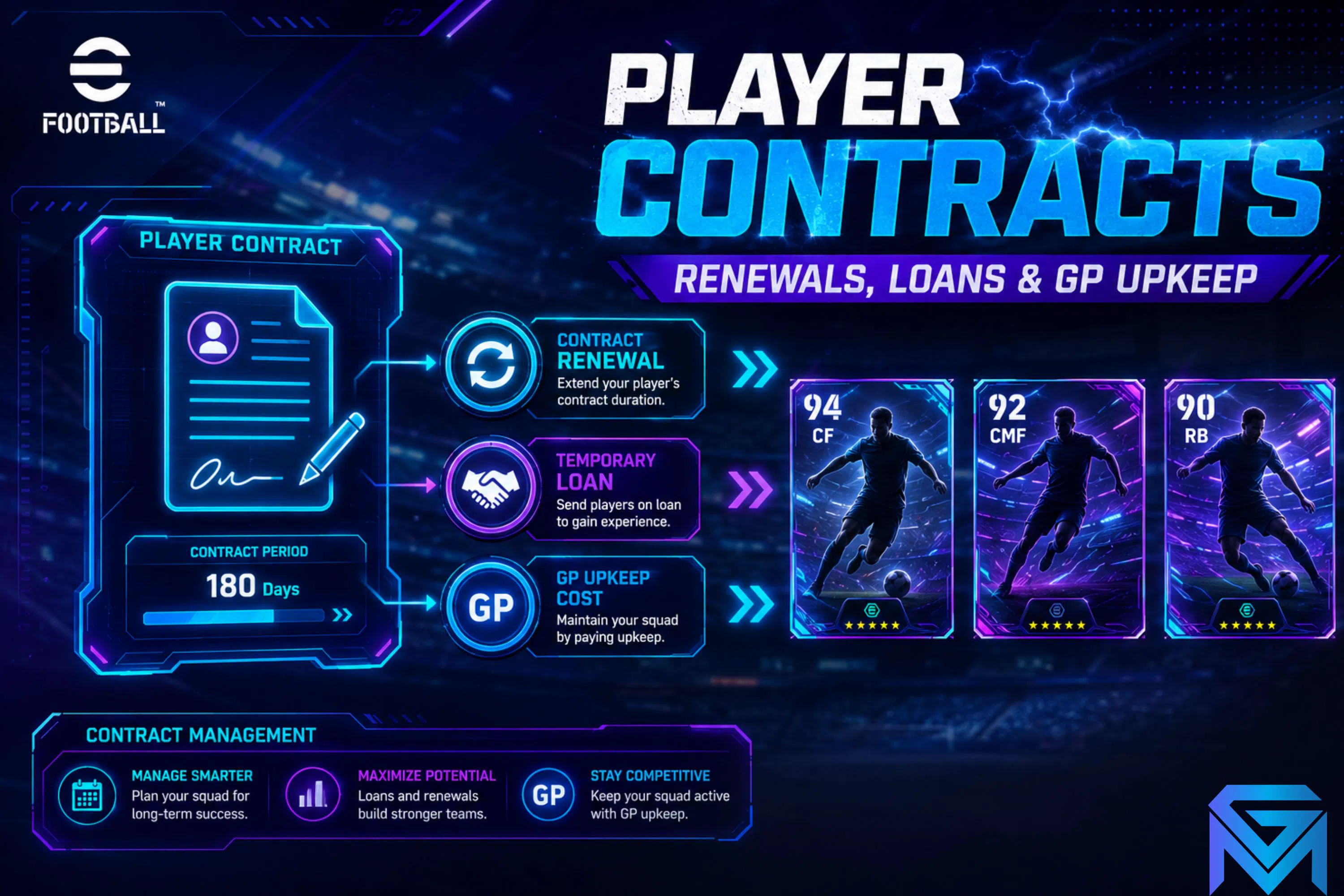
An eFootball player contract is a match counter attached to every player in your club: each appearance burns one match from it, and when the counter reaches zero that player becomes unselectable until you renew him with GP or a Contract Renewal Ticket. Squad upkeep, not squad building, is what quietly empties most GP balances, because the cost is recurring, it scales with how good your players are, and it arrives without any of the noise that a new signing makes. This guide covers how the counter actually ticks, what happens at zero, what drives the renewal quote, why loan players sit outside the whole system, and how to run a club whose running costs never ambush you the night before a final.
What is a player contract in eFootball?
A contract is a per-player allowance of matches, shown as a number on the player's card and in club management. It is not a real-time lease and it does not expire on a calendar; it only moves when that specific player takes the field, and every player you own carries one.
Konami built the system as a recurring GP sink, and understanding that intent explains most of its behaviour. A one-off cost would be paid once and forgotten, whereas a counter that drains as you play converts every match you enjoy into a small future bill. That is why the counter follows the player rather than the squad: your club does not have one shared upkeep bar you can top up in a single tap, it has as many small bars as you have players, and they empty at wildly different speeds depending on who you actually field.
The practical consequence lands early for new managers. You can hold a very large club, hundreds of cards deep, and pay nothing for the ones sitting idle, because idle players do not consume contract matches. Cost is generated by use, so a manager who fields the same eleven every day carries a heavier running cost than one who owns three times as many players but spreads the minutes. If you are still mapping how GP and Coins differ before working out what to spend them on, the eFootball Coins and GP guide covers which currency handles which job.
How does a contract count down?
The counter drops by one each time a player appears in a match that counts toward your club record, whether he starts or comes off the bench. Time on the pitch is irrelevant: a ninety-minute shift and a stoppage-time cameo cost exactly the same single match, and an unused substitute normally costs nothing.
That single rule does more to shape a healthy club than any other. Because the charge is per appearance and not per minute, a manager who brings on a fringe player for the last two minutes of a comfortable win has spent a full match of that player's contract for almost no benefit, while a manager who rotates two full elevens across a busy event week halves the drain on each individual card. The eleven names you trust are the eleven bills you will pay soonest.
The counters also fall in step, which is what makes the system feel sudden rather than gradual. A fixed starting eleven signed at the same time and played together will approach zero together, so instead of one renewal to fund every few days you get eleven landing in the same session. Staggering that is simple in principle: introduce new signings one or two at a time rather than rebuilding a whole line at once, and let rotation players absorb the low-stakes fixtures so the core drains at a different rate from the squad around it.
Modes differ in whether an appearance registers, and Konami has adjusted which fixtures consume contracts across versions, so treat the in-game help entry for your current build as the authority rather than a habit carried over from an older season. The stable part is the principle: appearances cost, benches do not. For a full breakdown of what actually changes at each version boundary versus what carries over, see GameMarket's eFootball seasons explained guide.
What happens when a contract hits zero?
Nothing is lost. A player at zero stays in your club permanently with his level, progression and skills intact; he simply cannot be selected until the contract is renewed. There is no decay, no penalty for leaving him idle at zero, and no deadline by which you must pay.
The damage is therefore never financial, it is tactical, and it lands at the worst possible moment. An expired player is dropped from selection, which means the squad you saved is no longer the squad you take into your next match. Depending on how your lineup is configured you may be pushed into a manual fix under time pressure or handed an automatic replacement several ratings lower, and a rating drop concentrated in one position tends to break the shape and the playstyle links you built the team around, not just the number on the team-strength readout.
This is why upkeep deserves a slot in your routine rather than your reflexes. Checking contracts before a competitive session takes seconds, whereas discovering a zero during matchmaking costs you either the player or the shape. The habit worth building is a pre-session glance at the eleven you intend to use, with anything under three matches renewed then and there.
What drives the GP cost of a renewal?
Renewal is quoted in GP and the quote is not flat. It scales with the player's standing, so a high-rated, heavily trained card costs meaningfully more to renew than a base squad player, and the game shows you the exact figure before you confirm.
Because the price follows quality, upkeep behaves like a progressive tax on ambition. Two managers playing the identical number of matches will pay very different weekly totals if one fields a squad of premium cards and the other fields solid mid-tier players, and the gap widens as those premium cards are levelled and trained. New managers often notice their GP balance holding comfortably for weeks and then draining fast, and the usual explanation is not that they started spending more, it is that the eleven they field got better.
Exact figures move between versions and card types, so hard-coding a number is a good way to be wrong by the next update; Konami publishes adjustments through its official patch notes and in-game notices when the economy is retuned. What is stable is the shape of the curve. Upkeep grows with the quality of what you field, which means the honest cost of chasing a stacked eleven includes the standing charge it creates, not just the GP or Coins it took to sign. If you want to see how much GP an ordinary week can realistically generate before committing to that standing charge, the eFootball GP farming guide maps the reliable sources.
What are loan players, and why can they not be renewed?
Loan players arrive from campaigns, login rewards and event distributions with a fixed number of matches and no renewal option. When the counter empties they leave the club entirely, and no amount of GP or tickets brings them back.
They are best understood as a consumable rather than a signing, and that reframing changes how you use them. Because the matches are finite and non-renewable, a loaned star hoarded for a special occasion is simply a resource decaying in your inventory, whereas the same card spent on the event you are actively grinding converts directly into progress. Loans exist to let you feel a top card and to carry you through content your permanent squad is not ready for, so the correct instinct is to field them early and often on the hardest content available to you.
The distinction from a permanent signing matters when you read a pack or campaign reward, since the two are presented in similar frames. Permanent cards signed through the game's contract mechanics stay in your club and enter the normal renewal cycle; loans never do. The guide to Chance Deals and nominating contracts sets out how the permanent signing routes work, which is the cleanest way to recognise a loan when you see one.
What do Contract Renewal Tickets change?
A Contract Renewal Ticket restores a player's contract without spending GP. They arrive through events, login streaks and campaign rewards, and some are restricted to a rating or card band, so the ticket you hold may not be usable on every player in your club.
Because a ticket replaces a variable GP quote with a fixed item, its real worth depends entirely on where you point it. Spending one on a base squad player saves a trivial amount of GP, while spending the same ticket on your most expensive card removes the single largest recurring line in your budget for a full cycle. Tickets should therefore flow upward through the squad, always to the priciest eligible name, and the only reason to break that rule is a band restriction that makes the ticket unusable on your top card anyway.
They are also the cleanest answer to a GP squeeze. If a big signing has left you short and your starting eleven is about to expire, tickets let you keep the strongest names available while your GP recovers, which is worth more than the equivalent GP would be at any other moment.
How do card types change what a squad costs to run?
Card quality and upkeep move together. Premium cards from featured drops carry the highest renewal quotes, standard and base players sit at the bottom of the range, and the mix you field, rather than the mix you own, sets your weekly bill.
That relationship is what turns a club into a pyramid rather than a wish list. A narrow squad of expensive cards is the costliest possible way to play, because every appearance is charged at the top of the curve and there is nobody cheap to absorb the fixtures that do not need your best team. A club with a strong core and a deep, inexpensive supporting cast plays the same amount of football for a fraction of the standing cost, since farming runs, daily objectives and low-difficulty event stages can be pushed through by players whose renewals barely register. Reading the rating bands correctly is part of that, and the breakdown of eFootball player card types explains which tiers sit where.
Depth also protects you from the synchronisation problem. When the core expires mid-session you want a second unit that can finish the night rather than a bench of expired names, and a supporting cast built from cheap, renewable players is what makes that possible without touching your GP reserve. Managers still assembling that first proper squad will find the groundwork in the eFootball beginner's guide.
How should you budget GP around squad upkeep?
Treat upkeep as a fixed cost you fund before anything else, then spend what is left. In practice that means holding a GP floor, renewing on a schedule rather than an emergency, and letting rotation rather than payment absorb as much of the drain as it can.
Renew when the player is in your first-choice eleven and the counter is under three matches, and do it before a session rather than during one. Rotate when the fixture does not need your best team, since a match played by a cheap squad player costs a fraction of the same match played by your most expensive card and yields identical event progress. Release or ignore the cards you no longer field at all, because a zeroed contract on a player who never plays is not a problem to solve; it is simply a bill you have correctly declined.
The floor is the part most managers skip. Keeping a reserve roughly equal to one full renewal cycle for your starting eleven means a pack, a training push or a signing can never leave you unable to field the team you built, which is the specific failure that turns a good week into a lost one. Build the reserve from routine income rather than one-off windfalls; the rundown of the best ways to earn Coins and GP is a useful checklist for what that routine should include.
Three habits cause most upkeep disasters, and all three are avoidable. Bulk-renewing the entire club at once buries GP in players who will not see the pitch this month. Spending down to nothing on a signing leaves the squad around the new arrival unfundable, so the upgrade never actually gets fielded. And letting the first-choice eleven drain together, with no cheaper second unit behind it, guarantees that the expiry arrives all at once and always during something that mattered.
Frequently asked questions
Do I lose a player when his contract runs out?
No. Permanent players stay in your club at zero with level, progression and skills untouched, and they become selectable again the moment you renew. Only loan players leave, because their match allowance cannot be renewed at all.
Does a substitute who never comes on use a contract match?
An unused substitute normally does not consume a match; the charge follows the appearance. Any player who takes the field, even for injury time, spends one full match from his counter.
Is it cheaper to renew several players at once?
Bulk renewal is a convenience, not a discount. Each player is still quoted individually against his own rating and progression, so renewing everything at once mostly moves GP into cards you were not going to field.
Should I save Contract Renewal Tickets or use them immediately?
Use them on your most expensive eligible player as soon as that player nears zero. A ticket's worth equals the GP quote it cancels, so holding one for later only pays off if you expect to point it at a pricier card than the one expiring now.
Where to Find eFootball Accounts and Marketplace Listings
Managers who would rather skip the contract grind entirely can browse eFootball accounts already stocked with signed squads and GP, or check the full eFootball marketplace for every listing type GameMarket.gg carries for the game.
If you would rather fund a season's worth of renewals and signings without grinding the GP for it first, you can compare the current eFootball top up listings and see how each option is described before deciding what your club actually needs.
Curious what separates a well-maintained squad from a true high-roller profile? GameMarket's breakdown of what's actually inside a high-roller eFootball account covers the card, GP, and Team Strength signals worth checking before you buy.
GameMarket.gg is a trusted digital marketplace for everything gaming-related. We serve the gaming community by providing secure access that enhances every gaming journey.