7DS Grand Cross Account Power Explained: Gear, CC and Roster Depth
By John Ganang
Account strength in The Seven Deadly Sins: Grand Cross is decided by gear quality, hero awakening and Ultimate Move levels — not by Combat Class alone. CC is a summary number; the account that clears content is the one with tuned substats, awakened key units and finished skill investment behind it.
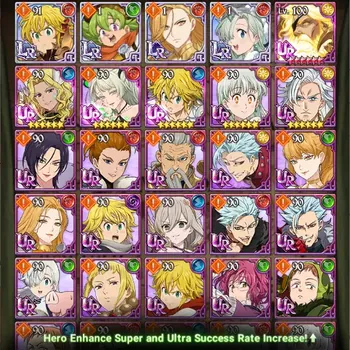
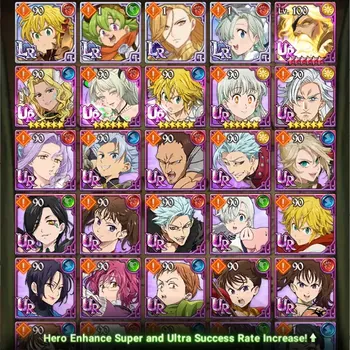
Every returning player eventually asks the same thing: what separates a roster that looks impressive on the hero list from one that actually clears Demonic Beast, Death Match and ranked PvP? Netmarble's progression systems stack multiplicatively, so two accounts showing a similar Combat Class can perform very differently once real content starts. This guide breaks down each layer that contributes to account power — Combat Class, gear main stats and substats, hero grade and awakening, UR evolution, Ultimate Move books, costumes, food buffs and Knighthood perks — and explains how to read them together instead of one at a time. If you are still learning the basics of the game's systems, start with the 7DS Grand Cross beginner's guide to heroes, diamonds and teams and come back here for the deeper progression layer.
Before comparing CC and gear across different sellers, it also helps to know what makes a listing trustworthy in the first place — see our guide on spotting trust signals and red flags in 7DS Grand Cross account listings.
What actually determines account strength in 7DS Grand Cross?
Account strength comes from four stacked layers: gear (main stat, set bonus and substats), hero grade and awakening level, Ultimate Move and skill investment, and passive sources such as costumes, food and Knighthood. Combat Class only summarises the first two.
The reason the layers matter more than any single score is that they multiply. A hero with well-rolled Attack and Critical Chance substats but no Ultimate Move investment will hit a damage ceiling in longer fights. A fully awakened hero wearing mismatched gear will survive but not threaten a boss health bar. In practice, the accounts that clear the hardest content have made deliberate, narrow investments — a handful of finished units rather than a wide shelf of half-built ones.
This is also why "how many SSR heroes" is a weak measure. SSR heroes arrive constantly from banners and events; what is scarce is the awakening material, gear rolls and Ultimate Move books needed to finish one. Depth of finishing, not breadth of collecting, is the real currency of progression.
How much does Combat Class really tell you?
Combat Class (CC) is an aggregate of a hero's stats after gear, awakening and level are applied. It is a useful shorthand for comparing two builds of the same unit, but it weights raw stat totals and can be inflated by defensive substats that contribute little to clearing damage checks.
Think of CC as a scale reading rather than a diagnosis. Because it sums stats, a hero stacked with Defence and HP substats can display a higher CC than a hero with fewer, sharper Attack and Critical Damage rolls — while the second hero clears content the first cannot. CC also rises from sources that do not change performance much in a specific fight, which is why players comparing rosters usually open the individual hero screen instead of stopping at the number.
Where CC is genuinely useful: tracking your own progress over time, checking gating requirements for content that lists a recommended CC, and spotting rough gaps in a team. Where it misleads: cross-comparing two different heroes, or judging whether a roster is "ready" for a boss without looking at the gear behind it.
Why does gear matter more than hero count?
Gear supplies the majority of a hero's usable stats. Each piece carries a main stat determined by its slot and type, a set bonus that activates when enough matching pieces are equipped, and randomly rolled substats that are enhanced as the piece levels up. Substat quality is the single biggest source of variance between accounts.
The set layer is the easiest to read. Attack-oriented sets push offensive output, Critical sets raise the chance and damage of critical hits, Defence and HP sets increase durability, and Regeneration-style sets support sustain builds. A team built around a damage dealer normally wants offensive sets on that unit and supportive sets on the heroes keeping it alive — mixing sets on a single hero usually means the bonus is not active at all.
The substat layer is where long-term investment lives. When a piece is enhanced, one of its substats improves, and the outcome is random. That means two identical-looking pieces can differ enormously in value: one may have concentrated its rolls into Critical Chance and Attack, another may have spread them across stats the hero does not use. Gear awakening and rank-up systems then add further stats on top, which is why veteran accounts often show a small number of exceptional pieces rather than a full inventory of average ones.
Practical reading order for any hero screen: check the set bonus first (is it active?), then the main stats by slot, then the substats against the hero's role. A damage dealer with no Critical Chance substats is unfinished no matter what its CC says. For the wider view of how these systems unlock as an account matures, the 7DS Grand Cross account progression guide covering heroes and gear maps the order most players follow. For the detail behind that, see Account Linking Explained Devices & Backup.
How do hero grade, awakening and UR evolution change a roster?
Heroes progress through grades and awakening stars, with duplicates and awakening materials pushing a unit toward its maximum star level, and later evolution systems such as UR grade extending that ceiling further. Each step raises base stats and, for many units, strengthens their kit directly.
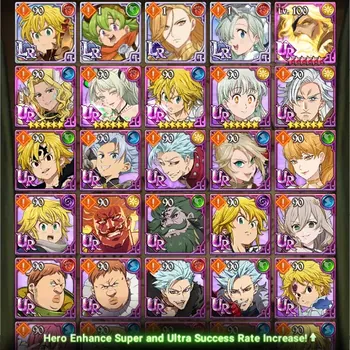
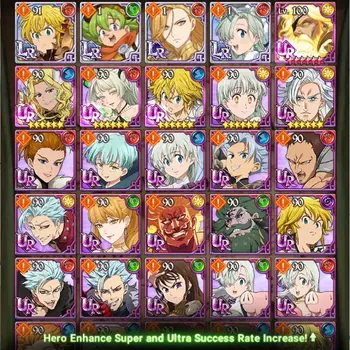
Awakening is where free-to-play and heavily invested accounts visibly diverge. Reaching the top star level on a hero requires either repeated pulls of the same unit or the awakening materials the game distributes through events, exchanges and shops. Because those materials are limited, most accounts can only fully awaken a limited number of heroes — so the identity of an account is essentially the list of units it has chosen to finish.
UR-grade evolution, introduced well after launch, added another ceiling above the traditional maximum for eligible heroes, using its own dedicated materials such as evolution items and pendants. According to Netmarble's official patch notes, availability of these upgrades is tied to specific heroes and content rather than being universally applicable, so a roster's UR count reflects both investment and how long the account has been active.
When reading a roster, the meaningful questions are: which heroes are at maximum awakening, which of those are still relevant to current content, and whether the account's evolution materials were spent on units that support each other in a team. Three finished heroes that form a working team beat six finished heroes scattered across incompatible attributes.
What role do Ultimate Move levels and skill investment play?
Ultimate Move levels raise the power of a hero's signature ability, and skill enhancement improves the cards a hero plays each turn. Both consume dedicated resources, and both change how a unit performs far more than an equivalent amount of raw stat gain would.
7DS Grand Cross runs on a card-based combat system: heroes draw skill cards, cards of the same type merge into higher ranks, and the Ultimate Move fires once its gauge fills. Because a merged, higher-rank card multiplies its effect, a hero whose skills are enhanced generates dramatically more value from the same number of turns. This is why skill investment often outperforms chasing a marginally better gear piece.
Ultimate Move upgrades are typically the most resource-hungry step on any hero, drawing on limited books or equivalent materials. As a result, the number of heroes with a fully upgraded Ultimate is one of the clearest signals of how much long-term progression an account has accumulated — much more reliable than a headline CC figure.
Which content clears prove an account is actually built?
Completed content is the most honest measure of account strength, because it cannot be inflated. Death Match progress, Demonic Beast difficulty tiers, Knighthood boss damage and PvP rank all require working teams rather than isolated strong units.
Demonic Beast in particular acts as a practical benchmark: each beast rewards specific gear and materials, and higher difficulties enforce real requirements around attribute matchups, sustain and damage output within a turn limit. An account clearing high tiers consistently has, by definition, at least one finished team plus the gear economy behind it.
PvP performance tells a different story. Ranked play rewards speed, turn control and counter-picking rather than pure numbers, so a strong PvP rank suggests both an invested roster and the units that matter in the current meta. Because that meta shifts with each balance pass and new release, a rank achieved recently means more than one achieved several seasons ago.
Story and event completion round out the picture. Deep story progress unlocks systems, currencies and daily income, so an account far into the campaign generally has better ongoing resource flow than a newer one at the same CC.
How do costumes, food and Knighthood add hidden power?
Costumes grant permanent stat bonuses that can be enhanced, food provides temporary buffs before a fight, and Knighthood membership contributes passive perks and boss content. None of these appear prominently on a hero card, but together they meaningfully change what a team can clear.
Costumes are account-wide investments: once enhanced, their bonuses persist and apply according to the costume's own rules rather than needing to be re-earned. Because many costumes are tied to limited events or collaborations, an older account frequently carries stat bonuses that a new account simply cannot obtain at will — a genuine, if quiet, difference in ceiling.
Food buffs sit at the opposite end: cheap, repeatable and easy to forget. Cooking the right dish before a difficult attempt is one of the most reliable free power increases in the game, and players pushing content ranks treat it as routine rather than optional.
Knighthood participation adds a social layer with concrete rewards — boss content, coins spendable on materials, and perks that accumulate over time. Active Knighthood membership is a strong indicator that an account has been played consistently rather than logged into occasionally.
How should a player read an account's progression at a glance?
Work from the outside in: check content clears first, then the top three heroes' gear substats and set bonuses, then awakening and Ultimate Move levels, then account-wide extras like costumes and Knighthood. Combat Class should be the last thing checked, not the first.
A workable checklist looks like this. First, what is actually cleared — Demonic Beast tier, Death Match stage, current PvP rank. Second, open the strongest hero and read its gear: is the set bonus active, do the substats match the role, how far are the pieces enhanced. Third, count how many heroes sit at maximum awakening and how many have a fully upgraded Ultimate Move. Fourth, look at costume count and Knighthood activity. Fifth, and only now, glance at CC to sanity-check the impression the first four steps created.
The same order works for auditing your own account. It tends to reveal that the fastest improvement is rarely another banner pull — more often it is finishing the gear or Ultimate Move on a hero you already own. Understanding where your currency goes helps here too; the 7DS Grand Cross diamonds guide on earning and spending covers which sinks return the most progression per diamond.
One caution on volatile details: banner rates, event material payouts and content difficulty tiers are adjusted over time. Treat any specific number you read — here or elsewhere — as accurate as of the time of writing, and confirm current values in-game or in Netmarble's official patch notes before making a large investment decision.
Frequently asked questions
Is a higher Combat Class always stronger?
No. CC sums stats without weighting them for the hero's role, so defensive substats can raise CC while lowering effective damage. Compare CC only between two builds of the same hero, and check gear substats before drawing conclusions.
Should I awaken many heroes or finish a few?
Finishing a few is usually stronger. Awakening materials and Ultimate Move resources are limited, and most content is cleared by complete teams. Spreading investment thinly tends to produce a roster that looks broad but stalls at higher difficulties.
How important is gear compared with pulling new heroes?
Gear generally matters more. A new SSR without gear, awakening or skill investment performs worse than an established hero that is fully built. Pulls expand options; gear and skill investment convert those options into clears.
Does an older account always outperform a newer one?
Not automatically, but older accounts often hold limited costumes, collaboration units and event materials that are no longer obtainable. Those add a ceiling advantage that a newer account cannot close purely through playtime.
Where to Find 7DS Grand Cross Accounts and Top Up
On GameMarket.gg you can browse the 7DS Grand Cross market hub.
If you would rather start from a roster that already has the gear, awakening and Ultimate Move investment described above, browse the available 7DS Grand Cross accounts on GameMarket.gg and compare their progression using the checklist in this guide.
GameMarket.gg is a trusted digital marketplace for everything gaming-related. We serve the gaming community by providing secure access that enhances every gaming journey.