7DS Grand Cross Geared PvP Explained: Defense Teams & Rewards
By Sir Ayup 3 October 2026, 11:00 WIB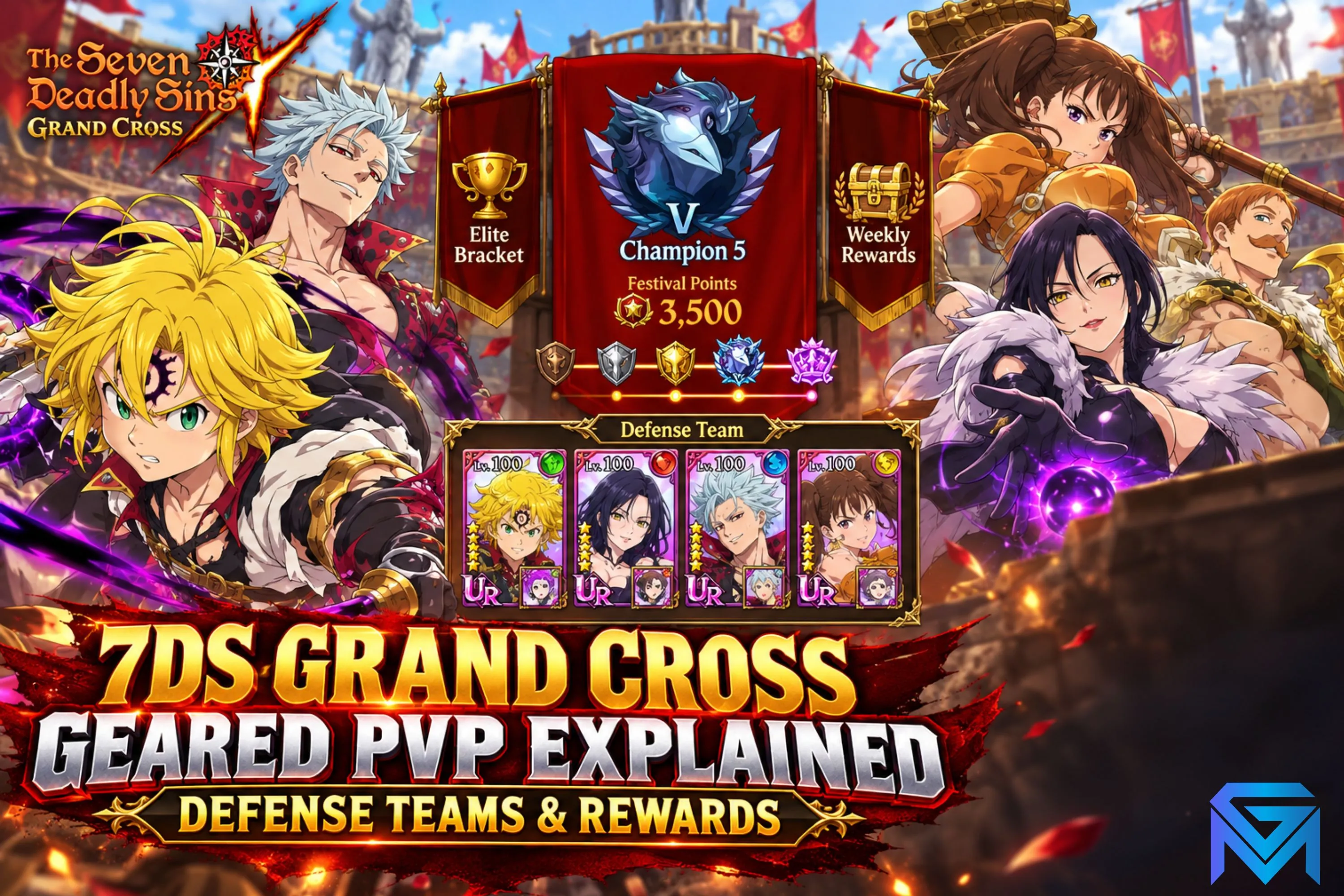
Geared PvP, officially the Elite bracket of the Vaizel Fight Festival, is The Seven Deadly Sins: Grand Cross's ranked arena where equipment stats finally count. It unlocks once your account reaches Gold tier in Normal (Ungeared) PvP, and from that point on your gear substats, not just hero level and awakening, decide who wins. This guide covers how promotion and demotion actually work, what the point thresholds are at each tier, and what a defense team should prioritize once gear enters the equation. If you haven't reached Gold yet, our 7DS Grand Cross rank up guide covers the account, hero, and PvP ladders that get you there.
🛡️ What is Elite PvP and how is it different from Normal?
Elite PvP is the geared version of the Fight Festival arena: both teams field 4 heroes plus 1 sub, but unlike Normal PvP, equipment stats are fully applied on top of hero level, awakening, and Ultimate Move levels. The team with the higher total Combat Class (CC) attacks first.
That single difference changes what "strong" means in the arena. In Normal PvP your costumes and hero fundamentals carry the match because gear is switched off; in Elite, a hero with maxed awakening but mediocre gear substats can lose to a lower-awakened hero running well-rolled SSR equipment. Elite only becomes available after your account clears Gold tier in Normal PvP, so it functions as a gate: the game assumes you've already built a competent roster before it asks you to also optimize gear rolls against real opponents.
📈 How does promotion and demotion work in the Fight Festival?
You rank up automatically once your Festival Points cross the next division's starting score, but moving from Division 1 of one tier into the next tier (say Bronze I into Silver V) requires winning a best-of-3 promotion match. Lose a promotion match and you get another attempt rather than losing your spot.
Demotion works the same way in reverse: if your points fall below your current division's starting score, you drop a division. There's a floor built in, though, because you're never pushed below Division V of a tier you've already reached, so once you touch Silver, for example, you can keep losing without ever falling back into Bronze. The one way to lose that protection is inactivity: if you sit out the Fight Festival for 4 weeks, or if it's your first time entering, you're placed through 5 fresh placement matches instead of dropping straight back in at your last rank. Fight Festival rank is only one of several rankings the game tracks; our Grand Cross game modes guide breaks down how it compares to Death Match and Demonic Beast Battle standings.
🏆 What are the PvP tier point thresholds?
Festival Points run from Bronze at 1,100 up to a single Challenger division at 4,000, with each of the six main tiers split into five divisions (V through I) in between. Elite PvP specifically opens at Gold V, which sits at 2,100 points.
The full ladder, by division starting score: Bronze runs V-1,100 through I-1,400; Silver runs V-1,600 through I-1,900; Gold runs V-2,100 through I-2,400; Platinum runs V-2,600 through I-2,900; Master runs V-3,100 through I-3,400; Champion runs V-3,600 through I-3,900; and Challenger sits alone at 4,000. Because Gold V is both a Normal-PvP milestone and the literal entry point to Elite, it's worth treating as your first real target rather than just another rung, since clearing it opens an entire second ranked mode with its own reward track.
⚔️ How do Commandments interact between the two teams?
When both your team and your opponent's team include heroes carrying Commandments, only one copy of each Commandment applies to the whole match, and it's decided by team slot position rather than by which side is stronger. The unit placed farthest to the left, across both teams, is the one whose Commandment effect is used.
This is a positioning detail most players never check, but it matters because a Commandment placed in your leftmost slot can override or coexist with an opponent's differently-themed Commandment depending on how the slots line up. If you're building around a Commandment-based passive, front-loading that hero's slot position is a free way to make sure your version of the effect is the one that actually resolves in the match.
🎯 What should a Geared PvP defense team prioritize?
Since CC decides who attacks first and gear stats are fully counted, a Geared defense team should prioritize SSR equipment with well-rolled substats over simply fielding your highest-level heroes. Anvils, bought from the Fight Festival Shop, let you reroll those substats instead of leaving them to chance.
Hero fundamentals still matter underneath the gear layer: level, Limit Break, awakening, and Ultimate Move rank all feed into CC the same way they do in Normal PvP, because equipment is additive rather than a replacement for those systems. What changes is the ceiling. Two accounts with identical hero investment can have meaningfully different Elite performance purely on substat quality, which is why veteran players treat Fight Festival coins less as spending money and more as a resource earmarked specifically for anvils and the costume slots that keep boosting CC once hero progression plateaus. This is also where the CC gap between PvP-built and PvE-built accounts shows up most clearly; our PvP vs PvE accounts breakdown covers what a gear-focused roster looks like next to a farming-focused one.
💰 What do Festival Coins and Festival Points buy, and how are they earned?
You earn Festival Coins for every match you win, while a loss costs you Festival Points instead of coins. Coins are spent at the Fight Festival Shop, mainly on anvils and costume pieces, and Points are the number that determines your division, tier, and eventual weekly reward payout.
One detail worth planning around: eating Coin Food before a battle grants 1,000% more coins for that win, not 100%, which makes it one of the highest-value consumables in the mode if you're stocking up for anvils. Rewards themselves are tallied at the end of each week and paid out based on the tier you're sitting in when the week closes, so a late push to lock in a higher division before reset is worth more than the same effort spent early in the week when you might still slide back down.
🤖 Are you always matched against real players in the Fight Festival?
No. Vaizel Fight Festival tries to pair you with another online player sitting near your current tier, but if it can't find a suitable opponent in time, it fills the match with an AI-controlled team instead. Both Normal and Elite PvP use the same fallback.
That matters most at the ends of the ladder. Fresh accounts pushing through Bronze and Silver tend to see more AI fights simply because fewer real players sit at that range at any given moment, which is part of why the early climb through Normal PvP feels faster than the fight for Champion later on. As you approach Champion and Challenger, the opponent pool of real, similarly-geared players is smaller and the matches you get are more consistently human, so the swings in win rate you'll feel near the top of Elite come from genuinely tougher competition rather than a change in matchmaking rules.
💎 How do Elite rewards differ from Normal PvP rewards?
Normal PvP pays out in Diamonds and Equipment Box Keys, the same premium currency used for gacha draws and stamina. Elite PvP instead pays Festival Coins, spent at the Fight Festival Shop, and Gold, the resource that gear enhancement and evolution burn through fastest.
The split is deliberate, because it ties each PvP mode to the resource bottleneck it's most relevant to. Normal PvP unlocks in Chapter 4 of the main story, long before most accounts have serious gear, so paying Diamonds and keys rewards the roster-building that Normal actually tests. Elite unlocks only after Gold tier and tests gear directly, so its Gold payout feeds straight back into the enhancement and evolution costs that gearing up demands; that connection is also why a heavy Elite push pairs naturally with the gold-farming routines covered in our 7DS Grand Cross gold farming guide, since climbing Elite both consumes Gold on gear and hands some back out weekly. Running both PvP tracks in parallel, rather than treating Elite as a simple continuation of Normal, is what keeps Diamonds, keys, and Gold all flowing instead of stalling on whichever resource you neglected.
🔎 Where to Find 7DS Grand Cross Boosting and Hourly Services
If you'd rather hand the Fight Festival grind to someone else, you can browse the current 7DS Grand Cross hourly services listings on GameMarket.gg to have a session push your rank or farm anvils and costumes while you focus on the matches that need your own decisions. For everything else the game offers, the full Seven Deadly Sins: Grand Cross marketplace covers accounts, Diamonds, and additional services in one place.
Whether you're pushing Elite for the first time or trying to lock in Gold before a weekly reset, a few well-timed hours from a hired hourly session can close the gap between where your gear sits now and the division you're aiming for.
GameMarket.gg is a trusted digital marketplace for everything gaming-related. We serve the gaming community by providing secure access that enhances every gaming journey.