Honkai: Star Rail Character Ascension Guide: Traces & Materials
By John Ganang
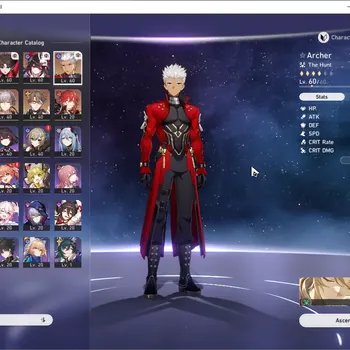
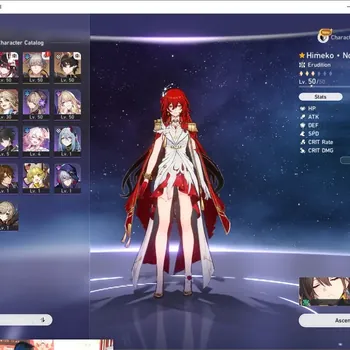
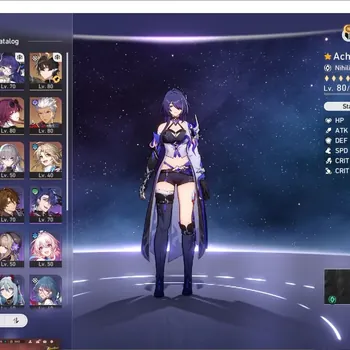
Character ascension in Honkai: Star Rail is the six-step promotion system that raises a character's level cap from 20 to 80, ten levels at a time, at levels 20, 30, 40, 50, 60 and 70. Each step costs Credits, EXP items and character-specific materials, and every step past 30 is gated by your Equilibrium Level. That gate is the part most players underestimate: your account level, not your material stock, is what usually stops a character from getting stronger. Before you're running Calyxes daily, planet exploration itself hands out a head start on these same materials — our world exploration guide covers what chests give per planet and how they connect to Trailblaze EXP.
Ascension is also the key that unlocks Traces. A character's skill tree only opens in tiers as they ascend, so the damage numbers you actually feel in combat sit behind the same six promotions. This guide covers what each ascension costs, which Equilibrium Level unlocks it, how the Trace tree is structured, which materials bottleneck it, and the investment order that gets a character combat-ready fastest. If you are still learning the basics of Warp, characters and Stellar Jade, the HSR beginner's guide to Warp, characters and Stellar Jade covers the ground underneath this one.
What is character ascension in Honkai: Star Rail?
Ascension is a promotion you perform manually once a character hits their current level ceiling. Characters run from level 1 to 80, but they start with a cap of 20. Each of the six ascensions raises that cap by exactly ten, so the ladder runs 20, 30, 40, 50, 60, 70 and finally 80.
Between those ceilings you level normally by feeding Character EXP materials, which come in three rarities: Travel Encounters, Adventure Log and Traveler's Guide. Every level-up also spends Credits, and the cost curve steepens sharply in the seventies. Community-compiled figures for a 5-star such as Bronya put a full 1-to-80 run at roughly 290 Traveler's Guides and around 887,800 Credits, which is why Credits, not EXP books, are usually the first resource a mid-game account runs dry on.
The promotion itself is a separate transaction. When a character sits at 20/20 they stop gaining EXP entirely, and you have to spend ascension materials plus Credits to open the next ten levels. Because the game will not let EXP overflow past a locked cap, feeding books into a capped character wastes nothing but does nothing either, so the practical habit is to ascend the moment you can rather than stockpiling.
Ascension is also the only route to three of a character's strongest passive Traces, which is the reason a level-70 character with a full tree routinely outperforms a level-80 character with a bare one. That relationship between promotion and skill tree is what the rest of this guide is really about.
Which Equilibrium Level do you need for each ascension?
Every ascension past level 30 requires a minimum Equilibrium Level, and Equilibrium Level itself requires a minimum Trailblaze Level plus a story trial. You cannot buy or farm your way around this. Even with a full inventory of materials, a character stops dead at the ceiling your account has earned.
The gates run in a clean pattern. Levels 1 to 30 are open from the start at Equilibrium 0. Levels 31 to 40 need Equilibrium 1, which asks for Trailblaze Level 20 and the Trial of the Equilibrium: Part One. Levels 41 to 50 need Equilibrium 2 at Trailblaze Level 30 and Part Two. Levels 51 to 60 need Equilibrium 3 at Trailblaze Level 40 and Part Three. Levels 61 to 70 need Equilibrium 4 at Trailblaze Level 50 and Part Four. Levels 71 to 80 need Equilibrium 5 at Trailblaze Level 60 and Part Five.
Because Trailblaze Level comes almost entirely from Trailblaze EXP earned through missions, exploration and daily activity, the gate is a soft time wall rather than a resource wall. That matters for planning: there is no point hoarding Stagnant Shadow drops for a level-80 push if your account is sitting at Equilibrium 3, since the materials will still be there in a week and the Trailblaze EXP will not arrive any faster. The HSR progression guide covering account levels, Warp and characters walks through how Trailblaze Level accrues and where the fastest sources sit.
One under-discussed consequence: raising Equilibrium also raises enemy strength across the whole game, so climbing the gate early with an underbuilt roster can make daily farming slower rather than faster. Higher Equilibrium does pay you back with better material drop rarities and larger Credit rewards, but the trade is real, and players who rush the Trials before their main damage dealer is ascended often find they have to slow down and catch up anyway.
What materials does each ascension cost?
Each ascension takes Credits plus a mix of two things: common enemy drops that scale in rarity as you climb, and Stagnant Shadow boss drops that only appear from the third ascension onward. The exact item names change per character, but the quantities follow a fixed pattern set by rarity.
For a 5-star character the six steps run as follows. Ascension 1, from 20 to 30, needs five 2-star enemy drops. Ascension 2, to 40, needs ten 2-star drops. Ascension 3, to 50, needs three Stagnant Shadow drops and six 3-star enemy drops. Ascension 4, to 60, needs seven Stagnant Shadow drops and nine 3-star drops. Ascension 5, to 70, needs twenty Stagnant Shadow drops and five 4-star drops. Ascension 6, to 80, needs thirty-five Stagnant Shadow drops and nine 4-star drops. Added up, a single 5-star costs 65 Stagnant Shadow drops and 44 enemy drops across their whole run.
A 4-star is cheaper but not dramatically so. The same six steps ask for four and then eight 2-star drops, then two Stagnant Shadow drops with five 3-star drops, then five with eight, then fifteen with five 4-star drops, and finally twenty-eight with seven. That totals 50 Stagnant Shadow drops and 37 enemy drops. The gap between rarities is about 23 percent on the boss material, which is smaller than most players assume and explains why a well-chosen 4-star support is such an efficient use of a farming week.
Notice where the weight sits. The final two ascensions alone account for 55 of a 5-star's 65 Stagnant Shadow drops. Because Stagnant Shadow is a Trailblaze Power activity with a hard weekly ceiling on what you can realistically clear, the 70-to-80 push is the single most expensive stretch of a character's life, and it is the step most veterans skip on secondary units.
Where do you farm ascension materials?
Ascension materials come from four practical places: Stagnant Shadow bosses for the character-specific drops, overworld and Simulated Universe enemies for the common drops, Assignments for passive accumulation, and the Omni-Synthesizer for converting what you already have into what you need.
Stagnant Shadow is the gate item. It unlocks at Equilibrium Level 2 and it is the only source of the boss material required from the third ascension onward, so an account below Equilibrium 2 physically cannot push a character past level 40 no matter how much overworld farming it does. Higher difficulty tiers of the same shadow give better drops for the same clear, so raising Equilibrium indirectly makes every future ascension cheaper in time.
The common 2-star, 3-star and 4-star enemy drops are the ones most players over-farm by hand. Assignments generate them passively while you are offline, and the Omni-Synthesizer converts lower rarities upward, which together cover the majority of a normal account's needs without spending a single point of Trailblaze Power. World Shops and the Embers Exchange sell limited stock as well, though World Shop stock does not refresh once cleared, so it is best treated as a one-time top-up when you are a handful of items short rather than a standing supply line.
Overworld grinding is the least efficient option because enemies take a day to respawn. Simulated Universe is the better version of the same idea, since elite and boss enemies there drop materials and reset with every new run, which makes it the standard fallback when you need common drops immediately and your Trailblaze Power is already committed elsewhere. The Trailblazer is the one exception to all of this: their ascensions use Enigmatic Ectostella, which comes from Trailblaze Missions and Trailblaze Level rewards claimed from Pom-Pom rather than from any farmable node.
How do Traces work and what do they actually upgrade?
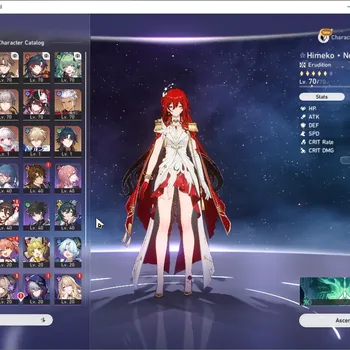
Traces are the per-character skill tree. Within it you level the four combat abilities, activate three Bonus Abilities, and unlock ten stat nodes spread across three stats chosen to suit that character. The tree's layout is dictated by the character's Path, so two Erudition units share a shape while a Remembrance unit looks different.
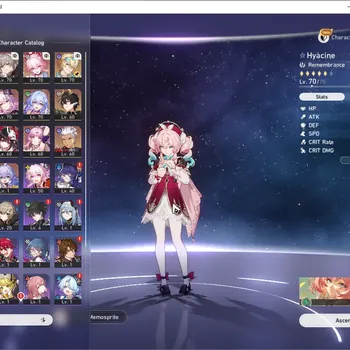
The ability nodes have hard ceilings that differ by type. Basic ATK tops out at level 6, while Skill, Ultimate and Talent each top out at level 10. Those four nodes carry the character's damage and healing multipliers, so they are where the visible power lives. Remembrance characters split this further, adding Memosprite Skill and Memosprite Talent nodes for the summoned companion, which is worth knowing before you budget materials for one.
The three Bonus Abilities are the ascension-locked layer, unlocking at Ascension 2, Ascension 4 and Ascension 6. They function like extra passive Talents and cannot be leveled once activated, so each is a single flat purchase. They also gate access to some of the stat nodes behind them, which is why the tree opens outward rather than all at once and why an un-ascended character shows large greyed sections.
The ten stat bonuses are small individually, typically a few percent of ATK, DEF, HP, CRIT Rate, Break Effect and Toughness break damage or an elemental damage type depending on the character, but they are cheap and they compound with everything else on the build. Because they cost only common Calyx and enemy materials rather than the scarce items, clearing every stat node is usually the highest value-per-material action available on a character you already like. Which characters deserve that spend depends on your lineup, and the guide to HSR characters, Paths and team building is the right place to work that out before committing materials.
What do Trace upgrades cost, and what gates them?
Trace upgrades consume Credits plus four material families: Crimson Calyx drops matched to the character's Path, common enemy drops, Echo of War boss drops, and Tracks of Destiny. The first two are abundant, the third is weekly-capped, and the fourth is the genuine bottleneck.
Crimson Calyx is where most of your Trailblaze Power goes over a character's lifetime. Each Calyx is tied to a Path, so a Harmony character and a Nihility character farm different nodes, and running the higher difficulty tier improves the odds of the higher-rarity tiers you need later. These materials cover the bulk of the tree from the ground up to around level 8 on the main abilities.
Echo of War is the weekly wall. Its drops are required to activate Bonus Ability traces and to push Skill, Ultimate and Talent past level 8, and the game only pays out Echo of War rewards three times per week. That single limit is why finishing one character's tree takes multiple weeks regardless of how much Trailblaze Power you have banked, and why choosing which boss to run each week is a real decision rather than a formality.
Tracks of Destiny are scarcer still. They are required to activate the Bonus Abilities unlocked at the fourth and sixth ascensions and to take Skill, Ultimate and Talent to their maximum level. They do not drop from any farmable node. They arrive from Simulated Universe rewards, the Nameless Honor track, occasional events, and a purchase from the Embers Exchange that is limited to once per month. Community-compiled totals for a fully maxed 5-star tree, using Dr. Ratio as a worked example, land around 8 Tracks of Destiny and roughly 3,000,000 Credits, so the practical constraint on how many characters you can max is not skill or Trailblaze Power but how many Tracks of Destiny your account has accumulated since launch.
Two soft gates sit on top of all of this. Trace tiers unlock only as the character ascends, and ascension itself needs Equilibrium Level, so the whole system chains back to account progress. A brand-new account with a perfect material stockpile still cannot max a tree.
What order should you invest in?
The efficient order is: level the character to the cap your Equilibrium currently allows, clear every cheap stat node, take Skill and Talent to 8, then Ultimate to 8, then activate Bonus Abilities as ascensions unlock them, and only afterwards spend Tracks of Destiny pushing 8 to 10. That sequence front-loads the cheap multipliers and defers the scarce resource.
The reason is the shape of the cost curve. Levels 1 to 70 and trace levels up to 8 are paid for with materials you can farm on demand, whereas the last two trace levels and the two late Bonus Abilities are paid for with Tracks of Destiny that arrive on a fixed monthly trickle. Spending a Track on your fourth-best character is a decision you cannot reverse, and there is no refund mechanism anywhere in the ascension or trace systems.
A second rule of thumb concerns breadth versus depth. Because the last two ascensions consume 55 of a 5-star's 65 Stagnant Shadow drops, taking three characters from 70 to 80 costs roughly the same boss material as taking eleven characters from 1 to 70. For most endgame content a full team of level-70 characters with completed trace trees clears more reliably than one level-80 character carrying two underbuilt teammates, so breadth generally wins until your roster is deep enough that further breadth adds nothing.
Sustaining any of this depends on Credits, which every step above consumes and which no amount of planning can substitute for. Credits come primarily from Golden Calyx runs, Assignments, Simulated Universe and daily activity, and a Credit shortage will stall a build long before a material shortage does, which is why experienced players keep a Golden Calyx day in their weekly rotation even when they do not feel short.
How does ascension progress show up on an account?
Ascension leaves a clear, readable trail. Trailblaze Level and Equilibrium Level show the account's hard ceiling, the count of level-80 characters shows how much Stagnant Shadow farming has been done, and trace levels on the main damage dealers show how many Tracks of Destiny and Echo of War weeks have been invested.
Those three signals are not interchangeable. A high Trailblaze Level with few ascended characters usually means an account that explored and ran story without committing to builds. A cluster of level-70 characters with maxed stat nodes but 8-level abilities means a player who farmed efficiently and simply has not had the calendar time to accumulate Tracks of Destiny. Reading the difference tells you far more about a roster's real combat readiness than the character list alone does.
Server also matters here, because ascension progress is bound to the account and region it was built on rather than to the device you play it from. If you are unclear on how regions and progression carry across platforms, the explainer on HSR servers and cross-progression covers how that works.
The practical takeaway is the one the intro promised. Materials are recoverable and Credits regenerate, but Equilibrium Level and Tracks of Destiny are both paid for in calendar time, and those two are what actually determine how far a character can go this month.
Frequently asked questions
Does the Trailblazer ascend the same way as other characters? The structure is identical, but the material is not. The Trailblazer uses Enigmatic Ectostella, which is granted through Trailblaze Missions and Trailblaze Level rewards collected from Pom-Pom rather than dropped by any Stagnant Shadow boss.
Do you get anything for ascending besides a higher level cap? Yes. The first, third and fifth ascensions each award a free Star Rail Pass, so taking a character through to level 70 returns three Warp tickets along the way, on top of unlocking the trace tiers.
Is it better to take one character to 80 or several to 70? Several to 70, for most accounts. The final two ascensions consume the large majority of the Stagnant Shadow cost, so the same farming budget spread across a full team produces more reliable clears than a single maxed unit alongside underbuilt teammates.
Can ascension materials be converted between characters? Only partly. The Omni-Synthesizer converts common enemy drops upward in rarity and allows some exchanges, but Stagnant Shadow drops are tied to specific bosses and specific characters, so those cannot be repurposed once farmed for the wrong unit.
Where to Find Honkai Star Rail Top Up and Accounts
On GameMarket.gg you can compare Honkai: Star Rail top-up options before you spend.
If you would rather start from a roster that already has the ascensions and trace levels done, browse the current Honkai: Star Rail accounts available on GameMarket.gg, where listings state Trailblaze Level and named characters up front. Rosters already past the Equilibrium 5 wall sit in the end game account category, while accounts still climbing the middle ascensions are grouped under mid game accounts.
GameMarket.gg is a trusted digital marketplace for everything gaming-related. We serve the gaming community by providing secure access that enhances every gaming journey.