eFootball Defending Guide: Pressure, Match-Up and Tackling
By John Ganang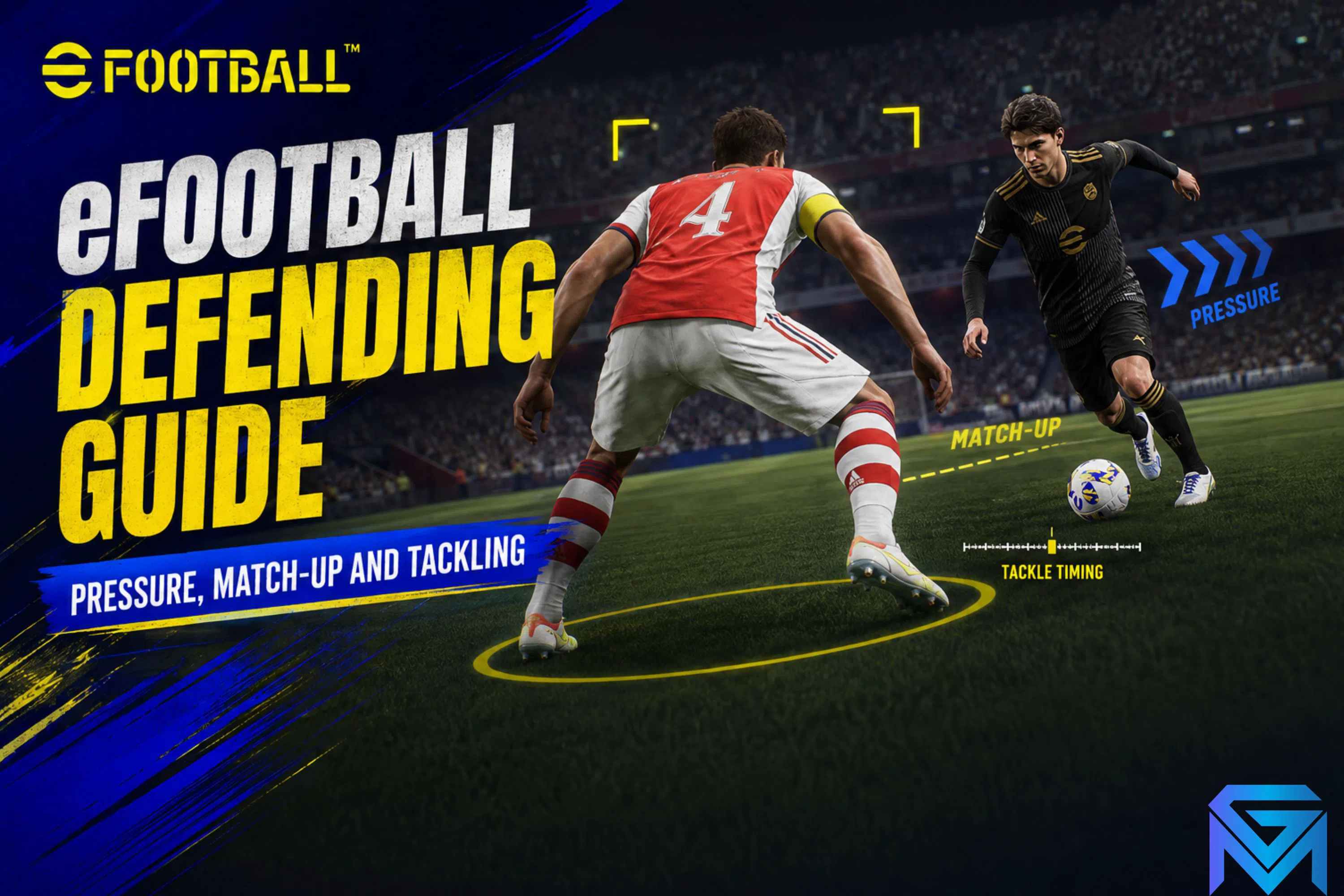
Defending in eFootball is won by delay, not by lunging: the reliable method is to hold your shape, contain the ball carrier with a light press, call a second defender to close the passing lane, and only tackle when the attacker has taken a heavy touch. Chasing the ball is what concedes goals. We cover EFootball Live Events Explained separately.
Most players who stall in the middle divisions do not have a squad problem. They have a defending problem, and it shows up the same way every match: the ball carrier gets isolated one-on-one, the defender sprints in, the attacker rolls him with one touch, and suddenly there are two players running at a back line that has already been pulled out of position. This guide covers what your defenders are actually doing when you hold each button, which team tactics change their behaviour, and how to defend the four attacking patterns you will meet most often in ranked play.
What does defending actually do in eFootball?
Defending in eFootball is a delay system rather than a ball-winning system. Your inputs decide how close a defender stands, how aggressively he steps in, and whether a second player joins. The ball is usually recovered because the attacker ran out of options, not because you tackled it.
That distinction matters because it changes what a successful defensive sequence looks like. If you measure yourself by tackles won, you will keep diving in, because a tackle is the only event that feels like a reward. If you measure yourself by whether the attacker was forced backwards or sideways, you will start winning possession in the places where losing it does not hurt you. eFootball's dribbling model gives the attacker a large advantage in a straight one-on-one, because the ball carrier chooses the moment to move while the defender can only react. Every defensive tool in the game is therefore built around removing that choice: taking away the forward pass, taking away the space to run into, and making the attacker commit first.
The practical version of this is a simple hierarchy. Position first, contain second, tackle last. Everything below is an expansion of that order.
What are the main defending controls, and what does each one do?
Four inputs cover almost all defending: a light press to close down, a held press to stay in front of the attacker, a teammate call that brings a second defender across, and a sliding tackle. Player switching sits alongside them, because it decides which defender the other three apply to.
On the default console layout the press is the cross button on PlayStation and A on Xbox, the teammate call sits on R1 or RB, the sliding tackle is on circle or B, and manual player switching is on L1 or LB. Konami has changed button assignments between versions and every layout can be remapped, so confirm your own scheme in the game's Controller Settings screen before you drill any of this. On mobile the same actions exist under both Classic and Advanced control types, alongside an auto-defending assist that presses for you. That assist is fine while you learn the flow of a match, but it will always press the nearest attacker rather than the dangerous one, so it becomes a ceiling once you reach the higher divisions.
The distinction that decides most one-on-ones is tapping versus holding the press. A tap sends your defender in and commits him to a movement, whereas a hold keeps him goal-side and matched to the attacker's body, backing off at the attacker's pace. That held press, which the game calls a match-up, is the single most valuable defensive habit in eFootball, because it converts a duel the attacker is favoured to win into a stalemate that costs him time. Time is what lets your other nine outfield players get back into shape.
Player switching deserves more attention than it usually gets, because automatic switching picks the player nearest the ball, and the player nearest the ball is frequently the one you least want to move. Pulling your last centre-back forward to press a winger is how a simple wide attack becomes a clear run at goal. So when an attack develops down a flank, switch deliberately to the full-back or the covering midfielder and leave the central defenders where they are.
Why does chasing the ball lose more goals than it wins?
Because a committed defender is a removed defender. The moment your player lunges, the attacker knows exactly where he will be for the next second, and eFootball's dribbling animations are generous to whoever moves second. One beaten defender does not concede; the shape collapse behind him does.
This is also where the most common ranked mistake lives, which is pressing with a centre-back. When you take control of a central defender and run him at the ball, you have voluntarily opened the exact channel the attacker wanted. The correct player to press with is almost always a midfielder or the full-back on that side, because if he is beaten there is still a line behind him. The question during a defensive phase is therefore not how you get the ball back, but which player can afford to lose this duel.
There is a fitness cost too. Each failed lunge drains stamina, and stamina loss makes the same defender slower for the rest of the match, which is why a squad that presses constantly for twenty minutes concedes in the last ten. Defending patiently is partly a stamina strategy, and it is one that compounds across a long league phase.
How should you use the second-man press without opening gaps?
Hold the teammate call only in short bursts, and only when the ball carrier is facing away from your goal or is near a touchline. The called defender runs a scripted path towards the ball, so holding it continuously drags a second player permanently out of shape and turns a contained attack into a two-versus-one. For the detail behind that, see Set Piece Guide Free Kicks, Corners and Penalties.
The reliable pattern is to contain with the player you control and tap the teammate call for roughly a second at a time, releasing whenever the attacker turns forward. What you are trying to do is not win the ball with the second man; you are trying to make him stand in the passing lane so the attacker has nowhere to lay the ball off. Once that lane closes, most attacking players either play backwards, which is a win for you, or attempt a threaded pass into traffic, which is where interceptions come from.
Touchlines do the work of an extra defender, so contain towards the sideline rather than towards the middle whenever you have the choice. An attacker with the ball in a wide area has far fewer passing options and a much worse shooting angle than the same attacker eight metres infield, which is why steering play wide is worth more than any individual tackle.
When is a sliding tackle worth the risk?
A slide is correct in three situations: the attacker has taken a heavy touch, the ball is being shielded near a touchline, or a shot or cross is about to be struck and you can reach it. Anywhere else, and in your own penalty area especially, the risk of a foul outweighs the reward.
eFootball's foul logic reads contact direction and timing, so a slide made from behind or across the attacker's standing leg is far likelier to be given than one made from the side while moving with him. That is also why slides inside your box are so expensive: the same animation that wins the ball cleanly in midfield becomes a penalty and a possible red card in the area, and the game will not warn you before you press it. Standing tackles, which come from the press input when your defender is already alongside the attacker, are the safer default in dangerous zones because a mistimed one usually costs a step rather than a set piece. There is a fuller breakdown in EFootball Squad Building Guide.
The heavy-touch cue is the one worth training your eye on. When an attacker sprints, the ball travels further ahead of him with each touch, and there is a visible moment where he is not in contact with it. That gap is the invitation, and it is the only moment in open play when a slide is close to a free action.
How do defensive team tactics change what your back line does?
Team tactics set the behaviour your players default to when you are not controlling them. Defensive line height decides how far up the pitch your back four sits, compactness decides how tightly the block squeezes towards the ball, and the defensive tactic itself decides whether the team hunts the ball or retreats into shape. Our guide breaks down Division Climb Guide Match Tactics That Win Points.
A high defensive line compresses the pitch and makes the second-man press far more effective, because your midfielders start closer to the ball and recover it in areas where a turnover immediately threatens the opponent's goal. It also leaves a large area behind the back line, so it only works if your centre-backs have the pace to defend that space. A deep defensive line does the opposite: it removes the ball behind the defence as an attacking option, hands the opponent the midfield, and asks you to defend a crowded box. Neither is correct in the abstract, because the choice follows your centre-backs' speed and your own comfort defending in space versus defending in a crowd.
Compactness is the setting most players never touch and probably should. A tighter block closes the central passing lanes that through balls live in, at the cost of leaving the far side of the pitch open, so it pairs naturally against an opponent who plays through the middle. Individual Aggressiveness settings then decide how eagerly each player leaves his position to press, and turning it down on your defensive midfielder is often the fastest fix for a team that keeps getting split open through the centre.
Playing Styles and Player Skills sit underneath all of this. A defensive midfielder with the Anchor Man or Destroyer style holds a screening position in front of the back four instead of drifting forward, which is worth more to a leaky defence than a higher-rated centre-back would be, and a Defensive Full-back stays home rather than joining attacks. Card attributes matter in the same quiet way, because Defensive Awareness governs positioning while the game is controlling the player, Ball Winning governs how often a challenge succeeds, and Defensive Engagement governs how quickly he steps towards the ball. A high Overall on a card whose Playing Style pulls him out of position will still defend worse than a lower-rated specialist who stays where you need him.
How does stamina change your defending in the last twenty minutes?
Stamina drains fastest from sprinting and from repeated pressing, and a tired player loses acceleration and reaction speed before he loses top speed. That is why late goals so often arrive down one flank: the full-back who has pressed all match can no longer recover the two metres he used to.
Condition arrows on the team sheet set the starting point, because a player on a poor condition arrow begins the match with less to spend and fades earlier. Since condition is rerolled between matches and is not something you can train, the practical response is a substitution plan rather than a squad change. Bringing on a fresh full-back or defensive midfielder around the hour mark restores the pressing intensity you have been spending all match, and it is a far cheaper fix than trying to defend the last half hour with legs that no longer arrive in time. For the wider picture of how cards, condition and squad ratings fit together, the eFootball beginner's guide to player cards, coins and squads covers the surrounding systems.
How do you defend the four attacking patterns you see most often?
Through balls, wing play, a dribbler running at your defence, and fast counterattacks account for most goals conceded in ranked eFootball. Each has a specific answer, and in every case the answer is a positional adjustment made before the ball moves rather than a reaction afterwards. It is worth knowing Formations Explained Best Setups for Beginners.
Against through balls, the fix is denying the passing angle rather than tracking the runner, so keep a controlled midfielder in the lane between the ball and the striker, raise compactness, and accept passes played wide. Against wing play and crossing, defend the near post with your controlled player and let the automatic defenders occupy the box, because switching to the player nearest the incoming cross usually pulls a marker off the striker who is about to receive it. Against a dribbler, the match-up hold is the whole answer: stay goal-side, back off towards your own box, and let him run into the compact area where a teammate can step in.
Counterattacks are the pattern that punishes attacking habits rather than defensive ones. If you commit both full-backs high and lose the ball in the opponent's third, no defensive setting will save the transition. The two changes that help are keeping one holding midfielder permanently behind the ball, and using the first two seconds after a turnover to run a defender back into the centre rather than pressing the ball carrier, since counterattacks are almost always resolved by whoever arrives centrally first.
Where can you practise defending without risking your division?
Training mode and the offline event and tour matches let you rehearse the same defensive sequence repeatedly without a rank cost. That matters because defending is mostly muscle memory, and the specific memory you need is releasing the press before an attacker turns, which is hard to learn while you are also worrying about a result.
A useful drill is to play a full offline match with a single constraint: never use the sliding tackle. Playing without it forces you to rely on containment and on the second-man press, and most players find they concede fewer goals with the tackle removed than with it available. Once that feels natural, add the slide back in for heavy-touch situations only. The same habits are what carry over into ranked play, because a division ladder rewards consistency far more than any single spectacular recovery.
Common questions about defending in eFootball
Does a higher-rated centre-back fix a leaky defence? Only partly. Attributes such as Defensive Awareness and Ball Winning improve the outcome of duels your defender is already in the right place for, but they do not correct a shape that keeps getting pulled apart by manual pressing. Positioning improvements are usually worth more than a rating upgrade.
Is auto-defending on mobile a disadvantage? It is a reasonable starting point and a ceiling later. The assist presses the nearest attacker, which is often the decoy rather than the threat, so competitive play eventually requires manual switching and manual containment.
Why do my defenders ignore an obvious runner? Uncontrolled players follow the marking and Aggressiveness settings you have assigned, not the danger you can see. If one runner is repeatedly free, check the marking assignments and lower the Aggressiveness of the player who keeps leaving him.
Does a fresh substitute really defend better than a starter? Yes, in the phase of the match where it decides results. Stamina loss reduces acceleration and reaction speed first, so a substitute with full stamina reaches challenges a tired starter arrives late for, even when the starter has better attributes on paper.
If you would rather have someone else grind the division climb while you work on these habits, browse the available eFootball boosting listings, or look at the eFootball hourly service options if you prefer a session-based arrangement; both sit inside the wider eFootball market hub.
GameMarket.gg is a trusted digital marketplace for everything gaming-related. We serve the gaming community by providing secure access that enhances every gaming journey.