eFootball Set Piece Guide: Free Kicks, Corners and Penalties
By John Ganang 14 September 2026, 08:00 WIB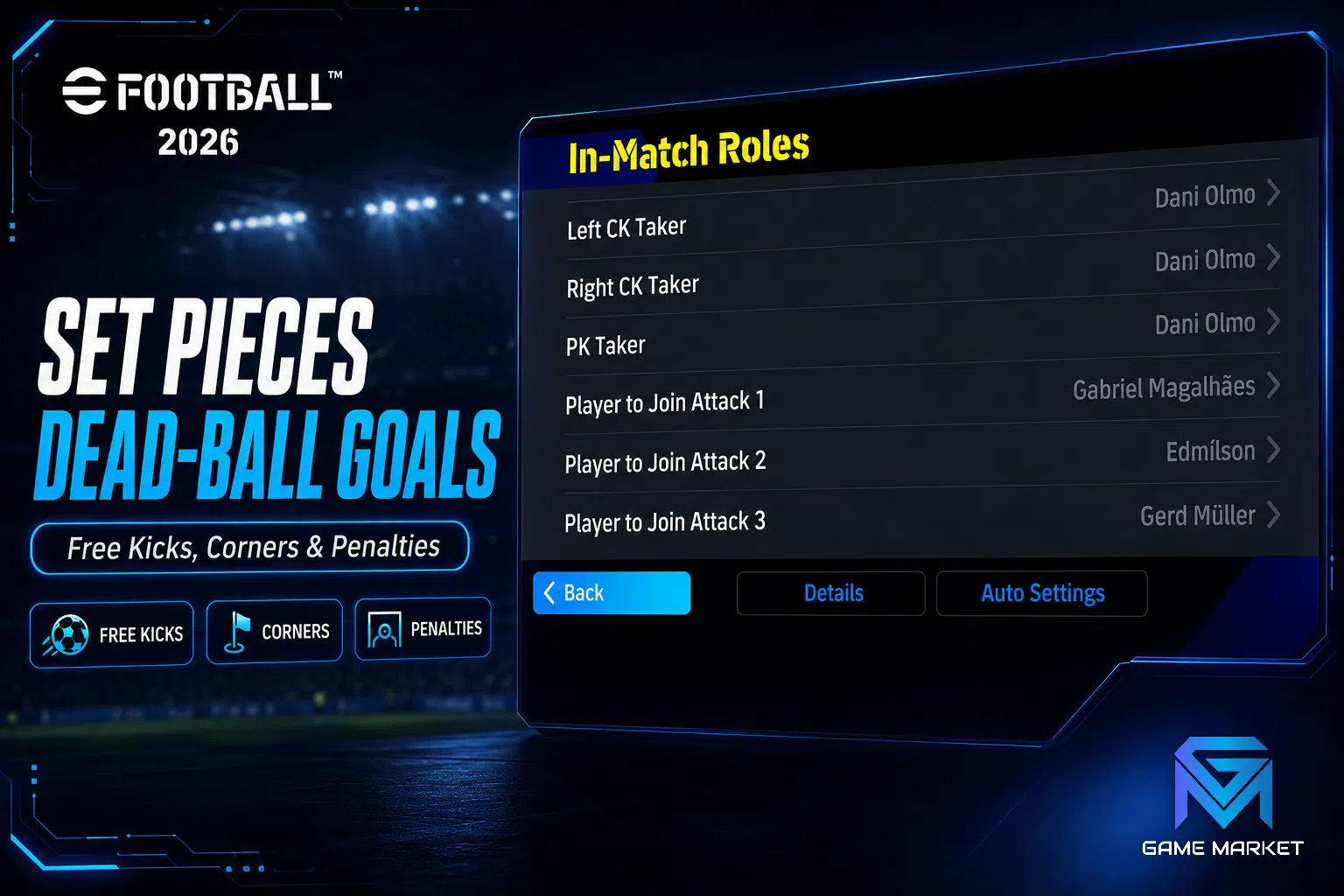
Set pieces in eFootball are the restarts you fully control: free kicks, corners and penalties. Because the ball is dead and the camera gives you an aiming reticle, they are the most repeatable way to score in the game. Learn the aiming rules once and they convert in every division.
Most players treat a free kick as a lottery. It is not. Konami's shooting model for dead balls uses a small number of inputs (aim direction, power, curve and, on the newer kick meter, a timing window) and those inputs behave the same way in every match, on every pitch, against every opponent. That consistency is exactly why set pieces are worth practising. Open play in eFootball changes constantly as your squad, your opponent's Team Playstyle and the condition arrows on the day all shift the balance. A corner routine does not change. Once you own a reliable near-post corner and one free-kick angle you trust, you have added goals to your account that no rating gap can take away.
This guide covers what each set piece actually is, how the controls map to the outcome, which player attributes decide whether the kick beats the wall, and how to defend the same situations when the restart belongs to your opponent.
What are set pieces in eFootball and why do they decide close matches?
Set pieces are restarts from a stopped ball: direct and indirect free kicks, corner kicks and penalty kicks. They matter because eFootball's Division-level matches are frequently decided by one goal, and a set piece is the only attacking phase where the defence cannot press you and you get a clean, unhurried aim.
In open play, every shot you take is contested. The defender is closing, your player's body shape is wrong, the pass arrived on the weak foot. A set piece removes all of that. The ball is stationary, your taker is chosen, and the opposition is frozen at the regulation distance. The only variables left are your own inputs and the taker's attributes.
That has a practical consequence for how you should think about squad building. A team that wins its individual duels will beat you in open play if the rating gap is large enough. But the same team concedes the same corner routine as everybody else. Set pieces are the great leveller in eFootball, which is why higher-division opponents almost always have a dedicated taker in the squad and a routine they run every single time.
There are four restarts worth learning properly:
- Direct free kick. A shot on goal from a dead ball, usually from 18 to 30 metres out, with a defensive wall between you and the keeper.
- Indirect or crossed free kick. A delivery into the box from wide or deep areas, aimed at a teammate rather than the goal.
- Corner kick. A cross from the corner arc, with your tall players pushed up into the box.
- Penalty kick. A one-on-one with the goalkeeper from the spot, decided entirely by aim and timing.
Each has its own control scheme and its own failure mode. Treat them as four separate skills rather than one.
How do you take a direct free kick in eFootball?
Aim with the left stick to set the direction of curve, hold the shoot button to fill the power gauge, then release. Aiming slightly outside the far post and letting the curve bring the ball back in is the highest-percentage shot, because it travels around the wall rather than over it.
The single most common mistake is aiming at the goal. New players point the reticle at the space between the keeper and the post, fill the bar, and watch the ball smash into the wall or fly into the crowd. Curve is applied after the ball leaves the boot, so your aim point has to account for the arc that is about to happen. Aim wide of the target and let the physics do the rest.
Power is the second variable and it is more forgiving than people expect. Roughly two thirds of the gauge is the working range for a shot from the edge of the box. Below that the ball arrives slowly enough for the keeper to set himself. Above roughly 80 percent the ball rises and the shot stops dipping in time.
Distance changes the shot you should choose:
- 18 to 22 metres, central. The wall is directly in the way and the keeper has almost no ground to cover. A curled effort around the outside of the wall into the near top corner is the standard answer here.
- 22 to 28 metres, wide of centre. The most productive band. You have an angle past the edge of the wall, and the keeper has to cover the far post. Aim outside the far post with heavy curve.
- Beyond 30 metres. Direct shots become low percentage. Treat these as crossing opportunities into the box instead.
- Very wide, near the byline. Not a shooting position at all. Deliver the ball like a corner.
There is a second option that is badly underused: the low free kick under the jumping wall. The wall jumps on almost every direct free kick, and a driven low shot aimed under it arrives before the keeper has committed. It is situational and it fails if the wall does not jump, but against opponents who have learned to defend the curled effort it is a genuine surprise.
The taker's Place Kicking attribute governs how tight the curve is and how much the ball dips at the end of its flight. A taker with high Place Kicking and the Knuckle Shot or Rising Shots playing style produces a noticeably different ball flight to a defender standing over the same kick. Attributes are not a gimmick on set pieces, they are most of the outcome.
Which player should take your free kicks?
Pick the player with the highest Place Kicking rating and a curl-related playing style, then check that his stronger foot suits the side of the pitch you are kicking from. In eFootball a left-footed taker on the right of goal curls the ball away from the keeper, which is the harder ball to save.
Squad rating does not tell you who your best free-kick taker is. A 95-rated striker can have mediocre Place Kicking, and a 78-rated midfielder can be excellent at it. You have to open the player card and read the attribute directly. The related numbers to check are Place Kicking, Curl and Kicking Power. If you are unfamiliar with how those numbers are laid out on the card, our breakdown of eFootball player stats, ratings, playing styles and skills walks through what each attribute controls.
Footedness is the part most players never configure. The rule is straightforward:
- Free kick on the right side of the pitch: a left-footed taker curls the ball away from the goalkeeper and towards the far post.
- Free kick on the left side: a right-footed taker does the same thing in mirror image.
- Central free kicks: either foot works, so use whoever has the better Place Kicking.
An away-swinging ball is harder to save than an in-swinging one because the keeper has to move across his goal while the ball is still bending. If your squad has both a left-footed and a right-footed specialist, you can assign them separately in the set-piece takers menu rather than accepting whoever the game defaults to. That menu also lets you nominate different takers for corners, penalties and long-range free kicks, which is worth doing once and then forgetting about.
How do corners work in eFootball and how do you score from them?
A corner is a manually aimed cross from the corner arc. Move the reticle to a target zone, choose a normal, lofted or low cross, and set power. Near-post deliveries at roughly half power to a tall attacker are the most consistent way to score, because the keeper commits late and defenders lose the flight.
Before you kick anything, look at who is in the box. eFootball lets you push extra players forward on a corner, and the difference between three and five bodies in the area is enormous. Sending your centre-backs up for a corner is standard practice, since they are usually your tallest players with the best Heading attribute.
Three deliveries are worth having in your repertoire:
- Near-post, half power, normal cross. The bread and butter. Aim just in front of the near post so a runner meets it moving towards goal. Contact does not need to be clean because a flick continues the ball's momentum into the far corner.
- Back-post lofted cross. Higher power, aimed beyond the six-yard box. This targets an unmarked runner arriving late and works well against opponents who over-commit to the near post.
- Short corner. A pass to the nearby teammate, which drags a defender out and opens a cut-back angle. Underrated, and very effective against defences that pack the box.
The attacker matters as much as the delivery. Check the Heading and Physical Contact attributes on your target man, and look for the Aerial Threat playing style, which changes how aggressively a player attacks a high ball. A striker with high Heading and Aerial Threat wins corners that a taller but passive player would not contest at all.
One habit that pays: vary the delivery. Opponents adapt. If every corner goes to the same near-post zone, a human opponent will start crowding it by the second half. Alternate near post, far post and short corner so the defence cannot settle.
How do you take penalties in eFootball?
Aim with the left stick, hold the shoot button for power, and release. Around 60 to 70 percent power aimed low into a corner is the reliable penalty in eFootball, because it stays under the keeper's dive height and does not risk the crossbar that swallows full-power efforts.
Penalties reward restraint. The instinct is to hammer the ball, but a full-power penalty in eFootball rises sharply and the margin for error at the top corners is tiny. A firmly struck low shot into the side netting is nearly unsaveable and almost never misses the target.
Two further points decide penalty shootouts:
Do not aim at the very corner. Point the reticle slightly inside the post. The shot still finishes in the corner once power spreads the aim, and you remove the risk of a kick that drifts wide by a fraction.
Change sides against human opponents. A human keeper reads patterns quickly. If you have gone left twice, the third dive is going left. Alternate, and use the centre of the goal occasionally, since a keeper who commits early leaves the middle completely open.
Your taker's Finishing and Kicking Power attributes influence how tightly the shot tracks your aim, and some players carry a penalty-specific playing style. As with free kicks, assign a dedicated penalty taker in the set-piece menu rather than letting the game pick your highest-rated forward by default.
How do you defend set pieces in eFootball?
On defensive free kicks, add players to the wall when the kick is central and within range, then control your goalkeeper's positioning rather than a defender. On corners, mark the near post, keep your tallest defenders back and avoid pressing the ball until the cross is in flight.
Defending restarts is half the value of understanding them, and it is where most conceded goals in tight matches come from.
For a direct free kick against you, the wall size is adjustable. A bigger wall covers more of the goal but slows your rush out if the taker plays a pass instead. Central kicks between 20 and 28 metres deserve the extra body. Wide kicks rarely do, since the shooting angle is poor and the real threat is the cross.
For a corner against you, three habits matter:
- Do not chase the ball with an outfield player. Sprinting a defender at the flight of a cross pulls him out of position and leaves the runner free. Hold your shape and contest at the point of contact.
- Keep your best headers in the box. Check that the game has not pushed a tall centre-back forward for a counter.
- Watch for the short corner. If the taker plays a pass, close it immediately, because the cut-back that follows arrives at the penalty spot where nobody is marking.
Goalkeeper attributes are decisive here in a way that squad rating hides. GK Catching and GK Clearing determine whether a claimed cross ends the danger or spills into the six-yard box. A keeper who punches everything into a crowded area is repeatedly giving your opponent a second chance from every corner.
How do you practise set pieces without wasting match time?
Use the Training or Practice Match mode, where set pieces can be repeated without a result on the line. Ten focused minutes on one free-kick distance produces more improvement than a full evening of ranked matches, because you get dozens of repetitions instead of two.
Deliberate practice is what separates a player who occasionally scores a free kick from one who expects to. The routine that works is narrow and repetitive:
- Pick one distance and one angle and stay there. Learning a 24-metre kick from the right half-space is a real skill. Randomly taking kicks from everywhere teaches you nothing.
- Change only one input at a time. Fix your aim point, then vary power alone until you know where the ball goes at each level. Then fix power and vary aim.
- Take at least twenty repetitions before judging whether the setting works. Ball flight in eFootball has variance and three attempts tell you nothing.
- Write down what worked. Aim point, power percentage, taker. Your settings are worth nothing next week if you cannot remember them.
- Then use it in a real match. Practice-mode confidence does not transfer until you have taken the kick with something at stake.
Once the routine is reliable, it compounds. Set-piece goals are especially valuable during the promotion phases of the ranked ladder, where a single point can decide whether you go up. Our guide to the eFootball Division system, points, phases and promotion explains how those thresholds work and why one-goal margins matter so much. If you are still getting to grips with the squad and currency systems that sit underneath all of this, the eFootball beginner's guide to player cards, coins and squads is the place to start.
Which player attributes and playing styles matter most for set pieces?
Place Kicking is the single most important attribute for free kicks and corners. Curl shapes the arc, Kicking Power sets ball speed, Heading and Physical Contact decide who wins the header, and GK Catching determines whether your keeper ends the attack or invites a rebound.
Reading the card properly changes who you pick. The attributes that actually govern dead balls are:
- Place Kicking. Governs accuracy and curve on free kicks and corners. The first number to check on any prospective taker.
- Curl. Controls how much the ball bends. High Curl is what gets a shot around a wall.
- Kicking Power. Ball speed. Useful, but a very high value makes fine power control harder, not easier.
- Finishing. Applies to penalties and to shots taken directly from a dead ball.
- Heading and Physical Contact. Decide corner outcomes. A target man needs both, since winning position matters as much as jumping.
- GK Catching and GK Clearing. Your defensive set-piece insurance.
Playing styles layer on top. Aerial Threat makes an attacker attack crosses more aggressively. Knuckle Shot and Rising Shots alter dead-ball flight in ways a keeper struggles to read. According to Konami's in-game descriptions, playing styles change player behaviour rather than simply adding a numeric bonus, which is why two players with identical Place Kicking can produce very different free kicks.
Frequently asked questions about eFootball set pieces
Can you change who takes free kicks and penalties in eFootball?
Yes. Set-piece takers are assigned in the squad management menu, with separate slots for short and long free kicks, corners from each side, and penalties. The game picks defaults that are often not your best options, so it is worth setting manually once.
Why does my free kick always hit the wall?
Almost always because the aim point is too close to the goal. Curve is applied after the ball is struck, so you need to aim outside the far post and let the bend bring it back. If it still hits the wall, reduce power slightly so the ball has more time to curve.
Are short corners actually worth taking?
They are, particularly against opponents who pack the six-yard box. A short corner pulls a defender out and creates a cut-back angle to the penalty spot, which is usually the least defended area in the box on a corner.
Does the goalkeeper's rating matter on penalties?
It affects reaction and dive range, but aim and power matter more. A low shot into the corner at roughly two thirds power beats most keepers regardless of rating, because it stays under the height at which a dive is effective.
Should centre-backs go up for corners?
Usually yes, since they tend to have the best Heading and Physical Contact values in the squad. The trade-off is exposure to a counter-attack, so it is a better idea when you need a goal than when you are protecting a lead.
If you would rather have an experienced player work on your Division push directly, you can browse the available eFootball boosting listings on GameMarket.gg, or arrange a session with a coach through eFootball hourly services and have your set-piece routine reviewed while you play.
GameMarket.gg is a trusted digital marketplace for everything gaming-related. We serve the gaming community by providing secure access that enhances every gaming journey.