eFootball Squad Building Guide: Formations, Roles and Proficiency
By John Ganang
A strong eFootball squad is built by matching a Team Playstyle to a formation, then filling every position with players whose Playing Styles and Playstyle Proficiency fit that role. Raw Team Strength matters far less than proficiency, position adaptability and stamina across a full match.
That single idea separates squads that look good on the team screen from squads that actually win Division rivals matches. Konami's team-building system is built on fit, not on the biggest number: an 89-rated striker played out of position with the wrong Playing Style will consistently underperform an 82-rated striker who sits exactly where the tactic wants him. This guide walks through the whole build in the order the game actually rewards — tactic first, formation second, roles third, and individual upgrades last — with the specific mechanics, breakpoints and habits that decide whether your squad holds up in the higher divisions.
Does Team Strength actually tell you how good your squad is?
Team Strength is a weighted average of your starting eleven's overall ratings adjusted for tactical fit, so it is a rough guide only. Two squads with identical Team Strength can play completely differently depending on proficiency, formation shape and manager tactics.
The number shown on your squad screen is calculated from the eleven starters, with contributions from the bench and from how well your players suit their assigned positions. Because the calculation blends fit into the total, a squad that jumps five points after a single signing has usually gained tactical coherence rather than raw quality. Konami has never published the exact formula, and the community-tested behaviour is consistent: moving a player into a position he has no adaptability for drags the number down even when his overall rating is unchanged.
The practical consequence is that Team Strength is a lagging indicator. Use it as a sanity check — a sudden drop usually means you broke a position fit — but never as the target you optimise. Players who chase Team Strength end up with eleven high-rated cards who do not press together, do not overlap and run out of stamina by the seventieth minute. Players who chase fit end up with a lower number and better results.
If you want the underlying attributes explained properly before you start comparing cards, the eFootball player stats guide covering ratings, Playing Styles and skills breaks down which numbers move which behaviours on the pitch.
Why should you choose a Team Playstyle before you choose players?
The Team Playstyle decides how your side builds attacks, where players position themselves off the ball and which individual Playing Styles get used. Choosing it first turns squad building from a shopping list into a checklist, because every position gains a clear job description.
eFootball offers a small set of team-level approaches — possession-oriented build-up, quick counter, long-ball counter, out-wide play and long-ball play among them — and each one rewrites your team's off-ball movement. Possession Game asks full-backs to tuck in and midfielders to offer short angles. Quick Counter asks forwards to break the defensive line the instant possession changes. Out Wide pushes wingers to hug the touchline and demands crossing quality plus a target in the box.
Because the tactic dictates movement, it also dictates which Playing Styles are useful. A Deep-Lying Forward is excellent in a possession side and largely wasted in a long-ball counter, where a Fox in the Box or a Goal Poacher will convert far more of the chances your shape creates. The same is true of full-backs: Offensive Full-back and Full-back Finisher only earn their keep if the tactic actually sends them forward.
Pick the tactic that matches how you enjoy playing, not the one that is fashionable. A player who likes patient build-up will get more out of a possession squad they understand than a counter squad the meta prefers. The team playstyle guide explaining every option covers how each approach changes movement so you can commit to one before spending resources.
Which formation should you build your squad around?
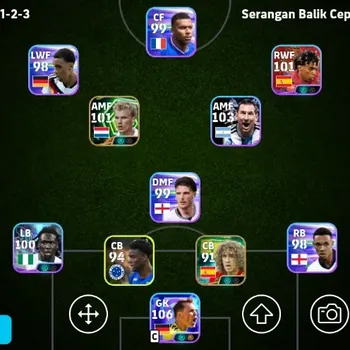
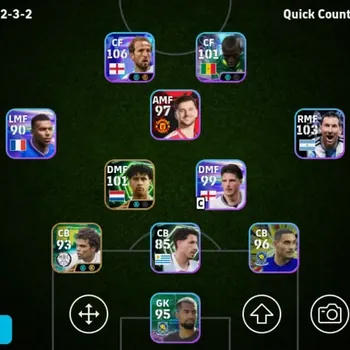
Choose the formation that gives your Team Playstyle the shapes it needs: a possession side wants a midfield triangle and short passing angles, a counter side wants pace in wide areas and a striker who stays high. The formation is a delivery system for the tactic, not a separate decision.
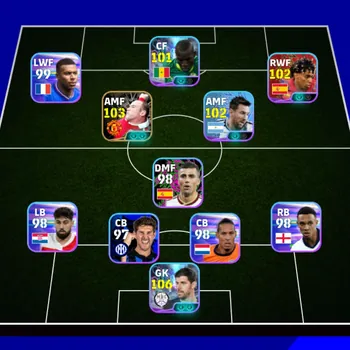
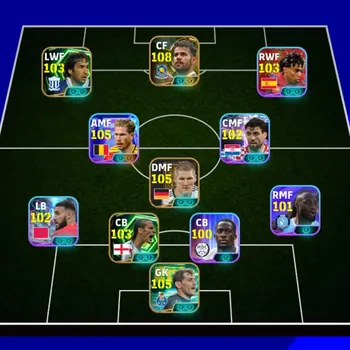
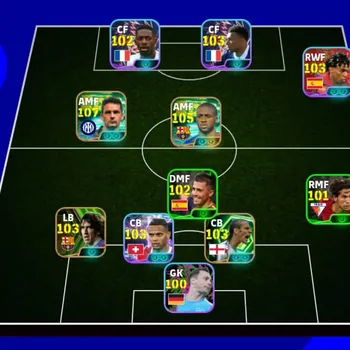
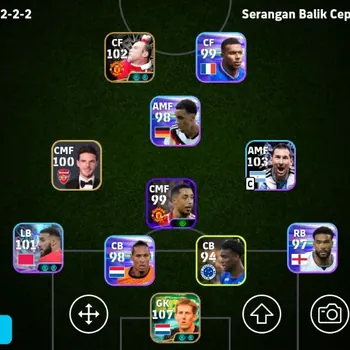
The most reliable starting points are the classic three. A 4-3-3 gives possession sides natural triangles and lets one deep midfielder screen the defence while two advanced midfielders rotate. A 4-2-3-1 gives you a double pivot that protects against counters and an attacking midfielder who becomes the main creator — useful if you build through the middle. A 4-4-2 keeps two strikers high for long-ball and quick-counter play and is the simplest shape to defend with, because the two banks of four are compact by default.
Modern eFootball also lets you set a separate shape for attack and defence, so your team can defend in a compact 4-4-2 and attack as a 3-2-5 without a substitution. That flexibility is the single most useful tool for players who keep conceding on the counter. The fluid formation guide showing how to set up both shapes explains how to configure the attacking and defensive layouts so they complement each other rather than fight.
Whichever shape you choose, keep it stable for at least a full week of matches. Formation changes reset the rhythm of your movement, and the learning curve is real — you need enough matches to know whether the shape is failing or you are simply unfamiliar with it.
How do you pick the right player for each role?
Match three things in order: position adaptability, Playing Style and then attributes. A player with high adaptability for the slot and the correct Playing Style will outperform a higher-rated card whose style pulls him out of the space your tactic needs him to occupy.
Position adaptability is shown per player and per position, and it is the first filter. A card played fully out of position loses effectiveness across the board, not just in one attribute. Position Training can convert a player permanently, but it costs progression resources, so it is worth doing only for cards you intend to keep.
Playing Style is the second filter and the one most new players skip. In defence, a Build Up defender is valuable in a possession side and irrelevant in a long-ball squad. In midfield, an Orchestrator drops deep to receive, a Box-to-Box covers ground, an Anchor Man shields the centre-backs, and a Hole Player pushes into the pocket behind the striker. Filling every midfield slot with the same style leaves obvious gaps: three Box-to-Box midfielders will all occupy the same channel and none will hold position.
Attributes come third, and only the relevant ones. For a wide forward in an out-wide system, Dribbling, Acceleration and Crossing decide almost everything; Finishing matters less than it does for the striker attacking the crosses. For an Anchor Man, Defensive Awareness, Ball Winning and Physical Contact matter more than Passing. Judging a card by its overall rating hides all of this.
What is Playstyle Proficiency and why does it decide the squad?
Playstyle Proficiency measures how well a player suits your chosen Team Playstyle, and it directly changes how he moves off the ball. High proficiency across the eleven produces coordinated runs and passing options; low proficiency produces players standing still while you look for a pass.
This is the mechanic that most obviously separates a coherent squad from a collection of good cards. When several players have high proficiency for the same tactic, their movements chain together — the full-back overlaps as the winger cuts inside, the midfielder fills the vacated space, the striker pulls a centre-back away. When proficiency is low, those chains break, and you end up carrying the ball into traffic because nobody is making a run.
Practically, aim for high proficiency in the spine first: centre-backs, the deepest midfielder, the main creator and the striker. Those four positions touch the ball most often in any tactic. Wide players can carry slightly lower proficiency if their individual attributes are strong enough to beat a defender one-on-one, because their job is more self-contained.
Proficiency is also the reason not to change Team Playstyle casually. Every switch re-evaluates the whole squad against the new tactic, and a group that scored highly for possession may score poorly for long-ball counter overnight — without a single card changing.
How much does the manager change your squad build?
The manager supplies the Team Playstyle, the default formation and the tactical instructions your squad inherits. Changing manager can revalue every player you own, so pick the manager whose base tactic matches the squad you already have rather than rebuilding around a new one.
Managers in eFootball are the container for the tactical settings, and each brings a preferred approach plus a set of default instructions such as defensive line height, compactness and support range. Those settings can be adjusted, but the manager's identity still sets the starting point and the Team Playstyle your proficiency is measured against.
For players building on a budget, this creates an efficient shortcut: choose the manager first, then buy or promote the cheaper cards that already have high proficiency for that tactic. It is far cheaper than acquiring elite cards and then hunting for a manager who suits them. A quick survey of current manager picks organised by playstyle is a faster way to find that starting point than testing managers one at a time.
Be careful with mid-season manager swaps. Because proficiency is recalculated against the new tactic, a swap that looks like a small tweak can quietly cost you the coordinated movement you spent weeks building.
How deep does your squad need to be?
You need roughly fifteen to eighteen usable players: eleven starters, three or four rotation options for the positions that tire fastest, and cover for the two positions where an injury would break your shape. Depth beyond that mostly wastes upkeep and progression resources.
Stamina is the reason depth matters at all. Wide players and box-to-box midfielders burn through condition fastest, and a tired player loses sharpness in acceleration, dribbling and defensive reactions long before the game tells you he is exhausted. Planning two substitutions around the sixtieth to seventieth minute is a habit that wins matches you would otherwise draw.
Condition also fluctuates between matches, shown by the arrow beside each player. A starter on a poor arrow is genuinely worse that day, so a bench option on a good arrow is often the better selection even at a lower rating. Checking arrows before every match takes seconds and is one of the cheapest edges available.
Depth should be targeted, not general. Two spare centre-backs are worth more than five spare attacking midfielders, because centre-back is the position where a forced out-of-position replacement damages the whole defensive shape.
How should you upgrade a squad over a season?
Upgrade in this order: fix the weakest position in your spine, raise proficiency where it is lowest, then train the players you already trust. Spreading progression resources evenly across the squad produces a uniformly mediocre team rather than a reliable one.
The weakest-link principle applies strongly here because opponents attack where you are thin. If your left-back is the position that keeps getting beaten, an upgraded striker will not fix your results. Identify the position that concedes or loses possession most, and spend there first.
Training programs and progression points let you raise attributes on cards you intend to keep for months, which is usually more efficient than chasing every new release. A well-trained card with the correct Playing Style and high proficiency will hold its place in the squad across an entire season, while an untrained new signing needs weeks of investment before it contributes.
Finally, resist rebuilding after a losing streak. Most streaks come from tactical drift — a formation you stopped adjusting, a substitution pattern you abandoned — rather than from the squad suddenly becoming worse. Change one variable at a time and give it a run of matches before judging it. If you want a refresher on the fundamentals underneath all of this, the eFootball beginner's guide to player cards, coins and squads is the natural place to start.
What are the most common squad-building mistakes?
The four that cost the most points are: signing by overall rating alone, ignoring position adaptability, mixing Playing Styles that occupy the same space, and never substituting. Each is easy to fix and each is worth more than any single new card.
Signing by rating is the most common and the most expensive. A card's overall figure compresses dozens of attributes into one number and tells you nothing about whether the player suits your tactic. Two identically rated midfielders can have opposite functions.
Ignoring adaptability is the second. Playing a natural centre-forward on the wing to squeeze him into the eleven weakens the wing and removes the movement your tactic expects there. Either use Position Training properly or use a lower-rated natural fit.
Duplicating Playing Styles is the subtlest. Three players who all drift into the same channel leave that channel crowded and the rest of the pitch empty. Deliberately mix roles so that someone holds while others advance.
Never substituting is the easiest to fix. Stamina losses are gradual and invisible until they cost you a goal; two planned changes per match protect the shape you built.
Frequently asked questions
Is a higher Team Strength always better?
No. Team Strength blends ratings with positional fit, so a coherent squad with a lower number frequently beats a higher-rated squad whose players are out of position or mismatched to the tactic.
Should I change my Team Playstyle if I lose several matches?
Usually not. Changing the tactic recalculates proficiency for the whole squad and resets your familiarity with the shape. Adjust instructions or one position first, and give the change several matches.
How many players do I need to train seriously?
Focus on the spine — two centre-backs, the deepest midfielder, the main creator and the striker — plus one rotation player at each of the two positions that tire fastest. That is a realistic target for a single season.
Does Position Training make a player fully effective in the new position?
It raises adaptability for that position permanently, which removes the out-of-position penalty. It does not change the player's Playing Style, so check that the style still suits the role before spending resources.
Where to Find eFootball Boosting and Hourly Services
On GameMarket.gg you can browse other eFootball listings, the eFootball market hub.
If you would rather practise a shape or climb a division with someone experienced alongside you, browse the available eFootball hourly services on GameMarket.gg and pick a session that fits what you are working on.
GameMarket.gg is a trusted digital marketplace for everything gaming-related. We serve the gaming community by providing secure access that enhances every gaming journey.