Blood Strike Rank Tiers Explained: Points, Resets and Rewards
By John Ganang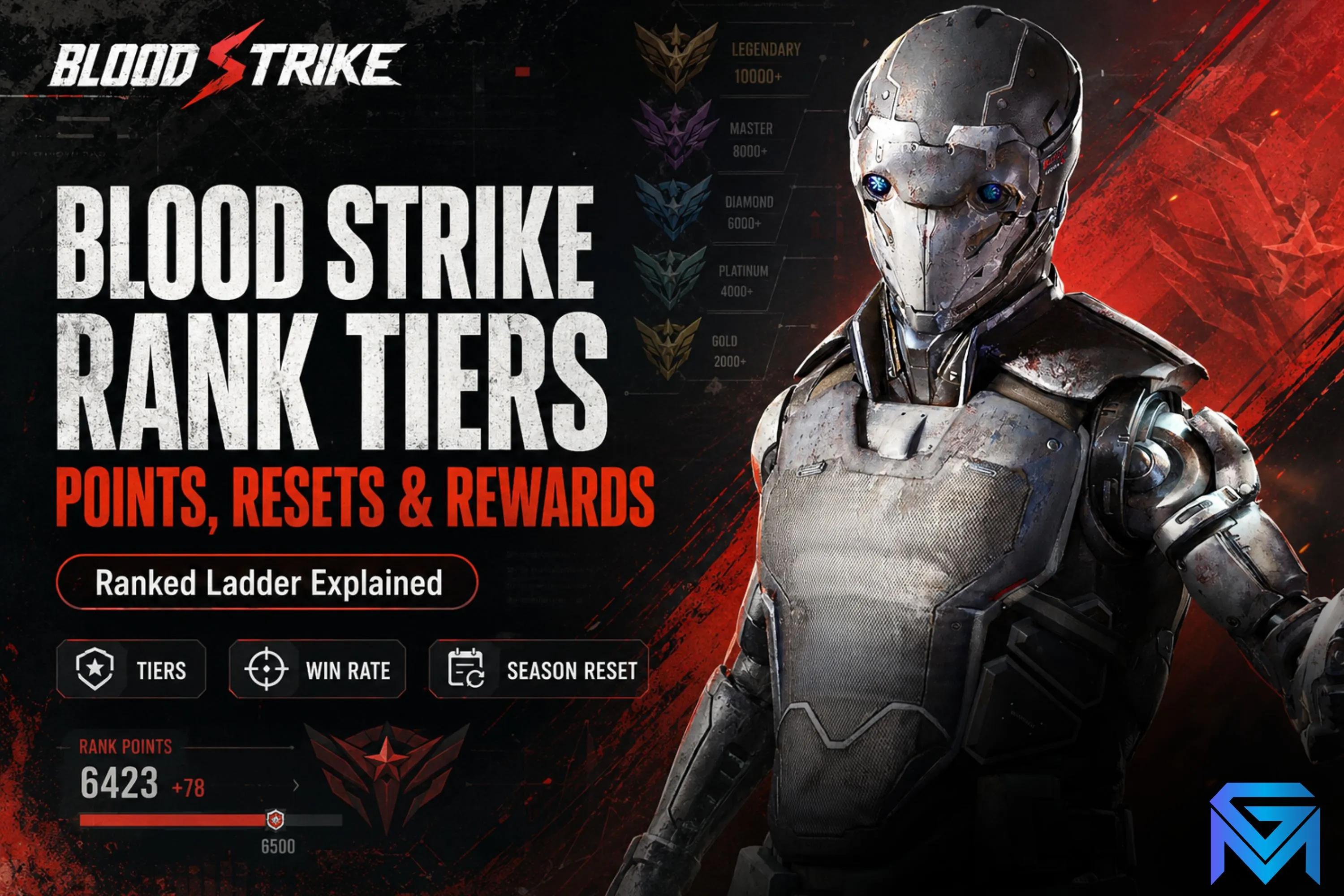
Blood Strike's ranked ladder is a points system, not a win counter: every ranked match adds or subtracts rank points based on where you place and how much you contribute, and your total points decide which tier you sit in. Tiers run from the entry ranks up through the apex bracket, each season resets you downward, and rewards are handed out by the highest tier you reached.
What are the rank tiers in Blood Strike and how are they ordered?
Blood Strike stacks its ranked ladder as a series of named tiers, each holding several numbered divisions, with a points-based apex bracket at the top. You climb by crossing the point threshold of your current division; the tier name changes only when you clear the last division inside it.
The ladder shape NetEase has used across Blood Strike's ranked seasons follows the familiar shooter progression: an entry tier for brand-new accounts, then Bronze, Silver, Gold, Platinum and Diamond as the main body of the ladder, then a top bracket — Master and Legendary — where players are sorted by raw point totals rather than by fixed divisions. Inside the lower and middle tiers you will see divisions written as III, II and I, with III as the entry division and I as the last step before promotion.
Two details matter more than the names. First, the number of divisions per tier is not constant — the middle tiers are deliberately longer than the entry tiers, which is why Gold and Platinum feel like they take far more matches than Bronze and Silver did. Second, once you enter the apex bracket, divisions stop protecting you: you are ranked against every other apex player by point total, so a bad night can move you several positions down a leaderboard even though your tier name stays the same.
Season to season, NetEase adjusts both the exact division counts and the point thresholds attached to them, and the in-game ranked panel is the only place that shows the current season's numbers. Treat any fixed threshold you read online — including a number in a guide written last season — as a rough shape rather than a live value, and confirm it against the ranked screen before you plan a climb. If you are still learning how ranks, Strikers and currency fit together, the Blood Strike beginner's guide to ranks, Strikers and Strike Gold covers the wider progression picture that sits underneath the ladder.
How do you earn and lose rank points in a match?
Rank points come from two sources that are added together: your placement in the match and your combat contribution, mainly kills, knocks and assists. Placement is the larger and more reliable half. Below a certain placement line the placement component turns negative, and your combat score is what claws it back.
The practical model is easier to hold in your head than the exact arithmetic. Think of every ranked match as starting with an entry cost, then paying you back in two instalments. The first instalment is placement: finishing in the top few squads pays a large positive number, finishing mid-table pays roughly what you spent, and dying early pays nothing and leaves the entry cost on your bill. The second instalment is your combat line, which scales with eliminations and knocks and is usually capped so that a twenty-kill game does not fully rescue a first-circle death.
That structure is why the two most common climbing mistakes cancel each other out. Players who chase kills at every landing spot post big combat lines but bleed placement points on the games they lose, netting close to zero across a session. Players who hide until the final circles bank steady placement points but never build the combat half, so their climb slows to a crawl in the tiers where the entry cost rises. The players who actually move up do both in the same match — they survive to the late circles and pick up fights they are favoured to win once they are already there.
The entry cost is the mechanic that quietly changes the game as you climb. In the entry tiers it is small enough that a mediocre match still nets positive points; in Diamond and above it is large enough that a mid-table finish is a net loss. This is the real reason the ladder tightens near the top, and it is baked into the system rather than a sign you have suddenly got worse. Our Blood Strike battle royale survival guide to landing spots, rotations and zone control goes into the placement half in detail, since that is the component you have the most control over.
Can you get demoted, and what protects your rank?
Yes — losing points can drop you a division, and in most seasons a small protection buffer stops you falling straight back through a tier boundary the moment you are promoted. Protection covers the boundary itself, not the divisions inside a tier, so mid-tier demotions happen freely.
The way this usually behaves in practice: when you cross into a new tier, the game gives you a short cushion — either a handful of points below the threshold or a small number of matches — during which a loss cannot push your tier name back down. Once that cushion is spent, the boundary behaves like any other threshold. Within a tier, dropping from division II back to division III is ordinary and carries no protection at all.
Blood Strike has also used point decay in the apex bracket in some seasons, where sitting inactive at the top of the ladder slowly sheds points so the leaderboard reflects current activity rather than a peak set weeks earlier. Decay does not apply to the ordinary tiers, so a Gold or Platinum player who takes a two-week break returns to exactly the rank they left. If you are near the apex, check the season notes for whether decay is active before planning a long absence.
What happens to your rank when the season ends?
Each ranked season ends with a soft reset: your points are pulled down toward the middle of the ladder rather than wiped to zero, and where you land depends on where you finished. Higher finishes are reset to a higher starting point, so the ladder re-sorts itself over the first weeks of the new season.
A soft reset serves two purposes. It gives every player a stretch of easier matches at the start of a season, which is where a large share of the season's total point gain is available, and it stops the top of the ladder from ossifying into a fixed list of accounts that never have to defend a position. The cost is that a player who ended in the apex bracket will spend the opening weeks grinding back through tiers they have already cleared.
The strategic consequence is that the start of a season is worth more than the end of one. The entry cost is at its lowest, the lobbies are at their widest in skill spread, and placement points are easiest to accumulate before the population settles. If you only have a limited number of evenings to spend on ranked play in a given season, spending them in the first two weeks reliably produces a higher finishing tier than spending the same hours in the last two.
Rank rewards are settled at the end of the season based on your peak tier, not your tier at the moment the season closes. That distinction protects players who push hard early and then play casually, and it means a demotion in the final days does not cost you the reward you already earned.
Do all game modes share the same rank?
No. Blood Strike keeps its battle royale ladder separate from its multiplayer modes, so a rank earned in squad battle royale does not carry into the smaller arena playlists. Casual, event and limited-time modes award no rank points at all.
Practically this means your account can hold more than one ranked identity at once — a high battle royale tier and a much lower multiplayer tier, or the reverse. It also means the skills being measured are different. The battle royale ladder rewards rotation reading, zone timing and knowing when a fight is worth taking; the multiplayer ladder rewards raw gunfights, spawn awareness and consistent movement, since there is no placement component to hide behind.
Team size matters within the battle royale ladder too. Solo, duo and squad queues draw on the same tier structure but produce very different point curves, because the placement half of the formula scales with how many other teams are in the lobby and how easily a single mistake ends your match. Players who move between queues often report that their rank feels inconsistent; the ladder has not changed, but the mix of placement and combat points reaching them has.
Because the multiplayer ladder is a pure mechanical test, it is the one most affected by your input setup. If your rank in the arena playlists lags well behind your battle royale tier, the Blood Strike sensitivity and settings optimization guide is usually a faster fix than more matches.
What rewards do the rank tiers actually give?
Ranked rewards in Blood Strike arrive in two forms: cosmetic season rewards issued at the reset according to your peak tier, and in-season milestone drops handed out the first time you reach a given tier. The headline items — rank-exclusive weapon skins, avatars, frames and emblems — sit at the higher tiers.
Milestone rewards are the ones most players underrate. Because they trigger on first arrival at a tier rather than at season end, they pay out immediately and they pay out again in later seasons if the reward set has rotated. That makes clearing a tier boundary you have not touched before worth noticeably more than adding points inside a tier you already occupy.
End-of-season rewards scale steeply rather than evenly. The gap between the entry tiers is usually a matter of avatars and profile decoration; the gap between the upper tiers is where weapon skins and animated frames appear. This is deliberate — it concentrates the reward value exactly where the entry cost makes the climb hardest, so the ladder keeps paying players who are already past the point where casual play carries them.
Rank-locked cosmetics also behave differently from store items. They are tied to the season that issued them, so a frame from an earlier season is a genuine marker of when an account was active rather than something that can be picked up later. Whether a specific reward set returns in a future season is decided by NetEase season by season and has never been guaranteed, so treat any rank cosmetic you want as available this season only.
Why do so many players stall at the same tier?
Most stalls are structural, not personal. The entry cost rises as you climb while the placement payout does not rise with it, so at some tier your existing habits stop netting positive points. Breaking a stall means changing what you do in a match, not playing more of the same matches.
The stall point is usually where a player's weakest phase of the match starts costing more than their strongest phase earns. A player who lands aggressively and wins most early fights will stall the moment lobbies are full of players who also win early fights, because the entry cost now punishes the matches where they lose. A player who survives well but avoids contact will stall when the combat half of the formula becomes the difference between a net gain and a wash.
Diagnosing which one you are is straightforward: look at whether your losing matches end early or end in the final circles. Early exits mean the placement half is your problem and the fix is landing and rotation discipline. Late exits with low combat scores mean the opposite — you are surviving fine and need to convert more of the fights you are already in. Blood Strike's movement system is the most common bottleneck for the second group, and the Blood Strike movement tech and slide-cancel guide covers the techniques that decide close-range trades.
Time is the last variable, and it is the one nobody controls. The ladder is designed so that reaching the apex bracket takes a serious match count for most players, and season length caps how far that can be compressed. If you want the tactical side of compressing a climb into fewer matches, the Blood Strike ranked guide to pushing Legendary without a thousand matches is the companion piece to this one.
Frequently asked questions
Does a ranked loss ever cost you more than the entry cost? No. The entry cost is the floor on what a single match can take from you, and your combat score only ever adds to that result. A disastrous match caps out at losing the entry amount plus the negative placement component, which is why long sessions rarely erase a whole tier in one night.
Do kills matter more in solo queue? Relatively, yes. With fewer teammates to contribute knocks and assists, a larger share of your combat line has to come from you personally, so the same tier is usually reached with a higher personal kill average in solo than in squads.
Is your rank visible to other players? Your current tier and emblem show on your profile and in the pre-match lobby. Your exact point total inside a tier is generally visible only to you, and only apex players appear on a public leaderboard by points.
Does playing with much lower-ranked friends hurt your rank? It changes your lobbies rather than your point formula. Squads are usually matched near the highest rank present, so a lower-ranked teammate faces harder opponents than usual while you gain and lose points at your own tier's rates.
Where to Find Blood Strike Boosting and Hourly Services
On GameMarket.gg you can browse Blood Strike hourly services, the Blood Strike market hub.
If you would rather spend your season on the matches you enjoy than on grinding a ladder you have already learned, browse the available Blood Strike boosting listings and compare what verified sellers are offering for the current season. You can also keep up with the rest of our coverage on the Blood Strike news hub.
GameMarket.gg is a trusted digital marketplace for everything gaming-related. We serve the gaming community by providing secure access that enhances every gaming journey.