Blood Strike Movement Tech & Slide-Cancel Guide: Become Impossible to Hit
By GameMarket Team 26 June 2026, 07:12 WIB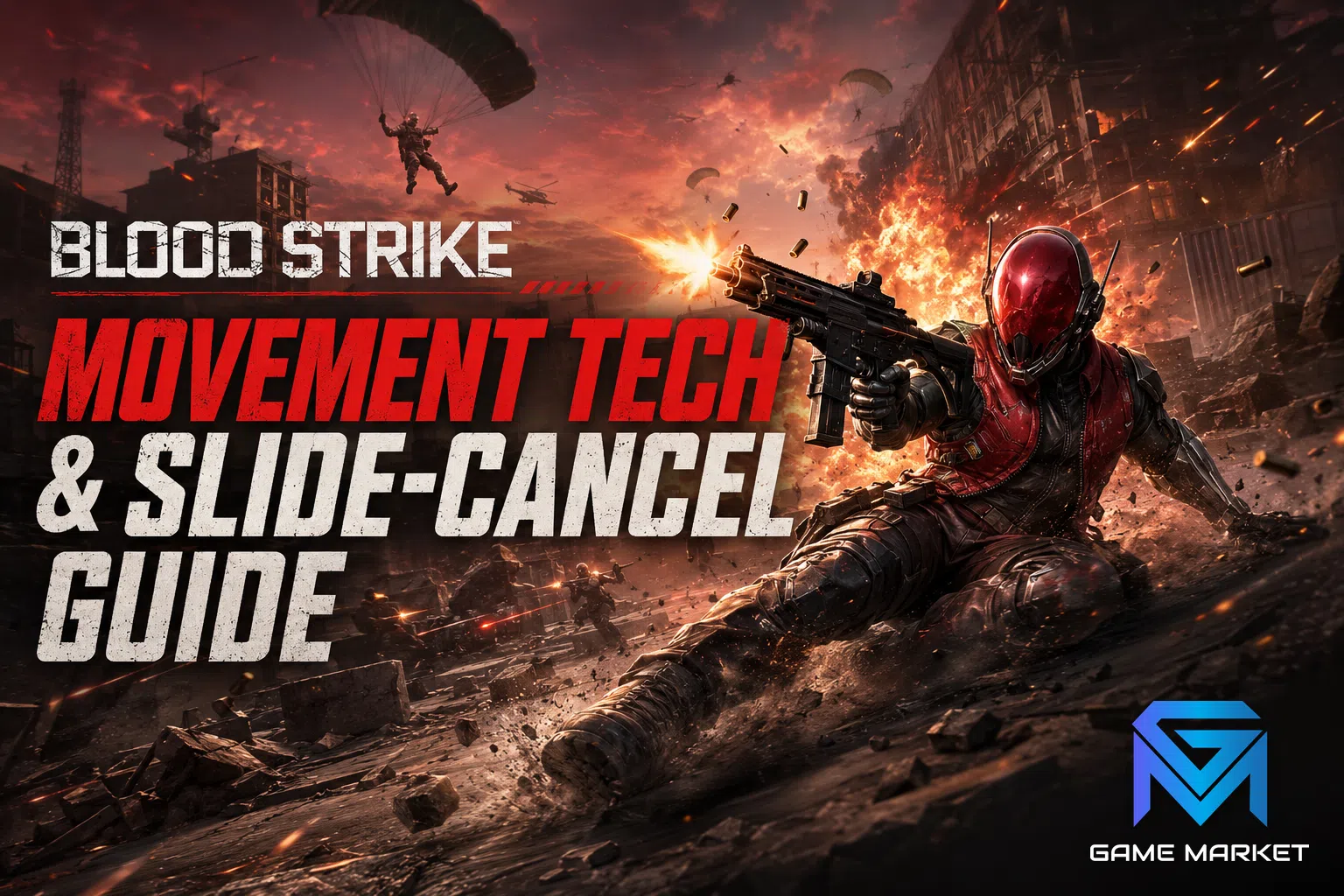
In Blood Strike, the fight usually goes to the player whose hitbox refuses to sit still, not the one with cleaner aim. Mastering the slide-cancel, jump-shot, drop-shot and smart verticality turns you into a target that is genuinely hard to track, letting you win close-range duels your raw aim alone would lose.
Why Does Movement Beat Aim in Blood Strike Gunfights?
Movement beats aim because a target that keeps changing height, direction and speed is far harder to track than a stationary or predictable one, so even a player with weaker aim can out-duel a better shooter simply by refusing to give them a clean read. This is the core logic behind every movement technique in this guide. If you would rather clear travel-distance missions efficiently than grind them manually, GameMarket.gg's guide to Blood Strike mission objective types breaks down how movement and distance objectives work. Every account tier can drill these fundamentals, but the strikers unlocked on higher tiers open up more ways to chain them — GameMarket.gg's Blood Strike account tiers guide breaks down what each tier actually unlocks.
Blood Strike's time-to-kill is fast enough that the first clean burst usually decides a fight, which means the player who lands the first hits typically wins. Standing still, or moving in a straight, predictable line, gives the enemy's crosshair time to settle onto your body and stay there for the whole exchange. Erratic movement does the opposite: it forces the enemy to keep re-adjusting their aim mid-fight, which costs them time, bullets and often the fight itself. This is true at every skill level, but it matters most in close-to-mid range engagements, where hitscan weapons reward whoever tracks first and punish whoever stands still.
What Is the Slide and Why Is It Blood Strike's Most Important Button?
The slide is a low, fast crouch-and-slip move triggered out of a sprint; it covers ground quickly, drops your hitbox lower than standing or crouching, and lets you reposition mid-fight without stopping to reload your momentum. On its own it is already useful for rounding corners, ducking into cover, or cutting down a slope faster than running.
What makes the slide the single most important button in Blood Strike's movement kit is that it is the base of everything else in this guide: you cannot jump-shot, drop-shot or slide-cancel without first understanding how and when to trigger a slide. Sliding draws from the same stamina resource as sprinting, so chaining slide after slide with no gap will eventually strand you standing still with nothing left in the tank — the exact opposite of what movement tech is trying to achieve. Good players slide with intent: into cover, around a corner an enemy is holding, or to break the angle a sniper has on them, rather than mashing the button on open ground for no reason.
How Does the Slide-Cancel Actually Work?
The slide-cancel means interrupting your slide before its slow stand-up animation plays, usually by jumping or firing partway through, so you stay mobile and stay a hard target instead of freezing in a vulnerable recovery pose. It is the single technique that separates a "slippery" Blood Strike player from a stiff one.
In practice it plays out in a short, repeatable sequence: sprint toward or across the fight, drop into a slide as you close the gap or round a corner, and instead of letting the slide finish naturally, cancel it early with a jump or by opening fire. Done cleanly, this lets you chain slide into jump into slide again, so your hitbox is constantly dropping, rising and shifting instead of settling into the standing pose an enemy's crosshair is trying to track. The first time you fight a player who slide-cancels well, it can feel like they are teleporting around the fight; that unpredictability is the entire point, not a visual flourish.
The technique rewards repetition more than reflexes. Because the cancel window happens at a specific point in the slide animation, the only way to make it consistent is to drill it outside of ranked pressure until the timing becomes muscle memory rather than something you have to think about mid-fight.
What Mistakes Make a Slide-Cancel Fail?
The most common mistake is letting the slide play out fully instead of canceling it, which leaves you standing up in the open exactly when the enemy's aim has settled onto you — the worst possible moment to be predictable. The fix is timing the cancel earlier than feels natural at first. For the detail behind that, see Diamond Rank Guide How to Climb to Master.
A second mistake is sliding into open ground with no cover or escape route nearby, which just gives the enemy a longer, cleaner look at a target that is admittedly harder to hit but still fully exposed. A third is treating the slide as a panic button and spamming it with no plan, which drains your stamina before the fight is actually decided and leaves you with nothing left when you need one more slide to break line of sight. Movement tech only pays off when it is aimed at something — a corner, a piece of cover, an angle you are trying to deny the enemy — rather than used on reflex.
How Do Jump-Shooting and Drop-Shooting Throw Off an Enemy's Aim?
Jump-shooting and drop-shooting both work by suddenly moving your hitbox to a height the enemy is not currently aiming at, buying you a fraction of a second where their shots miss and yours do not. They pair naturally with sliding to round out a complete movement kit.
The jump-shot means jumping at the exact moment you peek an angle or open fire: most enemies are tracking you at standing head height, so the sudden rise throws off shots that were already lined up. The drop-shot is the mirror version — dropping to prone in the middle of a close-range exchange pulls your hitbox down below where the enemy's crosshair is settled, and their bullets can sail over you while yours connect. Both techniques are situational rather than constant tools: overusing either one makes you predictable in a different way, and dropping prone in the open with no cover nearby can trap you in a bad position if the fight does not end immediately. Used sparingly and mixed into your normal slide-and-cancel movement, though, they add just enough unpredictability to wreck an enemy's tracking for the half-second that decides the fight.
How Should You Use Verticality, Mantling and Vaulting in a Fight?
Verticality wins fights by letting you take an angle the enemy is not expecting or cannot immediately return fire on, and Blood Strike's maps are built with enough ledges, rooftops and vaultable objects to make this a real, repeatable option rather than a gimmick. Smart players treat height as another movement tool, not just scenery.
Mantling onto a ledge or vaulting through a window mid-fight can instantly break an enemy's sightline, force them to reposition, or let you peek a target from above where their cover does nothing for them. The trade-off is exposure: climbing or vaulting has a brief animation where you move slower and cannot fully control your aim, so it is a poor choice when an enemy already has a clean bead on you and a much stronger one when you are using it to escape a losing fight or to open an angle nobody is watching. As with sliding, verticality works best when it is planned — rotating toward high ground before a fight starts, rather than trying to mantle your way out of a duel you are already losing.
What Kind of Terrain and Fights Reward Movement Tech the Most?
Movement tech pays off most in tight, close-to-mid range engagements with cover nearby — dense building interiors, multi-level compounds and narrow lanes where you can slide-cancel between pieces of cover and force repeated, awkward re-aims from the enemy. Open, flat ground rewards it far less.
In wide-open terrain with no cover, a moving target is still somewhat harder to hit, but a stationary or well-positioned long-range shooter has enough time to predict your path and lead their shots, which flattens most of the advantage movement tech gives you. The techniques in this guide are at their strongest in urban and structural POIs with multiple rooms, doorways, and vertical routes, where you can chain slide-cancels from cover to cover and use mantling to break line of sight entirely. Recognizing which fights are "movement fights" and which are pure long-range aim duels is itself a skill, and it is one of the clearest gaps between average players and players who consistently win close-quarters combat.
How Do You Practice Movement Tech Without Wasting Ranked Matches?
The fastest way to build slide-cancel timing is to drill it in low-stakes modes — training areas, casual matches, or warm-up lobbies — before trying it under ranked pressure, since fumbling the timing in a real gunfight usually costs you the fight outright. Repetition outside of pressure is what turns the technique into muscle memory.
A simple routine works well: pick a stretch of ground with a few pieces of cover, and practice chaining slide into cancel into slide again until it feels automatic, then add jump-shots and drop-shots into the same rotation once the base slide-cancel is consistent. Recording your own gameplay and reviewing fights you lost is also worth the time — it is usually obvious in hindsight whether you died standing still after a slide finished naturally, or because you genuinely got outaimed, and that distinction tells you exactly what to drill next.
What Separates High-Rank Players' Movement From Casual Players'?
High-rank Blood Strike players use movement with intent tied to a plan for the fight, while casual players tend to use it randomly or not at all; the gap is less about raw execution speed and more about knowing when a slide-cancel, a jump-shot or a rotation to high ground actually helps. That judgment only comes from repetition and match awareness.
Consistent movement also depends on settings that let your thumbs or mouse keep up with sudden direction changes, which is why serious players pair movement drills with a proper look at their Blood Strike sensitivity and settings optimization rather than fighting their own controls mid-duel. Knowing the map well enough to pick fights worth sliding into — instead of getting caught in the open — comes from the same positioning sense covered in the Blood Strike battle royale survival guide, and stacking movement tech with better decision-making across a full season is exactly how players climb in the Blood Strike ranked guide toward Rank Legend without needing a thousand matches of trial and error.
Frequently Asked Questions
Does the slide-cancel work the same way on touchscreen and controller?
The underlying mechanic is identical, but timing feels different depending on input: controller and emulator players often find the cancel window easier to hit consistently, while touchscreen players may need to adjust their button layout and sensitivity first so the slide and cancel inputs do not overlap or misfire.
Does sliding drain stamina separately from sprinting?
No — sliding pulls from the same stamina resource sprinting uses, so a slide immediately after a long sprint will be shorter, and chaining slides back-to-back without letting stamina recover will eventually leave you stuck standing still at the worst possible moment.
Can you fire your weapon immediately out of a slide-cancel?
Yes, and doing so is one of the main ways players cancel the slide in the first place — opening fire partway through the slide interrupts the stand-up animation, which is what makes firing-based cancels so useful in an actual gunfight rather than just a movement drill.
Is movement tech more important than aim in Blood Strike?
Neither replaces the other, but movement is usually the bigger differentiator at close range, since Blood Strike's fast time-to-kill means the player who is harder to track for even half a second often wins the fight regardless of who has the technically cleaner aim.
Where to Find Blood Strike Boosting and Hourly Services
If you would rather fast-track your rank instead of drilling movement tech solo, GameMarket.gg's Blood Strike rank boosting listings connect you with players who already have this movement kit dialed in, and the Blood Strike hourly play services section covers grinding, event pushes and battle pass progress by the hour when you would rather spend your time on ranked than on repetitive farming.
Every order on GameMarket.gg is covered by buyer protection, which holds your payment safely until you confirm the work was delivered as agreed — so if slide-cancelling your way into Rank Legend solo is not how you want to spend your season, GameMarket.gg's boosting sellers above can get you there while you focus on the matches you actually want to play.
GameMarket.gg is a trusted digital marketplace for everything gaming-related. We serve the gaming community by providing secure access that enhances every gaming journey.