Wuthering Waves Resonator Ascension Guide: Level Caps & Materials
By John Ganang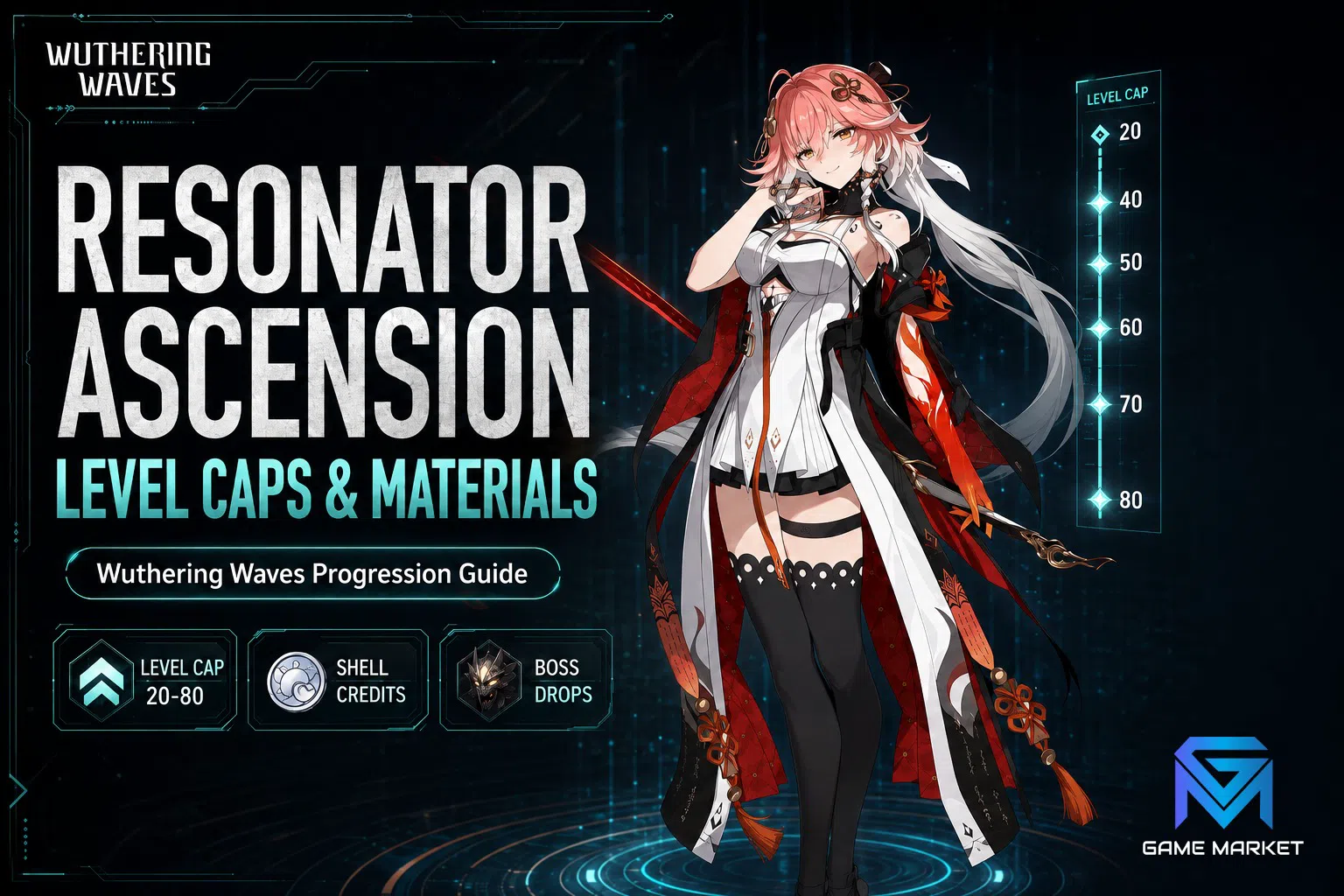
Ascension in Wuthering Waves is the gate that raises a resonator's level cap. Levelling stops at fixed ceilings — 20, 40, 50, 60, 70 and 80 — and each ceiling is lifted by spending Shell Credits plus three material types: a boss drop, a common enemy drop and a regional specialty. Every ascension also grants a flat stat jump on top of the levels it unlocks, which is why an unascended character stalls hard rather than gently. This guide covers what each ascension actually gives you, which materials come from where, why your account level quietly caps your roster, how to plan a farming week that does not waste Waveplate, and how to decide which resonators deserve the investment first.
What does ascension actually do for a resonator?
Ascension raises the level ceiling and adds a stat bonus of its own. Without it, experience material simply stops applying: a character at the cap absorbs nothing further, keeps the stats they have, and no amount of Waveplate spent on levelling changes that until the ascension is paid.
The stat jump is the part newer players miss. Each ascension rank grants an increase that arrives the moment you ascend, separate from the levels you then grind through, and higher ranks also unlock the character's passive nodes on their Forte Circuit. That combination means the difference between an unascended resonator sitting at a cap and the same resonator freshly ascended is larger than a single level of progress would suggest, so a character parked at a ceiling is not merely paused, they are underperforming their own build.
The practical framing is that levels are the cheap part and ascensions are the real currency of progression. Experience material accumulates steadily from Waveplate spending and events, whereas ascension materials come from specific bosses, specific enemy families and specific corners of the map. Kuro Games designs the wall this way on purpose, so a roster grows in deliberate steps rather than drifting upward, and planning around the steps beats grinding into them. If you are still assembling the fundamentals, the Wuthering Waves beginner's guide to resonators, echoes and Astrite covers the systems ascension sits on top of.
Which level caps does ascension unlock?
Resonators climb to level 90 through six ascensions, with caps at 20, 40, 50, 60, 70 and 80 along the way. The first two cover wide twenty-level bands and the later four cover ten each, so the ladder gets steeper in cost exactly as it gets shorter in reach.
That shape matters when you budget. The early ascensions are cheap and fast, and a brand-new resonator can usually be pushed to 40 in a single session out of materials you already hold, which is why an underused character often feels transformed by twenty minutes of attention. The back half is a different exercise: the last two ascensions demand the highest material tiers, the largest Shell Credit sums and the most experience material of the whole climb, and they are where accounts stall.
The useful consequence is that breadth is cheap and depth is expensive. Taking four resonators to level 60 costs dramatically less than taking one to 90, and for most content a well-built team of solid characters clears more than a single overlevelled star surrounded by underlevelled support. The usual advice for a new account therefore holds: get your main team to a comfortable shared band first, and treat the 80-to-90 push as a project you commit to once your team-wide floor is already high enough for the content you actually run.
What materials does each ascension need?
Every ascension asks for four things: Shell Credits, a boss drop tied to that specific resonator, a common enemy drop that comes in four ascending tiers, and a regional specialty plant gathered from the open world. Miss any one and the ascension is blocked regardless of how much of the others you hold.
Each of the four behaves differently, which is what makes ascension a planning exercise rather than a grind. Boss drops are the hard gate, because they come from one named boss and cost Waveplate per claim, so they cannot be rushed on a whim. Common enemy drops are the flexible tier: they fall from ordinary overworld enemies in abundance, and lower tiers can be synthesised upward into the higher ones you need later, which means the material you sweep up while exploring is rarely wasted. Regional specialties cost no Waveplate at all — they are plants and minerals on fixed respawn timers, so the only real cost is knowing the routes. Shell Credits are the silent constraint, since they are consumed by levelling, weapons, echo tuning and ascension alike.
Because only one of the four is Waveplate-locked, the honest bottleneck for most players is boss materials rather than effort. A player who gathers specialties while exploring and collects enemy drops as a by-product of ordinary play will find that the ascension they cannot complete is almost always waiting on boss runs, and that is a scheduling problem. Kuro's in-game material overview shows, per resonator, exactly which boss and which specialty you need, and reading it before the ascension screen blocks you is the single habit that saves the most time. For the detail behind that, see Forte Circuit Explained Nodes and Skill Priority.
Why does Union Level cap what you can ascend?
Union Level is your account's progression track, and it gates the higher ascension tiers. Reaching a required Union Level, and clearing the associated account-progression test, is what makes the next ascension rank selectable at all, so a resonator can be blocked by your account rather than by your materials.
This catches players who focus hard on one character. You can hold every material a level-80 ascension needs and still be refused, because the gate is not the material screen, it is the account track behind it. The fix is not more farming; it is Union Level experience, which comes from exploration, quests, activity rewards and ordinary daily play rather than from anything the ascension screen shows you.
The gates exist to keep power and world difficulty roughly in step, and knowing that changes how they feel. Rather than treating a blocked ascension as a wall, treat it as a prompt to spend a session on map completion and story progress, which pays Astrite and account experience at the same time and clears the block as a side effect. Exploration is the highest-value activity on a young account for exactly this reason, and it pairs naturally with the specialty routes you already need to run.
How should you plan a farming week around Waveplate?
Waveplate is the limiting resource, so the only question that matters is which activity earns it. Boss materials, weapon and skill materials, experience material and Shell Credits all draw from the same pool, and the ascension you are actually blocked on should decide the split before anything else does.
The reliable method is to work backwards from a target rather than farming by mood. Pick the resonator and the ascension rank you intend to reach, read off the boss material total that rank and the ranks below it require, and convert that into a number of boss runs; everything else in the plan is then filler around a known figure. Players who instead farm whatever looks convenient tend to accumulate deep stocks of the materials they did not need while remaining short on the one boss drop that is blocking them.
Two habits protect the plan. Never let Waveplate sit at its ceiling, since regeneration halts there and an overnight overflow is pure loss, and keep a rough eye on Shell Credits, because a credit shortfall stops an ascension just as firmly as a missing boss drop and is far easier to overlook. Echo farming competes for the same pool once your team is built, and the Wuthering Waves echo farming guide sets out when that competition is worth accepting.
Does weapon ascension follow the same rules?
Weapons ascend on the same ladder of level caps, but they draw on a different supply chain. Instead of boss drops and specialties, they consume forgery materials from timed challenges plus enemy drops and Shell Credits, so weapon progress and character progress compete for your Waveplate rather than for the same items.
Sequencing the two is where players gain or lose weeks. A weapon's attack contribution scales with the character wielding it, so ascending a weapon on an underlevelled resonator delivers less than the same investment made after the character reaches their next band. The order that generally serves best is to bring the resonator up first, then close the gap on the weapon, then return to the resonator, keeping the two roughly in step rather than pushing either far ahead.
Forgery challenges also rotate by day, which is the detail that quietly wastes the most Waveplate. The material you need may only be available on certain days of the week, so a player who farms on impulse discovers the correct challenge was open yesterday. Checking the rotation before you commit Waveplate is a small habit with an outsized payoff, and it pairs neatly with the combat consistency covered in the Wuthering Waves combat guide, since timed challenges reward clean execution as much as raw stats.
Which resonators deserve ascension first?
Ascend the characters you actually field, in the order they carry your team. Your main damage dealer comes first because their scaling converts most directly into clear speed, followed by the support or healer that keeps the team alive, with situational picks left at a lower band until the core is comfortable.
The reason to resist spreading investment thinly is that Wuthering Waves rewards a functioning team rather than a collection of half-built characters. A damage dealer at a high band supported by two under-ascended teammates loses fights that a slightly weaker but evenly built trio wins, because rotations depend on every member surviving and generating their part of the cycle. Evenness is the goal until the whole team clears your target content, and only then is a single-character push worth the materials.
Echoes deserve a mention here because they compete for attention and often win. A resonator with a well-chosen echo set at a moderate ascension frequently outperforms the same character fully ascended with poor echoes, so if your results feel flat despite steady levelling, the answer is more often the echo build than the ascension rank. The guide to echo cost, main stats and tuning covers how to fix that side, and the Data Bank levelling guide explains why the quality of echoes you can even find is capped by a track most players neglect.
Frequently asked questions
Can I ascend a resonator before reaching the level cap? No. The ascension only becomes available once the character sits at the current ceiling, so experience material spent early simply carries you to that ceiling faster rather than skipping ahead.
Do I lose anything by ascending a character I later stop using? Materials are spent and cannot be recovered, so the cost is the opportunity rather than a penalty. Early ascensions are cheap enough to treat as low-risk experiments; the expensive later ranks are the ones worth reserving for characters you are confident about.
Why is my ascension greyed out when I have every material? That is almost always the Union Level gate rather than a bug. Check the account-progression requirement for the rank you are attempting, and spend a session on exploration and quests to clear it.
Should I ascend a character to 90 or take a second character to 80? For most players the second character wins. The 80-to-90 band is the most expensive stretch on the ladder and returns a comparatively small share of a character's total power, whereas a second properly built resonator adds a whole role to the team.
Do regional specialties run out? They respawn on a timer, so a route you cleared today will be worth running again after the interval passes. Building two or three routes you know well is more efficient than searching fresh ground each time.
Where to Find Wuthering Waves Boosting and Hourly Services
On GameMarket.gg you can browse Wuthering Waves boosting services, the Wuthering Waves market hub.
If you would rather spend your play sessions on the content you enjoy than on boss runs and specialty routes, browse the Wuthering Waves hourly listings on GameMarket.gg and pick the option that matches the farming your roster is actually blocked on.
GameMarket.gg is a trusted digital marketplace for everything gaming-related. We serve the gaming community by providing secure access that enhances every gaming journey.