Wuthering Waves Combat Guide: Parry, Dodge & Rotation Basics
By John Ganang 18 August 2026, 08:00 WIB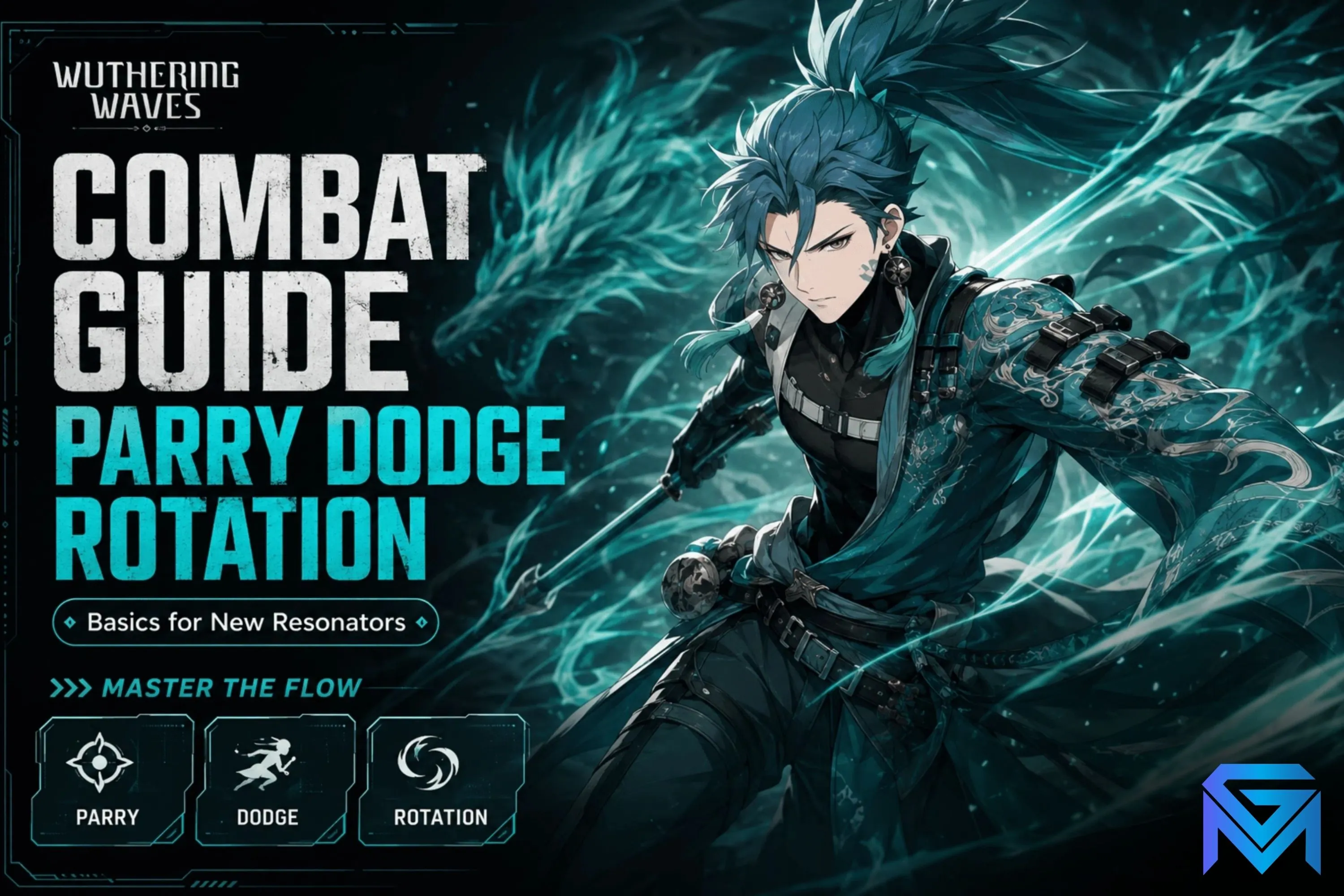
Wuthering Waves is an action game wearing a gacha's clothes, so your damage is decided far more by how cleanly you execute a fight than by which Resonators you pulled. The core loop is simple to name and hard to master: dodge at the last instant to survive and slow time, parry incoming blows to break an enemy's poise, build Concerto Energy on a support, and swap that energy into your main damage dealer's burst window. A whale who mashes buttons will lose a damage check to a free-to-play player who dodges on reaction and swaps on beat, which is exactly why combat execution, not roster power, is the skill this guide teaches. If you are new to the systems those inputs are built on, our Wuthering Waves beginner’s guide to Resonators, Echoes and Astrite covers the foundations first.
What makes Wuthering Waves combat different from other gacha games?
Wuthering Waves runs on real-time action combat rather than turn-based or auto-battle systems, so positioning, dodge timing, and manual swaps all matter. You control one character on the field at a time, react to telegraphed attacks with dodges or parries, and chain your three-character team together through swap skills instead of queuing commands.
That distinction changes how progression feels, because raw character levels and Echoes set your ceiling while your inputs decide how close you get to it. Most damage in the game is front-loaded into short buff windows you open yourself, so the fight is really a race to reach those windows with your resources ready. The game rewards a fast, cancel-heavy style often called quickswap, where you rotate through all three characters in seconds rather than standing on one, and understanding why that style wins starts with the two defensive tools that keep you alive long enough to use it: the dodge and the parry. Raising that ceiling faster is the job of our Wuthering Waves Echo farming guide for efficient grinding.
How does dodging and the Dodge Counter work?
Dodging gives your character brief invincibility frames, and dodging at the last moment before a hit lands triggers a Perfect Dodge that slows time for about a second. During that slow-motion window your next Basic Attack becomes a Dodge Counter, a free retaliating strike that deals bonus damage and costs you nothing.
The value here is not just survival but tempo, because a Perfect Dodge converts an enemy's aggression into your opening. Where a mistimed dodge only avoids damage, a perfectly timed one hands you a slow-mo beat to reposition behind the enemy, land a Dodge Counter, and immediately continue your rotation with no lost time. Learning an attack's wind-up is what makes this reliable, so you dodge on the enemy's swing rather than on the impact, since the invincibility has to overlap the exact frames the hit connects. Dodge is your universal answer to unblockable attacks and grabs, whereas the parry below is your answer to the flashing, telegraphed strikes the game specifically wants you to meet head-on.
How do you parry attacks in Wuthering Waves?
You parry by landing a Basic Attack or certain skills into an enemy attack that flashes with a brief highlight, which clashes with the blow and deflects it. A successful parry, sometimes called a deflection, cancels the enemy's attack and pours a large chunk of damage into their Vibration Strength bar, pushing them toward a stagger.
Parrying trades a little risk for a lot of poise damage, so it is the aggressive counterpart to the safe dodge. Because the deflection interrupts the enemy mid-swing, a well-timed parry can shut down a dangerous combo before it starts and simultaneously build toward the burst window you actually want. Not every attack is parryable, and the game signals the ones that are with a distinct visual and audio cue, so the read is which telegraph you are seeing rather than a guess. Many players blend both tools in one fight, dodging the heavy unblockable slams and parrying the fast flurries, and both feed the same goal of collapsing an enemy's poise. That poise damage is only useful because of what breaking it unlocks, which is why the stagger system sits at the centre of every burst rotation.
What is Concerto Energy, and how do Intro and Outro Skills work?
Concerto Energy is the resource that powers team swaps. You build it by attacking, using Resonance Skills, and triggering Echo abilities, and once a character's Concerto gauge reaches 100 you can fire their Outro Skill by swapping out, which hands a buff to whoever swaps in. That incoming character then plays an Intro Skill for extra damage and a smooth transition. For the detail behind that, see how the Tower of Adversity zones and Vigor work.
This pairing is the engine of the whole combat system, because it turns swapping from a defensive panic button into your main damage multiplier. A support builds Concerto, uses its Outro to buff your damage dealer as it leaves, and the damage dealer enters on an Intro Skill already amplified, so the buff and the burst line up by design rather than by luck. Because Outro buffs last only a short time after the swap, the entire art of a rotation is filling Concerto fast enough to keep those buffs uptime high on your carry. Concerto governs the swaps between characters, but each character also runs a second, personal resource that decides how hard they hit once they are on the field.
What is the Forte Circuit and Resonance Energy?
The Forte Circuit is a character-specific gauge that enhances a Resonator's kit, unlocking an empowered state, a stronger attack, or a resource unique to that unit. Resonance Energy is separate and simpler: it fills as you fight and, at full, lets you cast the character's ultimate, the Resonance Liberation.
Keeping these two straight matters because they are spent in different rhythms. Forte is usually consumed within a single character's on-field turn to power up their signature move, so you build and dump it in the same breath, whereas Resonance Energy accumulates across a whole rotation and is saved for the moment your buffs peak. A strong turn on a damage dealer therefore looks like entering on an Intro Skill, spending Forte on the empowered attack, and releasing the Resonance Liberation while the support's Outro buff is still live. The reason execution beats roster is right here, since a mistimed Liberation outside the buff window can lose half its value even on a fully invested character. All three resources, Concerto, Forte, and Resonance, ultimately point at the same target: the short stagger window where the enemy takes the most damage.
How does enemy stagger (Vibration Strength) create burst windows?
Every larger enemy has a hidden Vibration Strength bar, and depleting it staggers the target, leaving it stunned and taking increased damage for a few seconds. Heavy Attacks, parries, and certain skills chip that bar down faster than normal hits, so building toward a stagger is a deliberate part of the fight rather than a side effect.
The stagger is where your carefully stored resources are meant to land, because a staggered enemy cannot retaliate and eats your full burst at a bonus multiplier. That is why the ideal sequence breaks the enemy's poise first, using parries and heavy hits on a sub-carry, then swaps in the main damage dealer to unload Forte and the Resonance Liberation into the open window. Against smaller trash mobs the bar drains so quickly that you can skip the setup and simply attack, but boss fights and Tower content reward players who track the stagger and hold their Liberation until it triggers. Reading that bar is the difference between a burst that erases a boss health gate and one that fizzles into a still-swinging enemy, and putting all of these pieces in order is what a real rotation looks like. Our guide breaks down how Vibration Strength opens the damage window.
What does a clean combat rotation actually look like?
A clean rotation is a repeating loop: build Concerto and stagger on your support and sub-DPS, swap their Outro buffs into your main carry, and dump that carry's Forte and Resonance Liberation into the buffed, staggered window before the buffs expire. Most teams cycle all three characters in well under ten seconds.
In practice the loop reads as a chain rather than a checklist. You open on a support to fill its Concerto, deflect or dodge whatever the enemy throws so you keep pressure without taking hits, and fire its Outro Skill to buff the carry as you swap. The carry enters on an Intro Skill already amplified, spends its Forte on the empowered attack, and releases the Resonance Liberation into the stagger, after which you swap to the second sub-DPS to rebuild while the carry's own Concerto recharges offstage. Animation cancelling threads the whole thing together, because swapping or triggering an Echo Skill cuts the long recovery frames of a heavy attack, so a smooth player fits more damage into the same window than a slow one. The goal is buff uptime on the carry, and every dodge, parry, and swap you learned above exists to protect and extend that window. Get the order wrong and the same characters do a fraction of the damage, which is the single most common way accounts underperform.
What are the most common combat mistakes?
The most frequent mistakes are standing on one character instead of swapping, firing Resonance Liberations outside the buff window, ignoring the parry cue, and letting Concerto sit unused. Each one quietly caps your damage even when your Resonators and Echoes are strong. It is worth knowing where weapon and skill materials come from.
Camping on a single carry is the costliest habit, because it wastes every Outro buff and Intro Skill your other two characters could be feeding in, so the account plays like a solo unit rather than a team. Dumping the Resonance Liberation the moment it is ready feels productive but throws away the multiplier, since the same ultimate lands for far more inside a support's Outro window and a stagger. Treating every attack as something to dodge means you never parry, and parrying is what breaks poise on a schedule instead of by accident, so timid players stall out on exactly the boss health gates that reward aggression. Letting Concerto cap and then keep overfilling is pure lost tempo, because energy past 100 does nothing, and the fix is simply to swap the instant the gauge is full. Clean up those four and your existing team will clear content it was stalling on, which loops back to the opening point that in Wuthering Waves your inputs, not your pulls, decide the result. If a specific boss, Tower floor, or exploration wall is still blocking you after you have the rotation down, you can also hand that clear to an experienced player through the Wuthering Waves boosting services on GameMarket.gg and keep your account progressing while you practise.
Is Wuthering Waves combat hard for new players? It is approachable to start and deep to master. Basic dodging and attacking clear early content comfortably, while parries, stagger management, and swap-cancel rotations are the layer you grow into for end-game bosses and the Tower of Adversity. You can enjoy the game long before you optimise every input.
What is the difference between a Perfect Dodge and a normal dodge? A normal dodge grants invincibility frames to avoid a hit, while a Perfect Dodge, triggered by dodging at the last moment, adds a slow-motion window and enables a Dodge Counter. The Perfect Dodge turns a defensive move into a free damage opportunity. We cover what counts toward 100% region progress separately.
Do I have to quickswap to clear content? No for most story and world content, yes for efficient end-game. Casual play tolerates staying on one character, but timed modes and damage checks like the Tower of Adversity strongly reward chaining Intro and Outro Skills, because the buffs and burst only align through swaps. Those damage checks lean heavily on Echo quality, which our Wuthering Waves Echo guide on cost, main stats and Tuning breaks down.
What builds Concerto Energy the fastest? Resonance Skills, Echo Skills, and sustained attacking on the active character fill Concerto quickest, and some support Resonators are built specifically to charge it in seconds. Prioritising a character's skill rotation over long Basic Attack strings is usually the faster route to a full gauge.
If the grind behind a clean account, from farming Echoes to clearing the bosses that gate your progress, is eating more time than you want to spend, you can browse the current Wuthering Waves services and marketplace on GameMarket.gg, compare sellers by rating and price, and pick help that fits the exact wall your account is stuck on.
Combat feel is also shaped by which regional server your save is locked to — see GameMarket's guide to what server lock means for your account for how that first-login choice affects input latency and matchmaking.
GameMarket.gg is a trusted digital marketplace for everything gaming-related. We serve the gaming community by providing secure access that enhances every gaming journey.