Wuthering Waves Echo Guide: Cost, Main Stats & Tuning
By John Ganang 17 August 2026, 08:00 WIB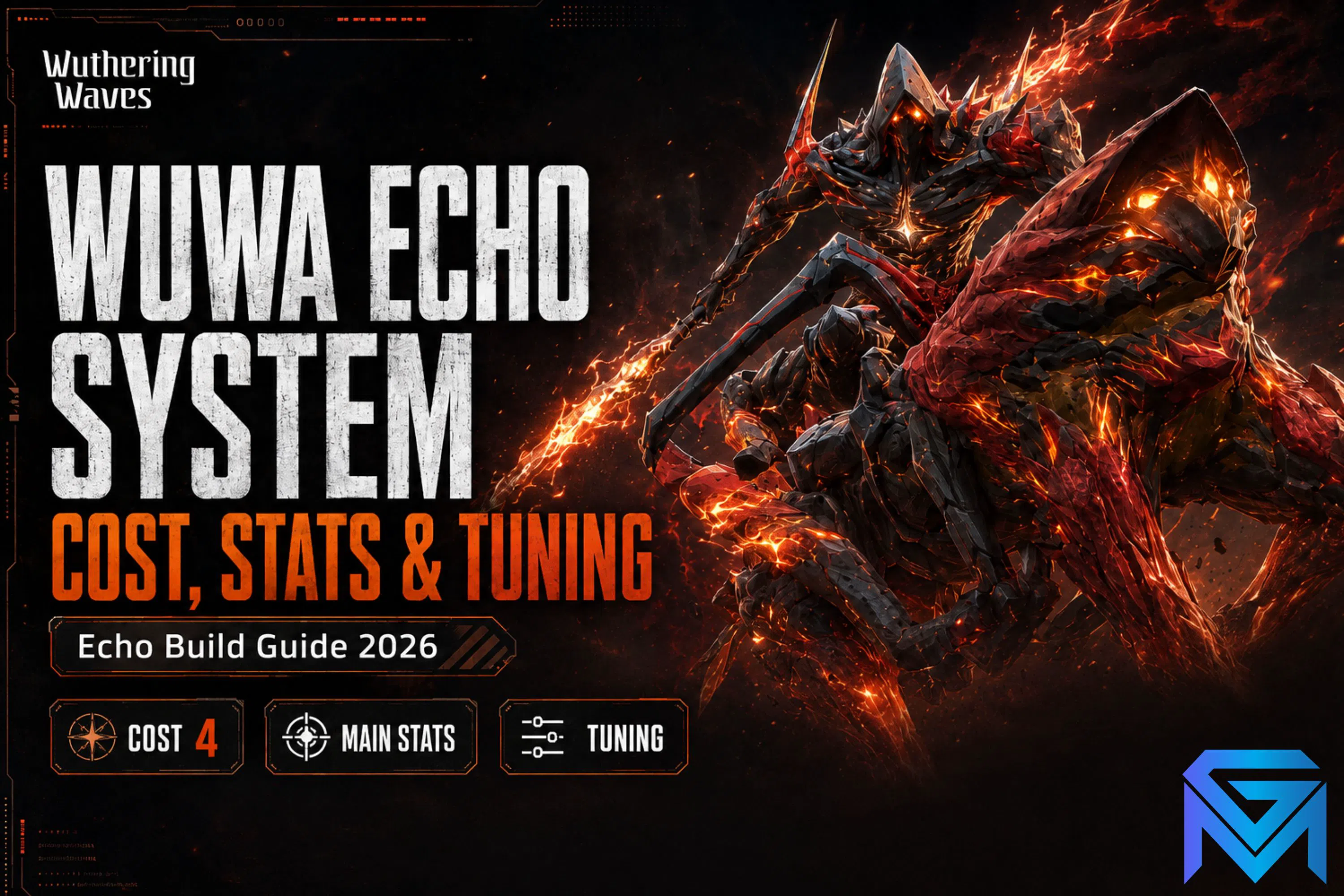
In Wuthering Waves, your damage is decided less by which Resonators you pull than by how well their Echoes are built. Echoes are the game's gear: five monster imprints you equip on a character for stats and a set bonus. Each Resonator carries a Cost budget of up to 12, normally split into one 4-Cost, two 3-Cost and two 1-Cost Echoes, and layered on top sit two main stats, up to five tuned substats, and a Sonata effect. Once you understand how those four layers interact, a free character with a clean build regularly out-damages a maxed one running junk Echoes, which is why this guide treats Echoes as the real progression system rather than an afterthought to your pulls. How you play those builds matters just as much, and our Wuthering Waves combat guide to parry, dodge and rotation basics covers the execution side.
How does Echo Cost work in Wuthering Waves?
Every Echo has a Cost of 1, 3, or 4 tied to its Class, and every Resonator has a total Cost budget you cannot exceed. That budget starts at 10 and rises to 12 as you upgrade your Data Dock, so an optimised loadout almost always reads as one 4-Cost, two 3-Cost, and two 1-Cost Echoes.
The Classes map cleanly onto those Cost values: Common Echoes are Cost 1, Elite Echoes are Cost 3, and the boss-tier Overlord and Calamity Echoes are Cost 4. Because 4 plus 3 plus 3 plus 1 plus 1 sums to exactly 12, that layout is the only way to run a Cost-4 boss Echo alongside two Cost-3 Echoes without wasting budget, and it is the template nearly every meta build follows. The single 4-Cost slot matters most, because that Echo supplies your character's Echo Skill (the summonable creature ability you trigger with the Echo button), so you pick it for both its skill and its main stat rather than for raw numbers alone. Getting this budget math right is the first thing that separates a functional build from a wasted one, and it sets up every stat decision that follows.
How do Echo main stats and substats work?
Each Echo carries two main stats that are fixed by its Cost, plus up to five random substats you reveal through Tuning. On 3-Cost and 4-Cost Echoes the second main line is always flat ATK, while the first main stat and all substats are where you actually shape a build.
The first main stat is the highest-value roll on the piece, and its options scale with Cost. A 4-Cost Echo can roll Crit Rate, Crit DMG, ATK%, HP%, DEF%, Healing Bonus, or an Elemental DMG Bonus as its headline stat; a 3-Cost Echo typically offers an Elemental DMG Bonus, Energy Regen, ATK%, HP%, or DEF%; and a 1-Cost Echo is limited to ATK%, HP%, or DEF% with a flat stat on the second line. Because those slots are fixed, a build is really a choice of which main stats to chase: most damage dealers want a Crit main on the 4-Cost, matching Elemental DMG Bonuses on both 3-Cost Echoes, and ATK% on the 1-Cost pair. Substats then fine-tune the piece, and unlike the main stats they are random, revealed one at a time, and cannot be edited once they appear, which is what makes substat priority the skill-heavy part of gearing.
What is the best Echo substat priority for DPS and support?
For damage dealers, Crit Rate and Crit DMG lead, followed by ATK% and your character's matching skill-type DMG bonus. Aim for roughly a 1:2 ratio of Crit Rate to Crit DMG, such as about 70% Crit Rate to 140% Crit DMG, reaching a stable Crit Rate first so your hits land consistently before you pile on multiplier.
That ratio exists because Crit Rate is your chance to crit and Crit DMG is the size of the crit, so pouring everything into Crit DMG while your Crit Rate sits at 40% just means a big number that rarely fires. Once a DPS is near the 70% Crit Rate mark, additional value flows into ATK% and the specific damage bonus that character leans on, whether that is Basic Attack, Heavy Attack, Resonance Skill, or Resonance Liberation DMG, since a targeted bonus multiplies only the part of the kit you actually use. Supports invert this entirely: an off-field buffer or healer usually prioritises Energy Regen so it can loop its Resonance Liberation on cooldown, then ATK% or HP% depending on whether its buffs and shields scale from attack or health. Knowing which of those two profiles a character wants is what keeps you from tuning a great substat onto the wrong build, and it also tells you which Sonata set to pair it with. For the detail behind that, see what a Tacet Field run costs in Waveplate and pays back.
What are Sonata effects and how do set bonuses work?
Sonata effects are Wuthering Waves' set bonuses. Equipping matching Echoes grants a 2-piece bonus for two of a set and a much stronger 5-piece bonus for a full five, and because five Echoes fill every slot you can run one complete 5-piece set or mix two different 2-piece sets on the same character.
The 2-piece bonuses are small and unconditional, usually a flat Elemental DMG Bonus or an ATK boost, whereas the 5-piece effect is the payoff and almost always fires from a condition your rotation already meets, such as using your Resonance Liberation, landing a Heavy Attack, or triggering your element's status. Kuro Games adds new Sonata sets with most major versions, so the exact bonuses shift over time, but the selection logic stays constant: a DPS wants the 5-piece set built around its own element and playstyle, while supports lean on utility sets that hand out energy or amplify healing rather than personal damage. The mix-and-match route matters for characters who care about two stats at once, because two separate 2-piece sets can stack, for example, an Elemental DMG Bonus with an ATK boost when no single 5-piece is clearly best. Choosing the set is only half the work, though, because a perfect Sonata with unrefined substats still underperforms, and that is where Tuning comes in.
How does Echo Tuning work, and what does Data Bank do?
Tuning is how you reveal and level an Echo's substats. Every five Echo levels, up to a maximum of 25, unlocks one new random substat drawn from a weighted pool, paid for with Tuners and Shell Credits. You cannot change a substat once it appears, so each reveal is a small gamble rather than a choice.
Your Data Bank is the quiet multiplier behind all of it. Raised by absorbing new Echo types into Kuro Games' in-game Data Bank, its level both widens the value range each tuned substat can roll and improves the rarity of Echoes that drop in the open world, which is exactly why experienced players push Data Bank to at least level 15 before farming Echoes seriously, and our guide to levelling your Data Bank up faster lays out the quickest route to that threshold. Farming a stack of golden Echoes at a low Data Bank wastes them, because their substat rolls are capped low and you will only re-farm the same pieces later at higher quality. When you do tune, the efficient habit is to stop pouring Tuners into a slot the moment it lands a strong roll and redirect them toward your weakest substat, since a build is limited by its worst line, not blessed by its best. That disciplined, one-good-Echo-at-a-time approach is what most rushed players skip, and it leads straight to the mistakes below.
Raising Data Bank and farming the Echoes to tune is its own grind, and our Wuthering Waves Echo farming guide to efficient grinding covers the fastest routes. Once your Echo build is ready, the Whimpering Wastes guide to stages, scoring and token rewards shows where it gets tested.
What are the most common Echo build mistakes?
The most common mistakes are farming Echoes before raising Data Bank, ignoring the Cost budget, running an off-element Sonata, and chasing a perfect substat roll long past the point of diminishing returns. Each one quietly caps your damage even when your characters and weapons are strong.
Farming too early is the costliest error, because Echoes tuned at a low Data Bank carry weak value ranges you will only replace later, so the hours feel productive while producing gear you throw away. Ignoring Cost is subtler: players equip five good-looking Echoes without checking the total, then wonder why a Cost-4 boss Echo will not fit, when the fix is simply the 4-3-3-1-1 layout. Off-element Sonata is a pure waste of the 5-piece slot, since a Fusion DPS gains nothing from a Glacio set's conditional bonus, and the correct set is almost always the one built around that character's own element or role. Finally, dumping Tuners into an already-strong substat to squeeze out a marginal roll burns materials you should have spent lifting a second Echo to usable quality, because breadth of decent pieces beats one flawless piece surrounded by junk. Avoid those four and your builds will already outperform most accounts at the same account level, which loops back to the opening point that Echoes, not pulls, decide your ceiling.
How many Echoes can each character equip? Five, arranged to fit a total Cost budget that starts at 10 and reaches 12 once your Data Dock is upgraded. The standard layout is one 4-Cost Echo, two 3-Cost Echoes, and two 1-Cost Echoes, which sums to exactly 12.
Can you re-roll an Echo's substats? No. Substats are revealed one at a time as you Tune the Echo every five levels, and once a substat appears its type is locked and cannot be changed. If the lines roll badly, the only real fix is to farm and tune a fresh copy of the Echo.
What Data Bank level should you reach before farming Echoes? Around level 15 or higher. Data Bank level widens the value range of tuned substats and improves the rarity of wild Echoes, so farming heavily below it produces capped, low-value pieces you will simply re-farm later at better quality.
Do Echoes transfer between characters? Yes. You can freely unequip an Echo and move it to another Resonator at no cost, so a strong Echo can be shared across a roster as your teams change, though most players eventually farm dedicated sets for their main damage dealers.
Where to Find Wuthering Waves Hourly Services and Boosting
On GameMarket.gg you can book an hourly Wuthering Waves session with a verified player.
If Echo farming and tuning is eating hours you would rather spend playing, you can hand the grind to a real player instead: browse the current Wuthering Waves boosting and Echo-farming services on GameMarket.gg, compare sellers on their per-run rate and rating, and pick a package that clears the farming backlog your account actually has. Once your Echoes are tuned, pairing them with the right sequencing matters just as much; GameMarket.gg's character swap timing and rotation guide covers how Outro and Intro Skills chain together once your stats are in place.
GameMarket.gg is a trusted digital marketplace for everything gaming-related. We serve the gaming community by providing secure access that enhances every gaming journey.W
If any of the underlying terms are new, our Wuthering Waves beginner's guide to Resonators, Echoes and Astrite sets out the basics first.



![Wuthering Waves Accounts Mid-Game SEA|UL 48|Rank 5|4 Char Limited [Hsin R2,Chisa]+Sign,Suisui,Rebecca|Mc Female|Check SS](https://img.gamemarket.gg/products/ihw1rdhx/wuthering-waves-accounts-sea-ul-48-rank-5-4-char-limited-hsin-r2-chisa-si-itq-thumbnail.webp "SEA|UL 48|Rank 5|4 Char Limited [Hsin R2,Chisa]+Sign,Suisui,Rebecca|Mc Female|Check SS WW510B")