Wuthering Waves Exploration Guide: 100% Region Progress Explained
By John Ganang 30 August 2026, 06:00 WIB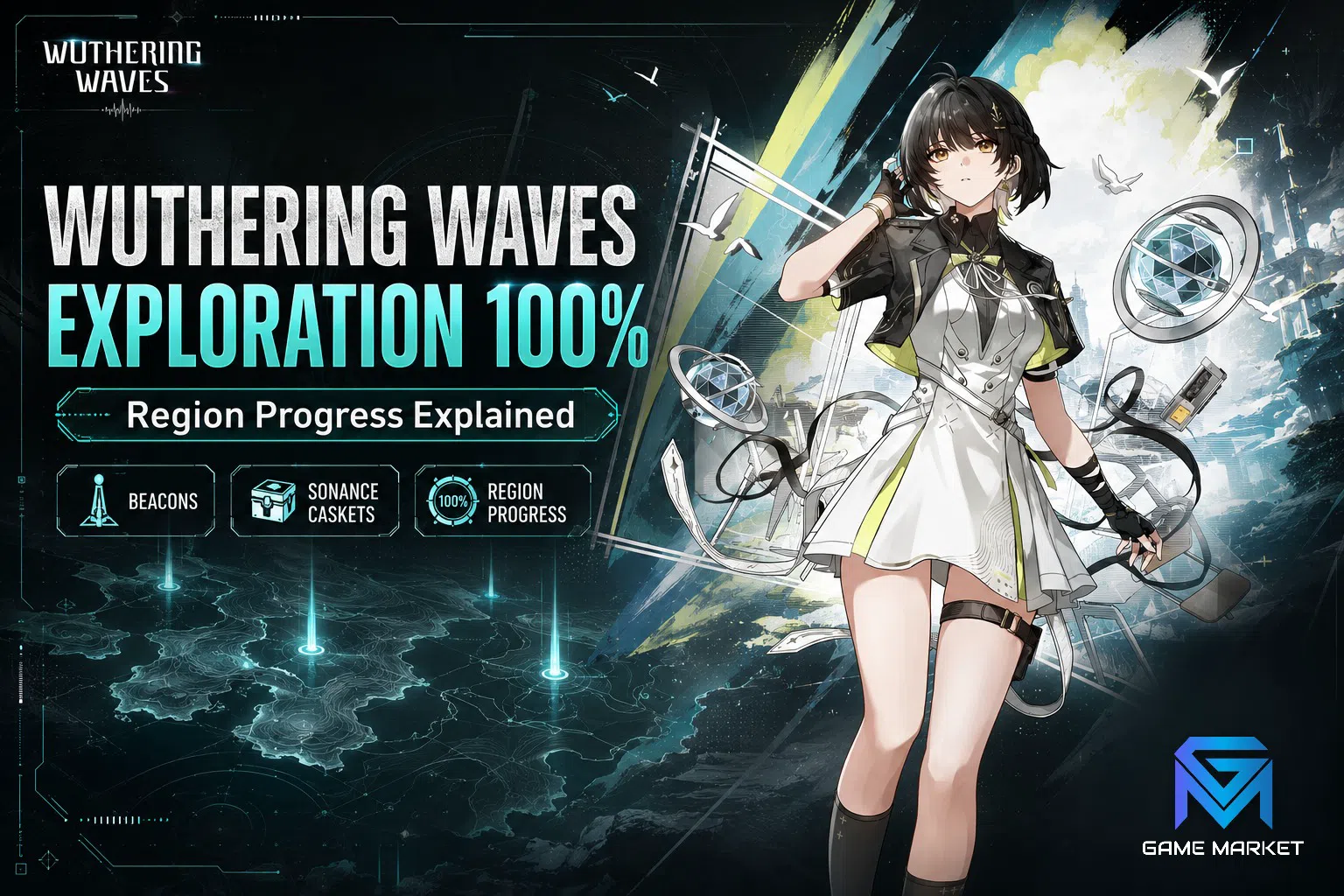
Reaching 100% exploration progress in a Wuthering Waves region means clearing that subregion's full collectible checklist: every supply chest and Sonance Casket, every Resonance Beacon and Nexus, every Tacet Discord and world quest, and every scripted puzzle the map tracks. The percentage is a completion counter, not a difficulty rating.
That distinction matters more than most guides admit. Exploration in Wuthering Waves is not a side activity you do when you run out of Waveplate — it is the single largest source of free Astrite in the game, and it is the only source that never regenerates. Every region Kuro Games ships arrives with a fixed pool of chests, beacons, quests and puzzles attached to it. Clear the pool once and it is gone forever; leave it half-finished and you are permanently carrying a deficit into every future banner. This guide breaks down what the exploration counter actually measures, how each collectible type is weighted, the route order that clears a subregion fastest, and what to do when a region stalls at 97% with no marker left on the map.
What does 100% exploration actually mean in Wuthering Waves?
It means every tracked collectible inside one subregion has been claimed. Wuthering Waves scores exploration per subregion rather than per continent, so Gorges of Spirits, Central Plains and Desorock Highland each hold their own independent percentage, their own milestone rewards and their own completion pool.
Open the map, select a region and the Exploration panel lists the subregions beneath it with a percentage next to each. Those numbers are the ones that pay. Kuro Games attaches Astrite bundles to milestone thresholds along the way — commonly at the quarter marks — plus a final payout when the bar fills. The continent-level number you sometimes see quoted is just an average of its children; it has no rewards of its own and chasing it directly is the fastest way to waste an afternoon.
The other thing to understand is that the counter is finite and fixed at version launch. Unlike Tacet Fields or the Simulation Challenge, exploration does not refresh weekly. When Version 3.x adds Rinascita's coastline or a new Septimont district, that content ships with its own sealed pool of collectibles. Nothing you missed in Huanglong at launch has expired — it is still sitting there — but nothing you clear will ever come back either. This is why veteran accounts and fresh accounts diverge so sharply in pull income: the veteran has already banked eighteen months of one-time exploration Astrite.
What counts toward a region's exploration progress?
Six categories feed the bar: supply chests of all tiers, Sonance Caskets, Resonance Beacons and Resonance Nexuses, Tacet Discords and Tacet Marks, world quests and side quests anchored to that subregion, and environmental puzzles or challenge trials. Collectible pickups such as plants and ores do not count.
That last point trips up a lot of players coming from other open-world gacha titles. Farming Belle Poppies or Iris across a subregion is genuinely useful for ascension materials, but it moves the exploration percentage not at all. If your goal for the session is the bar, ignore the flora entirely and hunt the six tracked categories.
Weighting is uneven, and this is where efficient routing comes from. A Resonance Beacon is worth a meaningful chunk on its own because there are only a handful per subregion. A Basic Supply Chest is worth a fraction of a percent because there are dozens. World quests tend to carry the heaviest single weights, since completing one often unlocks several chests and a puzzle chain as a side effect. In practice, a subregion that looks hopeless at 60% will frequently jump to 85% the moment you finish the one world quest you skipped.
Tacet Discords deserve their own note. These are the roaming Echo-dropping enemies scattered across the overworld, and defeating specific marked ones contributes to exploration in addition to dropping the Echoes themselves. That makes them the rare collectible that pays twice — once into your exploration bar and once into your Echo inventory — which is why they belong early in any route rather than as an afterthought.
How do Sonance Caskets and supply chests differ?
Supply chests come in Basic, Advanced and Premium tiers and pay escalating Shell Credits, Union EXP and occasional Astrite. Sonance Caskets sit above all three: they are the game's top-tier container, they always pay Astrite, and they are usually gated behind a puzzle, a platforming route or a combat trial rather than sitting in the open.
The practical consequence is that Sonance Caskets are where your Astrite actually lives. A Basic Supply Chest is a rounding error on your pull income. A Sonance Casket is a real contribution, and there are only a limited number per subregion. If you are exploring with limited time and want the best return per minute, open your map filters, hide everything except the puzzle and trial markers, and clear those first — the Caskets follow the puzzles almost without exception.
Sonance Caskets are also the collectible most likely to be genuinely hidden. Kuro Games places a good number of them behind Sonance Casket-specific mechanics: sound-based puzzles where you follow an audio cue, sealed containers that require a nearby Echo skill to open, or platforming sequences that only make sense once you have a wall-run or glide resonator in the party. Running the subregion once at speed and then doing a second pass specifically for Caskets is usually faster than trying to solve everything on the first sweep.
Why should you activate every Resonance Beacon first?
Because beacons are simultaneously fast-travel anchors, map-reveal triggers and high-weight exploration contributors. Lighting every beacon in a subregion before you collect anything else typically converts a blank map into a fully drawn one, moves the percentage several points, and removes almost all future travel time.
A Resonance Beacon is the standard teleport point. A Resonance Nexus is the larger regional anchor, usually placed at a town or major landmark, and it doubles as the respawn point for that area. Observation-style vantage points reveal terrain without acting as teleports. All of them are worth touching on the first pass, and the beacons especially, because the map fog is doing more damage to your efficiency than you think — an unrevealed subregion hides its own chest markers, so you cannot even see what you are missing until the fog is gone.
The routing rule that falls out of this is simple: beacons, then fog, then quests, then puzzles, then the cleanup sweep. Players who invert that order — chest-hunting first on a dark map — routinely spend twice as long and still finish the session at 70%.
How much Astrite does full exploration actually pay out?
Exploration is the largest single free Astrite source in Wuthering Waves, ahead of daily activity, event rewards and the Battle Pass free track. A fully cleared major region typically pays out enough Astrite for several tens of pulls once you combine milestone rewards, Sonance Casket drops and the Pioneer Podcast achievements that exploration unlocks along the way.
Exact totals shift with every version, and Kuro Games has retroactively added collectibles to existing regions more than once, so any hard number quoted here would be stale within a patch cycle. What is stable is the structure of the payout, and it has three layers.
The first layer is the milestone rewards attached to the subregion percentage itself — these arrive automatically as the bar crosses its thresholds. The second is the Astrite carried inside the Sonance Caskets and Premium chests you open on the way. The third, and the one most players forget, is the Pioneer Podcast: Wuthering Waves' achievement system pays Astrite for exploration behaviours you were going to perform anyway, such as activating a certain number of beacons or opening a certain count of chests. Those achievements do not auto-claim. Open the Pioneer Podcast menu after any long exploration session and collect the backlog — it is free income sitting in a menu.
Set against that, the recurring sources look small. Daily activity, Tacet Fields and the Simulation Challenge give materials and Shell Credits rather than meaningful pull currency. If your account feels short on Astrite heading into a banner, the answer is almost never "do more dailies" — it is "there are two subregions you never finished".
What is the fastest route order for clearing a new region?
Light every Resonance Beacon and Nexus, clear the fog, then run the subregion's world quests, then solve puzzle and trial markers for Sonance Caskets, then finish with a low-attention sweep of the remaining open chests and Tacet Discords. This order front-loads the high-weight collectibles and eliminates backtracking.
Step one is the beacon pass. Glide and climb the subregion with no intention of fighting anything, touching every teleport and vantage point you can reach. Ignore chests you pass — you will be teleporting back through here repeatedly and picking them up costs nothing later.
Step two is quests. World quests in Wuthering Waves are frequently the key that unlocks whole zones: sealed doors, drained lakes, gated elevators and NPC-locked puzzle chains. Doing quests before chest-hunting means you never have to make a second trip to a location that was locked the first time.
Step three is puzzles and trials, filtered on the map so the markers are visible. This is your Sonance Casket pass and your densest Astrite-per-minute window.
Step four is the sweep. With the map fully revealed and the quests done, the remaining markers are open chests, roaming Tacet Discords and the odd collectible challenge. This is the part you can do while half-attentive, and it is also the part best paired with combat practice — if you are still learning parry timing, the sweep is where you get free repetitions against overworld enemies. Our Wuthering Waves combat guide covering parry, dodge and rotation basics is the companion piece here, because a subregion sweep goes considerably faster when overworld packs die in one rotation instead of three.
How does exploration feed your Data Bank and Echo farming?
Exploration and Echo progression are the same activity performed with different intent. Every Tacet Discord you defeat during an exploration sweep is a potential Echo drop, and every Echo you absorb or submit raises your Data Bank level, which in turn raises the rarity and level ceiling of every Echo that drops afterwards.
This is why exploring early on a fresh account compounds so hard. A low Data Bank caps the quality of what the world gives you, so a player who rushes to endgame with an unexplored map ends up farming Echoes at a bad drop table for weeks. A player who cleared the overworld first is pulling higher-rarity Echoes from the same enemies, at the same Waveplate cost, for the rest of the account's life.
The sequencing that works is: explore broadly to raise the Data Bank ceiling, then farm narrowly for the specific sets and main stats your team needs. Details of that second half live in our Wuthering Waves Data Bank levelling guide and in the Wuthering Waves Echo farming guide, which covers the efficient grinding loop once your ceiling is high enough to be worth grinding against. If you are still deciding which Echoes are worth keeping at all, the Wuthering Waves Echo guide on cost, main stats and tuning explains the Cost budget and tuning system that determines whether a drop is a keeper or Data Bank fodder.
What should you do when a region is stuck at 99%?
Check four things in order: unfinished world quests hiding in the quest log, Sonance Caskets behind unsolved puzzles, areas gated behind an Echo skill or resonator you did not have on your first pass, and vertical or underwater space you never visited. One of those four accounts for almost every stall.
Unfinished quests are the most common culprit by a wide margin. Wuthering Waves buries some side quests behind ambient NPC triggers rather than map markers, and a quest sitting at step two of nine will hold several percent hostage. Sort your quest log by region before you start hunting anything else.
The second culprit is a puzzle you walked past and forgot. Turn off every map filter except puzzles and trials and look for the gap — the marker is usually still there, you have simply stopped seeing it.
Third is traversal gating. Some containers require a specific overworld Echo skill to open or reach: a wall-run, a grapple, a burrow, a launch. If you explored a subregion at Union Level 20 with three resonators, there are almost certainly containers you physically could not reach then and can reach trivially now.
Fourth is geometry. Wuthering Waves builds vertically and, in the coastal regions, downward. Cliff ledges, rooftop interiors, cave systems and underwater pockets hold a disproportionate share of the last few percent. If the map looks clean from above, the missing collectible is almost always above or below the plane you were walking on.
If all four checks come up empty, the honest answer is that the subregion's tracker may include a collectible added in a later version patch. Kuro Games has expanded existing regions before, and the percentage recalculates when it happens. Re-open the map after each version update and re-check any subregion you had previously finished.
How does Waveplate fit into an exploration day?
It barely does, and that is the point. Overworld exploration — chests, beacons, quests, puzzles and roaming Tacet Discords — costs no Waveplate at all. Waveplate is spent only on instanced content such as Tacet Fields, Forgery Challenges, Simulation Challenges and weekly boss claims.
That separation is the most underused piece of resource logic in the game. Waveplate regenerates on a fixed timer and caps out, so overcapping wastes it permanently. Exploration, by contrast, has no timer and no cap — it is entirely bounded by how much time you feel like spending. The correct daily shape is therefore: spend Waveplate first the moment you log in so the meter starts refilling, then explore for as long as you actually want to play.
Players who do it backwards — exploring for two hours and then remembering Waveplate — routinely sit at cap for a chunk of the session and throw away a Tacet Field run's worth of resources. It is a small leak, but it is a daily one, and over a version cycle it adds up to several character ascensions.
For the full picture of how Waveplate, exploration, quests and instanced content slot together on a fresh account, our Wuthering Waves beginner's guide to resonators, Echoes and Astrite lays out the early-game order of operations that this article assumes you already have in place.
Frequently asked questions about Wuthering Waves exploration
Does exploration progress ever reset between versions?
No. Cleared collectibles stay cleared permanently, and milestone rewards are claimed once. What can change is the denominator: when Kuro Games adds content to an existing subregion, the percentage recalculates downward and the new collectibles become available to claim.
Do I need 100% exploration to finish the main story?
No. The main quest is gated by Union Level and by its own prerequisite quests, not by exploration percentage. Exploration is optional in the sense that the story does not require it — and mandatory in the sense that it is where the Astrite is.
Is it worth going back to old regions after a new version launches?
Yes, for two reasons. Old subregions still hold their full one-time Astrite payout regardless of how long you leave them, and your current traversal kit and combat power make previously awkward containers trivial. Old-region cleanup is usually higher Astrite-per-minute than new-region exploration.
Do overworld collectibles scale with my Union Level?
Enemy level scales with world tier and Union Level, but the collectible pool itself does not. A chest holds what it holds whenever you open it, which is why there is no penalty for exploring early and no bonus for waiting.
Does exploring in co-op count toward my own progress?
Chests you personally open in another player's world do not credit your world's exploration counter. Co-op is useful for help with a difficult boss or a trial, but the collectible sweep has to happen in your own world to move your own percentage.
Where to Find Wuthering Waves Hourly Services and Boosting
On GameMarket.gg you can book an hourly Wuthering Waves session with a verified player.
If clearing a backlog of half-finished subregions is more grind than your schedule allows, you can browse the available Wuthering Waves boosting listings on GameMarket.gg and pick an offer that matches the regions and progress goals you actually care about, with the transaction protected end to end.
First-login region choice is a related account decision — see GameMarket's guide to what server lock means for your account for how that permanent choice interacts with cross-save and progress.
GameMarket.gg is a trusted digital marketplace for everything gaming-related. We serve the gaming community by providing secure access that enhances every gaming journey.



![Wuthering Waves Accounts Starter SEA|UL 20|Rank 2|4 Char Limited [Phrolova+Sign],Jiyan,Hiyuki,Lynae|Mc Male|TakeMail WW422B](https://img.gamemarket.gg/products/emzfiswa/wuthering-waves-accounts-sea-ul-20-rank-2-4-char-limited-phrolova-sign-ji-grh-thumbnail.webp "SEA|UL 20|Rank 2|4 Char Limited [Phrolova+Sign],Jiyan,Hiyuki,Lynae|Mc Male|TakeMail WW422B")

![Wuthering Waves Accounts Starter SEA|UL 48|Rank 5|3 Char Limited [Hsin RC6]+Sign,Chisa,Iuno|Mc Male|Check SS WW517B](https://img.gamemarket.gg/products/lb6vky3v/wuthering-waves-accounts-sea-ul-48-rank-5-3-char-limited-hsin-rc6-sign-ch-c4i-thumbnail.webp "SEA|UL 48|Rank 5|3 Char Limited [Hsin RC6]+Sign,Chisa,Iuno|Mc Male|Check SS WW517B")
![Wuthering Waves Accounts Mid-Game SEA|UL 57|Rank 6|3 Char Limited [Hsin RC6]+Sign,Chisa Rc1,Iuno|Mc Female|Check SS WW518B](https://img.gamemarket.gg/products/u8deackn/wuthering-waves-accounts-sea-ul-57-rank-6-3-char-limited-hsin-rc6-sign-ch-flm-thumbnail.webp "SEA|UL 57|Rank 6|3 Char Limited [Hsin RC6]+Sign,Chisa Rc1,Iuno|Mc Female|Check SS WW518B")