eFootball Player Stats Explained: Ratings, Playing Styles & Skills
By John Ganang 25 August 2026, 08:00 WIB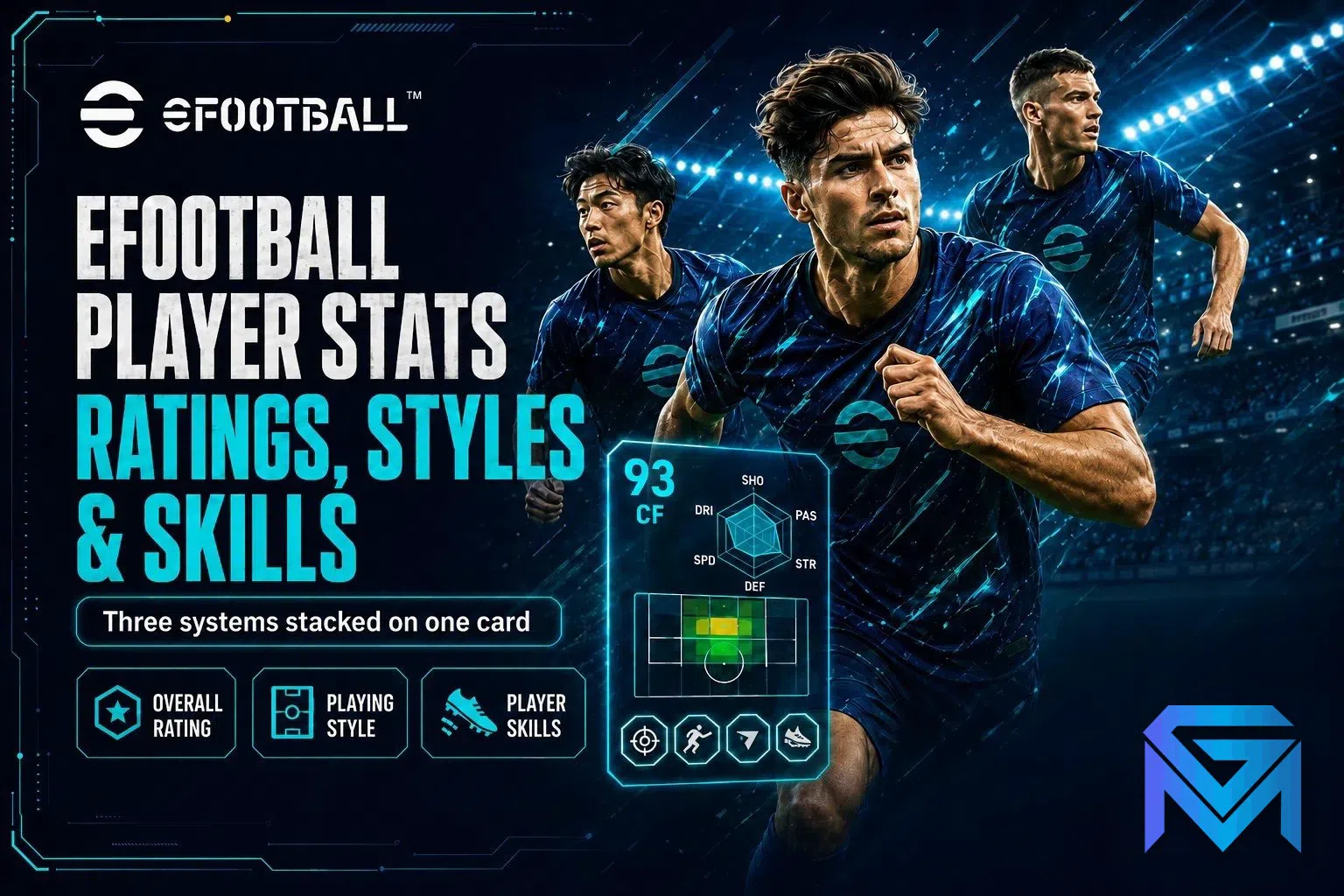
An eFootball player card is three separate systems stacked into one screen, and the Overall Rating only summarises the first of them. Attributes describe raw ability, the Playing Style decides where the AI actually puts that player, and Player Skills unlock moves the attributes on their own will never produce. Read a card in that order and a 95-rated name stops looking automatically better than a 90-rated one.
That is the whole argument of this guide. Most players compare cards by the big number in the corner, then wonder why the expensive signing drifts out of the game while a cheaper midfielder keeps turning up in the right place. Below, each layer of the card is unpacked once and then built on, so that by the end you can look at an unfamiliar player and predict how he will behave before you ever put him on the pitch.
What do the numbers on an eFootball player card actually mean?
Each card carries around forty individual attributes rated roughly 40 to 99, covering technique, physicality and awareness. The Overall Rating is a weighted summary of them, weighted for the player's registered position, which is why the same attribute spread produces a different Overall on a striker and a full-back.
The attributes themselves are grouped into families that repeat across every card. Offensive Awareness and Defensive Awareness govern how early a player reacts to a developing move, which matters far more than it sounds, because a forward with high Offensive Awareness starts his run before you press the through-ball button rather than after. Ball Control, Dribbling and Tight Possession describe how cleanly he carries the ball and how well he keeps it when a defender is leaning on him. Low Pass and Lofted Pass are split deliberately, so a deep midfielder can be excellent on the ground and ordinary in the air.
Finishing, Heading, Place Kicking and Curl handle everything that ends with a shot, while Speed and Acceleration are stored separately because they answer different questions: Acceleration decides who wins the first two yards, and Speed decides who wins the next twenty. The physical block covers Kicking Power, Jumping, Physical Contact, Balance and Stamina, and goalkeepers replace most of it with GK Awareness, GK Catching, GK Parrying, GK Reflexes and GK Reach.
Two smaller fields do more work than their size suggests. Weak-foot Usage tells you how willingly a player uses his other foot, and Weak-foot Accuracy tells you how well it goes when he does. A winger with low usage on both counts will shape onto his strong foot every time, so a defender who has watched you for ten minutes knows exactly which way you are going.
Which attributes matter most for each position?
There is no universal shortlist, because the attributes that decide a match depend entirely on the job the card is being asked to do. The practical approach is to pick two or three attributes that define the role, check those first, and treat everything else as a tie-breaker.
Working through the pitch, the priorities look like this:
- Centre forward: Finishing and Offensive Awareness first, then Physical Contact if he is the one holding the ball up, or Acceleration if he is running in behind.
- Second striker and attacking midfielder: Dribbling, Tight Possession and Low Pass, because this is the player who receives with his back to goal and has to survive contact before he can create anything.
- Winger: Acceleration over Speed, then Ball Control and Curl. A winger who cannot beat the first touch of pressure never gets to use his top speed.
- Central midfielder: Stamina, Low Pass and Defensive Awareness. Stamina is the quiet one here, since a midfielder whose condition collapses on seventy minutes stops arriving in the box exactly when matches are decided.
- Defensive midfielder: Defensive Awareness, Defensive Engagement and Tackling, with Physical Contact deciding whether he wins the duel or gives away the foul.
- Centre-back: Defensive Awareness and Jumping, then Speed. Pace matters more than it used to because so many teams play a high line and get punished by one ball over the top.
- Full-back: Stamina and Speed above everything, since the role asks for the same lane to be run in both directions all match.
- Goalkeeper: GK Awareness and GK Reflexes, with GK Reach mattering most if you concede a lot of crosses.
Those priorities are also the priorities you will use later when spending Progression Points, so it is worth deciding them before you invest anything in a card.
What is a Playing Style, and why does it matter more than Overall?
A Playing Style is the behaviour tag on the card, and it controls what the player does in the roughly eighty-five minutes when you are not personally holding the stick for him. eFootball carries twenty-one of them across the pitch, and the wrong one turns a brilliant attribute spread into a player who is permanently in the wrong place.
This is the single most common reason a highly rated signing disappoints. Attributes set the ceiling; the Playing Style sets how often the player is in a position to reach it.
Attacking styles split by where the player wants to receive the ball. A Goal Poacher lives on the last defender's shoulder and makes line-breaking runs, so he suits a lone-striker shape. Fox in the Box stays inside the penalty area instead of dropping, whereas a Deep-Lying Forward does the opposite and comes into midfield to link play. A Dummy Runner drags defenders away to open space for someone else, which means his own scoring numbers understate his value. Target Man holds the ball with his back to goal. Out wide, a Prolific Winger stays glued to the touchline to cross, while a Roaming Flank cuts inside into central areas.
Midfield styles divide along the same logic. Classic No. 10 and Creative Playmaker both sit high and create, but the No. 10 barely tracks back, so pairing two of them leaves an obvious hole. A Hole Player bursts forward into the box when your team has the ball, which is why he wants a shield behind him. Box-to-Box covers the whole pitch, Destroyer presses and tackles relentlessly, Orchestrator builds from deep while still defending, and Anchor Man parks in front of the defence. Cross Specialist is the wide-midfield delivery role.
At the back, Build Up centre-backs sit deep and pass out, Destroyer centre-backs step out and press, and an Extra Frontman joins attacks whenever he can. Full-backs choose between Offensive Fullback, Defensive Fullback and Fullback Finisher, the last of which drifts into central attacking areas. Goalkeepers pick between Offensive Goalkeeper, effectively a sweeper for balls behind a high line, and Defensive Goalkeeper, who stays on his line to stop shots.
The useful test is whether your eleven contains conflicting styles rather than whether each style is individually strong. Two Hole Players and a Classic No. 10 will all vacate midfield at the same moment, so the transition you concede is not bad luck; it is the styles doing exactly what they promised.
How do Player Skills change what a card can do?
Player Skills are unlockable abilities printed on the card, and there are over forty of them split across Shooting, Passing, Dribbling, Defending, Goalkeeping and a general "other" group. Unlike attributes, a skill is binary: the player either has the move available or he does not, no matter how high the related stat climbs.
That binary quality is why skills often decide a card's ceiling more than five extra Finishing points would. Shooting skills such as Long Range Curler, Chip Shot Control, Knuckle Shot, Dipping Shot and Rising Shot each unlock a specific shot type tied to a power range on the stunning shot input, so a striker without them simply cannot produce that animation. Acrobatic Finishing allows volleys from awkward bodies, One-time Shot sharpens first-time strikes, and Penalty Specialist matters in every knockout mode.
Passing skills follow the same pattern. Through Passing improves precision on tricky trajectories, Weighted Pass adds backspin to lofted and fly-through balls, Pinpoint Crossing sharpens deliveries, and Low Lofted Pass keeps the trajectory flat at any distance. Heel Trick, Rabona and No Look Pass are situational, whereas One Touch Pass affects almost every possession sequence you play.
Dribbling skills are mostly speed multipliers on specific feints, including Scissors Feint, Double Touch, Flip Flap, Chop Turn, Inside Bounce and Sombrero, with Sole Control making feints and turns generally faster and cleaner. Defensively, Man Marking makes a player harder to shake off, Interception and Blocker improve reactions to passes, Sliding Tackle raises both the speed and the success rate of slides, and Aerial Superiority decides who wins headers.
The general group holds the ones people overlook. Captaincy reduces fatigue for the entire team, Fighting Spirit keeps a player accurate under pressure while reducing fatigue effects on him, Super-Sub boosts a player brought on in the second half, and Gamesmanship helps win fouls in possession. Because Captaincy and Fighting Spirit both act on stamina, they quietly extend the window in which your midfield attributes are still real numbers rather than tired ones.
What makes Show Time skills different?
Show Time skills, also called special skills, appear only on selected Epic, Show Time and Big Time cards, and they are stronger and more conditional than regular skills. A card carrying one is doing something the rest of the roster structurally cannot do, which is the main reason those card types command attention.
Some are straightforward amplifiers. Phenomenal Finishing raises a player's ability to finish with every shot type, Phenomenal Pass improves the speed and accuracy of all passes, Bullet Header adds power and accuracy to headers, and Aerial Fort further boosts aerial ability. Blitz Curler adds a sharper curve to controlled shots above roughly half power, and Low Screamer unlocks a powerful low shot on a stunning shot under half power.
Others change how the ball behaves at your feet. Magnetic Feet improves control while heavily marked, Momentum Dribbling keeps the ball tight and speeds up transitions between moves, and Acceleration Burst gives a bigger acceleration boost off the dribble. Long Reach Tackle extends a defender's standing-tackle range and success rate, which is the single most noticeable defensive special skill in normal play.
A third group is explicitly situational and reads almost like a tactic. Fortress improves a player's defensive and physical output if his team leads at the start of the second half, while Game-Changing Pass boosts passing accuracy if the team is losing at half-time. Willpower builds a player's shooting ability the more shots he takes, and Visionary Pass temporarily improves the first-touch control and one-touch play of whoever receives his pass. Attack Trigger raises the Offensive Awareness of every teammate while the carrier has the ball, so its value scales with the squad around him rather than with his own numbers.
Those conditions are why two cards with identical Overall can sit in different tiers, because a special skill that only fires when you are behind at half-time is worth a great deal in long knockout runs and very little in short casual sessions.
How does levelling and Progression Points change a card's stats?
Levelling a card does not raise its Overall by itself. Experience raises the player's level, each level awards Progression Points, and only spending those points on attribute categories actually moves the numbers, which means an untrained max-level card is no stronger than the day you signed it.
Experience arrives from two directions. Playing matches in any mode earns it, with the amount influenced by your manager's affinity, since every manager favours a particular group such as forwards or younger players. The faster route is feeding Level Training Programs directly to the card. These come in fixed experience values of 100, 1,000, 4,000 and 10,000, so a stack of small programs is best used to top a card over a level boundary rather than to carry it from the start.
You gather those programs from event and campaign rewards, from releasing players you do not need, and by exchanging eFootball Points in the store. Releasing is the underrated one, because the return scales with the released card's stats and card type, so duplicate high-rarity cards convert into meaningful training rather than sitting unused.
Progression Points are then spent across roughly ten grouped categories rather than on individual attributes. Shooting, for instance, bundles Finishing, Place Kicking and Curl together, so one investment moves several related numbers at once. Because of that grouping, the position priorities from earlier translate directly into a spending order: strikers into Shooting and Dexterity, wingers into Dribbling and Dexterity, central midfielders into Lower Body, Passing and Dribbling, defensive midfielders into Defending and Lower Body, centre-backs into Defending and Aerial Strength, full-backs into Lower Body and Dexterity, and goalkeepers into their dedicated goalkeeping categories.
The mistake worth avoiding is spreading points evenly to make the card look balanced. Nothing on the pitch rewards balance for its own sake, so pushing two role-defining categories high beats nudging eight categories up slightly.
Why do the same card's stats change between matches?
Because eFootball applies a match-day condition on top of the printed attributes. Every player carries a Condition rating from A to E, and before each match the game rolls an arrow from that rating, which then raises or lowers his effective stats for those ninety minutes.
The arrow is the visible part. A blue upward arrow means boosted attributes for the match, a red downward arrow means the opposite, and the neutral state leaves the card as printed. The Condition rating decides the odds rather than the result, so a player rated A or B will usually land on a good arrow, a player rated D or E will usually land on a poor one, and a player rated C swings noticeably from match to match.
For cards affected by Live Update, that Condition rating tracks real-world performances and shifts through the season, which is why a base card can feel sharper in one month than another without anything about it changing on your side. This is also the reason a like-for-like comparison between two cards should never be made from a single match: you may simply have watched a good arrow play a bad one.
Fatigue works alongside it. Stamina, plus skills such as Captaincy and Fighting Spirit, determines how long a player holds his level within the match, whereas Condition determines the level he started at. Understanding both is what stops you blaming a card for a performance that the arrow had already decided.
How should you read a card before you commit to building it?
Work down the layers in the order they affect matches, and stop as soon as one of them disqualifies the card. Overall Rating is the last thing to look at, not the first, because it is the only number on the screen that cannot tell you anything you could not work out from the parts.
Build the card when the Playing Style matches the slot you actually need, the two or three role-defining attributes are already strong, and it carries at least one skill you will use every match. That combination is what makes an investment hold its value, since Progression Points spent on a card in the right role compound with everything else you do.
Skip the card when the Playing Style conflicts with the players around it, when the role-defining attributes are average and only the irrelevant ones are high, or when a striking Overall is being carried by attributes that never come up in your style of play. A 99 in Jumping does very little for a winger you use to cut inside and shoot.
Wait when the card is good but you have not yet decided the shape it will play in. Training resources are finite, and moving a heavily invested card into a role its Playing Style does not suit wastes the investment rather than transferring it.
The most common error, and the one that follows directly from everything above, is comparing two cards by Overall and stopping there. Compare the Playing Style first, then the two attributes the role lives on, then the skills, and the decision usually makes itself before the Overall Rating ever enters the conversation.
Common questions about eFootball player stats
Can you change a player's Playing Style? The Playing Style is a property of the card itself and is not something you swap through training. If the style does not fit, the answer is a different card rather than more investment in this one.
Does a higher Overall Rating always mean a better player? No. Overall is a position-weighted average, so it rewards being generally competent rather than excellent at the specific things a role needs. Two cards on the same Overall can behave completely differently.
Do Progression Points reset if you change your mind? Plan as though they do not. Treat every allocation as permanent and decide the card's role before spending, which is why the position priorities are worth settling first.
Are Show Time skills available on any card? No. They appear only on selected Epic, Show Time and Big Time cards, which is a large part of why those card types are valued differently from Standard ones.
Once you can read a card properly, the next question is usually which card types are worth chasing. Our eFootball player card types guide covers what separates Standard, Highlight, Epic and Big Time cards, while the eFootball beginner's guide to player cards, Coins and squads ties the whole progression loop together. On the currency side, the breakdown of how eFootball Coins and GP differ and the guide to what eFootball Coins are actually used for explain where signing resources come from, and the eFootball accounts listings show what a fully built roster looks like.
If you would rather put your training resources into the players you already know you want, you can browse the current eFootball Coins top up listings on GameMarket.gg and get straight back to building the squad instead of grinding for the resources to start it.
GameMarket.gg is a trusted digital marketplace for everything gaming-related. We serve the gaming community by providing secure access that enhances every gaming journey.
For a wider look at how manager level, GP, and card collections combine to shape an account's overall standing, see our guide on eFootball accounts explained.
If you want to see how these individual stats translate into the current tier lists at each position, check our eFootball current meta and best players guide.