Blood Strike Weapon Mastery Guide: Levels, Attachments & Camos
By John Ganang 27 August 2026, 06:00 WIB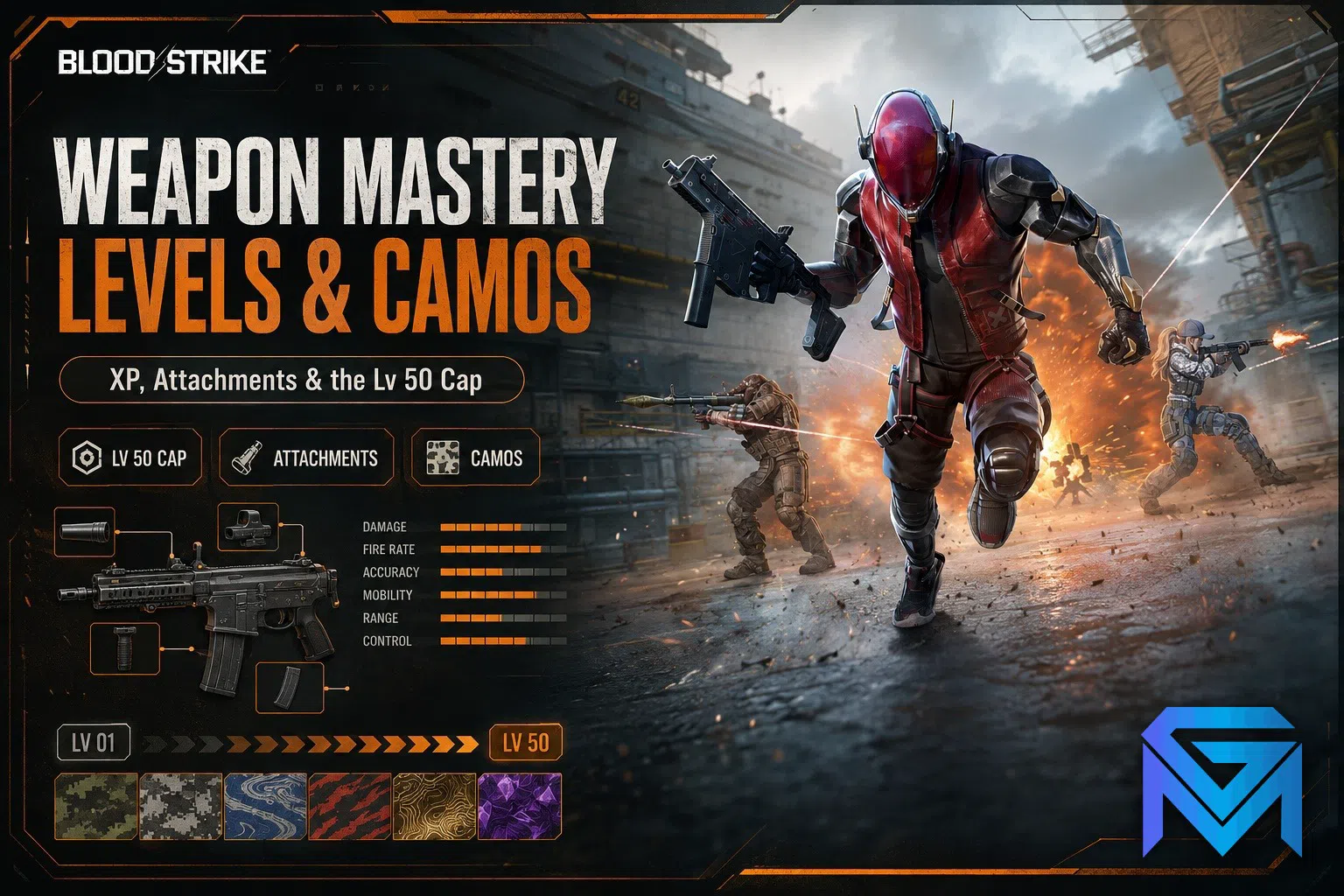
In Blood Strike, the gun does not get better because you get better; it gets better because you keep using it. Weapon mastery is a per-firearm experience track that unlocks attachments, cosmetics and handling upgrades as you play, and every attachment you unlock permanently changes how that weapon behaves. For which weapons are actually worth maxing out right now, check the current Blood Strike tier list.
That single fact explains most of the skill gap new players feel and cannot name. Two squads can drop with the same rifle, and one of them is firing a gun with a compensator, an extended barrel and a vertical grip while the other is firing the stock version with a recoil pattern that climbs off the target by the fourth round. Neither player is aiming better. One of them simply spent the hours. Below is how that track actually works: where the experience comes from, what unlocks at which point, why the level cap is not the same on every gun, how camo challenges differ from level progress, and roughly how long a full mastery run takes.
What is weapon mastery in Blood Strike?
Weapon mastery is a separate progression bar attached to each individual firearm rather than to your profile. Using a specific gun raises only that gun's level, and reaching new levels unlocks attachments, variants and cosmetic rewards for that weapon alone. Nothing transfers between guns.
This is the part that catches out players coming from games where a single account rank feeds everything. Your Striker level, your ranked tier and your battle pass tier all move on their own tracks, and the Blood Strike battle pass guide to tiers, rewards and season timing covers how that third track is paced. Your Striker level advances on its own track too — see how Striker abilities, roles and unlocks work in that guide. The AK-47 sitting at level 40 in your loadout contributes nothing to the sniper you have never touched. That separation is deliberate, because it is what makes a diverse arsenal expensive in time and therefore meaningful: a player with four maxed weapons across four categories has genuinely put in four times the work of a player with one.
It also means mastery is one of the few progression systems in the game that cannot be shortcut by spending. Currency accelerates the surrounding economy, which we cover further down, but there is no direct exchange rate between currency and weapon experience. If you want to see how mastery sits alongside the other progression tracks, the Blood Strike beginner's guide to ranks, Strikers and Strike Gold lays out how each one feeds the others.
How do you earn weapon XP?
Weapon experience comes from four channels: time spent with the weapon equipped, damage dealt with it, knockdowns and confirmed eliminations, and assists. All four accrue at once during a match, so the practical rule is simple. The gun you are holding when things happen is the gun that levels.
Damage matters more than most players assume. Because damage dealt is its own channel, a fight you lose still pays out, and a fight where a teammate finishes your target still pays out through the assist channel. That changes what an efficient session looks like. You are not hunting a clean kill count; you are hunting contact. A player who trades constantly and dies often will usually out-earn a cautious player who survives longer but fires twenty rounds a match.
The corollary is the single most common mistake in the system: switching weapons mid-match. Every swap splits the session's experience across two bars instead of concentrating it in one, so a player rotating between three guns takes roughly three times as long to see any of them finish. Commit to one firearm for a whole session, then rotate between sessions rather than within them.
Once a weapon finishes its track, the experience does not stop counting. Surplus experience converts into experience cards you can apply elsewhere, so continuing to play a maxed gun is not wasted effort; it becomes fuel for the next weapon on your list.
What unlocks as a weapon levels up?
Attachments unlock at fixed level thresholds, spread across the whole track so that a weapon keeps improving rather than transforming all at once. Optics and basic grips arrive within the first handful of levels, muzzles and barrels land in the middle of the track, and stocks and specialist underbarrels sit near the top.
The exact thresholds vary by firearm, but the published unlock tables across the roster follow a recognisable shape. A compact reflex optic can appear as early as level 2 and an extended vertical grip at level 3, which is why even a barely-used gun feels noticeably steadier than a fresh one. Lightweight muzzle brakes tend to land around level 12, tactical barrels around level 20, sniper stocks around level 30, and the strongest underbarrel options around level 40. Treat those figures as the shape of the curve rather than a universal table, because NetEase adjusts individual weapon trees with balance patches.
What matters strategically is which unlocks are worth chasing. Extended barrels and vertical grips deliver the largest returns per unlock on most primary weapons, because they attack recoil and effective range, the two attributes that decide medium-range trades. Optics are a preference rather than a power gain once you have any usable sight. If you are levelling a gun with a specific goal in mind, push to the barrel and grip thresholds first and treat everything above them as refinement.
The performance gap this creates is real and measurable. A fully-kitted weapon at the top of its track beats its stock counterpart on recoil pattern, sustained accuracy and time-to-kill in the same hands. That is why loadout tier lists and mastery levels are different conversations: a tier list tells you which gun has the highest ceiling, mastery tells you whether your copy of that gun has reached it. For the detail behind that, see Rank Tiers Explained Points, Resets and Rewards.
How does the Mastery Grid work?
The Mastery Grid is the interface layer on top of weapon levels. Instead of a straight line of rewards, unlocks sit in interconnected nodes, and claiming one node opens the adjacent ones. You spend accumulated weapon experience, and in some branches Strike Gold, to take each node.
Pathing is where players waste resources. Because nodes open sequentially, an early detour into a cosmetic branch can leave you several nodes away from the handling upgrade you actually wanted, and there is no refund. Before you spend anything on a new weapon, look at where the barrel and grip nodes sit and trace the shortest route to them. Peripheral nodes will still be there later; the recoil reduction you skipped will cost you fights every match until you take it.
Strike Gold's role in the grid is frequently misunderstood. It does not convert into weapon experience at any rate. What it does is buy the things that generate experience faster, chiefly stash openings that contain experience cards and the seasonal Strike Pass, whose tiers pay out cards alongside currency. So currency is a catalyst rather than a substitute, and a player who funds the economy expecting to skip the grind has funded a faster grind instead of no grind. Budget accordingly: the question is never how much currency converts into levels, but how much of it lands on stash openings and pass tiers that pay out cards.
Why do some weapons cap higher than others?
Most firearms finish their mastery track at level 50, which is where the full attachment suite becomes available. A small number of weapons run further. The P90 submachine gun is the best-known exception, extending to level 100 and gating a distinctive burst bolt attachment behind the extended track.
Extended caps exist to give a handful of signature weapons a long-term chase. The practical consequence is that "maxed" means different things depending on the gun, and a player comparing progress across an arsenal should read the cap before reading the number. A level 50 rifle is complete. A level 50 P90 is halfway.
Newer weapons have also started arriving with their own progression wrinkles rather than slotting into the standard tree. The Scorpion submachine gun, added in a 2026 update, introduced a weapon kit system that bundles attachment behaviour differently from the classic node layout. Expect this to keep happening: when a new firearm launches, check its tree before assuming it behaves like the last one you levelled.
How are camo challenges different from weapon levels?
Camos are earned through discrete combat challenges rather than accumulated experience, so they run parallel to the level track instead of along it. A camo asks for a specific achievement, and no amount of playtime unlocks it until that achievement happens.
The challenges are tiered from trivial to demanding. An entry camo might ask for twenty eliminations with the weapon. A mid-tier camo commonly combines a level requirement with a kill count, for example fifty eliminations once the weapon has reached level 30. The top tier asks for something you cannot accidentally do, such as a set number of triple-elimination streaks in a single match.
That last category is why camos read as status markers in a way levels do not. Levels prove hours; a streak-based camo proves you won three fights back to back without dying, repeatedly. It is also why currency cannot buy the top of a weapon's cosmetic tree. You can fund experience cards to reach the level requirement faster, but the streak still has to happen in a real match with real opponents.
Practical approach: read the full challenge list before you start levelling a gun, because several camos have level gates that make the order matter. Hitting fifty eliminations before you reach the gated level means those kills do not count toward the camo, and you will have to do it twice.
What is the fastest way to farm weapon XP?
Objective modes with rotating control points are the fastest environment, because they concentrate players into a small area and keep producing engagements without the travel time and looting that battle royale imposes. Hot Zone is the standard answer, and squad play adds roughly twenty percent efficiency through survival and assist bonuses.
Hot Zone rewards control of a designated area continuously while hardpoints rotate through the match, which produces something valuable for farming: predictable enemy movement. When the objective shifts, both teams have to travel to it along the same handful of routes, and sitting on one of those routes converts map knowledge directly into contact. Deserted Valley is the map most often cited for this, partly because its supply post density lets you resupply without leaving the traffic. Access to Hot Zone is gated behind Platinum rank in either the battle escape or battle royale ladders, so it is a mid-account activity rather than a day-one one.
Positioning inside the mode matters more than raw aggression. Sitting in the middle of a contested point exposes you from every angle and turns your session into a respawn timer, whereas holding the periphery gives you the same volume of engagements with an escape route and a higher survival rate. Since survival time and damage both pay out, staying alive at the edge of a fight usually beats dying in the centre of one.
Two alternatives are worth knowing. Team deathmatch produces a steadier, flatter experience curve without objective positioning to think about, which makes it the better choice for weapons that want short engagement distances. Battle royale pays more slowly per hour because of downtime, but it is the only mode where you are levelling under the conditions you will actually compete in. If your goal is ranked performance rather than a finished bar, some battle royale time is not wasted.
Ignore anything describing this as an idle or away-from-keyboard method. Because three of the four experience channels require you to be shooting, passive presence in a mode generates a fraction of what active participation does.
Why do trial loadouts matter while levelling?
Trial loadouts give temporary access to a fully-equipped version of a weapon without owning the unlocks. Using one while levelling that same weapon is the single most efficient trick in the system, because you fight with the attachments you have not earned yet while still earning progress toward earning them.
The tokens that open these loadouts come from ordinary play. Battle pass progression grants one at an early tier, and rank points can be exchanged for further tokens. Because the tokens are reusable, the cost is a one-time hurdle rather than a per-session drain.
The compounding effect is what makes this worth building a routine around. A trial-equipped weapon wins more fights, more fights mean more eliminations and damage, and more of both means faster levelling. Running a stock weapon through a farming session is doing the same hours at a worse win rate, which is the definition of a slow grind.
How long does it take to max a weapon?
Community benchmarks for a standard level 50 track cluster around 180 hours of focused play for an assault rifle, which works out to roughly a month at six hours a day. Squad play trims that to somewhere near 144 hours. At one hour a day, a single weapon is a multi-month project.
Those numbers are estimates from player testing rather than published figures, and they move with mode choice, win rate and patch balance. Use them for shape, not precision. The shape is the point: mastery is measured in weeks per weapon, which is why a mature arsenal is the clearest signal of long-term play on any account.
Set session-length goals instead of level goals. Match quality varies enough day to day that a "reach level 12 tonight" target will feel like failure on a bad night and produce nothing extra on a good one. Committing to a fixed session length and reviewing progress weekly smooths that variance out and keeps the routine sustainable, which matters far more than any single evening's rate.
How does weapon mastery show on an account?
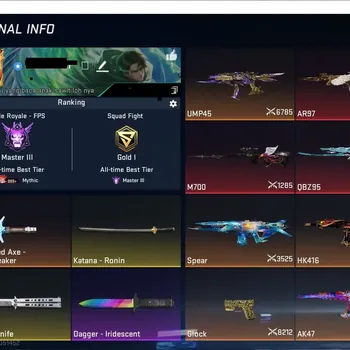
Mastery is stored per weapon on the account, so it is visible and permanent in a way that a good match is not. Weapon levels, unlocked attachments and earned camos all persist through seasons, which makes them a reliable read on how much real time an account has behind it.
This is why weapon levels turn up so often in account descriptions alongside skin rarity and rank. A listing noting a particular rifle at a high level is describing hundreds of hours that cannot be replicated quickly or bought outright, and it sits in the same category of durable progress as rare cosmetics. Our guide to Blood Strike account tiers from starter to high-end explains how these signals stack up, and the rare skins and collab guide covers the cosmetic side of the same question. One detail that trips people up when comparing accounts is region: progression is tied to the account's server, so it is worth checking which server an account sits on before reading anything else about it.
Read those three together and the picture is straightforward. A profile rank tells you how long someone has been playing. Camos and weapon levels tell you what they were doing with that time, and which weapons they can actually compete with today.
Where to Find Blood Strike Top Up and Accounts
On GameMarket.gg you can compare Blood Strike top-up options before you spend.
If you want to see how mastery, camos and skin rarity combine in practice, browse the Blood Strike accounts on GameMarket.gg and compare what sellers list against the systems above; the high-end Blood Strike accounts section is where long mastery tracks and completed camo sets tend to show up together.
GameMarket.gg is a trusted digital marketplace for everything gaming-related. We serve the gaming community by providing secure access that enhances every gaming journey.