Wuthering Waves Concerto Energy Explained: Outro and Intro Skills
By John Ganang 18 September 2026, 06:00 WIB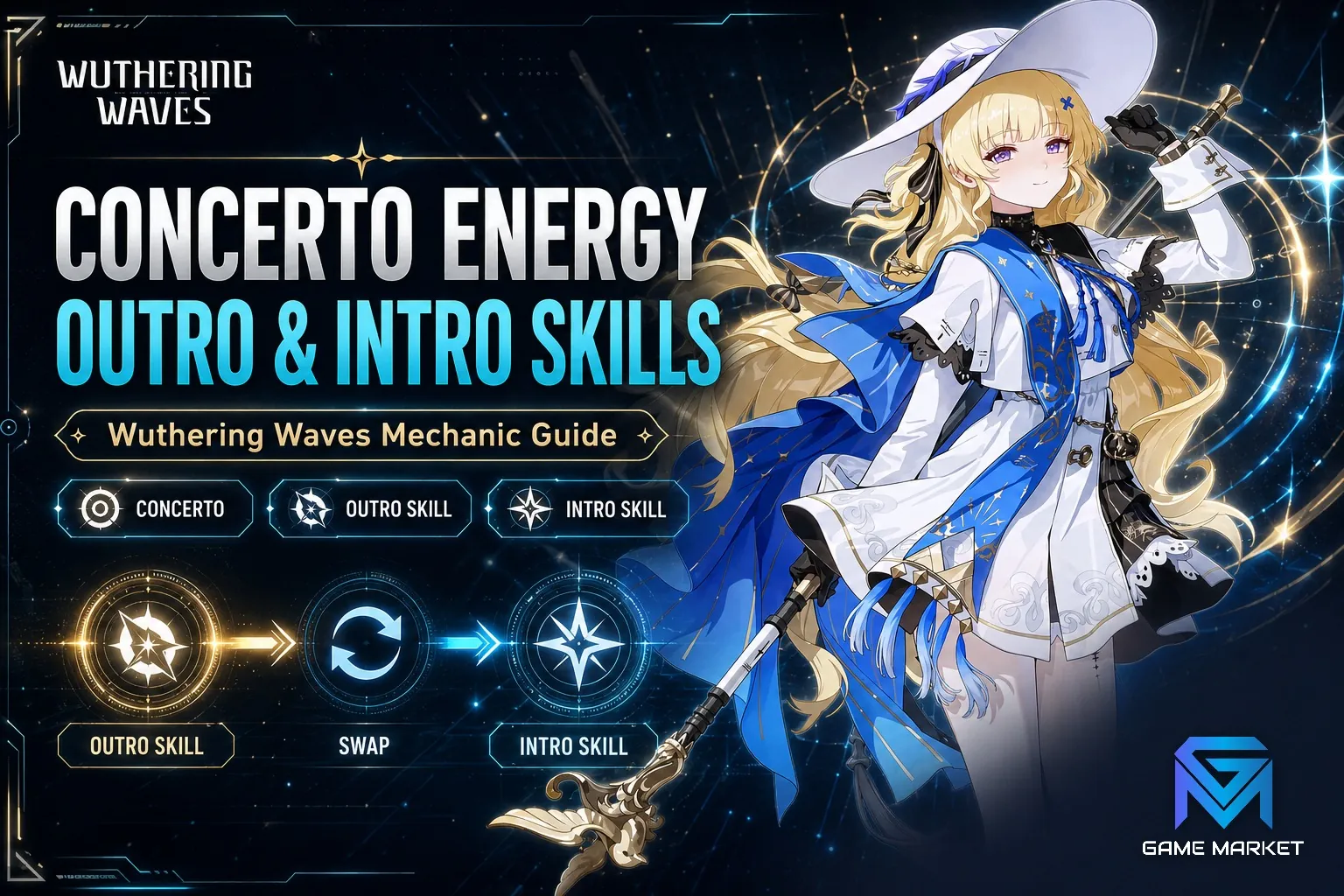
Concerto Energy is Wuthering Waves' team-rotation resource: every Resonator fills a personal 100-point gauge by attacking, and once it is full, swapping that Resonator out fires their Outro Skill and hands the incoming character an Intro Skill. It is the mechanic that turns three separate characters into one team.
Most players who feel stuck in Tower of Adversity are not short on character levels. They are losing the Outro buff before the damage window opens, because Concerto Energy is the only system in the game that punishes you for playing one Resonator too long. Learn how the gauge fills, how long the buff it grants survives, and the same roster starts clearing content it previously stalled on. This guide is written so a new Rover understands the loop from scratch, while veterans get the timing detail that decides whether a rotation lands inside a boss's stagger window.
🎼 What is Concerto Energy in Wuthering Waves?
Concerto Energy is a per-character gauge that caps at 100 and fills as that Resonator deals damage. At 100 it unlocks the Outro Skill, which triggers automatically when you swap that Resonator out. It is separate from Resonance Energy, which powers the Resonance Liberation ultimate.
The distinction matters because the two gauges reward opposite habits. Resonance Energy asks you to stay on a character long enough to build and spend an ultimate; Concerto Energy asks you to leave. Kuro Games' own tutorial text introduces the gauge as the "Concerto" ring that wraps the character portrait in the bottom-right of the combat HUD, and the moment that ring completes its circle, the swap arrow above your standby Resonators lights up. That lit arrow is the game telling you the rotation is ready, and ignoring it is the single most common reason a team underperforms its raw stats.
Every Resonator carries their own gauge, and those gauges do not drain while a character sits on the bench. If you build Verina to 100 Concerto and swap her out without triggering the intended buff order, that energy is gone for the cycle. If you build her to 90 and swap early, the Outro never fires at all and the incoming Resonator gets no Intro Skill. The gauge is binary at the point of use: 99 does nothing, 100 does everything.
⚡ How do you fill Concerto Energy fastest?
Concerto Energy comes from offensive actions rather than time. Basic Attacks and Heavy Attacks contribute steadily, Resonance Skills contribute in larger chunks, Echo Skills add a burst, and Resonance Liberation grants the biggest single deposit in the game, which is why ultimates sit at the centre of most rotations.
The practical ranking, from most to least efficient, holds across almost every Resonator in the roster:
- 🟢 Resonance Liberation — the ultimate is the fastest route to a full gauge, and for many characters it fills most of the bar by itself.
- 🟢 Echo Skill — your equipped Echo's active ability deposits a meaningful chunk and has its own cooldown, so it functions as a second, smaller ultimate.
- 🟡 Resonance Skill — reliable, off cooldown often, and the backbone of filling the gauge between ultimates.
- 🟡 Forte Circuit spenders — the enhanced attacks unlocked by a character's own resource bar generally pay well, because they are designed as the payoff of a mini-rotation.
- 🔴 Basic Attack strings — the slowest source, and the one that eats the most field time.
That ordering explains the standard opening most teams use. You lead with the support, spend their Liberation, top the gauge off with a Resonance Skill or Echo Skill, and swap. The support is on the field for a handful of seconds rather than a full combo string, because their job is to arrive at 100 quickly and leave. If you find yourself grinding out three full Basic Attack chains on a healer to complete the ring, the rotation is built wrong, not slow. Sustain characters are the exception worth knowing. Several healers and shielders fill Concerto through their support actions rather than raw damage, so their gauge climbs even when their numbers look unimpressive on the damage meter. That design is deliberate: it stops sustain units from becoming rotation bottlenecks. Understanding which of your Resonators fill through damage and which fill through utility is the first thing that changes how you order a team, and it connects directly to how the Forte Circuit feeds the gauge, covered in more depth in our Wuthering Waves combat guide covering parry, dodge and rotation basics.
🔁 What do Outro Skills actually do?
An Outro Skill fires the instant you swap a Resonator out at full Concerto, and it almost always applies a team buff, a debuff on enemies, or a lingering field effect. The buff lands on whoever you swap to, which is why the swap order decides who benefits.
Outro Skills are the reason Wuthering Waves teams are built as chains rather than collections. A typical support Outro grants an attack bonus, an element damage bonus, or a healing-over-time field; a typical sub-DPS Outro applies a damage amplification against the target or leaves a persistent damage source on the field. The effect is real, sizeable, and time-limited, and that time limit is the part players consistently misjudge. Outro buffs generally expire on one of two conditions: a fixed duration in seconds, or a number of actions taken by the buffed character. Some Outros end early if you swap again before the buff is consumed. This is why a "faster" rotation is not automatically a better one. Swapping your main damage dealer in, firing one Resonance Skill, and swapping straight back out can waste most of an Outro that was supposed to cover an entire Liberation-plus-Forte sequence. The Outro also stacks with your Echo set effects, so the buff arrives on top of whatever your five-piece Sonata bonus is already contributing. Because both are multiplicative layers on a damage window rather than flat additions, aligning them is worth far more than upgrading a single Echo substat. If your Echo builds are still a work in progress, the priority order in our Wuthering Waves Echo guide on cost, main stats and tuning pairs naturally with what you learn here.
🎬 How do Intro Skills fit into the rotation?
An Intro Skill is the short, free animation the incoming Resonator performs when they enter the field on a triggered swap. It deals damage, often carries invulnerability frames during the animation, and gives the arriving character a small head start on their own Concerto Energy.
Because the Intro Skill is granted by the outgoing character's Outro, the two are one mechanic seen from opposite ends. That coupling is what makes the rotation loop self-sustaining: character A fills to 100, swaps out, buffs character B and grants B an Intro, B's Intro deposits energy toward B's own gauge, B fights inside the buff window, B reaches 100, and the cycle repeats with character C. The invulnerability window is the underrated half. Intro Skill animations can be used to travel through attacks that would otherwise interrupt you, which makes a queued swap a defensive tool as well as an offensive one. Against bosses with long telegraphed sweeps, holding a full Concerto gauge as an escape option is often stronger than spending it a second earlier for marginally more uptime. Players who learn this stop dodging out of their own damage windows, and the effect on clear times against high-health targets is immediate. The same logic drives the damage-window discipline described in our Wuthering Waves boss guide on Vibration Strength and damage windows.
🧩 How should you order a team around Concerto Energy?
Order your team so that buffs arrive before your damage, not after it. The standard structure is support first, sub-DPS or amplifier second, main damage dealer last, so that the main DPS enters the field carrying two stacked Outro buffs and spends the entire window attacking rather than building.
In practice the loop looks like this:
- Open on the sustain or buffer. Spend their Liberation if it is up, fill to 100 with a Resonance Skill or Echo Skill, and swap out. Target five to eight seconds of field time, not a full combo.
- Enter the amplifier. They arrive with an Intro Skill and the first Outro buff already applied. Build their gauge with skills, not Basic Attacks, and leave as soon as the ring closes.
- Enter the main DPS. Two buffs are now live. This is the only character who should be spending real field time: Liberation, Forte Circuit spenders, enhanced attacks, all inside the window.
- Reset deliberately. Once the buffs expire, return to step one instead of forcing more Basic Attacks on the DPS at zero buff uptime.
The most common mistake is treating the main DPS like a character who also needs to reach 100 Concerto every cycle. Frequently they do not. Their job is to consume buffs; their Outro is usually the least valuable of the three, and staying on them until the ring closes can mean losing the tail of the buff window that made them strong in the first place. Judge the DPS by damage dealt inside the window, and judge the two supports by how quickly they can leave. Cooldown alignment is what turns a working rotation into a repeatable one. If your buffer's Liberation is on a longer cooldown than the loop takes to come back around, you will hit a cycle where they cannot fill the gauge quickly and the whole chain stutters. Adjusting Energy Regeneration on the support's Echo build, rather than chasing more damage substats, is usually the fix. This is the same tuning problem that makes or breaks staged content, which our Wuthering Waves Tower of Adversity guide to zones, Vigor and rewards approaches from the encounter side.
🚫 Which Concerto habits are costing you damage?
Four habits account for most wasted rotations: swapping before the gauge is full, swapping too early out of a buff window, building Concerto on a character whose Outro your team does not need, and letting a full gauge sit unused while an Outro buff expires on the bench.
Working through them in order:
- ❌ Swapping below 100. A manual swap without a full gauge triggers nothing. No Outro, no Intro, no buff, and the energy stays parked. Watch the ring, not the health bar.
- ❌ Cutting the window short. Rotating for the sake of rotating means your damage dealer never spends a full Liberation inside the buffs their teammates just paid for.
- ❌ Filling the wrong gauge. If a Resonator's Outro grants an element bonus your DPS does not use, that character is a battery you are over-investing in. Time spent building their Concerto is time not spent doing damage.
- ❌ Hoarding. A full gauge on the bench does nothing. It is not a resource that appreciates; it is a swap you have not taken yet.
- ❌ Ignoring the defensive use. Holding one full gauge as an emergency Intro Skill through a boss attack is often worth more than the marginal damage of spending it immediately.
Sequence Nodes complicate this in a good way. Several Resonators gain upgraded Outro effects, longer buff durations, or additional Concerto generation from their Sequence upgrades, which can change how long a rotation should be for that specific team. Read your Sequence text before assuming a general rotation applies to your build, because a longer buff duration usually means you should slow the loop down rather than speed it up.
🏆 Where does Concerto mastery matter most?
Rotation quality matters most in timed and scored content: Tower of Adversity, Whimpering Wastes, and boss fights with narrow stagger windows. Open-world combat forgives sloppy swaps because enemy health pools are small; endgame content is scored on how much damage lands inside a buff window.
Whimpering Wastes in particular rewards clean loops, because its scoring pushes you to clear waves before buffs decay and each wasted rotation compounds over the run. Boss encounters apply a different pressure: the Vibration Strength system means your damage window is often gated by when the target is staggered, so a rotation that finishes filling the gauge two seconds too late lands its Liberation into a moving, unstaggered enemy. Both cases reward the same skill, which is knowing when to leave a character rather than how long to stay. If you are pushing for score rather than clears, the stage-by-stage breakdown in our Wuthering Waves Whimpering Wastes guide to stages, scoring and tokens shows where the rotation pressure actually sits.
❓ Concerto Energy questions players still ask
Does Concerto Energy carry over between fights?
Gauges persist while you remain in combat and generally reset outside of it, including between separate endgame stages. Plan each stage as its own rotation rather than expecting a full gauge on entry.
Can I trigger an Outro Skill without swapping?
No. The Outro is a swap-out effect by design. A full gauge with no swap produces no buff, which is why holding it too long is a loss rather than savings.
Does the Intro Skill's damage matter?
It scales off the incoming Resonator and is not negligible on sub-DPS units, but its bigger value is the free entry animation, the invulnerability frames, and the Concerto it deposits toward the next loop.
Should every team run three characters?
Yes for endgame content. A two-character team can only chain one Outro before returning to the first Resonator, so buff uptime falls sharply and the loop stops covering your damage windows.
Does Energy Regeneration affect Concerto?
Energy Regeneration governs Resonance Energy for Liberations. It influences Concerto only indirectly, because a faster ultimate means a faster deposit into the Concerto gauge.
If you would rather have an experienced player walk your account through a rotation live, or clear a stage that is currently gating your progress, browse the available Wuthering Waves hourly services on GameMarket.gg, or look through Wuthering Waves boosting listings if you want a specific piece of endgame content handled for you.
GameMarket.gg is a trusted digital marketplace for everything gaming-related. We serve the gaming community by providing secure access that enhances every gaming journey.

![Wuthering Waves Accounts Starter SEA|UL 48|Rank 5|1 Char Limited [Jingran Resonance 6]|Mc Female|Check SS WW479B](https://img.gamemarket.gg/products/tgnjmmyl/wuthering-waves-accounts-sea-ul-48-rank-5-1-char-limited-jingran-resonance-tey-thumbnail.webp "SEA|UL 48|Rank 5|1 Char Limited [Jingran Resonance 6]|Mc Female|Check SS WW479B")

![Wuthering Waves Accounts Starter SEA|UL 45|Rank 5|4 Char Limited [Jingran&Luno]+Sign,Mornye R1,Hiyuki|Mc Female|Check SS](https://img.gamemarket.gg/products/s6a8mgjc/wuthering-waves-accounts-sea-ul-45-rank-5-4-char-limited-jingran-luno-sig-9de-thumbnail.webp "SEA|UL 45|Rank 5|4 Char Limited [Jingran&Luno]+Sign,Mornye R1,Hiyuki|Mc Female|Check SS WW477B")
![Wuthering Waves Accounts Starter EU|UL 48|Rank 5|1 Char Limited [Jingran Resonance 5]|Mc Female|Check SS WW476B](https://img.gamemarket.gg/products/ksefklsh/wuthering-waves-accounts-eu-ul-48-rank-5-1-char-limited-jingran-resonance-scj-thumbnail.webp "EU|UL 48|Rank 5|1 Char Limited [Jingran Resonance 5]|Mc Female|Check SS WW476B")
![Wuthering Waves Accounts Starter SEA|UL 49|Rank 5|4 Limited[Hiyuki Rc1,Cartethyia]+Sign,Mornye,Jingran|1 Semi PremTeam|Mc](https://img.gamemarket.gg/products/hy6wehkz/wuthering-waves-accounts-sea-ul-49-rank-5-4-limited-hiyuki-rc1-cartethyia-pvb-thumbnail.webp "SEA|UL 49|Rank 5|4 Limited[Hiyuki Rc1,Cartethyia]+Sign,Mornye,Jingran|1 Semi PremTeam|Mc Female|Check SS WW474B")