eFootball Game Modes Explained: Rewards and Time Efficiency
By John Ganang 20 September 2026, 12:00 WIB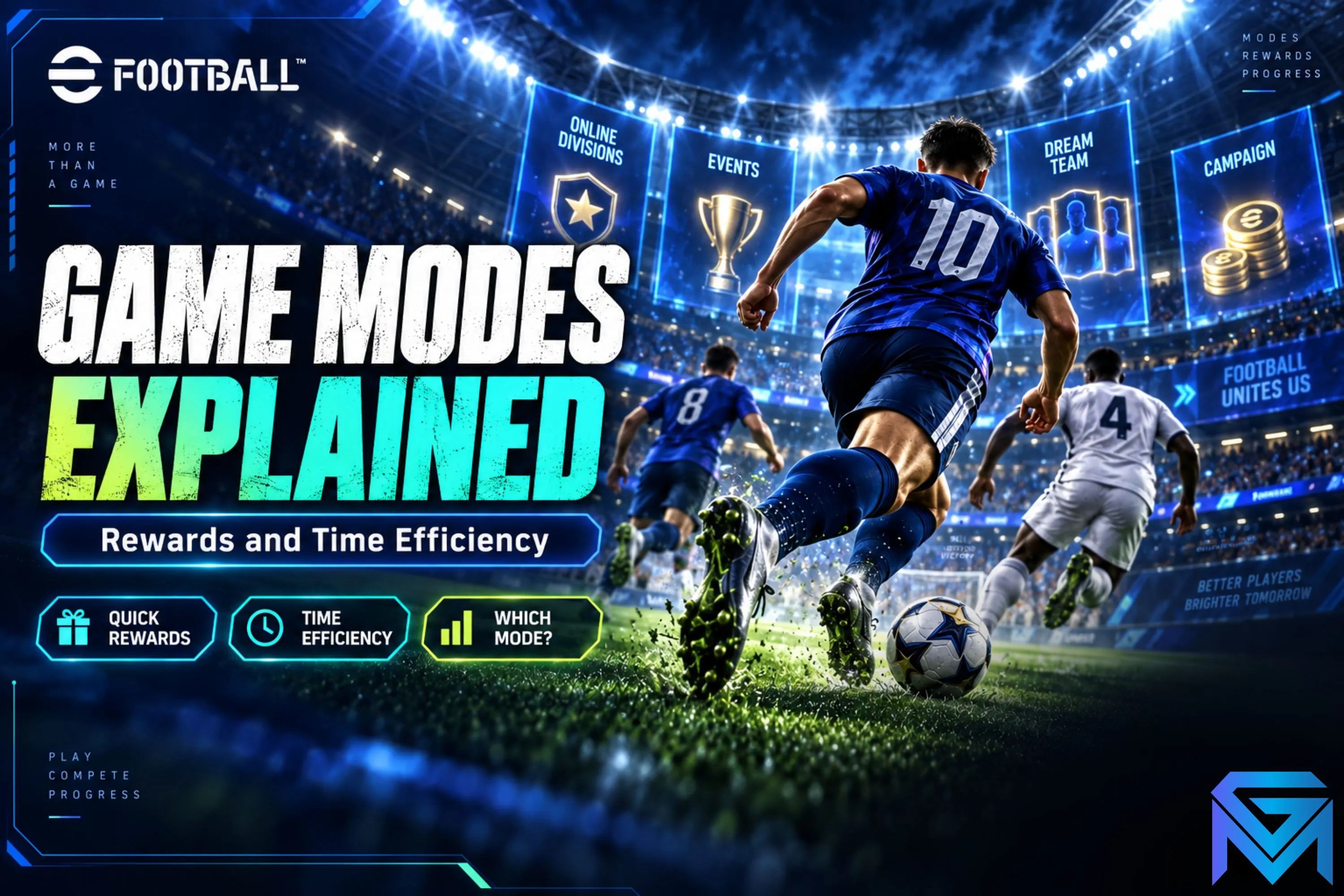
eFootball splits its content into a handful of modes that each pay different currencies at different speeds: Online Division matches give the steadiest GP and Coin flow, Tour events give contract tickets and trainers, and Challenge events give the limited player cards. Knowing which mode pays what is the whole game outside the pitch. Konami's free-to-play football title does not hand out a single progression track; it hands out five or six overlapping ones, and a squad that grows every week is usually a squad whose owner picked the right two modes rather than the one who played the most matches. This guide maps every mode in Dream Team against what it actually returns, how long a session in it costs, and where the objective system quietly doubles your income.
What are the main game modes in eFootball?
Dream Team is the hub, and inside it sit Online Division, Event matches, Tour events, Challenge events and Simulation. Alongside Dream Team, eFootball Championship runs competitive brackets, Authentic Team offers licensed club play, and Trial matches let you test squads without stakes.
The distinction that matters is not competitive versus casual; it is which reward pool a mode draws from. Online Division and eFootball Championship pull from the ranked pool, paying GP, Coins on milestone finishes, and division-based season rewards. Tour and Challenge events pull from the event pool, paying contract tickets, Skill Trainers, Position Trainers and the event's own player cards. Simulation and Trial pull from almost nothing, because they exist for testing rather than earning.
Because those pools are separate, playing more of one mode does not accelerate the other. A player who has spent a fortnight climbing divisions can still be short on Skill Trainers, and a player who has cleared every Tour event can still sit in a low division with a thin GP balance. Progress in eFootball is not one bar; it is several, and they fill from different taps.
Which modes pay the most GP for the time you spend?
Online Division matches are the most reliable GP source per minute of play, because every match pays a base amount win or lose, and the daily and weekly objectives attached to match count stack on top. Tour events pay less GP directly but far more in items.
A single Online Division match runs roughly ten to twelve minutes of real time including menus, and pays out a base GP figure plus a win bonus. On its own that is modest. What makes the mode efficient is stacking: the same match simultaneously advances the daily "play a match" objective, the weekly match-count objective, any active event's match tally, and your division points. One action feeds four counters, and that is the definition of time efficiency in this game.
Tour events invert the ratio. A Tour match against AI is shorter and lower-risk, and the reward is front-loaded into first-clear bonuses rather than repeatable payouts. Clearing a Tour's full ladder once gives a large lump of tickets and trainers; replaying it afterwards gives very little. Treat Tours as a resource to be harvested when they appear, not a farm to be returned to.
Challenge events sit in between. They gate high-value player cards behind a points threshold, and those points accumulate per match played within the event window. The efficiency question there is not GP per hour but whether the threshold is reachable in the days remaining. If it is not, the matches are still paying division points and objective progress, so the time is not wasted; it is simply paying into a different pool than you intended.
How does the Division system change what a match is worth?
Division rank sets the size of your ranked payouts. Higher divisions pay larger GP and Coin rewards at phase end and at season reset, so the same ten minutes of play is worth measurably more in Division 3 than in Division 8. Climbing is therefore an income decision, not only a pride one.
The Division system runs in phases, with promotion and relegation resolved at each phase boundary and a broader reset between seasons. Points accrue on wins, hold or decay on draws, and drop on losses, with the exact thresholds shifting between seasons. The practical consequence is that a player parked in a comfortable low division is quietly taking a pay cut every phase. Our eFootball Division system guide covers the points and promotion mechanics in detail.
That interacts with objectives in a way many players miss. Weekly objectives frequently ask for wins rather than matches. In a division above your squad's real strength, wins come slowly and the weekly set can expire unfinished, costing you the item rewards attached to it. In a division slightly below your strength, wins come quickly, objectives clear early, and you bank both the ranked payout and the objective payout. The optimal division for income is not the highest one you can survive in; it is the highest one where you still win comfortably more than half your matches.
How do Tour and Challenge events fit into a weekly plan?
Events are time-boxed and non-renewable, so they take priority over anything permanent. A Tour that closes on Thursday is worth playing before a Division push that is available every day of the season. Permanent content waits; event content does not.
Konami rotates events on a roughly weekly cadence, typically aligned with real-world football fixtures and with the game's own campaign calendar. Each brings its own objective set, its own point currency, and its own reward ladder. The ladders are usually structured so that the first two thirds are achievable by a casual player and the final third demands either a strong squad or a heavy time commitment.
The sensible read on that structure is to treat the achievable portion as mandatory and the tail as optional. Grinding the last rungs of an event ladder for a single card is where players burn their whole week and end up with less overall progress than someone who cleared three events to two-thirds each. Breadth beats depth when the rewards are items rather than a single chase card you specifically need.
Event objectives also frequently overlap with the permanent daily and weekly sets, which is where the real gains live. A weekly objective asking for five matches and an event objective asking for five event matches can be satisfied by the same five matches if you play them inside the event. Reading both objective lists before you queue costs a minute and can halve the number of matches you need. The eFootball news hub tracks which events are running in a given week.
Which modes actually cost you resources to play?
Every mode consumes contract duration on the players you field, and GP spent renewing contracts is the hidden tax on high-volume play. Modes that let you field a weaker rotation squad are cheaper to grind than modes where you must field your best eleven to win.
Player contracts in eFootball tick down by matches played rather than by real time, and renewing a high-rated card costs meaningfully more GP than renewing a base card. A player who grinds forty matches a week with a single first-choice eleven will spend a substantial share of their GP income simply keeping that eleven on the pitch. This is why the GP-per-hour figure for any mode is really a net figure, not a gross one.
Tour events against AI are the clearest example of a mode where a rotation squad works. The difficulty is tuned low enough on the earlier tiers that a second-string eleven clears them, which keeps your expensive cards fresh for ranked play. Online Division is the opposite: fielding a weak squad costs you the win, the win bonus, and division points, so the saving on contracts is usually a false economy.
Simulation mode occupies an odd position here. It resolves matches without you playing them, which makes it attractive for objective counters that only ask for matches completed. The payouts are smaller and the results are not in your control, but for a player who wants a daily objective cleared during a lunch break, it converts time into progress at a rate no other mode matches.
What does a time-efficient weekly routine look like?
Check both objective lists first, play event matches to satisfy event and permanent objectives at once, run your Division matches in the division where you win most often, and clear each Tour's first-clear ladder within its window. Four habits, and the weekly set finishes itself.
In practice that looks like a short daily block and one longer block. The daily block is two or three matches, chosen to sit inside whatever event is live, which clears the daily objective set and chips at both the weekly and the event tallies. The longer block, once or twice a week, is where you clear the current Tour ladder in one sitting while it is fresh, since Tours reward first clears rather than repetition.
Season timing matters too. The last days before a phase or season reset are when unclaimed division rewards are decided and when event ladders close simultaneously. Leaving both to the same forty-eight hours is how a week's worth of rewards gets forfeited. Front-loading event content early in its window leaves the tail end of the week free for the ranked push.
None of this requires playing more. It requires that each match you do play is counted by more than one system at a time. A player putting in five hours a week with overlapping objectives will out-progress a player putting in ten hours with none, and that gap compounds over a season into a visible difference in squad strength and GP reserves.
Which modes are safe to skip entirely?
Trial matches and most Simulation play can be skipped by anyone with time to play manually, because neither pays a competitive reward. Authentic Team is optional unless you specifically want licensed club football, and eFootball Championship suits players chasing brackets rather than steady progression.
Trial exists for testing formations and new signings, and it is genuinely useful for that. What it is not is a source of income, so treating it as content rather than as a tool wastes the slot. If you are trialling a squad, do it deliberately and briefly, then take the squad into a mode that pays.
eFootball Championship is a different case. It is a real competitive track with its own calendar and its own rewards, and for players who enjoy bracket play it is the most engaging thing in the game. For a player whose goal is squad growth, though, its reward density per hour is lower than a focused Dream Team routine, because the format concentrates payouts at the top of the bracket rather than distributing them across matches.
The useful way to think about it: modes that reward participation suit progression, and modes that reward placement suit competition. Both are legitimate, but mixing them without noticing is how players end up feeling they have played a great deal and progressed very little.
Common questions about eFootball modes
Does losing a match still pay GP?
Yes. Online Division matches pay a base GP amount regardless of result, with a bonus on a win. Objective counters that ask for matches played also advance on a loss, so a losing session still produces progress, just less of it.
Do event matches count toward weekly objectives?
Usually yes for generic counters such as matches played or goals scored, since those track any Dream Team match. Objectives that specify Online Division explicitly will not advance from event play, so read the wording before assuming overlap.
Is Simulation worth using regularly?
It is worth using when you cannot play manually. Payouts are lower and outcomes are outside your control, but it converts idle time into cleared daily objectives, which is better than an expired objective set.
Should I climb divisions or farm events?
Farm events first, because they expire. Division content is available for the whole season, so it absorbs whatever time is left after the time-boxed content is cleared.
If you would rather have someone else grind the objective sets and event ladders while you keep the account and the rewards, browse the available eFootball hourly services on GameMarket.gg and pick a provider whose scope matches the week you are trying to clear.
GameMarket.gg is a trusted digital marketplace for everything gaming-related. We serve the gaming community by providing secure access that enhances every gaming journey.