eFootball Attacking Guide: Build-Up, Through Balls and Finishing
By John Ganang 19 September 2026, 06:00 WIB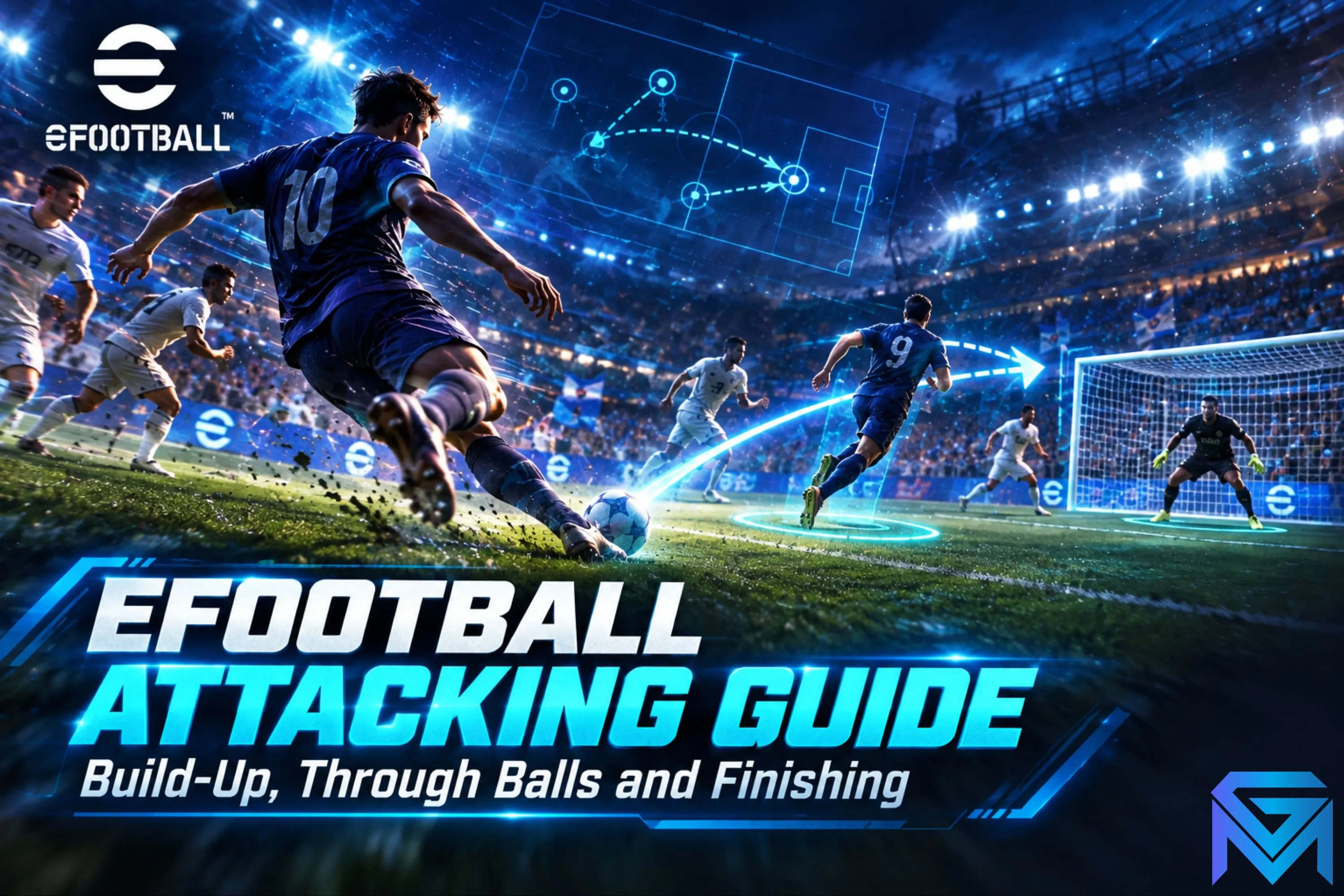
Attacking in eFootball comes down to three linked skills: building up without losing the ball, breaking the last line with the right pass, and finishing calmly inside the box. Master those in order and goals stop feeling random. This guide breaks down each phase, the controls behind it, and the mistakes that stall most attacks.
Konami's eFootball is a possession-and-transition game. Unlike arcade football titles, it rewards players who understand ball-carrying weight, pass-power modulation, and player Playing Styles far more than raw squad rating. Two managers with identical squads will produce very different chance quality because one recognises when the defensive line is high, and the other simply sprints forward. Everything below assumes the standard control scheme on Advanced settings, which is what competitive Division play uses.
How should you build up play in eFootball?
Build up by moving the ball sideways before you move it forward. Use short passes between your centre-backs and holding midfielder to pull the opponent's press out of shape, then release into the space that press leaves behind. Patience beats speed here.
The single most common attacking error is vertical panic: winning the ball and immediately launching it forward into a compact block. eFootball's defensive AI shifts across as a unit, so a straight forward pass usually meets three covering bodies. A lateral pass, by contrast, forces every defender to re-orient, and for roughly a second the far-side channel opens.
Concretely, the build-up loop looks like this. Receive with your deepest midfielder — usually a player with the Anchor Man or Orchestrator Playing Style. Play one square pass to a centre-back. Watch the opposition's striker step across. That step is your cue: the passing lane to the opposite full-back is now live. Switch play there and you have started your attack five metres higher than you would have by hoofing it.
Three build-up habits that hold up in ranked matches:
- Two touches, then decide. Holding the ball for three or more touches under pressure invites the second defender to arrive. Receive, glance, release.
- Use the goalkeeper as a spare man. Passing back is not weakness — it resets the shape and often draws the press higher, which is exactly what a through ball needs.
- Match the pass power to the distance. A full-power short pass arrives too hot to control; your receiver takes a heavy touch and the interception happens on the second ball, not the first.
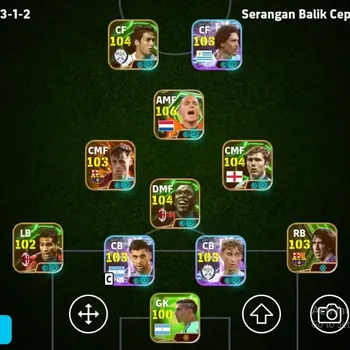
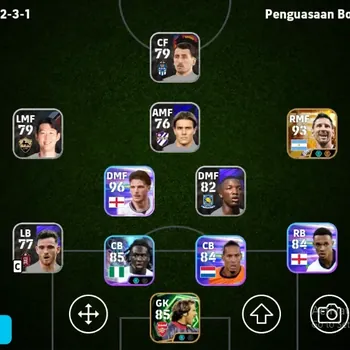
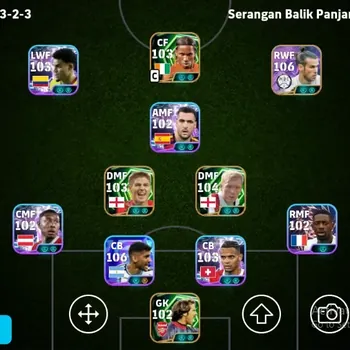
Formation matters here too. A shape with a genuine pivot gives you a permanent central outlet, whereas a flat midfield forces every switch to travel the long way around. If your build-up keeps dying in the same zone, the shape is usually the culprit, not the players.
When should you play a through ball instead of a normal pass?
Play a through ball when a forward is already moving and there is grass behind the last defender. If your striker is stationary or the defensive line is deep, a through ball simply runs to the keeper. Through balls reward timing, not repetition.
eFootball gives you several forward-pass tools and they are not interchangeable. The standard through ball plays into space ahead of the receiver. The lofted through ball lifts the ball over a flat back line — devastating against a high line, useless against a deep block. A manual pass lets you aim into a gap the assisted pass refuses to see, at the cost of full responsibility for weight and direction.
The decision tree is simpler than it looks:
- High line, striker with pace, gap behind: lofted through ball, low power. Aim to drop the ball just behind the last defender's shoulder.
- Mid block, runner arriving from midfield: ground through ball, medium power, played the moment the run starts — not when it is already at full speed.
- Deep block, no space behind: no through ball at all. Recycle wide, or use a short pass into a forward's feet and play off the lay-off.
The other half of through-ball play is creating the run in the first place. Calling a teammate forward manually gives you a runner you chose, at the moment you chose — far more reliable than waiting for the AI to break the line on its own. Combine a called run on the far side with a switch of play and defenders have to choose between tracking the runner and holding the line. Either choice gives you something.
Playing Styles decide who is worth aiming at. A Goal Poacher lives on the shoulder of the last defender and is the natural target for lofted balls. A Deep-Lying Forward drops between the lines and prefers passes to feet. Sending lofted balls to a Deep-Lying Forward is not bad luck; it is a mismatch between the pass and the profile.
How do you finish chances consistently?
Finish with controlled power and a clear angle rather than maximum force. Most missed chances in eFootball come from over-powered shots taken while the player is still turning. Set your body, use roughly two-thirds power inside the box, and aim across the keeper.
Shot power in eFootball scales with how long you hold the shot input, and the sweet spot is narrower than most players assume. Inside the penalty area a shot at full power frequently rises, because the animation prioritises force over placement. Around two-thirds power, aimed toward the far post, produces the most repeatable results — the keeper has to travel further, and the ball stays under the bar.
A few situational rules that raise conversion:
- One-on-one: do not shoot immediately. Take a touch to shift the keeper, then place low and across. Rushing the shot lets the keeper set his angle.
- Cut-back from the byline: one of the highest-value chances in the game. A pulled-back pass to the penalty spot arrives with the defence facing the wrong way.
- Volleys and headers: lower power, more aim. These animations already carry force; adding more sends the ball over.
- Finesse-type shots suit players with the matching Playing Style and a strong Curl stat. On a player without it, the shot is slower without being more accurate.
Shot selection is also a squad question. A striker with high Finishing and low Physical Contact will convert clean chances but lose the duels that create them. Reading your own forwards' stat spread — Finishing, Kicking Power, Curl, Speed — tells you which chances your team should be manufacturing in the first place.
Is wide play better than central attacking?
Wide play is more reliable against organised defences because the touchline creates space that central areas do not have. Central attacking is faster when it works, but it runs into more bodies. Most consistent attacks start wide and finish centrally.
The reason is geometric. In the middle of the pitch, a defender covers threats on both sides of him. Near the touchline he can only be beaten in one direction, and his cover defender has to travel diagonally to help. That is why a full-back overlapping outside your winger produces so many clean crosses: two attackers, one defender, and no time to make a decision.
Effective wide patterns include the overlap, where your full-back runs outside a winger who has cut inside; the underlap, where the runner goes between full-back and centre-back rather than outside; and the simple hold-and-wait, where your winger shields the ball with his back to the line until a runner arrives. All three are executed with the same call-a-run and short-pass tools — the difference is where you aim.
Crossing itself deserves care. A high, floated cross into a crowded box is close to a coin flip. A low cross aimed at the near post, or a cut-back from the byline, converts far more often because it removes much of the goalkeeper's ability to claim. If your headers keep being won by centre-backs, the fix is usually a lower cross rather than a taller striker.
How do transitions change your attacking approach?
Transitions are the moments immediately after winning or losing the ball, and they are where many goals originate. When you win possession, the opponent's shape is broken for two or three seconds — attack directly. When you lose it, collapse centrally before pressing.
Attacking transition is the one moment where the vertical pass is usually correct. A defence that has just committed players forward cannot reform instantly, so the through ball that would be reckless against a set block becomes a high-percentage option. The window is short: if you take four touches before playing forward, it has closed.
Defensive transition matters to your attack more than it seems. Losing the ball with your full-backs high leaves the channels open, and conceding on the counter changes how you play for the rest of the match — usually into something too cautious. Keeping one full-back home during sustained possession costs you very little offensively and prevents the counters that make you abandon your game plan.
Condition and momentum are real systems in eFootball rather than player folklore: form arrows and in-match momentum affect how your team performs. Practically, this means the period right after you score is often when your team presses best and the opponent is most disorganised. Attacking with intent in those two or three minutes converts one goal into two more often than sitting back does.
How does attacking well translate into Division progress?
Division points come from wins, and wins come from converting more of the chances you already create. Improving finishing and build-up raises your points per match far more than swapping in a slightly higher-rated card, because rating does not decide who takes the better shot.
If you are climbing ranked, the practical order of improvement is: stop losing the ball in build-up, then create better chances through wide play and called runs, then convert them with disciplined shot power. Each step feeds the next. A full breakdown of how points, phases and promotion actually work is covered in the eFootball Division system guide: points, phases and promotion, which pairs naturally with the attacking habits here.
Newer players should start further back. Card types, currencies and squad basics come first, and the eFootball beginner's guide to player cards, coins and squads covers that ground before you worry about attacking patterns.
Finally, track your own numbers. eFootball shows possession, shots and shots on target after every match. A player taking twelve shots and scoring once does not have a finishing problem alone — he has a chance-quality problem. Fewer, better chances beat volume every time.
What attacking mistakes cost the most goals?
The costliest mistakes are sprinting with the ball in traffic, shooting at full power inside the box, and playing forward before a run has started. All three feel aggressive but hand possession back, and possession lost in your own half is a common source of conceded goals.
Holding sprint permanently is the clearest beginner tell. Sprinting widens your player's touches, so the ball travels further from his feet and a standing defender simply steps in. Sprint in open space; release it the moment a defender is within a couple of metres.
The second is ignoring stamina. Attackers who have run channels for seventy minutes lose a visible amount of pace and their condition drops, which affects finishing. Substituting a tiring forward around the seventieth minute is often worth more than any tactical change.
The third is predictability. If every attack goes down the right because that is where your best winger plays, opponents will overload it by the twentieth minute. Alternating flanks, even when the switch does not immediately lead to a chance, keeps the defence honest and makes the right-side attacks work again later.
If you would rather spend your time playing matches than grinding the climb itself, browse the available eFootball boosting services on GameMarket.gg and pick a seller whose offer matches the division you are aiming for.
GameMarket.gg is a trusted digital marketplace for everything gaming-related. We serve the gaming community by providing secure access that enhances every gaming journey.