Honkai: Star Rail Currency Guide: Stellar Jade, Shards & Passes
By John Ganang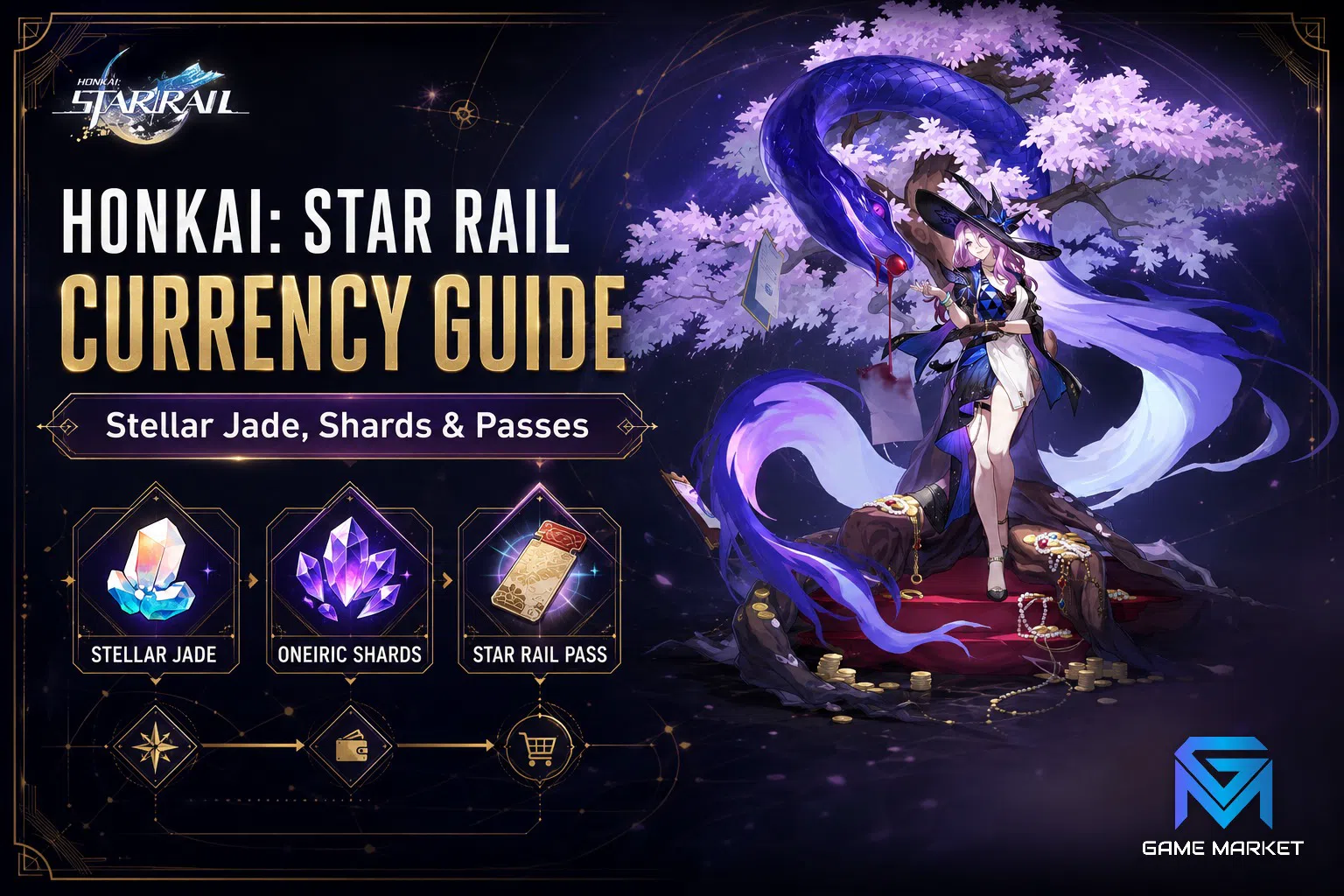
Honkai: Star Rail runs on three linked currencies: Stellar Jade, the free premium currency you earn by playing; Oneiric Shards, the purchased currency that converts into it; and Star Rail Passes, the tickets you actually spend on a warp. Jade is not what you spend. Passes are, and jade is simply how most players buy them.
That distinction matters more than it sounds, because every planning mistake in this game starts with treating jade as the finish line. A Trailblazer sitting on 20,000 jade and a Trailblazer sitting on 125 passes are holding the same thing in different wrappers, yet only one of them can see how close the next guarantee really is. This guide walks the whole chain: what each currency is, where jade comes from at a realistic monthly rate, how the conversion and pity maths turn that income into pulls, and how to decide between spending jade on passes or on Trailblaze Power refills. Figures reflect the systems as of August 2026; HoYoverse adjusts payouts and caps between versions, so treat the structure as fixed and the exact numbers as something to confirm in your own Trailblaze Profile.
What are the three currencies in Honkai: Star Rail?
Stellar Jade is the earned premium currency, Oneiric Shards are the purchased premium currency that converts one-for-one into jade, and Star Rail Passes are the warp tickets themselves. Jade buys passes at a fixed rate of 160 jade per pass, which makes 160 the only exchange number you truly need to memorise.
The pass side splits in two. A Star Rail Pass works on the Stellar Warp, the permanent standard banner, while a Star Rail Special Pass works on the limited character and Light Cone banners that rotate with each version. They are not interchangeable, and that catches people out: a stack of standard passes cannot be pointed at the limited character you were saving for. Both cost the same 160 jade in the shop, so when you convert, convert into the type that matches the banner you are actually chasing.
There is a fourth currency worth knowing because it quietly funds pulls too. Undying Starlight is what duplicate warp results turn into, and it can be exchanged for Star Rail Passes in the Embers Exchange, subject to a monthly cap of five. Five passes a month is 800 jade of value you never had to earn, so ignoring the Starlight tab is leaving roughly one guaranteed 4-star's worth of pulls on the table every version. Credits, Trailblaze Power and material currencies sit outside this chain entirely; they gate how fast you can build a character, not how many you can obtain.
Where does Stellar Jade actually come from?
Stellar Jade comes from four buckets: repeatable dailies, one-time exploration and story rewards, cyclical endgame clears, and time-limited events. Only the first and third repeat forever, which is why long-term income is far flatter than a new account's first fortnight suggests.
The daily bucket is the reliable floor. Completing Daily Training to 500 activity points pays 60 jade, and that is the one payout you can count on 365 days a year. It looks small next to a chest-hunting session, but 60 a day compounds into more jade over a version than most events pay, and unlike an event it never fails to appear.
The one-time bucket is the largest and the most misleading. Trailblaze Continuance missions, world exploration, treasure chests, Trailblaze Puzzles and the achievement lists in your Trailblaze Profile hand out enormous sums, which is why a fresh account can warp constantly for its first two weeks and then feel like the taps closed. They did close. Those rewards are consumed once, and the only way to reopen them is a new region shipping in a major version. If you are budgeting, count one-time income as a windfall, never as a rate.
The cyclical bucket is where committed accounts separate themselves. Simulated Universe pays weekly point rewards, and the three endgame modes pay per cycle: Memory of Chaos, Pure Fiction and Apocalyptic Shadow each reset on their own schedule and each pay out in tiers according to how many stars you clear. Because those payouts scale with clear depth rather than attendance, investing in a second usable team is effectively an investment in your jade income, not just in your combat ceiling. An account that three-stars the back half of Memory of Chaos earns several hundred jade per cycle that a stalled account simply does not receive.
Events fill the gap between versions, and this is where the free track of Nameless Honor also lives; it hands out Star Rail Passes directly rather than jade, along with credits and upgrade materials. Maintenance compensation and login campaigns round it out. None of these are guaranteed in size, so treat them as variance rather than budget.
How much Stellar Jade does a free player earn each month?
A free-to-play account clearing dailies, running the weekly Simulated Universe rewards, finishing the endgame modes and playing through events lands roughly in the 4,000 to 8,000 jade range across a six-week version, which converts to about 25 to 50 warps. The spread is wide because event generosity and endgame clear depth vary far more than daily income does.
Break that down and the structure becomes obvious. Dailies contribute about 1,800 jade over a 30-day stretch and never move. Endgame cycles contribute a comparable amount if you clear deeply, and close to nothing if you cannot. Events contribute the rest, and their payouts swing with the version's scale, so an anniversary patch and a quiet mid-cycle patch are not remotely the same month.
Two optional purchases change the shape of that curve rather than its nature. The Express Supply Pass pays an immediate lump of jade plus a daily allotment across 30 days, which roughly doubles a free account's baseline daily income because it stacks on top of Daily Training rather than replacing it. The paid tier of Nameless Honor pays a jade lump plus additional passes each version. Both are structural rather than dramatic; they raise the floor, and neither removes the need to save through a version to reach a guarantee. That is worth stating plainly, because the honest answer to "can I get any character I want" is that patience does most of the work and money mostly buys speed.
How many warps does a character actually cost?
On the limited character banner the hard pity is 90 warps, the rate begins climbing sharply from roughly warp 74, and the first 5-star you hit carries a 50/50 chance of being the featured character. Lose that coin flip and the next 5-star is guaranteed, so the true worst case for one specific character is 180 warps, or 28,800 jade.
That worst case is the number to budget against, but it is not the number you should expect. Because soft pity usually resolves well before 90 and because half of all coin flips land in your favour, the practical average sits closer to 60-something warps per 5-star obtained and somewhere around 90 to 100 warps for a specific featured character across many attempts. Planning at 180 and landing at 100 leaves you with a surplus; planning at 100 and losing a 50/50 leaves you 80 warps short with a banner ending in three days, which is exactly how accounts end up spending money they did not intend to spend.
Light Cone banners run on a separate counter with a hard pity of 80 and a considerably higher rate-up chance on the featured cone, which is why the signature weapon is cheaper in isolation but rarely cheaper in practice: it is a second full pity track competing for the same jade. The 4-star counter is a guaranteed 10, and it shares the banner's featured pool, so incidental 4-star pulls are where a surprising share of your usable roster comes from. Every one of these counters is banner-type-specific and carries across versions, meaning the 60 warps you sank into a character banner in one patch are still sitting under the next character banner unspent. Your accumulated pity is an asset. Check it in the warp history before you decide you cannot afford a banner.
Should you spend jade on passes or on Trailblaze Power?
Passes, in almost every case. Jade also refills Trailblaze Power at 50 jade for the first refill of the day, with the price escalating on later refills within the same day, and that escalation is the whole argument: the second half of a refill session costs several times what the first did while returning identical materials.
There is a narrow case for refilling. If you are one relic domain run from finishing a build that unlocks a deeper endgame clear, and that clear pays jade you would otherwise forfeit this cycle, the first cheap refill can pay for itself. Beyond the first or second refill of a day the maths stops working, because materials are permanently farmable while a banner is not. Reserved Trailblaze Power exists precisely so that offline hours are not wasted, and using it costs nothing but attention.
The same reasoning governs the shop's material bundles. Anything you can farm on your own schedule is a poor jade purchase; anything gated by a limited window is where jade earns its keep. If you want the fuller picture of how power regenerates and what the caps are before deciding, our guide to HSR Equilibrium Level and what it changes covers how difficulty tiers and reward scaling move together as your account climbs.
How should you plan a warp budget around banner cycles?
Work backwards from the guarantee rather than forwards from your balance. Decide which upcoming character you want, check your current pity and whether your 50/50 is guaranteed, then work out how many warps you are short and how many versions of income that represents at roughly 25 to 50 warps per version.
Versions run about six weeks and are split into two banner phases, so a given patch presents two decision points, not one. Skipping a phase entirely is a real strategy and not a failure state, because a skipped phase converts directly into a guaranteed pull later. Veterans who always seem to have pulls ready are not earning more jade than you; they are declining more banners. The habit is covered in depth in the Stellar Jade saving guide for HSR veterans, which is worth reading alongside this one because it handles the discipline side while this guide handles the arithmetic.
One more planning input is worth naming: the Light Cone question. Because a signature cone is a second 80-pull track, committing to both a character and their cone effectively doubles the version's cost, and for most accounts a well-invested 4-star cone closes enough of the gap that the second track is not worth opening. Which cone actually substitutes well depends on the path and the effect, and our breakdown of HSR Light Cones, paths and superimposition lays out where the free and low-rarity options hold up.
If you are early enough that the roster itself is the constraint rather than the jade, the sequencing question changes shape, and the HSR progression guide covering levels, warp and characters is the better starting point; a newer Trailblazer can also work through the HSR beginner's guide to warp, characters and Stellar Jade first and return here once the basics are settled.
What do most Trailblazers get wrong about jade?
The two costly errors are converting jade into passes far ahead of need and ignoring pity that has already been paid for. Converting early is harmless mechanically, since passes never expire, but psychologically it locks you into a banner type you may not want by the time the phase arrives.
The second error is more expensive. Players routinely stop pulling at 50 or 60 warps because a banner "isn't working", then start fresh on a later banner and pay the early, low-rate portion of the counter twice. Because pity carries over within a banner type, the warps you already sank are the cheapest part of the next 5-star you will ever obtain, and abandoning them mid-climb throws away exactly the progress that was hardest to buy. Before you decide a banner is unaffordable, open warp history and count. The answer is frequently that you were 15 pulls from soft pity and did not know it.
A third, quieter mistake is under-clearing endgame content and calling it a combat problem when it is an income problem. Because Memory of Chaos, Pure Fiction and Apocalyptic Shadow all pay in tiers, a second functional team is one of the highest-return investments available to a mid-game account, and it pays in the same currency you are trying to save. If team depth is where you are stuck, the overview of HSR characters, paths and team building is the practical next step.
Frequently asked questions
Do Stellar Jade or Star Rail Passes ever expire? Neither expires. Jade and passes both persist indefinitely on your account, which is what makes skipping a banner a genuine saving strategy rather than a deferred loss. Event-specific currencies do expire when the event closes, so those are the ones to spend down before a version ends.
Can Stellar Jade move between servers or accounts? No. Jade, passes, pity counters and your roster are all bound to a single account on a single server, and HoYoverse does not offer a transfer between the America, Europe, Asia and TW/HK/MO servers. Playing on a second server means starting the entire currency chain again from zero.
Is Undying Starlight the same as Stellar Jade? No. Starlight is the by-product of duplicate warp results and is spent in the Embers Exchange, where it converts into Star Rail Passes up to a monthly cap of five, along with other goods. It cannot be used directly at the warp screen, and it does not convert into jade.
Does the pity counter reset when a banner ends? No. The counter belongs to the banner type rather than the individual featured character, so progress on the limited character track carries into the next limited character banner. The guaranteed flag from a lost 50/50 carries over in the same way.
Where to Find Honkai: Star Rail Accounts and Top Up
On GameMarket.gg you can browse Honkai: Star Rail accounts on GameMarket, the Honkai: Star Rail market hub.
If you would rather shorten the saving cycle and add currency to an account you already play, browse the verified sellers on the Honkai: Star Rail top up listings and compare what each offer actually includes before you commit.
GameMarket.gg is a trusted digital marketplace for everything gaming-related. We serve the gaming community by providing secure access that enhances every gaming journey.