Blood Strike Match Length and Game Modes Explained
By John Ganang 25 September 2026, 12:00 WIB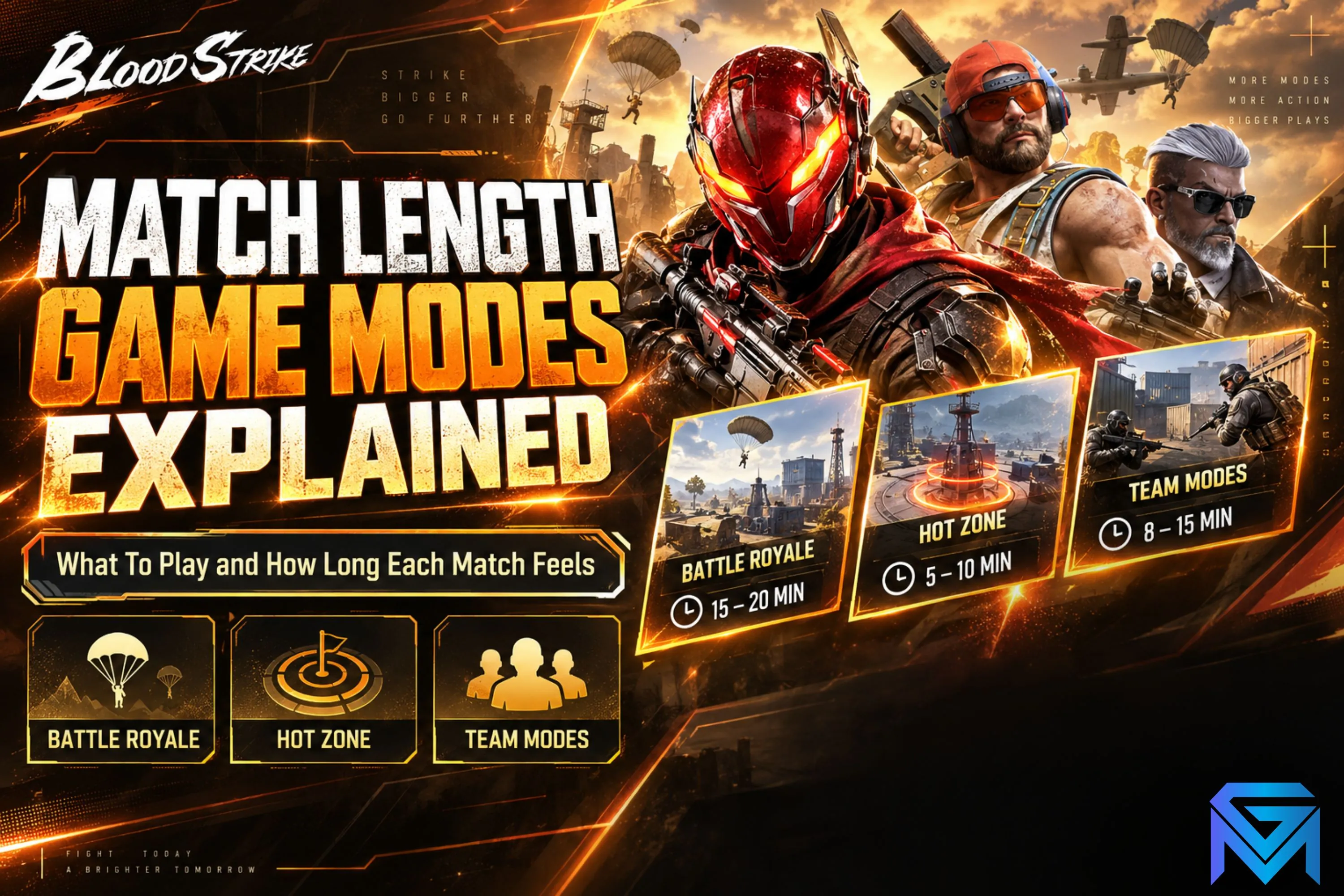
A Blood Strike match usually wraps up in well under fifteen minutes, since the game is built as a fast, mobile-first battle royale with a shrinking map and elimination-heavy pacing. Mode choice — Solo, Duo, Squad, or Ranked — is the single biggest factor in how long any individual match actually runs, which matters for planning how much you can realistically get done in a limited play window.
What game modes does Blood Strike offer?
Blood Strike's core rotation is Solo, Duo, and Squad battle royale queues, plus a dedicated Ranked queue built on Squad-style team play, alongside rotating limited-time modes that NetEase cycles in and out with each update, such as arena-style team deathmatch variants and themed collaboration modes.
Solo, Duo, and Squad all share the same core loop — drop onto the map, loot, survive a shrinking play zone, and outlast the field — but the player count per team changes how fights actually unfold. Ranked sits on top of the Squad format specifically, since team coordination is what the points system is built to reward. Limited-time modes are a separate track entirely: some seasons bring collaboration content built around a licensed IP, like the Attack on Titan crossover content NetEase has run before, and others bring smaller, faster arena formats that strip out the survival loop for straight elimination combat. These rotate on NetEase's own update schedule and are period-limited by design — a mode that leaves the rotation may return in a later season, but that isn't guaranteed and shouldn't be assumed when planning around it.
How does the shrinking play zone pace a Blood Strike match?
The play zone starts large and shrinks in stages toward a final safe area, and each stage after the first closes faster and hits harder than the one before it. Early stages give players room to loot and rotate without much pressure; later stages compress the remaining lobby into direct fights, which is where most of a match's actual runtime gets decided.
That front-loaded structure is the main reason match length is so sensitive to how many players are still alive when the later, faster-closing stages begin. A lobby that's already thinned out heavily by the midpoint burns through the remaining stages quickly because there are fewer fights left to have; a lobby that's still crowded going into the later stages usually means a slower start, since more players survived the early, low-pressure phase to contest the smaller zones together. This is also why Squad and Ranked matches, which tend to keep more players alive longer through revives and cautious play, feel like they spend more time in the tense, fast-closing final stages than Solo or Duo matches typically do.
How long does an average Solo or Duo match last?
Solo and Duo matches tend to be the fastest matches in Blood Strike, because fewer total players in the lobby mean the elimination pace and the shrinking play zone both reach a final fight sooner. These formats generally finish well inside the quick-session pacing NetEase designed the game around.
Fewer players per team also means fewer revives slowing the match down — in Solo there's no revive at all, so every elimination is final and the lobby thins out in a straight line rather than in the stop-start rhythm a squad wipe creates. Duo adds one layer of that stop-start pattern back in, since a downed partner can still be revived, but with only two-player teams in the lobby the overall player count clears out at a similar rate to Solo. Drop zone choice matters more here than in Squad: landing in a dense, popular area front-loads eliminations and tends to shorten the match further, while an edge landing spreads fights out later into the circle.
Which drop strategy leads to a faster or slower match?
Dropping into a busy, loot-dense area front-loads eliminations and generally shortens a match, since a chunk of the lobby fights it out within the first minute or two; dropping at the edge of the map, away from other squads, generally lengthens a match by delaying your first real fight until the zone forces a rotation into contact with other survivors.
Neither approach is strictly better — it depends on what a session is actually for. A hot drop is the faster path through a match when the goal is simply getting more games played in a limited window, since even an early elimination just means queueing into the next match sooner. An edge drop trades that speed for a better chance of surviving deep into a match, which matters more when the goal is Ranked placement points or a specific mission that needs several minutes of active survival time rather than another quick queue. Squads coordinating a Ranked push tend to favor edge or quiet drops precisely because it stretches survival time without forcing an early fight the team isn't ready for.
How does Squad play change match length?
Squad matches generally run a little longer than Solo or Duo, because full revives and squad-wipe mechanics slow the pace at which the lobby actually empties out, and coordinated teams holding strong positions can stretch a match closer to the upper end of a typical session.
A four-player squad has to be eliminated as a unit before it's fully out, so a team that plays cautiously and revives quickly can outlast lobbies that would have thinned out much faster in a lower player-count mode. This is also where team composition starts to matter for pacing: a squad running a support-heavy setup that prioritizes reviving teammates over pushing fights will naturally play longer, methodical games, while an aggressive squad hunting eliminations early tends to either end a match fast or get eliminated fast itself. Either way, Squad is the format where match length varies the most from game to game.
How does a Ranked match compare in length and pace?
Ranked matches run on the same Squad-based map and shrink timers as unranked Squad games, but tend to play slightly longer in practice, because teams are optimizing for placement points rather than kills alone, which favors patient rotations over early aggression.
Since Ranked scoring rewards surviving deeper into a match in addition to eliminations, teams have a direct incentive to avoid unnecessary fights and instead rotate around the shrinking zone toward a safer, higher-placing position. That shift in incentive is the main reason Ranked queues, session for session, tend to run longer than casual Squad matches even though both use the same map and the same zone-shrink pacing underneath.
How many Blood Strike matches fit into a single session?
Because most matches land under fifteen minutes once lobby and loading time are included, a focused hour of play comfortably covers roughly four to six Solo or Duo matches, or a slightly smaller number of Squad or Ranked matches once revive time and more cautious late-game rotations are factored in.
That range is a useful planning number for anything session-based — deciding how many games to queue before a set amount of time runs out, or estimating how far a squad can realistically push a Ranked climb in an evening rather than assuming an unlimited number of attempts. Solo and Duo are the more predictable formats for this kind of planning since match length varies less game to game; Squad and Ranked sessions are harder to estimate precisely because a single long, contested match can eat into the time budgeted for two or three shorter ones.
Does match length change during limited-time modes or events?
Rotating limited-time modes can run shorter or longer than standard battle royale depending on their format. Arena-style team deathmatch variants usually finish faster than a full battle royale match, while larger collaboration modes with expanded player counts or special mechanics can push a session past the usual range.
This is worth checking on the mode-select screen before queueing into something unfamiliar, since a limited-time mode's match length isn't always obvious from its name alone. According to NetEase's own official update notes, these modes are tied to specific update windows rather than running indefinitely, so the roster of available limited-time modes — and their typical match lengths — shifts from one update to the next.
Where to Find Blood Strike Hourly Services and Support
If session length is the thing standing between you and a Ranked push or a specific in-game goal, GameMarket.gg lists Blood Strike hourly services from vetted sellers, priced and scoped by the hour, and the full range of Blood Strike listings on GameMarket.gg covers everything else tied to the game.
Frequently asked questions
Does party size affect how fast the play zone shrinks?
No. The shrinking play zone runs on a fixed timer set by the mode, not by how many players or teams remain. Party size changes how quickly the lobby empties out, not how fast the zone itself closes.
Can you rejoin a Blood Strike match after being eliminated?
Elimination normally ends your part in that match, though some limited-time modes have experimented with respawn mechanics on their own separate rules. Standard Solo, Duo, Squad, and Ranked queues do not let an eliminated player rejoin the same match.
Is match length the same on mobile and PC?
Yes. Blood Strike runs the same underlying match on mobile and PC through cross-play, so map, zone timers, and typical match length don't change based on which platform you're playing from.
Ready to make the most of a limited play window instead of guessing how many matches you'll actually finish? Browse Blood Strike hourly services on GameMarket.gg and book time that fits the session you actually have.
GameMarket.gg is a trusted digital marketplace for everything gaming-related. We serve the gaming community by providing secure access that enhances every gaming journey.