NTE Runaway Echoes Guide: Cards, Echo Bosses and Level 180
By Sir Ayup 9 September 2026, 16:00 WIB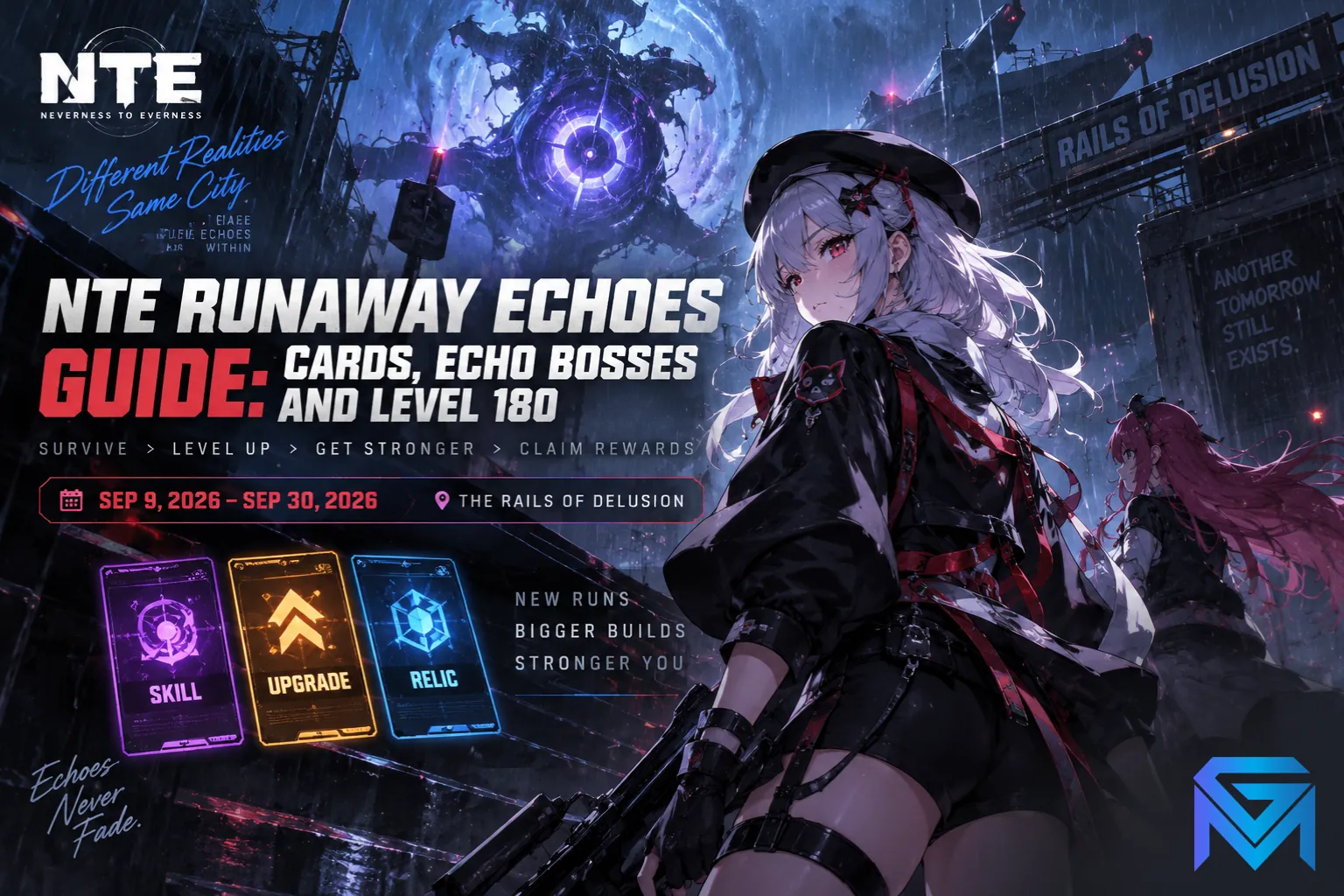
Runaway Echoes opens in Neverness to Everness on 9 September and runs to 30 September — a wave-survival mode where you level from scratch to 180 inside a single run, picking upgrade cards as you go.
It looks like a standard roguelike until you reach the last screen. Finishing a run awards Talent Points, and those buy permanent Skill Tree bonuses that carry into every run afterwards.
That one detail changes how you should approach the whole event.
The short version
- Runs 9 – 30 September 2026, Version 1.3.
- Arena: the Rails of Delusion. Kill mobs, collect EXP orbs, level up to a maximum of Level 180 per run.
- Every level-up offers a card pick — and you can lock, remove or reroll your options.
- Three card types: Skill, Upgrade and Relic.
- An Echo Boss spawns every 60 seconds, dropping a large chunk of EXP and extra items.
- Completing a run earns Talent Points for permanent Skill Tree bonuses.
- Two modes: Simulation (fixed survival window) and Endless (no ceiling).
- Rewards: Annulith, Fabricated Dice and Fons.
No run is wasted
This is the structural point, and it should shape how you play from the first attempt.
In a pure roguelike, a failed run is time spent for nothing. You learn something, you lose the build, you start over.
Runaway Echoes doesn't work that way. Finishing a run earns Talent Points, spent on Skill Tree stat bonuses that are permanent and apply to every subsequent run.
So early runs aren't practice — they're investment. Even a run that ends badly contributes to making the next one easier, provided you finish it.
Two consequences:
- Don't reset a run because it's going poorly. Completing a mediocre run banks Talent Points; abandoning it banks nothing.
- Difficulty falls over time on its own. If you're struggling in week one, the answer is more runs rather than better play — the Skill Tree does part of the work for you.
The card system, and why it isn't pure luck
Every level-up brings a new card pick, drawn from three types:
- Skill cards
- Upgrade cards
- Relic cards
And you can lock, remove or reroll your options.
That's the mechanic that turns this from a lottery into a decision. Most wave-survival modes hand you three random cards and ask you to take the least-bad one. Here you have tools to shape the offer.
How to use each:
- Lock holds an option you want but can't take yet, so a card you're building toward doesn't vanish on the next roll.
- Remove clears a card you'll never take out of the pool, which raises the quality of every subsequent offer.
- Reroll replaces the current set outright.
Remove is the one players underuse. Clearing dead cards early compounds — every removal makes later picks more likely to be useful, and the benefit grows across a long run to Level 180.
Mixing types matters too. A run built entirely from Upgrade cards scales what you already have; a run built around Skill and Relic cards changes what you do. The mode's framing is explicit that you're building the playstyle you want, which means there isn't one correct build to copy.
The 60-second boss clock
An Echo Boss spawns every 60 seconds, awarding a large chunk of EXP and extra item drops.
That gives every run a fixed rhythm. Your run isn't a continuous grind — it's a series of one-minute cycles, each ending with a boss you need to be ready for.
Plan card picks against the clock. If you're forty seconds into a cycle with a build that's struggling against trash, the next boss is going to be worse. Cards that fix your immediate weakness matter more than cards that scale you late.
And bosses are the fastest EXP in the mode. Reaching Level 180 in a single run means treating boss spawns as opportunities rather than obstacles — killing them quickly accelerates your levelling, which accelerates your card picks, which makes the next boss easier.
That's the compounding loop the mode is built on, and falling behind it is how runs stall.
Simulation or Endless?
Simulation Mode has a fixed survival window. Endless Mode has no ceiling.
Pick based on the run length you want, not on which sounds harder.
Simulation is better for banking Talent Points efficiently — a defined endpoint means predictable session length, and finishing is what pays.
Endless is better for testing builds and pushing limits, since nothing cuts you off while a build is working.
If you're early in the Skill Tree, favour Simulation. Guaranteed completions build the permanent bonuses that make Endless viable later.
The rewards
Annulith, Fabricated Dice and Fons.
Exact quantities and reward thresholds haven't been published, so how much of the event track is behind repeated runs versus one-off milestones isn't yet clear. Check the event page in-game on 9 September.
9 September is a crowded day
Runaway Echoes doesn't open alone, and the collision is worth planning around.
- Linko's banner — Surfing All Channels! — opens 9 September, running to 30 September.
- Hotori's rerun — Misty Tipsy Style — opens the same day, same window.
- Zankou's banner and the Nanally rerun both close on 9 September.
- Gold Clash, which doubles Fons and Paw-Paw Coins from Pink Paws Heist, runs to 14 September.
That Gold Clash overlap is five days of double Fons landing at the same time as a new mode that also pays Fons. If Fons is your bottleneck, the first week of the event is worth more than the last three.
And if you were pulling on Zankou or Nanally, tomorrow is your deadline — not a week from now.
What isn't published
- The card list — which Skill, Upgrade and Relic cards exist, and what they do.
- The Skill Tree's contents and what each node grants.
- How Talent Points are calculated per run.
- Simulation Mode's survival duration.
- Reward quantities and event track thresholds.
Any build guide published before the mode goes live is describing cards nobody has seen.
What to do on 9 September
Do a run immediately, even a bad one. Talent Points from a completed run make everything after it easier.
Finish runs rather than restarting them. Abandoning a weak run throws away the only progress that persists.
Use Remove early and often. Clearing dead cards improves every later pick in the same run.
Watch the 60-second clock. Card choices should answer the next boss, not a hypothetical late game.
Farm Fons before 14 September while Gold Clash is still doubling.
Close out Zankou and Nanally today if you wanted either — both banners end when this event begins.
Building the account behind it
A mode that scales to Level 180 rewards a roster with the Espers and investment to survive the later waves — and character progression is the slow half of Neverness to Everness, not the mode itself. Browse verified Neverness to Everness accounts if you'd rather run the event from a developed roster, keep dailies and event grinding moving with Neverness to Everness hourly services, or push story and endgame progression through Neverness to Everness boosting while Version 1.3 runs.
GameMarket.gg is a trusted digital marketplace for everything gaming-related. We serve the gaming community by providing secure access that enhances every gaming journey.



![Neverness to Everness Accounts SEA |HL32|Tycoon 13|7 S-Class|3 Limited [Zankou A1,Nanally+Sign,Hotori]|MC Male|TakeMail](https://img.gamemarket.gg/products/3edqwqyo/neverness-to-everness-accounts-sea-hl32-tycoon-13-7-s-class-3-limited-zankou-a1-hzw-thumbnail.webp "SEA |HL32|Tycoon 13|7 S-Class|3 Limited [Zankou A1,Nanally+Sign,Hotori]|MC Male|TakeMail Check SS NTE796Z")

![Neverness to Everness Accounts SEA| HL37 |Tycoon 27|8 SSR|3 Limited [Zankou+Sign,Iroi+Sign,Chaos]+5 char standar|TakeMail](https://img.gamemarket.gg/products/aglbuqkh/neverness-to-everness-accounts-sea-hl37-tycoon-27-8-ssr-3-limited-zankou-sign-pzu-thumbnail.webp "SEA| HL37 |Tycoon 27|8 SSR|3 Limited [Zankou+Sign,Iroi+Sign,Chaos]+5 char standar|TakeMail Check SS NTE795Z")
![Neverness to Everness Accounts SEA |Fresh Starter HL 8|2 Limited 3 SSR [Zankou+Outfit,Iroi,Fadia]| 3 S-Class Selector | 1](https://img.gamemarket.gg/products/lsuqhev5/neverness-to-everness-accounts-sea-fresh-starter-hl-8-2-limited-3-ssr-zankou-ou-bsk-thumbnail.webp "SEA |Fresh Starter HL 8|2 Limited 3 SSR [Zankou+Outfit,Iroi,Fadia]| 3 S-Class Selector | 1 Gliders |Take Mail|Check SS| NTE789Z")