Wuthering Waves Account Progression Explained: Key Milestones
By John Ganang 21 September 2026, 06:00 WIB
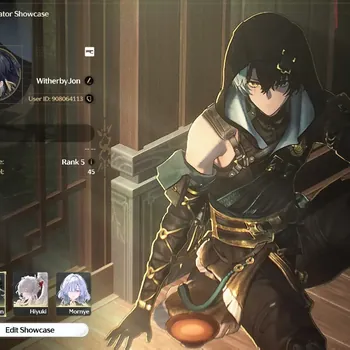
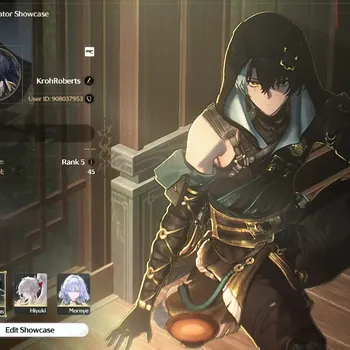
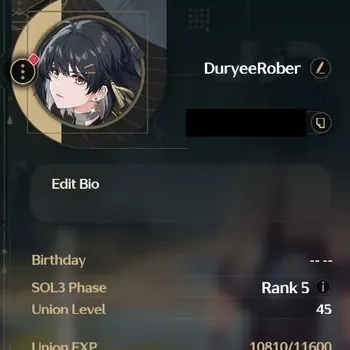
A Wuthering Waves account's progression is measured by five things, not one: Union Level, Data Bank level, resonator roster depth, Resonance Chain and weapon investment, and echo quality. Union Level gates content, Data Bank gates echo drops, and everything else decides whether the endgame modes are actually clearable.
Players tend to describe their account with a single number — usually Union Level — because that is the number the game puts on the screen. It is a poor summary. Two accounts sitting at the same Union Level can be separated by months of real progress, because Union Level tracks how much content has been opened, while the Data Bank, the roster, and the echo pool track how much of that content can actually be beaten. Kuro Games built Wuthering Waves so that these systems advance on different clocks: one is unlocked by playing, one by farming, one by pulling, and one by grinding a stamina currency called Waveplate. Understanding which clock you are on is the difference between a plan and a treadmill.
This guide walks each layer in the order it starts to matter, names the breakpoints that actually change what you can do, and ends with a realistic picture of what an account looks like at the early, mid, and endgame stages.
What actually defines a Wuthering Waves account's progression?
Five layers define it: Union Level (content access), Data Bank level (echo rarity and drop quality), resonator roster (how many teams you can field), Resonance Chains and weapons (damage ceiling), and echo sets (the multiplier on everything else). A weak layer caps the rest.
The useful way to think about this is as a chain of gates rather than a score. Union Level unlocks the door, the Data Bank decides what falls out of the room behind it, and your roster decides whether you can walk in at all. An account with a deep roster but a low Data Bank will hit a wall because it has nothing good to equip. An account with a maxed Data Bank but only two built resonators will fail the endgame modes that demand multiple simultaneous teams. Progression is therefore about keeping the layers roughly level with each other, not about pushing one to its maximum.
This also explains the most common complaint from returning players — that their account "feels stuck" despite a high number on the profile card. Almost always, the stalled layer is the Data Bank or the echo pool, because those two are the only ones that require sustained daily resource spending rather than a burst of story completion.
How does Union Level gate what an account can do?
Union Level is account XP earned from quests, exploration, Waveplate spending, and world activity. It raises the Waveplate cap, unlocks endgame modes, raises world level, and gates resonator and weapon ascension tiers. It cannot be rushed with resources — it advances by playing.
The early Union Levels come almost free from the main quest, which is why new accounts feel fast. The pace changes once quest XP thins out and the majority of Union XP starts arriving from Waveplate spending and exploration. From that point Union Level becomes a soft daily cap on the account: you gain it at roughly the rate you spend stamina, and no amount of pulling changes that.
The gates that matter most are the ones tied to ascension. Resonators and weapons cannot pass their level caps until the account's Union Level allows it, so a freshly pulled five-star on a young account will sit under-levelled regardless of how many ascension materials are stockpiled. This is the single most common reason a new player's damage feels wrong: the character is fine, the account is not old enough to let it grow.
World level rises alongside Union Level, which is a double-edged upgrade. Enemies gain health and damage, but drops improve — higher-tier ascension materials, better echo rarities, and better returns per Waveplate. Accounts that outpace their combat power by pushing exploration hard can end up in an uncomfortable window where the open world hits harder than their built teams can answer. It resolves itself, but it is worth knowing that the discomfort is structural rather than a mistake.
Why does the Data Bank decide echo quality on an account?
The Data Bank is the echo system's own progression track. Its level determines which echo rarities and COST tiers can drop in the open world, what the Tacet Field rewards contain, and how high echoes can be tuned. A low Data Bank makes good echo stats mathematically unavailable, no matter how much you farm.
Data Bank levels come from absorbing echoes you have not recorded before and from continuing to absorb duplicates for reduced XP. Because the XP requirement climbs, the practical route is to absorb every new echo you encounter early rather than hoarding, and to keep absorbing rather than selling once the collection is broad. The reward for reaching the higher Data Bank tiers is that gold echoes begin dropping with usable main stats instead of being a lottery, and the daily Tacet Field runs stop feeling like a waste of Waveplate.
This is the layer most often neglected, and it is the one that most cleanly separates an account that looks progressed from one that is. A roster of five-star resonators equipped with under-tier echoes will underperform a smaller roster with a mature Data Bank behind it. If you are auditing an account — your own or one you are evaluating — the Data Bank level is the fastest single indicator of how much real farming has happened.
What does a healthy resonator roster look like?
A healthy roster is not the largest one. It is two complete teams of three that cover different damage types, each with a main damage dealer, a sub-DPS or amplifier, and a support or healer. Endgame modes require two teams simultaneously, so breadth beats depth past a point.
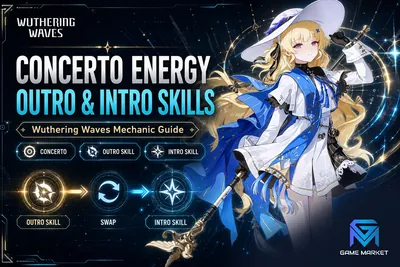
Wuthering Waves teams are built around swapping. The Concerto and Forte systems reward rotating through all three characters rather than parking on one, and Outro and Intro skills mean the value of a resonator depends heavily on who is standing next to them. That makes a roster's quality a question of coverage: do you have a second damage dealer of a different element for content that resists your first, and do you have two healers or shielders so both teams can survive?
Elemental and role coverage matters more than star rating. Several four-star resonators — Baizhi, Sanhua, Danjin, Yangyang, Taoqi and others in that tier — remain genuinely competitive in support and sub-DPS slots long into the endgame, and a fully invested four-star will outperform an under-invested five-star. Accounts that spread investment across eight characters at half-strength usually clear less content than accounts that finished six.
The practical target for a mature account is six to eight fully ascended, fully skilled resonators arranged into two coherent teams, with one or two flexible units that can slot into either. Anything beyond that is comfort rather than capability.
How much do Resonance Chains change an account's ceiling?
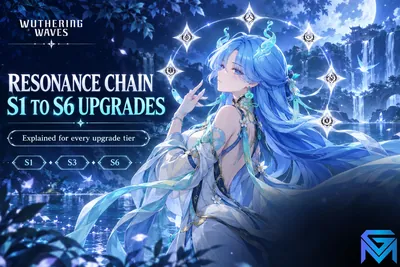
Resonance Chains are the duplicate-unlock system, running S1 through S6. Each stage adds a specific buff to that resonator — usually more damage, better energy generation, or a mechanical change. They raise a character's ceiling substantially, but they are not required to clear content.
The important nuance is that Resonance Chains are unevenly valuable. Some resonators gain a modest percentage at S1 and little of consequence until S6; others gain a rotation-defining change at S1 or S2 that reshapes how the character is played, such as an energy refund that lets them use their burst every rotation instead of every other one. Because of that variance, "chains" is not a single quality axis on an account. An S2 on a character whose S2 is transformative is worth more than an S4 on a character whose chains are flat damage.
For planning, this means Resonance Chains should be treated as an outcome of pulling rather than a target. Astrite spent chasing a specific chain is astrite not spent on a new resonator that would have widened your team coverage — and coverage is what the endgame modes check. Our companion breakdown of how weapons and Resonance Chains interact in practice goes deeper on where the sharp breakpoints actually sit.
Which weapons matter on a developed account?
Signature five-star weapons give the largest single stat jump available to a resonator, but the gap to the best four-star and battle-pass alternatives is smaller than the gap between a tuned and an untuned echo set. Weapons are a refinement layer, not a foundation.
Every resonator uses one of five weapon types — sword, broadblade, pistols, gauntlets, or rectifier — and the crafted and event four-star options in each category are deliberately serviceable. A five-star signature typically supplies both a higher base attack and a passive tuned to that character's exact mechanic, which is why it reads as a large upgrade in isolation. Measured against an account's total damage, it is usually a smaller improvement than finishing a character's Forte Circuit nodes or replacing a mismatched echo main stat.
The order that gives the most output per resource on a developing account is consistent: ascend and level the resonator, complete the Forte Circuit, fix echo main stats, then upgrade the weapon. Accounts that invert that order — a signature weapon on a half-built character — are the most common form of wasted investment.
How do echoes separate a mid account from an endgame one?
Echoes are the equipment layer, built from monsters you defeat and absorb. Each has a COST value of 1, 3, or 4, and a team's echo loadout must fit a total COST budget of 12. Sonata Effects — the set bonuses — activate at two and five matching pieces.
The COST system is what makes echo building a real decision rather than a checklist. A 4-COST echo carries the flexible main stat, usually a damage bonus or critical stat, and is the single most impactful slot. The 3-COST slots carry elemental or attack bonuses, and the 1-COST slots carry flat stats and are the cheapest place to complete a Sonata Effect. Fitting a five-piece Sonata inside the budget while getting the right main stats on the 4-COST and 3-COST pieces is the core optimisation problem of the game's endgame.
Tuning is where the account-hours actually go. Echoes gain sub-stats through Tuners, and the sub-stat rolls are random, so a mature account is one that has farmed enough Tuners and echoes to discard bad results rather than settle for them. This is the layer where the Data Bank level, the daily Waveplate spend, and months of routine compound into something visible. Nothing else on the account shows farming history as plainly.
What do the endgame modes reveal about account maturity?
Tower of Adversity, Whimpering Wastes, and Depths of the Illusive Realm each test something different. The Tower checks whether you have multiple complete teams, the Wastes check sustained clear speed against scoring thresholds, and the Illusive Realm checks adaptability with borrowed buffs rather than raw investment.
Tower of Adversity is the honest audit. Its hazard zones require separate teams for separate towers, so an account that has funnelled everything into one damage dealer will clear the first tower and stall on the others. Full clears are the standard benchmark for "endgame-ready", and they demand roughly six built resonators, not three.
Whimpering Wastes rewards scoring rather than binary completion, which makes it a sensitive measure of echo quality and rotation execution. Two accounts with identical rosters will score differently based on echo tuning alone. Depths of the Illusive Realm sits apart from both — its roguelite buffs flatten investment differences, so a newer account can clear it well and should not read that as proof the rest of the endgame is open.
What are the realistic progression stages by playtime?
Early accounts are Union Level gated and roster-poor. Mid accounts have two functional teams and a partial Data Bank. Endgame accounts hold six-plus built resonators, a maxed Data Bank, tuned five-piece Sonata sets, and full Tower of Adversity clears. The transitions take weeks, not days.
In the early stage the constraint is access. Story progress raises Union Level, world level, and the Waveplate cap, and there is no meaningful way to accelerate past it. The correct play is to push exploration and the main quest rather than to farm, because farming returns are still low and echoes gathered now will be replaced.
The middle stage is where accounts diverge. The constraint switches from access to resources, and daily Waveplate discipline starts compounding — Tacet Fields for echo XP and Tuners, Forgery Challenges for skill materials, boss fights for ascension items. Accounts that establish a routine here reach the endgame stage; accounts that log in only for events do not. This is also where the astrite economy starts to matter, since roster breadth now depends on pull income; our astrite income breakdown per patch cycle and the free-to-play convene roadmap both cover how much roster growth is realistically fundable.
The endgame stage is defined by optionality rather than power. The account can field a team for any content, so pulls become preference instead of necessity, and Waveplate goes toward improving echoes that are already good. Reaching it is a matter of months of consistent play for most players, and the number on the profile card is the last thing to tell you that you have arrived.
What should you check before treating an account as endgame-ready?
Check six things: Union Level and world level, Data Bank level, the count of fully ascended resonators, whether two complete teams exist, whether five-piece Sonata sets are equipped and tuned, and whether Tower of Adversity clears fully. Any single failure is the account's real bottleneck.
Run them in that order, because they gate each other. A low Union Level makes ascension impossible, so fixing the roster first is wasted effort. A low Data Bank makes echo farming inefficient, so tuning first is wasted Tuners. The first failing check is the only one worth working on, and once it clears, the next one becomes visible.
It is also worth checking the housekeeping that has nothing to do with power: which regional server the account sits on, since Wuthering Waves keeps progress separate per region and there is no transfer between them, and which platform login the account is bound to, since PC, mobile, and console share progress only through the same account binding. These are not progression, but they determine whether progression is portable, and they are the details players most often discover too late. The foundational systems behind all of this are covered in our Wuthering Waves beginner's guide to resonators, echoes and astrite.
Frequently asked questions
Does a high Union Level mean a strong account?
No. Union Level tracks content access and Waveplate spending, not combat power. An account can reach a high Union Level through exploration and story while leaving the Data Bank, echo sets, and roster underdeveloped. Check the Data Bank and Tower of Adversity clears instead.
Is it better to pull for Resonance Chains or new resonators?
For most accounts, new resonators. Endgame modes require two complete teams, so coverage gaps cost more clears than a missing chain does. Chains are worth chasing once you already have six built resonators and a specific character whose early chains change their rotation.
Can Wuthering Waves progress transfer between regions?
No. Kuro Games keeps each regional server independent, and progress made on one region does not move to another. Platform is a different matter — the same account binding carries progress across PC, mobile, and console within the same region.
How long does it take to reach the endgame stage?
For a player logging in daily and spending Waveplate consistently, the transition from a mid account to full Tower of Adversity clears typically takes a few months. The limiter is echo tuning and roster breadth, both of which are capped by daily resources rather than by skill.
Are four-star resonators worth investing in long term?
Yes. Several four-star supports and sub-DPS units remain standard picks in endgame teams, and a fully built four-star consistently outperforms a partially built five-star. They are also cheaper to chain, which makes their upgrades more reliably attainable.
If you would rather start from a roster that has already cleared these milestones, browse the verified Wuthering Waves accounts available on GameMarket.gg and compare Union Level, Data Bank, and built resonators against the audit checklist above before you decide.
GameMarket.gg is a trusted digital marketplace for everything gaming-related. We serve the gaming community by providing secure access that enhances every gaming journey.