

Monster Hunter Outlanders Lance: Skills, Role & Team Value
By Rivan Wi 6 October 2026, 17:00 WIBMonster Hunter Outlanders hits mobile on October 29, 2026, and out of everything shown so far, the hunter sparking the loudest debate is not a flashy damage dealer but a tank: an SSR Support built around the Lance. That is a strange thing to get hyped about in a series known for giant swords and explosions. It makes sense once you remember how the game works, though. When four players pile onto a monster the size of a building, the hunter who can plant their feet, raise a shield, and simply refuse to die often decides whether the hunt ends in a trophy or a wipe. So the reveal leaves you with a genuinely divisive question: is a defensive anchor worth one of your four squad slots, or would you rather fill it with raw firepower?
A quick look at the game itself
Since this is a brand-new title that nobody has played at launch yet, a little context helps. Monster Hunter Outlanders is a free-to-play hunting action game made for phones, developed by TiMi Studio Group under an official Capcom license. The loop will feel familiar to anyone who has touched the series: hunt a massive monster, carve it for parts, craft better gear, then go after something nastier. You can head out alone or link up with three others for a full four-player hunt, and that co-op side is where the whole tank conversation comes from. Seven weapon types are ready at launch, the Great Sword, Long Sword, Dual Blades, Hammer, Lance, Heavy Bowgun, and Bow, each with its own rhythm and role in a party.
It is shaping up to be a proper open-world take rather than a stripped-down phone port. Hunts play out in living environments you actually explore, the roster includes original monsters built for this game, and a companion system of Buddies, Palico, Rutaco, and Trillan, fights alongside you. All of that gives a party a lot to juggle mid-hunt, from tracking the monster to managing positioning, and it is part of why having a teammate who can reliably control the fight carries so much weight.
Three classes, and why a tank is its own thing
Outlanders sorts its hunters into three jobs. Assault hunters exist to deal damage, Disruptors specialize in crowd control, and Support hunters keep the team standing through healing, buffs, and protection. The Lance user sits in that Support bucket, but calling it a "healer" misses the point. A healer fixes damage after it lands; a tank stops it from landing at all by baiting the monster and eating its scariest attacks on a raised shield. Those are two very different ways to keep a squad alive, and a smart team usually wants a bit of both. Stack four pure attackers and you will shred a monster fast, right up until one unlucky roar flattens the whole group. That fragility is exactly the gap a tank is built to cover.
There is a social layer to it too. In a four-player hunt, roles naturally shape how a team communicates and who takes the lead during a fight. A tank tends to become the hunter everyone else reads: when it commits to holding the monster, the Disruptor knows when to lock it down and the Assault hunters know when it is safe to unload. On harder monsters, that kind of silent coordination is often the difference between a smooth clear and a frantic scramble, which is why experienced groups value a good anchor far more than a flashy solo carry.
The Lance, and the hunter wielding it
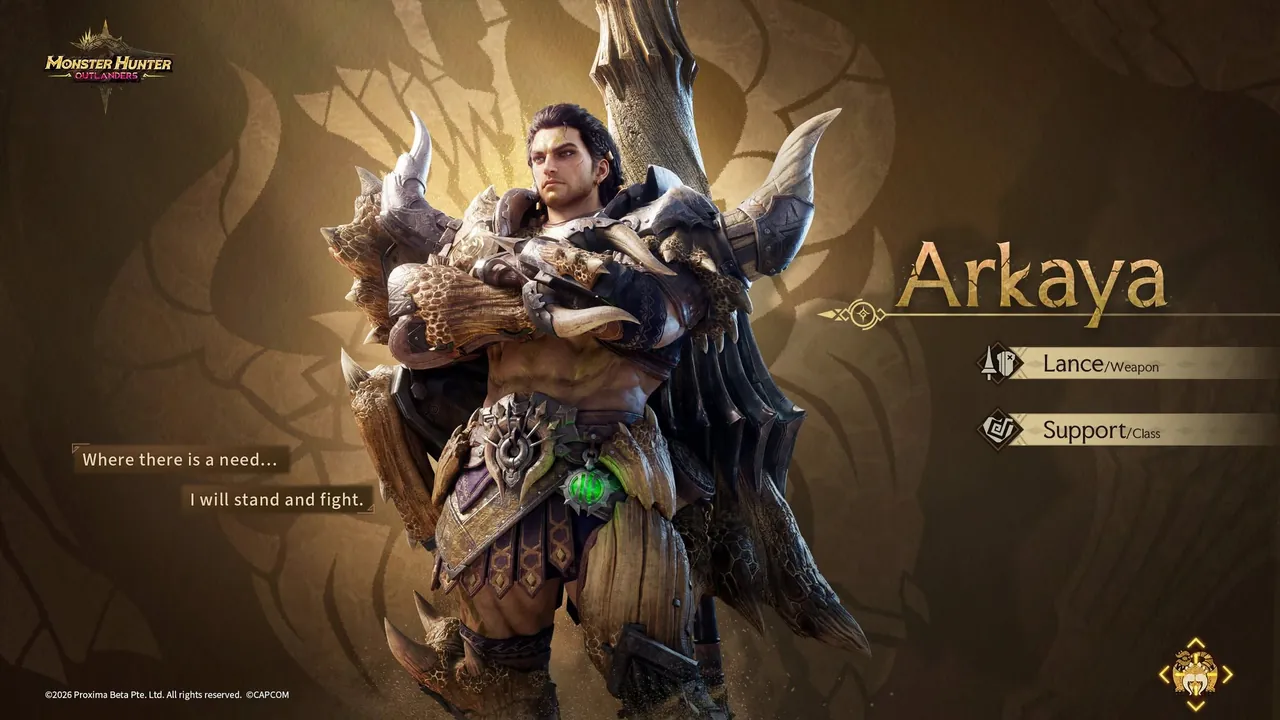
The Lance is the natural home for this playstyle. It is the series' classic turtle: a long thrusting spear paired with a shield big enough to weather almost anything, and famously the one weapon that can poke and block at nearly the same time, so you rarely have to fully lower your guard to deal damage. The reach lets you jab from a hair outside a monster's swing, and the shield soaks hits that would send a lighter hunter flying. The catch is speed. The Lance is slow and clumsy to reposition, so playing it well is a game of reading attacks and holding the right spot rather than dashing around.
The SSR hunter in the spotlight leans fully into that identity, with three skills that each do one job:
- Boulder Stance: plants you in place to eat a hit you would normally dodge, trading mobility for raw durability right when a monster commits to a big attack.
- Driving Assault: the opposite impulse, a forward move that keeps you glued to the target and its aggression pointed at you instead of a squishier teammate.
- Relentless Thrust: fills the space between, turning defensive patience into a slow but steady stream of chip damage so you are never purely passive.
Together they make a kit about holding ground and grinding a monster down rather than bursting it, and none of it is flashy, which is the whole appeal, since the fun of a tank is the quiet confidence of standing where everyone else is running from.
The real value of a hunter like this shows up in how it frees everyone else. When one player can reliably hold a monster's focus and survive its heaviest blows, the attackers stop glancing over their shoulders and start committing to the big, risky combos that actually end hunts quickly. A good tank does not just protect itself; it quietly makes the entire squad hit harder. It is also a forgiving way into the game for newer players, because surviving while you learn a monster's patterns is a lot less punishing than trying to master the timing of a glass-cannon weapon under pressure.
Getting it, the SSR question, and the verdict
On the money side, the news is reassuring. Hunters can be unlocked for free through normal play and daily challenges, with paid options for anyone who wants to skip ahead, so an SSR tank is something a patient free player can realistically chase. That matters because SSR is the top rarity, usually the strongest and the hardest to pull, and knowing it is not locked behind a paywall makes it far more appealing than a premium-only exclusive. Commit early and you can have a solid anchor ready for the brutal endgame hunts that always follow a launch.
The timing of this reveal is no accident either. Showing off a tank right before launch, rather than another damage hero, is a deliberate signal about how the developers want people to think about their squads from day one. It tells you the hardest content will reward balance over brute force, and it gives early players a reason to consider the less glamorous roles instead of everyone piling onto the same flashy attackers. For a free game that lives or dies on how long its community sticks around, nudging players toward real team composition this early is a smart way to keep hunts feeling fresh.
Whether it earns a spot on your team really depends on how you play. If you are gunning for the hardest content with a group of friends, a dedicated Support Lance is the kind of pick that turns a near-wipe into a clean clear, so serious squads will want one. If you mostly solo or you simply live for the biggest damage numbers, you will probably hand that slot to an attacker and trust your dodging to keep you upright. Both answers are fine, and that is the point. The reveal is really a preview of how much team-building will matter in Outlanders, and judging by how quickly players are taking sides, the squad system has real depth waiting at launch. The smart move, if you are even a little curious, is to try the Lance yourself in the first week while the whole community is still figuring out the meta. Tanks rarely top a highlight reel, but the player holding the line is often the reason the hunt gets finished at all, and that is a role worth understanding before everyone else does.
If you want to be ready the moment Monster Hunter Outlanders goes live and skip the slow early grind, you can explore trusted Monster Hunter Outlanders Accounts, save time building your hunter roster with reliable Monster Hunter Outlanders Hourly Services, or take down the toughest monsters faster through dependable Monster Hunter Outlanders Boosting.
GameMarket.gg is a trusted digital marketplace for everything gaming-related. We serve the gaming community by providing secure access that enhances every gaming journey.