MCGG Commander Guide: How to Pick the Right One
By Sir Ayup 4 August 2026, 22:00 WIB
Your Commander is the first decision of every Magic Chess: Go Go match, and it's the one most players make on instinct — picking whoever looks best or whoever they used last time. That's a mistake, because Commanders don't fight. They deal no damage and take no space on the board. What they do is change the rules you play by: how much gold you generate, how quickly you find hero copies, or what happens on the board each round. Pick one that pulls against your playstyle and you spend the whole match fighting your own setup. Here's how the system works and how to choose deliberately.
How the Commander system works
The essentials, since plenty of players run dozens of matches without knowing them:
- You bring exactly one Commander into a match, chosen before it starts. There's no swapping mid-game.
- Commanders don't participate directly. Their skills operate around the match rather than inside it.
- They're obtained through events, campaigns, the Chess Pass and similar features, not as a straightforward shop unlock.
- Duplicates matter. Collecting three copies of the same Commander raises its rarity, and higher rarity strengthens the skill's values.
- Skills scale during the match, with several unlocking their strongest effects only once you reach higher levels.
That last pair of points drives most of what follows.
The four archetypes
Almost every Commander falls into one of four categories, and identifying the archetype tells you more than any ranking does.
Economy Commanders generate extra gold, reduce hero costs, or improve your interest. They pay off across the match rather than immediately, which suits players comfortable losing early rounds to build a stronger late game. Lancelot's escalating per-round gold and Tharz's discount on expensive heroes are classic examples of the type.
Acquisition Commanders help you find the specific heroes you need — improving the odds of hitting copies, collecting shards toward a reward, or pulling high-cost units directly. These reduce the variance that decides most auto-battler games, and they suit players chasing a three-star upgrade on a specific carry. Dyrroth's devouring mechanic and Guinevere's improved copy rates sit here.
Combat Commanders add direct effects to the board each round — area damage, stuns, shields or healing. Layla's damaging hologram and Lucas's shockwave statue are examples. These are the most immediately visible skills and the easiest to judge, which is why they suit newer players.
Synergy Commanders manipulate the synergy system itself. Gusion, for instance, summons a Sigil displaying a random Role Synergy that you can then apply to a hero of your choosing. These carry the highest skill ceiling: enormous when they complete a synergy you couldn't otherwise reach, wasted when you don't spot the opportunity.
Star level usually beats tier placement
Here's the rule most tier lists bury: a higher-star Commander is generally better than a lower-star one, even if the lower-star Commander ranks higher on a list.
Rarity strengthens skill values, and those values are what actually change the match. A mid-tier Commander at high rarity, whose skill you've seen a hundred times and know how to time, will usually serve you better than a freshly acquired top-tier Commander at one star.
The practical consequence: build depth in a few Commanders rather than breadth across many. Spreading duplicates thinly leaves you with a dozen weak versions of powerful skills.
Matching the Commander to how you actually play
Ask which of these describes your matches:
- You want to win early and snowball. Combat Commanders that add board damage each round keep a win streak alive, and streak pressure closes games before opponents assemble their late boards.
- You're comfortable taking damage early for a stronger board later. Economy Commanders reward exactly this pattern — but only if you have the discipline to hold gold rather than rerolling on impulse.
- You commit to one carry and upgrade it. Acquisition Commanders cut the luck involved in reaching three stars, which is the difference between a plan and a hope.
- You improvise around whatever the board offers. Synergy Commanders reward flexible reading and punish players who decide their comp before the match starts.
There's no correct answer here, only a match or a mismatch. An economy Commander in the hands of someone who rerolls constantly is worse than no advantage at all, because the skill's entire value rests on the discipline it assumes.
What beginners should pick
If you're new, the useful advice isn't "pick the strongest" — it's pick the most legible.
Combat Commanders with a consistent, visible effect every round teach you the game faster, because you can see what your Commander did and judge whether it helped. Economy and synergy Commanders require you to already understand gold curves and synergy breakpoints to evaluate their value, which makes it hard to learn from your own results.
Start with something whose impact you can observe, learn the board, then graduate to the picks with higher ceilings.
Where tier lists go wrong
Three reasons to treat any Commander ranking — including any you find elsewhere — as a starting point rather than an answer:
- Balance patches land every few weeks, buffing and nerfing Commander skills. A ranking written a month ago may describe values that no longer exist.
- Seasons revamp synergies, which changes what synergy and acquisition Commanders are worth. A Commander built around a synergy family that gets reworked loses value without being touched directly.
- Star level isn't reflected in rankings. Lists rank skills at full strength; your account has what it has.
Open the Commander's skill description in-game before committing. It's the only source that's both current and accurate to your account.
Building your Commander pool
- Focus duplicates on two or three Commanders covering different archetypes — an economy option and a combat option, at minimum.
- Claim Commanders from events and passes even if you don't plan to use them; duplicates accumulate over time and rarity only ever goes up.
- Learn one deeply before adding another. Knowing exactly when your Commander's skill peaks is worth more than a broad roster you use inconsistently.
- Re-evaluate after each season change, since synergy revamps shift which archetypes are strongest.
Build a stronger Commander roster
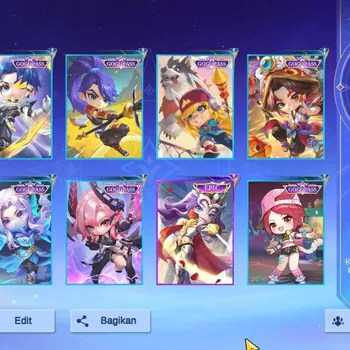
Commander depth takes months of events to accumulate, and rarity — not variety — is what makes those skills land. Browse verified Magic Chess: Go Go accounts if you want a roster with high-rarity Commanders already unlocked, or check the Magic Chess: Go Go marketplace for top-up options ahead of the next season's events.
GameMarket.gg is a trusted digital marketplace for everything gaming-related. We serve the gaming community by providing secure access that enhances every gaming journey.





![Magic Chess: Go Go Accounts Global | Rank Mythic Best Master 543* | Spesial Zilong |CB [Spesial 1& Elite 1]| 7 CMD B*3| (36](https://img.gamemarket.gg/products/4xxixtyf/magic-chess-go-go-accounts-global-rank-mythic-best-master-543-spesial-zi-e5z-thumbnail.webp "Global | Rank Mythic Best Master 543* | Spesial Zilong |CB [Spesial 1& Elite 1]| 7 CMD B*3| (36 CMD B*2) | TakeMail MCG14B")


![Magic Chess: Go Go Accounts Global | Rank Epic *1 Best Mythic 416* | SPECIAL Johnson | CB [Special 2+Elite 1] | 6 CMD B*3| 4](https://img.gamemarket.gg/products/jloadn07/magic-chess-go-go-accounts-global-rank-epic-1-best-mythic-416-special-j-lvb-thumbnail.webp "Global | Rank Epic *1 Best Mythic 416* | SPECIAL Johnson | CB [Special 2+Elite 1] | 6 CMD B*3| 4 CMD B*2 | TakeMail MCG09B")