Clash Royale Royale Shuffle Guide: All 12 Modes Explained
By Sir Ayup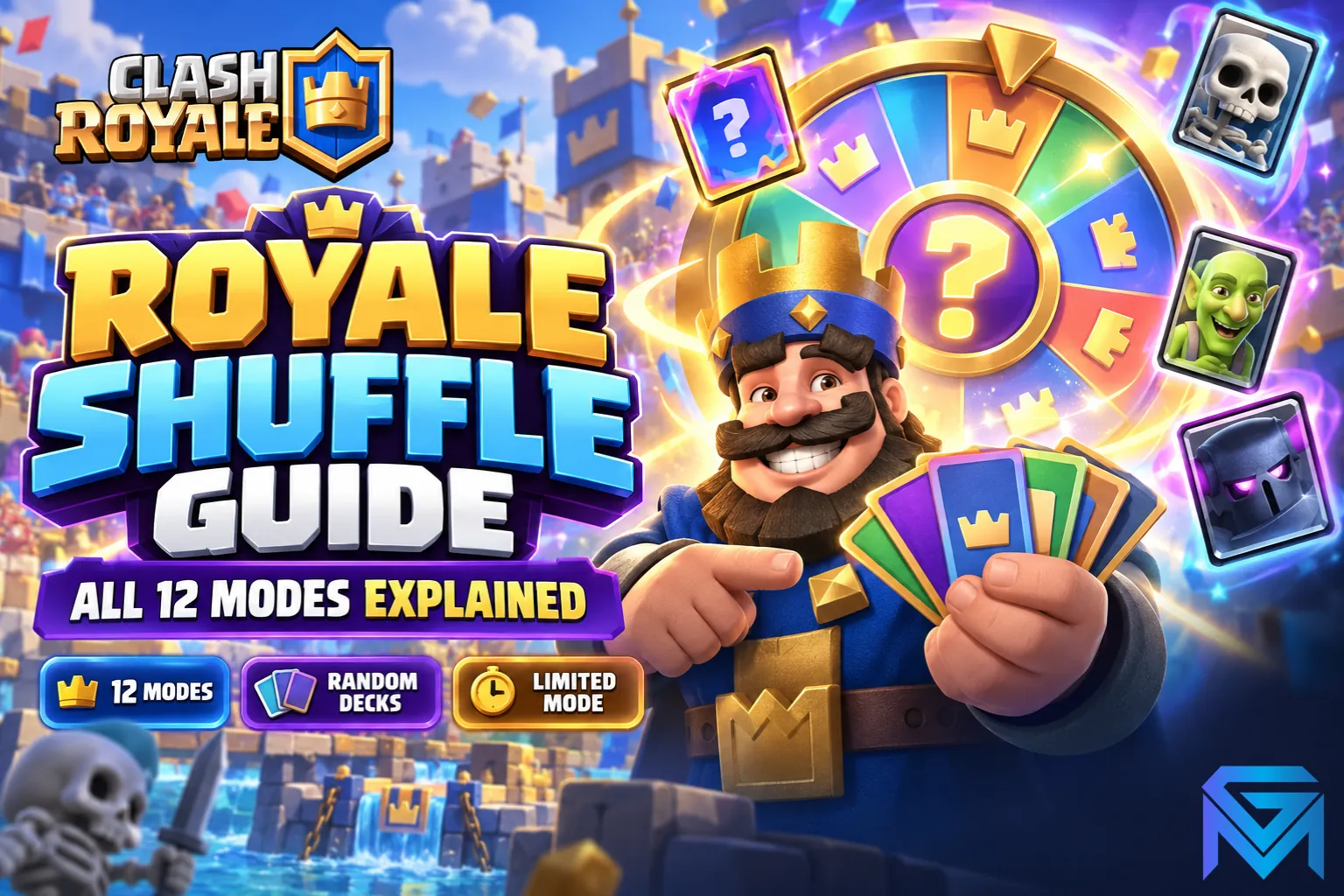
Royale Shuffle opens on 21 September, and it removes the one thing Clash Royale players normally control completely: your deck.
Spin the wheel, get one of 12 random modes, and play it with a random deck — for both you and your opponent. You can't prepare a list, you can't counter-build, and you can't lean on the cards you've levelled.
What you can do is know the modes. Here's every one of them, and what each asks of you.
The short version
- Limited-time mode: 21 September – 5 October 2026.
- Limited-time challenge: 28 September – 5 October 2026.
- One of 12 modes is chosen at random, and both players' decks are random too.
- Not part of ladder or Global Tournaments, at least this season.
- All 12 modes have appeared before — some returning after a long absence.
- A "Shuffle Star" badge for winning in every mode was spotted in development builds. Not confirmed.
Where the skill actually is
Random mode plus random deck sounds like pure luck. It isn't quite.
Deck building is gone, so the skill moves elsewhere:
- Recognising the mode instantly. The first few seconds decide whether you play for tempo, for an objective, or for survival.
- Knowing cards you don't own. You'll be handed decks built from anything, which rewards broad card knowledge over a deep collection.
- Adapting mid-match. Several modes change their rules on a timer.
One practical consequence: this is the fairest mode in the game for accounts with weak collections. You're not bringing your cards, so your card levels don't decide the match your opponent's cards would.
Details below come from development-build previews and may change at launch.
Elixir-speed modes
1. Triple Elixir Battle
- 3x Elixir from start to finish.
- Decisions happen fast and mistakes get punished immediately. Cycle quickly and don't sit on elixir.
2. Sudden Death Battle
- The first player to destroy a tower wins.
- 2x Elixir from 5:00 to 3:00, then 3x Elixir to the end.
- Don't overcommit to defence. One clean push ends the match, so a strong counter-attack is worth more than a perfect hold.
3. Rage Battle
- The entire arena is permanently in a Rage state.
- Elixir escalates in stages: 1.3x from 3:00 to 1:00, 2.7x from 1:00 into the first minute of overtime, then 4x for the final minute.
- Pace your pushes to the elixir stages. The late phase gives you far more to spend than the opening.
Objective modes
4. Heist Battle
- Originally from a Brawl Stars collaboration.
- Defenceless safes replace the towers. They don't attack at all.
- Safe HP: 12,060.
- Your troops are your only defence. With no tower fire, every push has to be answered by units — which makes this closer to a damage race than a normal match.
5. Whose Mortar Is It Anyway?
- A giant mortar sits in the centre of the arena.
- Whoever destroys it gains it as an ally. Neutral HP: 3,840.
- It respawns after a set time once destroyed.
- Contest the centre early. The mortar is a permanent siege unit for whoever takes it, and it keeps coming back.
6. Dragon Hunt
- A dragon egg sits in the centre. Destroying it summons a random friendly dragon.
- Egg HP: 2,560. It respawns after a set time.
- Lower HP than the mortar, so it changes hands faster. Keep spell damage in reserve to steal it at the last moment.
Unit-bonus modes
7. All Evolutions
- Every card in both decks is evolved, with a few non-evolved spells included for balance.
- Know what each Evolution does differently. A card you recognise may not behave the way you expect.
8. Super Troop Showdown
- Each deck contains one Super Card — examples include Super Necromancer, Super Magic Archer, Barbarian Launcher and Terry.
- The Super Card is usually the match. Plan your elixir around deploying it and answering theirs.
9. Mega Monk
- A giant Monk periodically appears behind both players' towers.
- Like the standard Monk, he can use his ability — at a cost of 2 elixir.
- He respawns after a set time once defeated.
- Spend the 2 elixir on his ability deliberately. It's a cheap swing if timed against a real push.
Hazard modes
10. Snowball Fight
- Giant snowballs periodically rain down across the arena.
- Don't cluster troops unnecessarily. Random area damage punishes stacked pushes.
11. Blackout
- The arena periodically goes dark.
- In the dark, you only see level displays and HP bars — you know where units are, but not which card they are.
- Memorise what gets played before the lights go out. Tracking your opponent's deployments is the whole mode.
The restriction mode
12. 4-Card Clash
- Four cards instead of eight.
- Each card has a cooldown of a few seconds after use, so you can't spam the same card repeatedly.
- Every card matters. With half a deck, a single bad deployment leaves you with nothing to answer the counter-push.
Mode and challenge
The limited-time mode runs 21 September to 5 October. Previous free event modes have allowed unlimited battles, but that hasn't been stated for this one.
The limited-time challenge runs 28 September to 5 October — a shorter window. Its loss limit and reward track haven't been published.
Royale Shuffle isn't in ladder or Global Tournaments this season, so it doesn't touch your trophies.
The badge, if it's real
A Super Rare "Shuffle Star" badge — awarded for winning at least once in every Royale Shuffle mode — appeared in development builds.
Whether it ships is unconfirmed.
If it does, it's luck-gated. Modes are chosen at random, so you can't target the ones you're missing. Twelve modes means potentially many matches before the wheel lands on your last one — and the window closes on 5 October. Start early if you want it.
Where it fits
Royale Shuffle continues a run of deliberately chaotic modes from Supercell, following Princess Gambit and the C.H.A.O.S mode before it. It arrives in the Minion Academy season alongside Minion Giant and Hero Ice Wizard, with Shocktober announced as coming next.
What isn't confirmed
- Challenge rewards and loss limits.
- Whether the Shuffle Star badge ships.
- Whether card levels are normalised in random decks.
- Mode weightings — whether all 12 are equally likely.
- Final values, since previews came from development builds.
What to do
Learn the 12 rules before you play. Recognising the mode in the first seconds is the main skill.
Play the free mode first, then take on the challenge from 28 September.
Contest the centre in Mortar and Dragon Hunt.
Track deployments before the lights go out in Blackout.
Start early if you're chasing the badge. Random selection makes it slow.
Building the collection behind it
Royale Shuffle levels the playing field for a fortnight, but ladder, Path of Legends and Clan Wars still run on card levels, Elite Wild Cards and Gold reserves — the slow half of Clash Royale. Browse verified Clash Royale accounts if you'd rather return to ranked from a developed collection, book Clash Royale hourly services to keep daily progress and season challenges moving, or push trophies through Clash Royale boosting while the season runs.
GameMarket.gg is a trusted digital marketplace for everything gaming-related. We serve the gaming community by providing secure access that enhances every gaming journey.