Arknights Stronghold Protocol: Alliance Guide — Economy, Synergies & Co-op Tips
By Official GameMarket News 24 August 2026, 10:00 WIB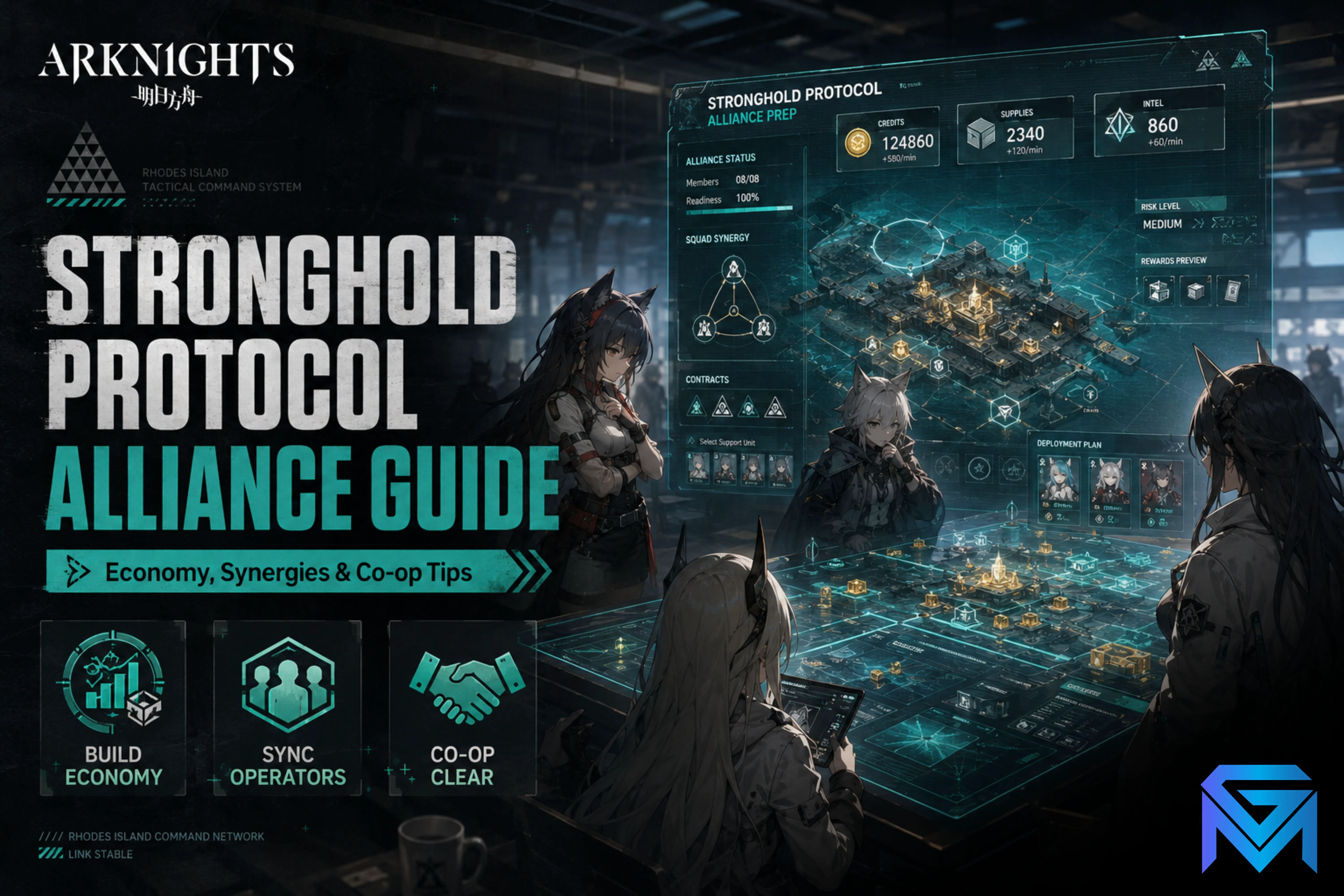
Arknights Stronghold Protocol: Alliance Guide — Economy, Synergies & Co-op Tips
Arknights brings back its experimental auto-battler mode with Stronghold Protocol: Alliance, challenging four players to defend separate lanes while managing a shared team objective.
Unlike regular Arknights stages, Operators fight automatically after deployment. Victory depends on building Alliance synergies, managing Funds, upgrading the Dispatch Center, equipping the correct items, and coordinating around a shared Operator pool.
Stronghold Protocol: Alliance runs from August 20, 2026 at 09:00 until October 1 at 03:59 (UTC-7). That corresponds to August 20 at 23:00 until October 1 at 17:59 WIB for Indonesian players. The dates were confirmed through the official Arknights announcement.
Here is how the mode works and what your team should prioritize during each run.
How Stronghold Protocol: Alliance Works
Stronghold Protocol combines Arknights’ tower-defense mechanics with an auto-battler economy system.
Each player controls a separate defensive area. However, everyone contributes to the same Life Point total. Enemies that escape through one player’s lane reduce the shared Life Points, potentially ending the entire run.
A match alternates between two main phases:
Preparation Phase
During preparation, players can:
-
Purchase Operators from the Dispatch Center
-
Refresh the available Operator selection
-
Upgrade the Dispatch Center
-
Deploy and reposition Operators
-
Combine duplicate Operators
-
Equip items
-
Review incoming enemies
-
Adjust Alliance synergies
This phase is where most important decisions happen. Once combat begins, you cannot manually activate skills or reposition Operators normally.
Battle Phase
Operators automatically attack, block enemies, and use their selected abilities.
Players must rely on their preparation and positioning until the wave ends. If enemies reach the objective, the shared Life Point total decreases.
A poor lane can damage the entire team, so building only for personal damage without considering survival is risky.
Build Around One Core Alliance
Alliances provide passive effects when enough compatible Operators are deployed.
They are divided into two main categories:
-
Core Alliances: Usually based on an Operator’s faction
-
Add-on Alliances: Secondary traits that provide additional combat or economic bonuses
Most Core Alliances activate with three Operators and receive an enhanced effect at six Operators. Ægir works differently and reaches its higher requirement with five members.
Core Alliance options include factions such as:
-
Ægir
-
Kjerag
-
Laterano
-
Sargon
-
Victoria
-
Yan
Do not purchase every powerful Operator you see. Begin each run by identifying one realistic Core Alliance and build around it.
Your decision should account for:
-
The starting Strategy
-
Active Alliance bans
-
Available Operators
-
Enemy types
-
Your Support roster
-
The Alliances chosen by teammates
Trying to activate several incomplete Core Alliances usually produces a weaker board than completing one strong synergy.
Add Secondary Synergies
Add-on Alliances are more flexible than Core Alliances. Most activate with two compatible Operators and improve after reaching three.
They can provide benefits such as:
-
Additional damage
-
Attack Speed
-
Defensive bonuses
-
Better positioning effects
-
Extra Funds
-
Free Dispatch Center refreshes
-
Improved equipment interactions
Choose Add-on Alliances that naturally overlap with your Core faction. An Operator contributing to both your main Alliance and a useful secondary effect is generally more valuable than one who only adds raw stats.
Avoid forcing a secondary synergy if it requires replacing several important frontline or damage Operators.
Check Alliance Bans Before Committing
Every match can restrict specific Alliances or Operators.
Some restrictions completely remove an Alliance, while others only reduce the number of compatible Operators available. These partial bans can make a composition possible but much harder to complete.
Before purchasing Operators:
-
Review the active bans.
-
Check which Core Alliances remain available.
-
Inspect your selected Strategy.
-
Observe what your teammates are building.
-
Choose a faction with enough remaining depth.
Do not automatically repeat the same composition every run. Stronghold Protocol rewards adaptation, especially when your preferred Core Alliance is restricted.
Manage Your Funds Carefully
Funds control nearly every part of your run.
You need them to:
-
Purchase Operators
-
Refresh the Dispatch Center
-
Upgrade the Dispatch Center
-
Build upgraded Operator copies
-
Adjust your composition
Spending everything every round can prevent you from reaching higher Dispatch Center levels. However, saving too aggressively can leave your defense too weak to survive the next wave.
Use this general priority:
-
Stabilize your lane with a blocker and reliable damage.
-
Complete the first level of your Core Alliance.
-
Save Funds when your current formation can handle the next wave.
-
Upgrade the Dispatch Center when you can do so safely.
-
Refresh only when searching for an important upgrade or missing Alliance member.
-
Preserve enough Funds for emergency purchases.
Free refreshes should also be treated as economic resources. If they remain available between rounds, do not waste them simply because the button can be pressed.
Do Not Fight Teammates for Operators
The Operator pool is shared between all participating players.
When one player purchases several copies of an Operator, that Operator becomes harder for everyone else to find. This is especially important for high-tier Operators needed to complete a Core Alliance.
Check your teammates’ compositions before buying expensive Operators.
If another player is clearly building Laterano, avoid holding key Laterano units unless they directly support your own formation. The same principle applies to every faction.
Strong teams usually divide their Core Alliances early so players are not competing for the same limited units.
Upgrade the Dispatch Center at the Right Time
A higher Dispatch Center level unlocks stronger Operator tiers.
Upgrading too slowly limits your late-game potential. Upgrading too early can leave your current lane without enough Operators to survive.
Before upgrading, ask:
-
Can my current formation clear the next wave?
-
Is my frontline stable?
-
Have I activated my first Core Alliance bonus?
-
Will the upgrade leave enough Funds for an emergency purchase?
-
Do I actually need higher-tier Operators yet?
If your board is already struggling, strengthen it before upgrading. A better shop does not help if your team loses the run during the next battle.
Prepare Your Support Roster
Stronghold Logistics allows players to prepare Support Operators before entering the mode.
Up to 20 Support Operators can be selected to fill gaps in your available roster. This is useful for incomplete accounts or players missing key members of a preferred Alliance.
However, adding too many unrelated Operators can dilute the available pool and make important units harder to find.
Use Support slots to:
-
Complete one or two preferred Core Alliances
-
Cover missing frontline roles
-
Add reliable ranged damage
-
Provide healing or utility
-
Access Operators essential to a specific Strategy
A focused Support roster is usually more consistent than selecting powerful Operators with no shared synergy.
Position Operators for Automatic Combat
Because battles play automatically, deployment order and positioning matter more than usual.
Before each wave:
-
Check every enemy entrance
-
Identify aerial or invisible enemies
-
Protect ranged Operators from direct pressure
-
Place blockers where lanes converge
-
Avoid stacking every damage dealer in one area
-
Keep healing coverage over your frontline
-
Confirm that every objective route is defended
Some bosses and stages can reverse or change expected targeting patterns. Always inspect the next wave instead of relying on the same formation throughout the run.
A strong Alliance bonus cannot compensate for leaving an entire route open.
Use Equipment to Complete Your Build
Equipment provides additional stats and effects, while some combinations can influence Alliance membership or improve specific faction mechanics.
When equipment appears:
-
Prioritize items that support your primary damage dealer or frontline.
-
Avoid taking equipment clearly intended for a teammate’s Alliance.
-
Combine matching items when an upgrade is worthwhile.
-
Check whether an item can help activate an additional Alliance.
-
Do not equip items randomly without reading their effects.
Equipment should strengthen your existing plan. Rebuilding an entire composition around one situational item is rarely worth the cost unless it creates an especially powerful synergy.
How the Unity Phase Helps the Team
Strong defensive performances can trigger the Unity Phase, allowing selected players to assist another part of the battlefield.
This system helps compensate for uneven lanes, but it should not be treated as a replacement for a functional personal defense.
When assisting another player:
-
Identify the lane most likely to leak
-
Cover missing damage or blocking
-
Avoid disrupting established positioning
-
Prioritize dangerous enemies and bounty targets
-
Keep the shared Life Points in mind
The best teams use the Unity Phase to reinforce a weak lane or secure additional objectives, not to rescue the same unprepared player every round.
Recommended Beginner Strategy
New players should keep their first runs simple.
Use this approach:
-
Review the available Alliances and bans.
-
Choose one Core Alliance with enough available Operators.
-
Build an early frontline before chasing damage.
-
Activate the first Core Alliance bonus.
-
Add one compatible secondary Alliance.
-
Save Funds whenever your lane is stable.
-
Upgrade the Dispatch Center gradually.
-
Avoid competing with teammates for key Operators.
-
Reposition after checking each incoming wave.
-
Spend remaining resources before the final boss.
Sargon and Kjerag are generally easier to understand than compositions requiring complicated economic stacking or equipment interactions. However, availability and active bans should still determine your final choice.
Common Mistakes to Avoid
-
Building several incomplete Core Alliances
-
Ignoring the starting Strategy
-
Committing to an Alliance before checking bans
-
Spending every Fund on unnecessary refreshes
-
Upgrading the Dispatch Center while your defense is unstable
-
Buying Operators needed by a teammate
-
Filling Support slots with unrelated units
-
Ignoring aerial, invisible, or multi-lane enemies
-
Taking equipment that does not support your composition
-
Forgetting that Life Points are shared
-
Entering battle without checking the next enemy wave
-
Depending on Unity Phase to rescue a weak formation
Stronghold Protocol rewards roster depth: activating Core Alliances, covering missing roles, and adapting to bans are much easier when your account has enough developed Operators. Browse Arknights accounts if you want a stronger starting roster, get flexible assistance with daily and event progression through Arknights hourly services, or pursue specific account and event goals with Arknights boosting.
GameMarket.gg provides a secure digital marketplace where players can find gaming accounts and services suited to their progression goals.
Stronghold Protocol: Alliance remains available until October 1, 2026 at 03:59 (UTC-7). Check the official Arknights news page for event notices and possible schedule changes.




![Arknights Accounts Mid-Tier #A179 [Global] Level 110 | 284 Operators, 6 Operator MAX Lv90 | 14 Limited NEW Wang, Kirin Pot3](https://img.gamemarket.gg/products/mnsl4vpx/arknights-accounts-a179-global-level-110-284-operators-6-operat-qof-thumbnail.webp "#A179 [Global] Level 110 | 284 Operators, 6 Operator MAX Lv90 | 14 Limited NEW Wang, Kirin Pot3, Nearl Pot3, Sakiko, Eyjafjalla | 67 Operator 6*")