Chaos Zero Nightmare 9/9 Update Guide: Olga, Anis and the Fracture Loop
By Michael Pras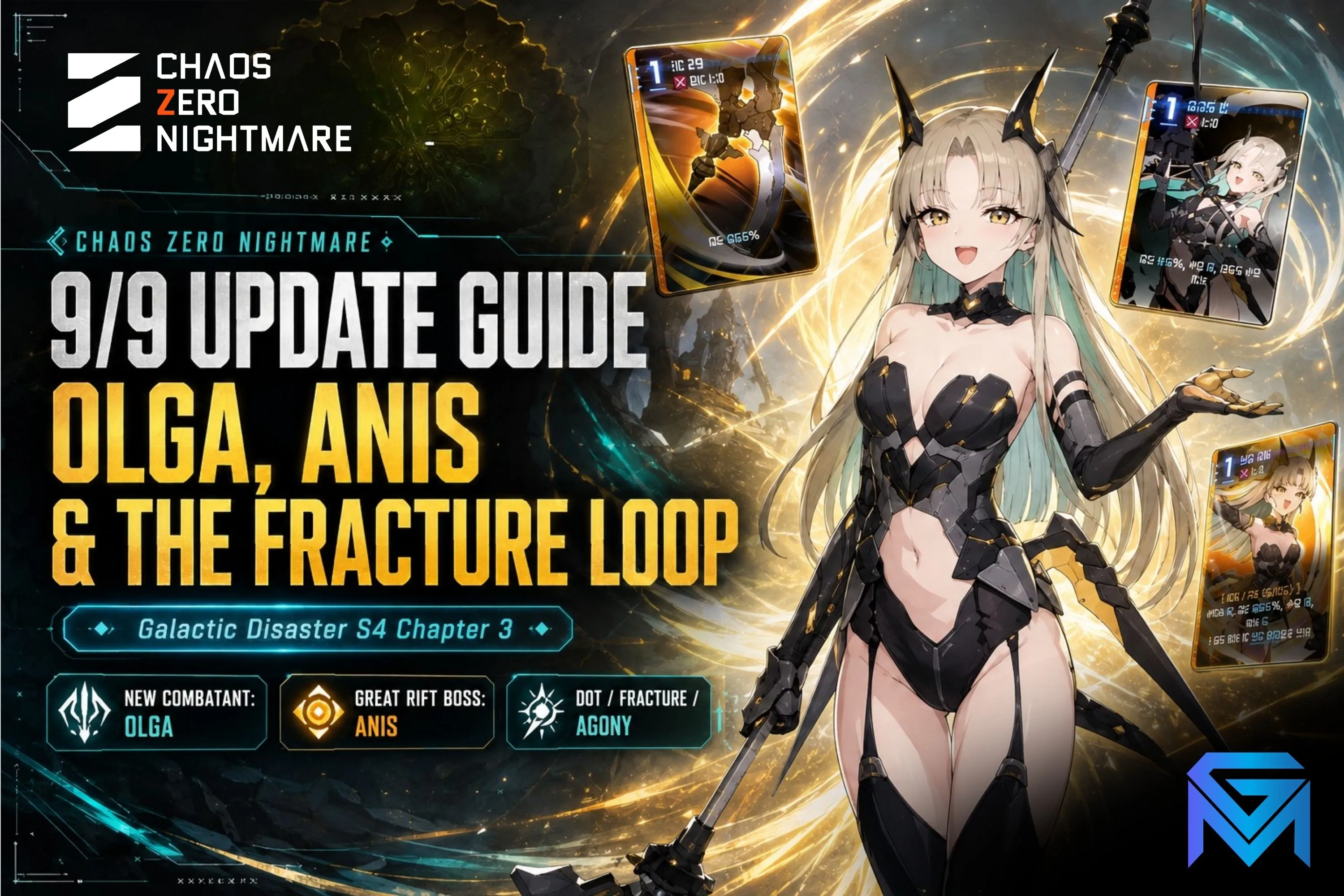
The 9 September update brings Galactic Disaster Season 4 Chapter 3, a new Great Rift boss called Anis, and a new Combatant, Olga. Smilegate published a developer note ahead of it so players can plan.
Read the two together, because they were designed together. Anis cannot be beaten efficiently by direct attacks — it summons Fragments that can't lose HP until they're all hit simultaneously or a DoT on them activates. Olga is a Combatant whose entire kit amplifies ally DoT and converts it into extra damage. The boss is the character's exam.
And the engine underneath Olga is cleverer than the card list suggests. Her two Brand effects are cross-wired: activating Fracture hands you an Agony card, and activating Agony hands you a Fracture card. It's a pendulum, not a loop in one direction.
Olga: what she does
Olga is a 5-star Psionic Combatant of the Instinct attribute — an offensive support who raises allies' DoT Amount while dealing damage through her own Fracture and Agony effects. Her banner runs 9 to 30 September 2026, alongside her Signature Partner Emilie.
She triggers enemies' Fracture and Agony to deal damage, and synergises with anything that reacts to DoT activation.
Shattering is her signature contribution. It's an effect she grants that deals additional Fixed Damage equal to 30% of the DoT damage taken by the target whenever a DoT on that target activates. That damage cannot crit, and Shattering decreases by 1 at the end of each turn. The stronger your allies' DoT, the more Shattering returns — which makes Olga scale off your existing roster rather than replacing it.
The cross-wired Brand system
This is the mechanical heart of the kit, and it's easy to misread from the card list.
Brand of Fracture: when Fracture inflicted by Olga activates, move one Dispersed Desire to hand and reduce its cost by 1 until it's used. Max 3 stacks.
Brand of Agony: when Agony inflicted by Olga activates, move one Rift of Severance to hand and reduce its cost by 1 until used. Max 3 stacks.
Now look at what those cards do. Rift of Severance applies and activates Fracture. Dispersed Desire applies and activates Agony.
So the Brands feed each other in opposite directions. Fracture activation gives you the Agony card. Agony activation gives you the Fracture card. Playing one refills the other, at reduced cost, and the loop sustains itself as long as you keep both status types alive on the target.
Break Apart & Renew is what starts the engine, granting either Brand of Fracture or Brand of Agony, which is why it's the card the developer note singled out for a name change in its edit history.
Rapacity, and the End of the Line / Reckoning pair
End of the Line is a 1-cost attack card applying 2 Shattering, 200% damage, 2 Fracture and 4 Agony. On activation it transforms into Reckoning.
Reckoning costs 0, deals 400% damage, adds +20% base damage per Rapacity stack, activates all Agony and Fracture Olga inflicted, then transforms back into End of the Line.
Rapacity is the new keyword, and it works like this:
- Damage dealt by the card is also treated as DoT
- Rapacity increases by 1 whenever Fracture or Agony is applied through an ability
- Activating Reckoning resets the stack count
- Maximum 30 stacks
At 30 stacks that's +600% on top of a 400% base. The tension is obvious once you see it: Rapacity builds from your whole team applying Fracture and Agony, and Reckoning spends all of it at once. Firing early wastes the ceiling; waiting too long means the card sits unused while the fight moves on.
Her Ego Skill, Maelstrom of Oblivion, costs EP5 and hits all enemies for 400%, gaining +50% base damage per Fracture, +20% per Agony and +30% per Scorched activated that turn, capped at +300%. Note the Scorched line — it rewards pairing her outside her own status types.
One more card worth flagging. Insatiable Cravings applies 2 Fracture and 3 Agony whenever Fracture or Agony activates through a Targeting Card, up to three times per turn — which is the piece that makes the whole system stack rather than tick over.
Anis: why direct damage fails
Anis carries a powerful Damage Reduction effect, so hitting the boss directly is inefficient by design.
It summons Fragments throughout the fight, and those Fragments enter play unable to lose HP. They become vulnerable only after all Fragments have simultaneously taken a certain number of hits, or when a DoT applied to them activates.
That's the whole puzzle. All-Target Attack Cards and DoT effects are the only tools that touch every Fragment at once, which is precisely what the developer note recommends.
Fragments are never actually killed. At 0 HP they recover instead — and each recovery weakens Anis.
But weakening Anis raises the stress your Combatants take. The more successful your strategy, the more punishing the fight becomes. That's a genuine risk curve rather than a difficulty slope, and it means the optimal line has a cost that escalates exactly as you start winning.
So the intended loop is: hit all Fragments simultaneously with All-Target Attacks and DoT, cycle them through HP recovery to weaken Anis, then focus the boss — while managing stress before it collapses the run.
Olga completes Season 4's Instinct trio
She's the third. Season 4 introduced three new Instinct characters sharing DoT mechanics — Hilde in Phase 1, Arabella in Phase 2, and now Olga.
And the pieces interlock. Arabella introduced the Fracture tag. Her Partner Licinia increases the damage enemies take whenever a Fracture ailment activates through an ability. Olga raises ally DoT Amount and converts DoT activation into Fixed Damage through Shattering.
Three phases, one team. Anyone who pulled Arabella and Licinia has been building toward this without necessarily knowing it — and anyone who skipped them will find Olga does less work than her card text implies, because her scaling depends on allies who apply DoT in volume.
What to check before 9 September
- Look at who applies Fracture and Agony on your roster. Olga amplifies; she doesn't generate enough alone to carry a team.
- Assume you'll need All-Target Attack cards. The Anis fight is built around them, and a deck without them cannot make Fragments vulnerable efficiently.
- Plan for stress, not just damage. The boss punishes success, so stress management is a build consideration rather than an afterthought.
- Note that Olga is not flagged Seasonal the way Arabella was. Coverage of Season 4's structure singled out Arabella specifically as the seasonal character, and her window closed on 9 September. Olga carries no such label in the material published so far — but confirm on the banner screen, because it's the difference between a hard deadline and a normal limited banner.
- Know the pity before you pull. Hard pity guarantees a 5-star Combatant or Partner every 70 pulls, with the rate climbing by 4.5% per pull from the 58th onward. That's generous by genre standards, and it means a targeted pull is far cheaper here than in most gacha titles.
What isn't confirmed
Whether Olga carries the Seasonal limited tag Arabella did, the Great Rift's scoring thresholds for Anis, and Emilie's skill set.
The developer note carries its own caveat: the details outlined in it are subject to change at the time of the actual update. Developer notes in this game are previews rather than patch notes, and numbers move between the two.
Our Arabella preview explains why the Seasonal tag changes the budgeting calculation, and our Beach Café Festival guide covers the event running to 30 September alongside all of this.
A three-phase season asks for your currency three times
Season 4 has now introduced three Instinct Combatants across three phases, and Olga's value depends on owning the allies whose DoT she amplifies — which is exactly the situation where roster gaps cost more than they look. Browse Chaos Zero Nightmare accounts for rosters with the season's Combatants already in place, with listings stating level, SSR count and story progress before you pay. If it's the daily loop rather than the roster holding you back, Chaos Zero Nightmare hourly services keep stamina and mission progress moving through the weeks you can't log in. And for the Great Rift itself, Chaos Zero Nightmare boosting covers the harder clears through verified players, with payment released only once you confirm delivery.
GameMarket.gg is a trusted digital marketplace for everything gaming-related. We serve the gaming community by providing secure access that enhances every gaming journey.


![Chaos Zero Nightmare Accounts Asia|Lv 41|6 SSR(Sereniel,Tenebria,Chizuru,Rita,Khalipe,kayron)|11 SR[AnikaM3,ReiM3,Etc]|10](https://img.gamemarket.gg/products/8ibwjfxu/chaos-zero-nightmare-accounts-asia-lv-41-6-ssr-sereniel-tenebria-chizuru-rita-kh-rl6-thumbnail.webp "Asia|Lv 41|6 SSR(Sereniel,Tenebria,Chizuru,Rita,Khalipe,kayron)|11 SR[AnikaM3,ReiM3,Etc]|10 Free Combat Rescue|Stove|CZN2307")

![Chaos Zero Nightmare Accounts Asia|Lv 54|8 SSR([SerenielM2,YukiM2]+Sign,VeroM2,MeilinM5,RenoaM1,RinM1,MagnaM1,Etc|11SR|10](https://img.gamemarket.gg/products/uk1maz5z/chaos-zero-nightmare-accounts-asia-lv-54-8-ssr-serenielm2-yukim2-sign-verom2-m-4xx-thumbnail.webp "Asia|Lv 54|8 SSR([SerenielM2,YukiM2]+Sign,VeroM2,MeilinM5,RenoaM1,RinM1,MagnaM1,Etc|11SR|10 Free Combat Rescue|Stove|CZN2306")
![Chaos Zero Nightmare Accounts Global|Lv.43|4 SSR [Sereniel]+Sign|Crystals 10,453|Story Ch5|Mission Ch6|Check SS CZN145B](https://img.gamemarket.gg/products/ifqrylvw/chaos-zero-nightmare-accounts-global-lv-43-4-ssr-sereniel-sign-crystals-10-453-sla-thumbnail.webp "Global|Lv.43|4 SSR [Sereniel]+Sign|Crystals 10,453|Story Ch5|Mission Ch6|Check SS CZN145B")

![Chaos Zero Nightmare Accounts Global|Lv.55|9 SSR [Sereniel EM4]+Sign,Yuki EM1,Magna EM1,Etc|Story Ch4|Missions Ch4|Check SS](https://img.gamemarket.gg/products/qmo38sg4/chaos-zero-nightmare-accounts-global-lv-55-9-ssr-sereniel-em4-sign-yuki-em1-ma-bkg-thumbnail.webp "Global|Lv.55|9 SSR [Sereniel EM4]+Sign,Yuki EM1,Magna EM1,Etc|Story Ch4|Missions Ch4|Check SS CZN148B")
![Chaos Zero Nightmare Accounts Global|Lv.48|7 SSR [Sereniel]+Sign,Arabella,Fei,Diana,Rin,Nine|1 Omega Code|Story Ch5|Missions](https://img.gamemarket.gg/products/uabks8wh/chaos-zero-nightmare-accounts-global-lv-48-7-ssr-sereniel-sign-arabella-fei-di-lzg-thumbnail.webp "Global|Lv.48|7 SSR [Sereniel]+Sign,Arabella,Fei,Diana,Rin,Nine|1 Omega Code|Story Ch5|Missions Ch6|Check SS CZN151B")