Where Winds Meet 2.0 — Everything New in the Hidden Mountain Update
By GameMarket Team 23 July 2026, 16:00 WIB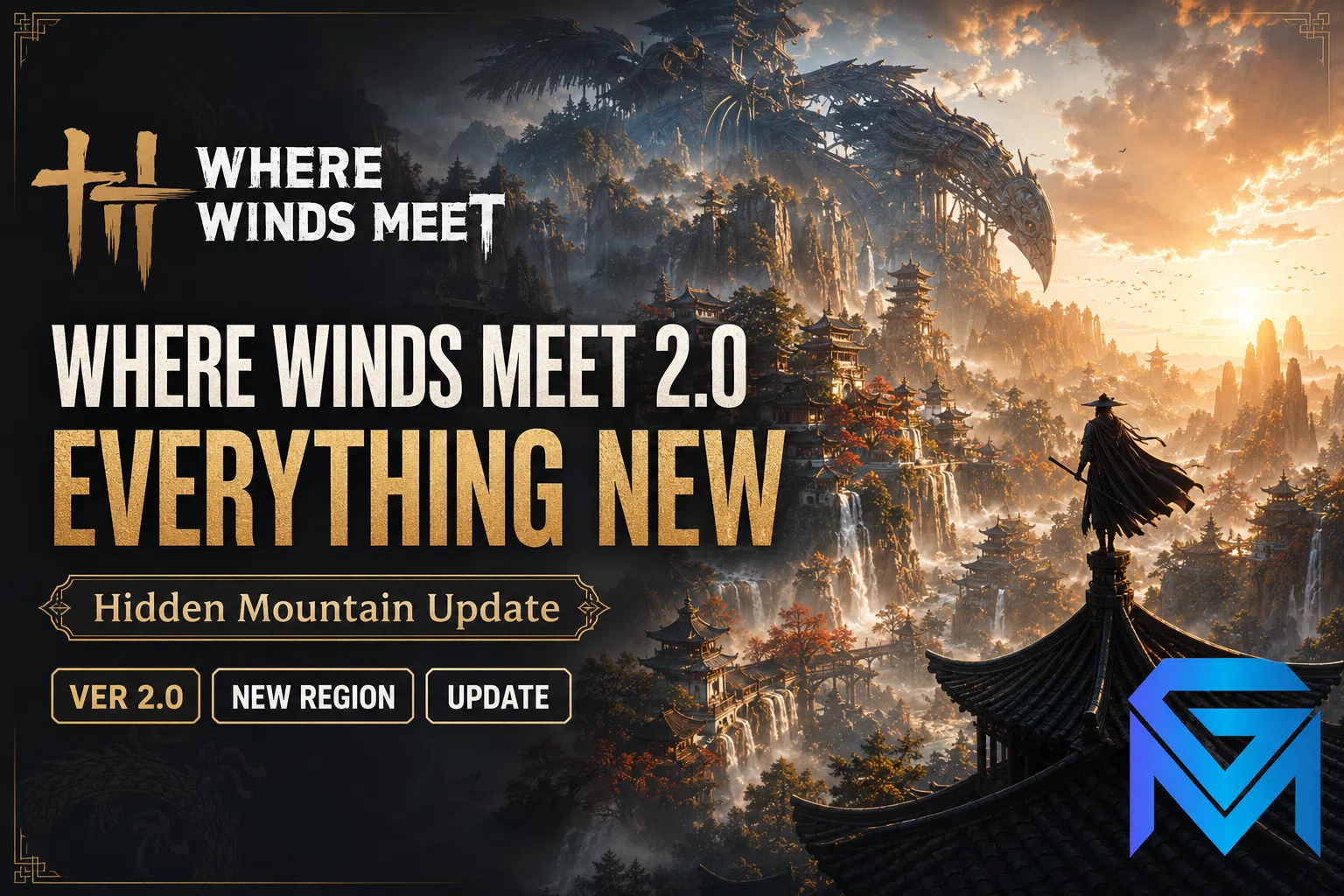
Where Winds Meet Version 2.0 "Unseen Approach" goes live today, July 23, 2026, and Everstone is calling it 2.0 rather than 1.9 for a reason that holds up. The Hidden Mountain Expansion stacks four distinct environments on top of one another, hands you a crafting system for building the vehicles that reach them, and drops an Eastern Steampunk sect of engineers into a tenth-century wuxia world. Alongside that sits the long-awaited Gauntlet weapon, a new campaign called Changeless Heart, mechanical world bosses, a balance pass touching all eight Paths, and a gear tuning overhaul that finally lets you undo a bad roll. This is everything that just landed.
🏔️ Version 2.0 at a Glance
- Live: July 23, 2026 (UTC), following maintenance
- New region: Hidden Mountain, a vertically stacked map spanning underwater trenches, underground palaces, mountain peaks, and floating sky cities
- New sect: Mohist Hill, built around engineering and crafting rather than martial lineage
- New campaign: Changeless Heart
- New weapon: Gauntlets
- New world bosses: Ci & Cuo, and the Ironheart Centipede
- New system: mechanical device and custom vehicle crafting
- Entry point: Kaifeng
What separates this from the Qinchuan and Imperial Palace updates is that those added ground to walk across, whereas Hidden Mountain adds elevation to climb through. That single design choice ripples into the traversal, the crafting, and the bosses, so it is worth understanding before anything else.
⛰️ Hidden Mountain — A Region That Goes Up
Hidden Mountain is built as a layered zone rather than a flat expanse. You descend into underwater depths and underground palaces, then climb through towering peaks toward floating cities suspended above them. Getting between those layers is the point: Lightness Skill, climbing, and gliding all carry more weight here than in previous regions, and the new mechanical vehicles exist specifically to cover elevation changes that traversal alone cannot.
The aesthetic is where Version 2.0 breaks from everything before it. Kaifeng, Hexi, Liangzhou, and Qinchuan all sit comfortably inside classical wuxia, but Hidden Mountain leans into what the developers describe as Eastern Steampunk: chained caverns, moving machinery, and ancient contraptions built into the terrain. That is not a random genre swerve, because the region's lore ties it to the Mohists, a school historically associated with engineering and mechanism-craft. The machinery is the sect's fingerprint.
The technical work supports the vertical concept rather than sitting on top of it. Version 2.0 ships improved wind dynamics, layered canyon audio, updated rock textures, reworked lighting, and ray tracing support, all tuned around a region defined by scale and elevation. Expect exploration to be more puzzle-driven than in earlier zones, since mechanisms and hidden routes replace the open-field approach Qinchuan trained you on.
⚙️ Mohist Hill and the Changeless Heart Campaign
The new main storyline, Changeless Heart, picks up after the intrigue of the Imperial Palace arc and sends you toward Mohist Hill alongside familiar allies. The Mohist Sect is the narrative and mechanical anchor of the whole expansion: their machinery explains the region's look, their engineering explains the crafting system, and their constructs explain why so many of the new enemies are mechanical rather than human.
That last point matters for how you play. Where previous campaign bosses tested parry timing and duel reading, Hidden Mountain's encounters lean on foes with what amounts to a mechanical advantage, which pushes you toward tools and positioning instead of pure martial rhythm. If you clear content on reflexes alone, this campaign will feel different.
Access begins in Kaifeng, so head there first rather than looking for a new entrance out in the world.
👊 Gauntlets — The New Weapon Path
Gauntlets arrive as a new weapon discipline, and they have been on the community wishlist long enough that their addition is arguably the most player-facing item in the patch. They slot into the existing Path and Martial Art framework alongside swords, spears, umbrellas, fans, blades, and rope darts.
Because a new weapon type means a new set of Martial Arts and Inner Way interactions to learn, treat the first week as experimentation rather than commitment. Gear tuning in this game is expensive, and Version 2.0 happens to make that mistake cheaper to undo, which is covered further down.
🔧 Mechanical Crafting and Custom Vehicles
The expansion adds a crafting system for assembling mechanical devices and custom vehicles. This is not cosmetic. Vehicles exist to cross Hidden Mountain's elevation gaps, and devices exist to solve the mechanism puzzles gating parts of the region, so crafting sits directly on the critical path of exploration rather than beside it.
In plain terms: in earlier regions you found a route and travelled it. Here you sometimes build the route. That makes the Mohist crafting loop worth engaging with early, because skipping it means walking into locked terrain with no way through.
🐛 New World Bosses
Two named world bosses arrive with the expansion, joined by a broader roster of mechanical enemies:
- Ci & Cuo — a paired encounter
- Ironheart Centipede — a segmented mechanical foe
- Marionette-style enemies that attack in coordinated rhythm with their controllers, plus insect-like constructs and serpentine machines with grappling pincers
The design direction follows what the Wandering Ark established back in the Hexi expansion, where mechanics and weak-point destruction mattered more than raw damage output. If that fight suited you, Hidden Mountain is built for how you already play. Our Wandering Ark boss guide is a useful reference point for the approach these encounters reward.
⚔️ Path Rebalance — What Changed for Your Build
Version 2.0 ships a balance pass across all eight Paths, and several changes are significant enough to shift how you build rather than just how much damage you see.
Damage-over-time was standardised. Qi damage from DoT effects now follows a consistent baseline matched to how each effect applies. Bleeding and High Bleeding from Strategic Sword gained Qi damage, while Weeping Blood, Qingyi's Poison, Combustion, and Divinecraft's Burning had theirs reduced. If you run a DoT-heavy build, your numbers moved in one direction or the other, so check before assuming your rotation still holds.
Dragon's Breath gained a new branch called Dark Scorch, which replaces the Combustion debuff when selected. The important part is that multiple players' Dark Scorch stacks coexist independently on a single target, because previously only one Wanderer in a team could benefit from the Combustion damage bonus at a time. That opens genuine multi-player Dragon's Breath compositions for the first time.
Exhaustion vulnerability was moved into a different multiplier bucket, sitting alongside Mechanism-Based DMG Boost in Boss Modes. Paths that leaned heavily on universal damage boosts were suffering diminishing returns from multiplier dilution, and this reduces that.
Buff Food was split into Vitality Food and Attack Food, which can now be active simultaneously for both Max HP and Physical Attack. Auto-Buff Items supports equipping both. The stat calculation also changed: food bonuses now add to your Base Attributes before percentage buffs scale everything, and the character UI now separates Base from Effective Physical Attack so you can actually see the difference.
Individual Path highlights include smoother skill chaining under high latency for Nameless Sword, Snowparting Blade, and Infernal Twinblades, removed AoE damage falloff on Nameless Sword's Sword Energy, longer Soul-Shaken duration on Heavenquaker Spear, and a Thundercry Blade talent converting to Max Physical Attack instead of Critical Rate to stop players overcapping. Arena received 35 separate experience adjustments plus a server-side hit-validation system that negates damage when the defender was verifiably dodging. If you main Snowparting Blade, our Snowparting Blade guide covers the rotation these changes are tuning.
💎 Gear Tuning Overhaul — You Can Finally Undo a Roll
This is the quietest change in the patch notes and probably the most valuable one for anyone deep into progression.
A new item called the Modulating Stone enables Gear Tuning Reset on Tier 100 Epic and Legendary gear, stripping a piece back to its initial attributes so you can tune, retune, and attune it again. Until now a bad tune was permanent, which meant high-potential base gear was a gamble you committed to blind. Each piece has a limited number of reset attempts and a cooldown, resets do not refund spent materials, and the action is irreversible, so it rewards planning rather than impulse.
Supporting changes make the whole system less punishing:
- Modulating Stones drop as a bonus when recycling or consuming fully tuned Legendary gear, so clearing bag clutter now feeds the reset economy
- They also modulate Relaid Gear for a guaranteed 4.5% step toward an attribute's maximum
- Tuning Quick Add selects optimal Tuning Stone combinations for you
- Large Tuning Stones can be split into ten Small Tuning Stones of the same tier
- Retuning Correction cooldown dropped from seven days to five
- Maxed affixes now display a permanent At Cap marker, so you can see at a glance what still needs work
Note that Tuning Reset is unavailable for Tier 91 and below, since most players have already recycled that generation of gear. Newly unlocked Tier 96 gear also brings merged Attuning affixes on Vernal Umbrella, with Tier 91 relays automatically taking the higher of the two values. For the wider context on how gear and endgame progression fit together, see our endgame modes and gear progression breakdown.
🎯 What to Do First
Version 2.0 drops a lot at once, so a sensible order for your first session:
- Head to Kaifeng to unlock Hidden Mountain access and start Changeless Heart
- Check your Path in the balance notes before grinding anything, because DoT and multiplier changes may have shifted your rotation
- Rebuild your food setup now that Vitality and Attack Food coexist, since this is free power most players will forget to claim
- Engage the Mohist crafting loop early rather than treating it as optional, because vehicles and devices gate parts of the region
- Try Gauntlets before committing gear to them, and remember that tuning mistakes are now reversible on Tier 100 pieces
- Recycle fully tuned Legendary gear you no longer use, since it now returns Modulating Stones
- Save the world bosses until you have adjusted to mechanism-driven encounters rather than duel pacing
Returning players who stopped somewhere around the Qinghe or Kaifeng chapters have a longer road, because Hidden Mountain sits well past the Imperial Palace arc in both story and power. The upside is that 2.0 is a natural re-entry point: the visual overhaul applies across the whole world, not only the new region, so the old content you still need to clear looks considerably better than when you left it.
🛒 Gear Up for Hidden Mountain
Version 2.0 asks for progression before it opens up, since Hidden Mountain sits deep past the Imperial Palace arc and its bosses expect endgame-tier gear. Wanderers who want to explore the new region today rather than grinding toward it can explore trusted Where Winds Meet Accounts with the progression and gear tier already in place, accelerate every material and tuning grind with expert Where Winds Meet Hourly Services, or clear Ci & Cuo, the Ironheart Centipede, and the rest of the new roster through reliable Where Winds Meet Boosting.
GameMarket.gg is a trusted digital marketplace for everything gaming-related. We serve the gaming community by providing secure access that enhances every gaming journey.




![Wuthering Waves Accounts Starter SEA|UL 46|Rank 5|4 Char Limited [Hiyuki,Sigrika,Shorekeeper]+Sign,Rebecca|Mc Male|TakeMail](https://img.gamemarket.gg/products/78lh2gmt/wuthering-waves-accounts-sea-ul-46-rank-5-4-char-limited-hiyuki-sigrika-sh-eyx-thumbnail.webp "SEA|UL 46|Rank 5|4 Char Limited [Hiyuki,Sigrika,Shorekeeper]+Sign,Rebecca|Mc Male|TakeMail WW365B")